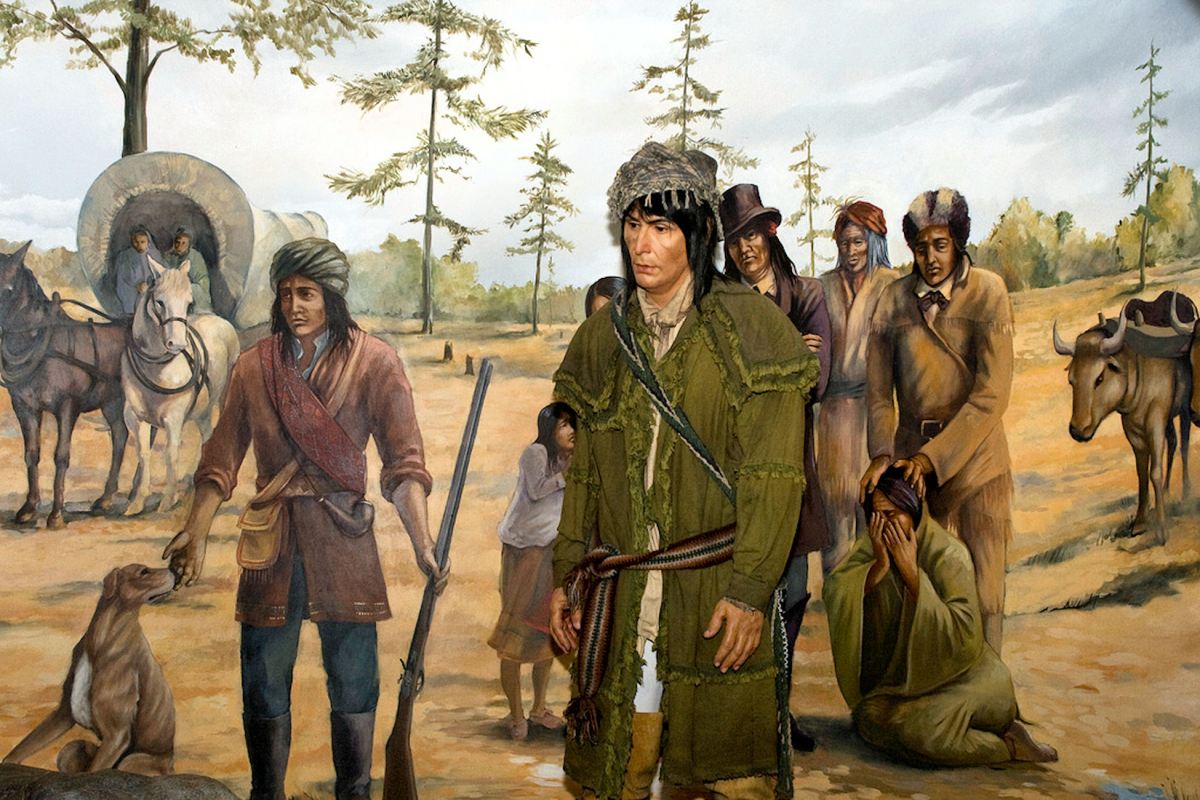
by Richard L. Thornton, Architect and City Planner
Tsali’s persecution was far more outrageous than described in Cherokee mythology.
This is something that few people know. During 2012 to 2016, Access Genealogy, Inc. paid me to research the Native American History of EVERY county in Alabama, Georgia, Florida, Eastern Tennessee, Western North Carolina and the South Carolina Low County. I systematically analyzed all of the early descriptions, river basins, coast lines and islands of this region to determine the real history of that region. All available eyewitness accounts, historical maps and archaeological reports were interpolated to discern the truth from the mythology. I found that local histories in the older counties of South Carolina and the eastern edge of Georgia often contained factual tidbits of history that were left out of state and national history books.
For example, research by professors at the University of Oklahoma determined in 2008 that there was no Battle of Taliwa and never any Creek town named Taliwa. The fertile lands of northwest Georgia were secretly transferred from the Creeks to the Cherokees by Georgia officials in 1784. So Cherokee Nancy Ward couldn’t possibly been the heroine of this battle and the Cherokees never “conquered” all of North Georgia. The 40 year long Creek-Cherokee War ended catastrophically for the Cherokees. They signed a surrender treaty in December 1754, which gave back all lands to the Creeks, which had been occupied by the Cherokees at the earliest stage of the war.
In 2016, I went a step further and traced the paper trail of how Nancy Ward’s mythological life as a “full blooded Cherokee princess” was created by white people long after she died. She was actually about 3/4th to 7/8th Caucasian. She had a white father and most of her life, she mainly associated with white people. Her first, and only Cherokee husband, Kingfisher, died on October 17, 1793 at the Battle of Etowah Cliffs . . . which was a catastrophic defeat for the Cherokees . . . not in the fictional 1754 Battle of Taliwa. However, by then Nancy had lived with a series of white men, including John Ward. She was the first or one of the first Cherokees to own slaves and promoted slavery among her people as a way of making them more “acceptable” to whites. The first mention of the fictional Battle of Taliwa was in a “dime novel” by a distant white cousin of hers . . . four years after her death. You can learn the true history of Nancy Ward in another Americas Revealed article.

Three years ago, I ran into an opposite situation, while studying the Little Tennessee River Basin. The real story of Tsali’s capture and persecution is far more outrageous than told out these days in “Cherokee history” literature or portrayed in the outdoor drama, “Unto These Hills.” 1
The official (Wikipedia) biorgraphy of Tsali was that he was a Cherokee man from North Carolina, who struck and killed a federal soldier, while he and his family were being marched to a fort, where they were to be held until marched to the Indian Territory. He escaped, but voluntarily returned to face a court martial in return for a promise that other Cherokees in hiding would not be tracked down. He and most of his sons were killed by a firing squad.
There are some factual, thoroughly researched, articles and books on Cherokee history. The Wikipedia article on Tsali is not one of them . It is republished at the end of this article. Wikipedia has placed warnings at the top of the Tsali article that it lacks citations to justify statements and appears to contain inaccurate history. That is an understatement.
Try to insert factual history on Tsali with reputable sources. You will be thwarted by anonymous “gatekeepers.” For example, I merely tried to change the statement at the end of the Wikipedia article on Tsali, which said that “the Lower Muskogee Creeks rebelled against the United States.” The Lower Creeks were allies of the United States. It was the Red Stick Creeks in Alabama, who rebelled against the Creek Confederacy. As references, I used the Wikipedia article on the Redstick War and a publication from the National Park Service. Within an hour, someone had changed the text back to the original false statement, stating that my changed lacked credible references. These people get away with maintaining false history, because no one is monitoring their activities, but they are given the power to unilaterally delete factual history.
Major contradictions and false history in an outdoor drama
The author of this Wikipedia article has embellished the Tsali story to match the new revision of the “Unto These Hills” outdoor drama in Cherokee, NC. The 2007 version left out the story of Tsali. Outdoor dramas by playwrights, living hundreds of miles away from the scene of 200 year old events, are NOT suitable references for history texts. Much of the history of Tsali was created by the original version of the play and is not based on historical records. In the latest revision of the play, Tsali is a great Chickamauga Cherokee warrior and chief from Coosawattee (now Carters Lake, GA) who warns his people to flee to the section of the Cherokee Nation in the Smoky Mountains, where they will find refuge . . . pure fiction.
The fact is that after 1763, the current location of the Cherokee Reservation was 45 miles EAST of the most easterly point of Cherokee land and that in 1838, none of the Smoky Mountains was in Cherokee territory. Where the Cherokees live now was purchased by a white man, Will Thomas, who then allowed the Cherokees to live on his land.2 These families were legally citizens of North Carolina living outside the Cherokee Nation, but were being rounded up by soldiers anyway.
Since 1763, all land in North Carolina, east of Murphy, NC was outside Cherokee Territory. The eastern boundary was the 84th Meridian (longitude) which runs through Murphy, NC and Robbinsville, NC.3
The Wikipedia article states that this region of North Carolina, which had been outside Cherokee territory for 75 years, was densely populated with Cherokees. That’s horse manure. White families and some men with mixed blood Cherokee wives had long lived there. The Cherokee families lived on 640 acre allotments. That is not a “dense population.” 4
The Chickamauga War ended in 1794. If Tsali had been a leading warrior in the Chickamauga War, he would have been at least 64 years old in 1838, more likely around 70. Yet in all versions of his story, he has a family of teenagers, children, toddlers and newborn baby living with him. Wannabe’s and playwrights . . . if you are going to create fictional history, at least think through the implications of your fibs.

The original history of Tsali states that he was born in Cusseta. The outdoor drama, “Unto These Hills” place Cusseta on or near the present day Qualla Cherokee Reservation because Western North Carolina is the Center of the World. I hate to burst their bubble, but Cusseta was the name of the farthest north CREEK towns in the late 1700s. One was located on the boundary line between the Creeks and Cherokees in present day Stephens County, GA on the Savannah River. The other was located near present day Blairsville, GA. It was abandoned in 1794, when that section of Georgia was ceded to the United States by the Cherokees and Creeks. Cusseta was 102 miles east of Coosawattee.
Some anonymous Wikipedia author said, “Oh geez, all Injun words are Charakey words and Cusseta sound like Coosawattee, so it must be the same place!” No, it is not. Coosa and Cussata words are Anglicizations of the Creek root words, Kusa and Kusate . . . the Upper Creeks!
Cusseta made even more sense, when I stumbled upon the real meaning of Tsali. Tsali is how Cherokees spelled the Creek name, Tchali. The Cherokee hero, Tsali had a Creek name. The Creek name is how they spelled the English name Charlie. Now, I ask all of you horrified Cherokees and wannabe Cherokees at this point to find ANY Cherokee, named Tsali before 1838?
As you will read below, the new “Unto These Hills”/Wikipedia version of Tsali’s life has he and his family being marched to a Cherokee containment stockade on the Hiwassee River – Fort Butler. Originally, the play didn’t say where he lived, then a later version had him living in Coosawatee. There were three Cherokee Removal forts built near Coosawattee. It was ludicrous to have him walking to a fort 90 miles away to the east. So the current version of the play and Wikipedia now has his family hiding out in the Smoky Mountains. Always before, Tsali and his family were living on their family farm, when soldiers, hardened by the Seminole War, suddenly showed up and forced the family to leave at bayonet point.
While preparing the “Native American history of Rabun County, GA for Access Genealogy, I stumbled across some very interesting information. The official early history of Rabun County, GA, written by a 19th century history professor, stated that Tsali lived on his family farm near present day Dillard, GA and the Little Tennessee River. The writers of “Unto These Hills” greatly altered the biography of Tsali to create a mythological man.
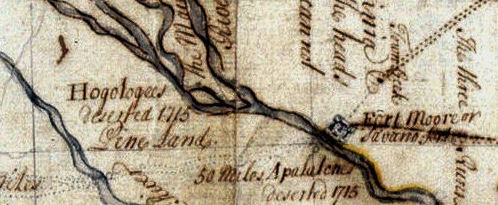
Dillard was an odd location for a Cherokee to be in 1838. Georgia Colonial Era maps show what is now Rabun County and the northern half of Stevens County to be occupied by Hogeloge (Tokahre-Uchee). The portion east of the Dillard Valley was been ceded in 1794 and became part of the original Habersham County. The remainder of Rabun County was ceded in 1819. Why would battle hardened soldiers be suddenly sent many miles outside the boundaries of the Cherokee Nation to round up Cherokees at the last minute, just before it was time for all Cherokees to march west?
Sketches of Rabun County History by Dr. Andrew Ritchie (1948) answered the riddle.5 In 1818 the Creek and Cherokee Nations ceded a narrow corridor of land, east of the Chattahoochee River, which ran from the North Carolina line down to what is now Gwinnett County in Metro Atlanta. It was occupied by mixed bloods and remnants of several tribes, who had no real ties to either the Cherokee or Creek Nation. Creeks did send initially representatives to their national council in present day Columbus, GA, but the Uchee occupants of the Cherokee portion in northern Habersham and Rabun Counties had no representatives on the Cherokee Council. They spoke a dialect of the Itsate Creek language, which was mixed with Uchee words. For example, these Uchee-Creeks used the word “Naguchee” for the Creek word nokoshe, which means “bear.” That’s how the famous Nacoochee Valley got its name.
These isolated Native American families were offered an option of being granted 640 acres of land per family and becoming citizens of the State of Georgia. Many accepted the offer. Approximately 330 “Cherokee heads of households” in Rabun, Habersham and Towns Counties, very few of whom were actually ethnic Cherokees, applied for state citizenship and the allotments.
This previously unknown allotment program explains the presence of many authentic Native American families in Towns County, GA, who do not carry DNA typical of ethnic Cherokees. They were missed by the soldiers because they were citizens of the State of Georgia and not on the “pickup lists.”
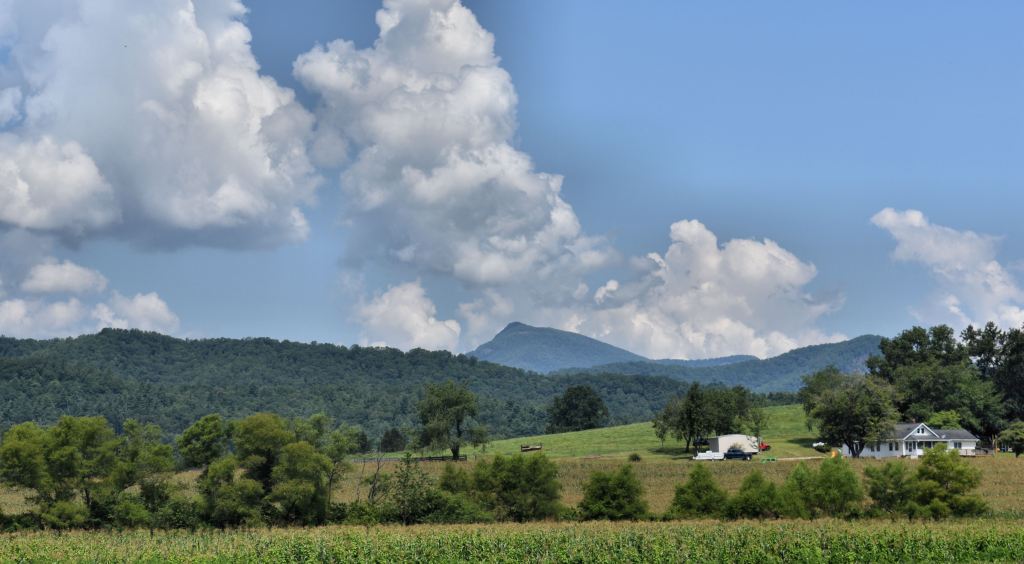
In 1819, a Native American woman named Betty was granted state citizenship and 640 acres along what is now Betty’s Creek in the Dillard Valley and the southern part of the Rabun Gap-Nacoochee School campus. That same year, North Carolinian, John Dillard, bought most of her land. However, Native American families continued to live on the less desirable portions along Betty’s Creek. Tsali was probably Betty’s son or son-in-law.
In 1838, many Native American families lived in the mountainous sections of western Rabun County. Being property owners and citizens of the State of Georgia, they were not subject to removal to the Indian Territory. This is why no Cherokee Removal stockades were built in Northeast Georgia.
Apparently, some whites in Northeast Georgia saw an opportunity to grab free land. They notified soldiers that there were “Cherokees” living in western Rabun County, whose names were not on the official “pickup” list. None of the soldiers checked for boundary lines or state citizenship. To them Injuns were Injuns. They hated all Injuns after just being chewed up by the Florida Seminoles.
Apparently, Tsali only spoke broken English or the soldiers ignored what he said. In anger, he was trying to tell them that he was NOT a Cherokee, but a Uchee or Creek living as a Georgia citizen. He owned his farm legally and could not be forced to move.
The original Cherokee version of Tsali’s life as portrayed in the original version of “Unto these Hills” was that when a soldier jabbed his wife with a bayonet in front of his house, Tsali grabbed the musket and clubbed him to death. The muskets were not loaded, so his sons grabbed the other soldiers’ muskets. They ran off. Even in the laws of that time, that would be justifiable homicide-self-defense. The soldiers were carrying out an illegal action against citizens. Tsali and his sons were to get no justice. However, according to the official reports of the US Army, that is NOT what happened.
The US Army’s version of events
In 1977, University of Tennessee professor, Dr. John R. Finger, thoroughly researched the available information on Tsali in the National and US Army Archives.6 His research was originally published in the Quarterly of the East Tennessee Historical Society in 1978, but that article is no longer available. Fortunately, it was republished in the 1979 North Carolina Historical Review. This version is available online and even is used as a reference by the Wikipedia article on Tsali . . . but generally ignored, except when it made a good story line.
Upon learning that soldiers were coming to Rabun County to arrest the Indians living there legally on allotments, Tsali led the families westward into the rugged mountain of northwestern Habersham County in the vicinity of present-day Batesville, GA. This area was occupied by a few Soque families, also living on allotments since 1818. A estranged neighbor of Tsali, named Euchella, tipped off federal soldiers where Tsali’s family were hiding.
During this period, some whites, perhaps soldiers, had been murdered. Will Thomas, using Euchella (Utsala) as a scout, led about sixty men in search of Tsali after being told by Euchella, that Tsali was one of the murderers.
On November 24, Colonel William S. Foster, who was ordered to find Tsali, wrote to his commander, General Winfield Scott that the mission was a success—that, of the twelve Indians that had been in the original group, all but Tsali had been recaptured and the three men most culpable in the attack “were punished yesterday by the Cherokees themselves in the presence of the 4th Regt. of Infantry.”
Foster had made clear in other communications that he did not believe that Tsali was a murderer. His conviction is explicit in his dismissal of the search party and leaving the area. There are two different versions of history here. One has Euchella killing Tsali on the trail, while another has Tsali being given a summary court martial, without a lawyer to represent him at Fort Butler.
Both versions agree that after Foster had called off the search, the next day Euchella and another Indian caught Tsali. Euchella later claimed that he personally killed Tsali, so there must have been some sort of personal vendetta going on. The other version is that Euchella was in the firing squad that executed Tsali.
Foster issued a proclamation in support of Euchella and his men and sent Scott a petition signed by residents in favor of the Indians’ wishes to stay. Euchella and his men were given permission to remain in North Carolina with the Indians, led by Junaluska. At this time, the Junaluska Band lived in Haywood County, NC where the United Methodist Church World Headquarters is located.
The official US Army version says that Tsali and most of his family were eventually re-captured as they were traveling along the Hiwassee River in Northeast Georgia and taken to a nearby fort. Finger, being a Tennessean, named that fort as being in Tennessee. However, that is highly unlikely, since Fort Butler (present day Murphy, NC) was about 20 miles downstream, not in Tennessee.
No one seemed to understand what Tsali said in his summary court martial. The Cherokee translator understood only a few words. The act of a civilian citizen striking a solider was a minor civil offense under federal law and not even addressed in Georgia’s code. Therefore, Tsali and his sons were charged with being in violation of CHEROKEE LAWS. The Cherokee National Council, in order to appease federal authorities had made it a capital offense to assault a white soldier or law enforcement officer.
Obviously, US Army personnel had no constitutional authority to enforce Cherokee law or to hear a capital criminal case of a citizen of Georgia without him being represented by an attorney. Tsali and all of his sons, except a teenage boy, were sentenced to death. The executions were carried out by Cherokee scouts under the command of Junaluska (according to General Scott) . . . not US Army soldiers as portrayed in the outdoor drama, “Unto These Hills,” which is performed on the Cherokee Reservation. Foster’s version is that the firing squad was composed of Euchella’s band . . . who also lived outside the boundaries of the Cherokee Nation.
There was no connection made in the US Army reports between the execution of Tsali and the decision of General Winfield Scott to cease hunting for Cherokees in hiding. The army continued to look for “fugitive” Cherokees, but an agreement with the State of Georgia required the US Army to move all captured Cherokees out of forts in Georgia within one month of the inception of the roundup. Although not even subject to deportation, Junaluska’s band had been promised that they could stay in North Carolina, if they rounded up other Cherokees.
Tsali’s story began to take shape with its embellished twist in 1849. Since then 20th and 21st century deified him into a religious figure. There are many significant differences in the two versions of history. Tsali (with a Creek name) was born in Cusseta, Georgia. He was either a Creek or a Uchee. Tsali never lived in North Carolina . . . was originally captured by a posse’ led by Will Thomas . . . never killed any soldiers . . . and never voluntarily surrendered. In other words, he never made the “noble sacrifice” for which he is idolized in Cherokee literature. He was killed because an Native American neighbor had a grudge against him.
Most of the other 300+ Cherokees, who avoided deportation and “founded” the Eastern Band of Cherokes were either citizens of North Carolina or Georgia, living east of the Cherokee Nation’s boundaries for many decades. That is why they speak a different dialect of Cherokee than Oklahoma Cherokees. Throughout the next few decades, the original 300 Eastern Cherokees were steadily joined by Cherokees, living on North Georgia allotments, who found life unbearable under Georgia’s punitive “Indian Laws”.
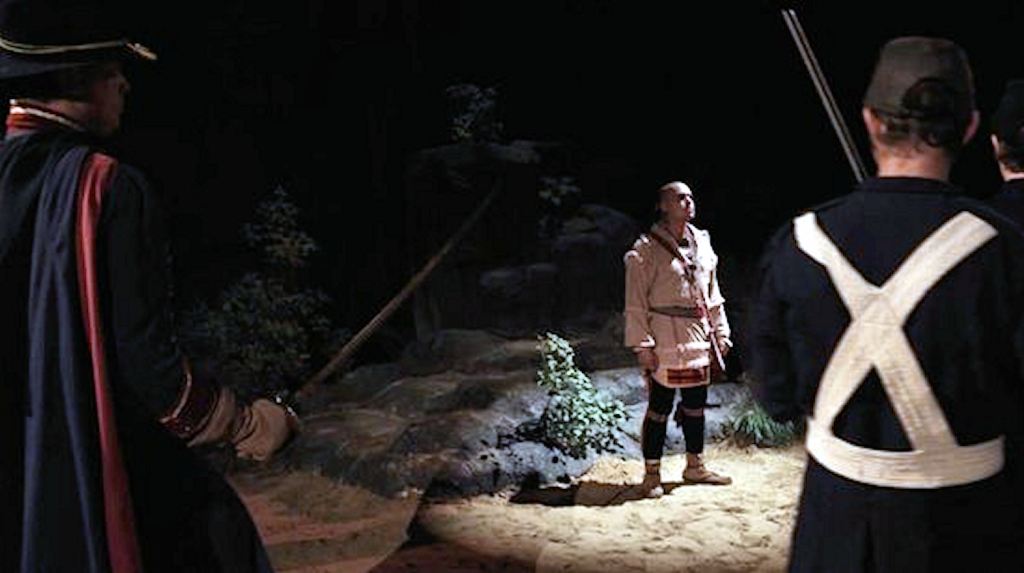
New version of Tsali’s life in Wikipedia and new version of “Unto These Hills”
Tsali (Cherokee: ᏣᎵ), originally of Coosawattee Town (Kusawatiyi), was a noted leader of the Cherokee during two different periods of the history of the tribe. As a young man, he followed the Chickamauga Cherokee war chief, Dragging Canoe, from the time the latter migrated southwest during the Cherokee–American wars. In 1812 he became known as a prophet, urging the Cherokee to ally with the Shawnee Tecumseh in war against the Americans.
Later, during the 1830s roundup of Cherokee for Indian Removal, Tsali, his wife and brother, his three sons and their families were taken by surprise and marched at bayonet point toward the Indian Agency on the Hiwasee River. When Tsali’s wife paused to care for the needs of her baby, one of the guards whipped her and prodded her with his bayonet, to force her on her way.[1]:235 According to a secondhand account by Wasidana, Tsali’s son, the mother and baby were forced onto horseback and, in the process, “she got her foot hung in the stirrup. Then her baby dropped. It went that way, out yonder, and bust the head. And it died right then.”In response, a surprise attack was made on the soldiers, one guard was killed and the rest wounded or subdued.
Tsali and his relatives fled to the mountains and hid out in a cave in the Smoky Mountains. His successful evasion was reported to the other Indians by grapevine and soon the mountain Cherokees by dozens, then by hundreds, joined him in the hideout, living off roots and berries on the border of starvation.
General Scott was baffled by the situation. He had not the troops to track down Indians in that impervious and secret region. Nor was he certain that he wanted to. But if Tsali’s freedom went unchallenged, a fateful example would be set for other Cherokees. Scott enlisted the services of William Thomas, a white trader who had lived for twenty years among the North Carolina Indians and had their confidence. Thomas was given a message to the leader of the fugitives. If Tsali and his family would surrender themselves to military justice, the rest of the Cherokees in the mountains could remain free.
He and his brother and sons came down from the mountains and gave themselves up. Tsali’s youngest boy Wasidana was spared; the others were executed. According to Wasidana, they were shot by a firing squad of Cherokee prisoners, compelled to the act as a means of impressing on the Indians the hopelessness of their position.
Cherokee-written sources consistently state Tsali’s story as occuring close to or within the North Carolina Cherokee Reservation. There is no town or community in North Carolina named either Cusseta or Coosawatee. In the annual presentation of “Unto These Hills” the latest version still shows US Army soldiers shooting Tsali. It never happened. He was killed by Cherokees . . . either in a firing squad or as assassins on a remote mountain trail . . . as part of a neighborhood feud.
The absurdity of it all
The demons that possessed many North Georgia whites in the 1830s, still seem to be rampant. On July 28, 2019, while I was trying to find the actual site of Tsali’s farmstead, I was constantly stalked by two SUV’s with whip antennas, filled with heavily armed vigilantes from a Southern Baptist church near Gainesville, GA. I understood later that they were “investigating me” for being a sexual pervert. Former girlfriends and school classmates, who subscribe to this website, are welcomed to make comments about that particularly accusation. On September 15, 2019 when I hunted down the location, where Tsali was captured, I was tailed by a federal law enforcement vehicle . . . its delusional, ultra-rightwing, law enforcement driver evidently being convinced that I was trying to “escape” . . . for what reason, I would want to “escape”, I have not a clue. Perhaps I have irritated these pesky flies, because I have refused to take Adolf Hitler “as my lard and saveyer.” Some things never change.
REFERENCE NOTES
- Tsali – https://en.wikipedia.org/wiki/Tsali
- Thomsen, Paul A. (2004). Rebel Chief: The Motley Life of Colonel William Holland Thomas, C.S.A. Tom Doherty Associates. ISBN978-1-4668-0644-3.
- Louis De Vorsey, The Indian Boundary in the Southern Colonies, 1763–1775 (1966) p. 39.
- Brown, John P. Old Frontiers: The Story of the Cherokee Indians from Earliest Times to the Date of Their Removal to the West, 1838. (Kingsport: Southern Publishers, 1938).
- Ritchie, Andrew Jackson. Sketches of Rabun County, Georgia (1948) Lakemont, GA: Copple House Books.
- Finger, John R. The North Carolina Historical Review, Vol. 56, No. 1 (January, 1979), pp. 1-18
 The Americas Revealed
Being Cherokee myself, your scholarship in regards to Tsali is particularly important to me; my grandfather was named for Tsali. And just like the historical Tsali, my grandfather was called Charley too, by those in the small town nestled in the Appalachian Mountains where I grew up.
Unfortunately, I can only take seeing text on a screen for so long because I was injured during combat and as a result of traumatic brain injury I have a never-ending intractable migraine. That’s what limits my screen time. Rest assured, I will return to this when I’m able and continue reading.
Wado or sgi, meaning thank you for your work in this regard, oganalii. In case you don’t know any of our language wado and sgi both mean thank you and oganalii means my friend.
LikeLiked by 1 person
Yes, I know those words. I lived among the Snowbird Cherokees in the spring of 2010, when I was homeless and living in a tent with my three herd dogs. They also asked me “What are you?” LOL I told them that I was Itsate Creek, not Muskogee Creek – My closest Native American kin would be the Miccosukee.
LikeLike
Hey there author. I’ll cut to the chase:
I’m a direct descendant of the mixed people that owned the land in what is now present day Deep Creek in the Smoky Mountain National Park in Swain County. They unlock the gate for us Wiggins’s to go check on our graves every year.
Abraham Wiggins (B1761) I believe is the man you are talking about. Or Reverend Abraham Wiggins. Or Abraham Wiggins Jr… William Holland Thomas is my great grandfather as well. There’s a lot.
My Grandmother being a Brown from Tellico. My mother’s side as well, all the way from New orleans, to the bronx, back, to Europe, back to Robbinsville, Graham county.
After everything we only have abouta few acres out towards the end of massey branch. If you’re aware of the Exodus of the Cherokee in Graham County, the road that the logging companies used with the removal went down long creek and over tatham gap.
So much more BS that I had ignored and almost forgotten. Let’s chat!
LikeLike
Yes, the original Cherokees were forcibly removed from Graham County. Junaluska’s band lived outside the boundaries of the Cherokee Nation and theoretically were not required to relocate, but the soldiers sent to North Carolina and Georgia didn’t know that. Junaluska’s band was allowed to stay because they helped hunt down other Cherokees. A significant percentage of the Snowbird Cherokees are actually Uchees from North Central Georgia, who were forcibly removed to the Snowbird Reservation, during the early 1900s, when the Chattahoochee National Forest was being created.
LikeLike
I need to consolidate my research. This link scratches the surface at least. And yes, the history says the same with some minor differences. I’m back there this week, plan on going to see an elder that is at least 100 years old who I feel has a lot to get off her chest.
https://friendsofthebccemetery.org/files/biographical/Wagonload_of_Wigginses.pdf
I also believe the teenage son that was saved was adopted by Joseph Wiggins. There is a photo with names in the link. Real tall guy standing in the back, sunken eyes bushy eyebrows long mustache you name it lol.
A lot of pain and “Do as I say, not as I do” being said. I believe my Grandfather William Ray Wiggins thought they might get their home back if they served. He lied about his age to join the marines in WWII and was the second wave at Iwo Jima. My dad ENLISTED for Vietnam. They also attended the snowbird Christian school but were never mentioned in any article Via UNCA or WNC, along with my uncle Russell.
I’ve been beat down by every race, everywhere. Literally every tribe or South American I’ve met asked “What are you.” I’ve been having a lot of dreams and coincidences I can’t ignore over the past few years. Thank you for all the research and work you have done, my dad was very happy for me to read this to him and to know of my new found love for my history and where I’m from.
LikeLike
If you would like me to gather my family history, which is incredibly documented thanks to Abraham being a genius, it would be my pleasure and duty for my ancestors. I was friend with all major names from Thomas’s legion.
LikeLiked by 1 person
I don’t get into genealogy at all – strictly architecture and linguistics. I post the information online and on Youtube, so the information won’t get lost. Shouldn’t such information go to the Graham County Library and Graham County Library? If it went to me, it would be tossed in the trash by some cleaning crew, cleaning our my house after I died.
LikeLike
welp, fair enough. It’s there. That link had all of the land owned by Abraham not just family history. Easily findable in public records.
The coopers started the Mormon church in Cherokee and were also a part of the Cherokee National Historical Society which used the same tactics the church did/does to change their history Pretty straight forward cult tactics, along with faking deeds to land and forcing individuals to sign.
Everything will not be on the Graham County site. Abraham, William Thomas, and all the others were shunned. I’m sure you know where WH Thomas ended up. Several “accidents” etc.
I’ve obviously gotten overzealous with information. my ancestors visited me in my dreams with the adopted son of Tsali. Then I stumbled upon this blog. I used to ignore it all growing up because people called me crazy. Then 3 owls visited me in the day time 3 days in a row. Grew up in WNC and up till 26 I had never actually heard or seen an owl in the wild. The ECBI convinced me it was a bad omen but of course another scare tactic.
My family History isn’t trash. Well documented maps, surveyed land, land given away on multiple occasions with several confirmed witnesses. This is the typical response which is a bummer. As if genealogy during that time wasn’t a reflection of land owned, but since the Wiggins could read and write people hated it. And the fact that Seqouyah was half white and wrote the Cherokee language and was from tuskeegee somehow we were the ones trying to stop the Cherokee from having land and speaking their language.
There is a reason almost all speakers are in snowbird and people I’ve known my whole life a county over haven’t went past Massey Branch. Plus the 3000 acres of old growth forest in Graham county alone no one talks about.
Sorry for wasting your time if that’s all the research you are doing. Thank you and may God protect you to the fullest extent during your work, it is truly appreciated.
LikeLike
Ben, You need to find some permanent location for your information in North Carolina. Here is the website for the North Carolina Genealogical Society. https://www.ncgenealogy.org/ That crazy stuff is typical for the area around Cherokee, NC. People, who spend all their time conjuring demons, quickly end up being possessed by them. The white boys in WNC used the owl sounds when sneaking up to my campsite to attack me. Bad mistake. I would just copy their sounds and lure them into ambushes. LOL Good luck with your journey. Richard
LikeLike
William Alonza Brown, Wilma Lea Brown, Wilma Lea rose Hebert, willa Mae lea rose, willa Mae millsaps bradley. The first one would be my mother’s grandfather, the other names are all the ones I know of my grandmother. Williams land was stolen while he was away at war. That’s all the hints left without me being scared of backlash. James Holland Rose. The Carvers. Fontana Dam.
LikeLike