
Their Pre-Columbian villages with earth-bermed houses on the Coosawattee, Oostanaula, Coosa, Chattahoochee, Dog, Tallapoosa, Tennessee and Ocmulgee Rivers were scientifically excavated by prominent 20th century archaeologists, but the presence of these peoples are left out of Native American history references. The Cherokee Capital of New Echota was built on the site of a recently abandoned Kansa earth-bermed houses village, which the Cherokees named Kansagiyi (Place of the Kansa People).
Gansagi-yi’s Creek name was Kawshe-haci or Descendants of the Eagle Old Town. Kaw is the Itza Maya and Itsate Creek word for eagle. The Kansa People today preferred to be called the Kaw Nation.
by Richard L. Thornton, Architect and City Planner

In order to get the most advanced features of the new version of Artlantis Virtual Reality program to work property, I am having to convert all of my CADD computer models from the English measurement system to metric. This is taking some time.
The next village in this 12 mile (19 km) long model that you will visit in the Nacoochee Valley was composed of earth-bermed houses and was located at the present day Chattahoochee Stables pasture in Sautee, GA. You will see that it was identical to paintings of Kansa, OtoE and Mandan villages in the 1700s.
At the bottom of this article is a link to a very popular video that I created for the King Village Site, which is on the Coosa River, west of Rome, GA. This documentary will give you a better understanding of the architecture created by the Siouan peoples in the Southeast and how it differed from Proto-Creek Architecture.

On the left is my virtual reality site plan. On the right is the inaccurate birds-eye view that appears in the Wikipedia article on the King Site. Someone among Georgia archaeologists did not want you to know that there were Siouan peoples in Northwest Georgia, living in Mandan-style houses, when Hernando de Soto and Juan Pardo came through the Southeast. An artist was instructed to portray a typical Proto-Creek village with Creek-style houses and a tall tree trunk in the center. Actually near the center of the village plaza was a vertical bundle of modest dimension logs. This is type of monument is found in all earth-lodge villages on the Western Plains.
More fudged Native American History
There are at least four surviving migration legends among the earth-lodge peoples of the Great Western Plains. These are NOT included in the articles on the Mandans, Quapaw, Kansa and OtoE in Wikipedia. Within an hour after I inserted the migration legends (with academic citations) plus the two drawings above that explain the village town plan, they were deleted.
While I was asleep that night, six Wikipedia “Purple Gatekeepers” in southern England . . . with absolutely no educational or professional backgrounds to evaluate Native American History . . . orchestrated an accelerated process to permanently ban me from Wikipedia.
Articles in Wikipedia about the “Earth Lodge tribes, consistently place there original location somewhere in the Midwest. These Midwestern homelands are stated as fact, but actually were pure speculations from Midwestern university academicians without a shred of archaeological evidence to back them up. The only known Pre-Columbian period villages with earth-berm houses in eastern North America are located in South Carolina, Georgia and Alabama!

The architecture and village plan at Bullard Landing was almost identical to a Mandan village in the 1700s. Clay roofs were only possible at locations out west with minimal rainfall.
The four migration legends
Quapaw – Late 20th century elders among the Quapaw had a cultural memory of living on Winyah Bay near present-day Georgetown, SC. They remember generally unpleasant encounters with the first European explorers. They decided to move away from the coast and headed west until they reached the Mississippi River. They then traveled northward until reaching the mouth of the Missouri River then followed it northwestward.
Mandan – The Mandan had cultural memories of living in Northwest Georgia Between present-day Chattanooga and the Coosa River. They began migrating down the Coosa River until they reached the Alabama River and then the Gulf Coast. They eventually migrated up the Mississippi River until they reached its source then migrated southward until reaching the Missouri River then followed the Missouri until reaching the Dakotas.
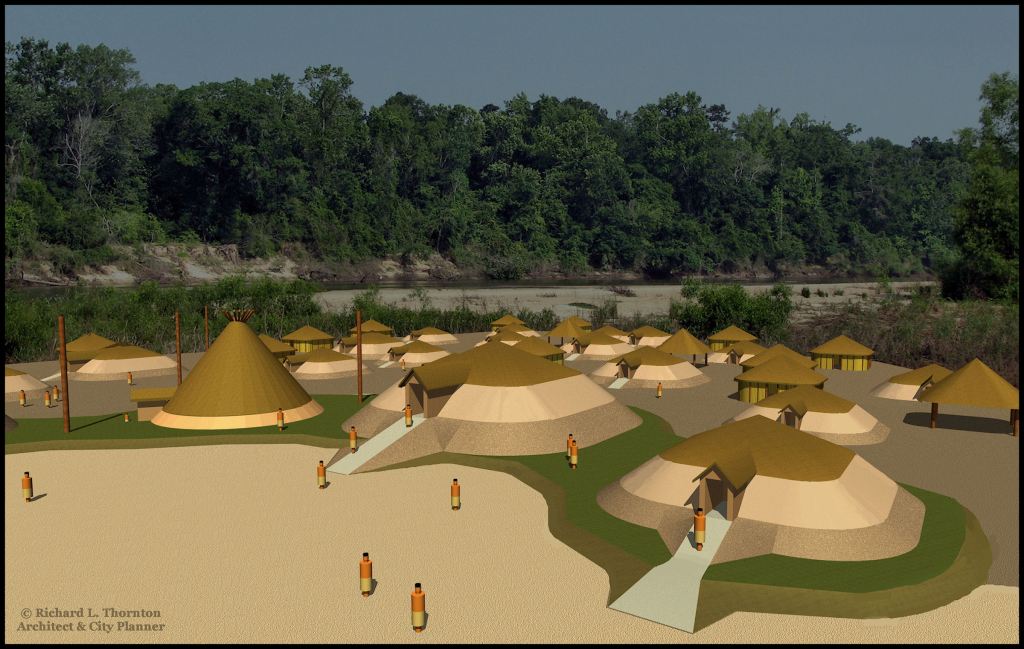
Bullard Landing on the Ocmulgee River in Georgia
Oto or OtoE – The Oto have a cultural memory of being on the Ocmulgee River near Warner Robbins, GA. They were called the Ato or Atosi by the Creeks. That name appears on early maps of the Southeast and Georgia. Their principal town was probably the Bullard Landing Site, which was thoroughly studied by Dr. Mark Williams of the LAMAR Institute in 1993. His report is published online. There is no excuse for this tribe not being included in the Southeastern history literature.
The Oto moved to the Chattahoochee River to get away from the Spanish. Some remained as a tribal division of the Creek Confederacy. The remaining Oto migrated westward at a fairly late date then journeyed up the Mississippi to the Missouri River.
Kansa or Kaw – The Kansa have cultural memories of being on an island in the Tennessee River near present-day Guntersville, AL. They became too numerous for the island and so migrated to the Coosawattee and Coosa Rivers in Northwest Georgia, where they became vassals of advanced peoples, who taught them agriculture. That was probably the Chickasaw and Itsate Creeks, since I found several words in the Kansa dictionary that mean the same in either Chickasaw or Itsate (Itza Maya).
After Europeans became a problem for the Kansa, individual bands started migrating westward until they reached the Mississippi River. They went up the Arkansas River in what is now the state of Arkansas then individual bands drifted northward into what is now Kansas. Kansas is the French version of their tribal name.
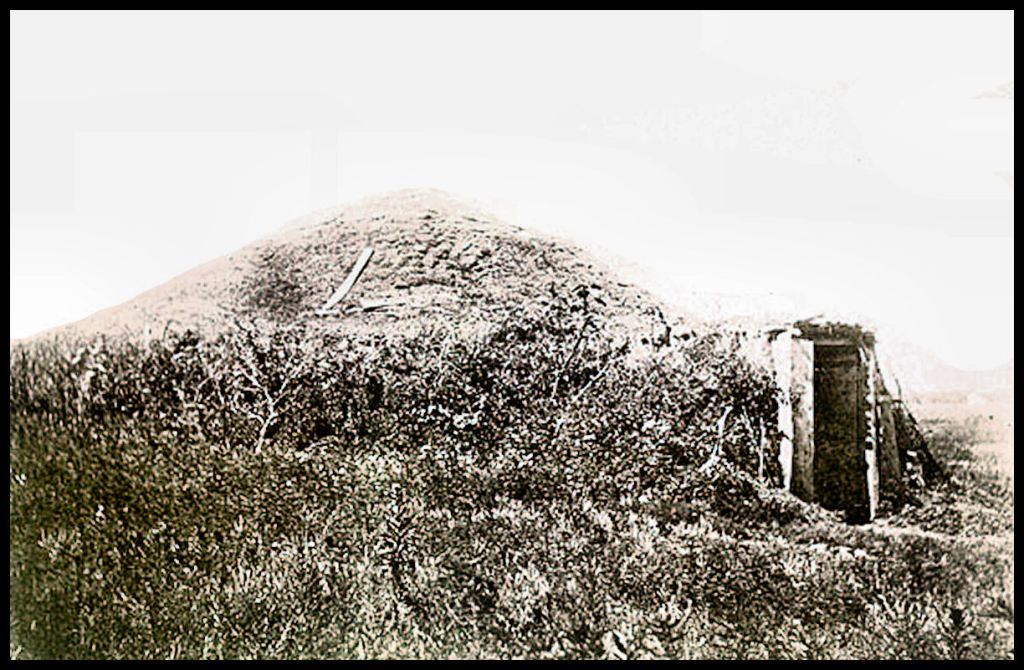
The earliest known photograph of a Kansa house in Arkansas, shows a structure identical to the earth-berm houses at the King Site and Bullards Landing. They had thatched roofs.
 The Americas Revealed