
Native American barns in the Nacoochee Valley were identical to those on the Gulf Coast of Mexico, but they also served a dual social purpose . . . if you were young and single! They were preferred location for young folks to get to know each other better in the romantic tradition known as “parking” today.
by Richard L. Thornton, Architect and City Planner
Image Above – This is a snapshot of the 12 mile (19.3 km) long computer model of the Upper Chattahoochee River Basin as it looked in 1500 AD. This was the last stage, not containing European artifacts, of a village unearthed by archaeologist Robert Wauchope in 1939. It is now the pasture for Chattahoochee Stables.
The structures in the right-foreground are large barns that might have been build by a merchant, mikko or town council. In the background is a small barn, which would have been built by a young couple, just getting started. They were called a picha in Chickasaw . . . tohto in Muskogee-Creek . . . imisa in Koasati, Itsate-Creek or Itza Maya . . . shoge in Kansa.
Also, in the back of the large barns is a summer house. Both the barns and the summer houses had walls composed of vertical river canes. These canes functioned like a window screen. The gaps allowed air to flow, but blocked most insects.
In the far background is the spectacular Kenimer pyramid. Identical earthen pyramids were also sculpted from large hills by the Itza and Kekchi Mayas in the highlands of Chiapas, Guatemala and western Belize. This was a specific form of architecture, solely constructed to honor the sun god. Neither the Itza nor the Kekchi built stone pyramids.

While on my fellowship in Mexico, I observed hundreds of barns on stilts in the Gulf Coastal Plains of Campeche, Tabasco and southern Vera Cruz. This one was somewhat different, so I photographed it. The structure was very similar to some Seminole Chikees that I had seen in Florida.

Within the interior of the Yucatan Peninsula, the Mayas traditionally built their barns on the ground. This dilapidated river cane structure was about 30 feet from the Maya hut near Labna, where Ana Rojas and I were based for a week. On one side, it was formerly used as a kitchen, grain storage and summer house. The other side was apparently always a barn for animals. However, after the Maya site manager moved into a much larger Maya style house, built for her by the government, this entire structure became the abode of pigs, chickens, turkeys and cone shaped hives for stingless indigenous honey bees.
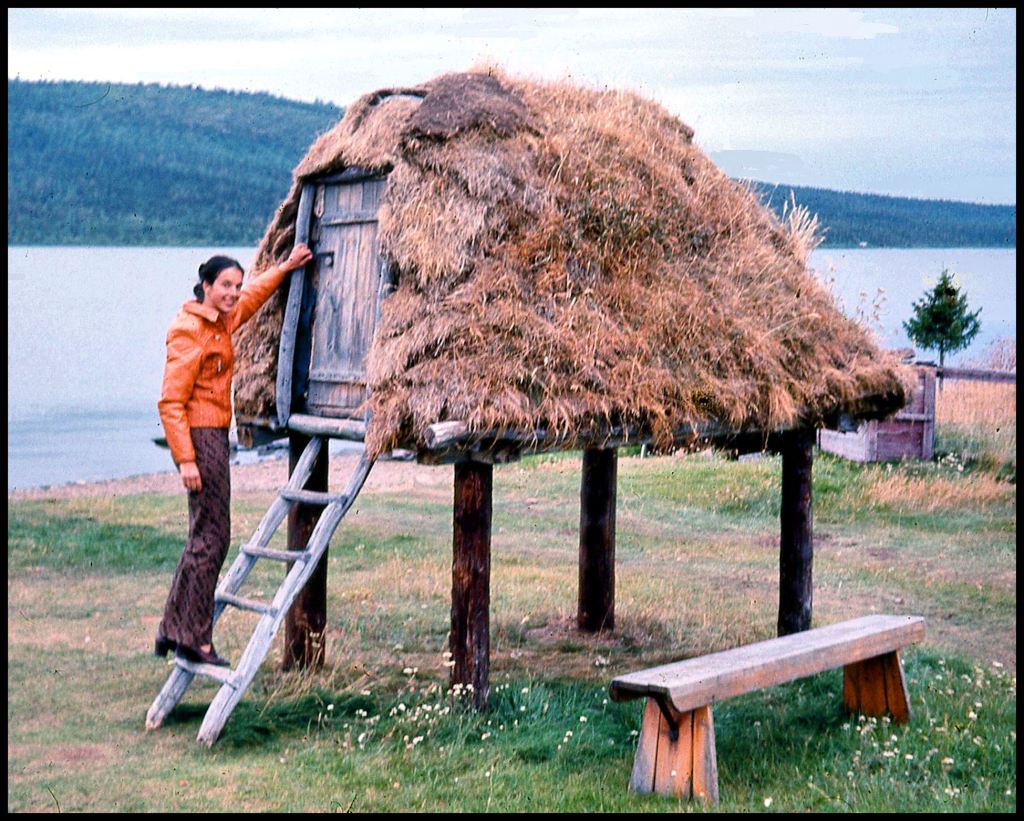
A Sami barn near Jukkasjarvi, Lapland in 1972. My travel companion, Joana, was not a Sami, but rather an Austrian descendant of a Sami tribe that migrated to the Tyrolian Alps during Late Roman times. She was a biologist taking samples of radioactive fallout from Soviet nuclear tests. I was asked to pose as her husband or boyfriend (and body guard), because most Scandinavians, even Sami, assumed that both of us were Northern Sami. Assuming us to be locals, Swedish tourists in the only major town, Kiruna, asked us for directions.
Jukkasjarvi back then was like the situation with Cancun, Mexico two years earlier, while on the fellowship. Reached by a single lane, graveled road, Jukkasjarvi was a small Sami village in the middle of nowhere, seldom even seen by ethnic Swedes. It is now the focus of Arctic tourism in Scandinavia.
Thirty-six years later, while doing research for the Muscogee-Creek Nation, I would realize that chiki was the Totonac, Itza Maya and Creek word for a summer house. The Creek, Chickasaw, Choctaw and Alabama word for a winter house is choko or chuko. Choko happens to be the Itza Maya word for “warm.”
The original Love Huts
Several colonial-era explorers and traders commented on the “extracurricular” usage of Creek barns by the teenagers and young adults. The most detailed information comes from John Lawson in the early 1700s and James Adair in the mid-1700s. Lawson was particularly interested in the young Creek women, because he was a young, healthy man without an significant other.
Culturally, he didn’t have much in common with the young women of most of the tribes in South Carolina and North Carolina, but because Creek women typically waited until their early 20s to get married, they had time to be educated in a much broader range of topics beyond cooking, weaving and making pottery. Creek and Chickasaw females were equal in all ways to men. They had both the right to vote and to hold political . They individually owned all the domestic buildings.
Maya immigrants to the Southeast had brought with them the knowledge of how to make a birth control potion out of the wild sweet potato. Modern birth control pills were originally made from the wild sweet potato. Small daily doses of the sweet potato potion would prevent conception. Large doses would abort the fetus.
From what I have been able to discern from Mexican academic literature, the Southeastern Muskogeans made far more use of birth control techniques than the Mayas. There was far more protein in their diets. The babies were healthier and child mortality rates were much lower.
Maya commoner women married very young and were expected to start producing babies soon thereafter. Birth control was typically only used after a certain number of children were born or else during famines and droughts.
The original love shack
Chickasaw and Creek teens literally began dating, shortly after puberty. Very few, if any other indigenous cultures in the Americas had any social custom similar to Muskogean and modern-day dating. They both “dated around” and “went steady” . . . but with no thoughts of getting married anytime soon.
Initial contacts were usually at the sock hops held on town plazas or during bad weather in the chokopa (rotunda). This is why the Creeks have so many social dances in which men and women hold hands.
The next step were dates such as walking in the woods, going fishing together, dinner with the family, walking over to visit relatives in other towns, etc. If this went well, an invitation to the barn followed. Here the couples chatted and made out for an hour or so in order to get to know each other. Groups of girls would also meet in the barn to get tipsy on muscadine wine or corn beer . . . perhaps even get zonked on psychedelic morning glory seeds.
The Creeks and Chickasaws had another tradition unique in the Americas – coed vacations. In the spring, groups of single men and women would walk to the beach for a few days of frolicking. In the summer, they walked to Ohio to party with the Shawnee at their festivals. In the autumn they went to the mountains to admire the colorful leaves (and other things).
French Captain Dominique de Gourgues stated that Asebo (Ossabaw) Island near the mouth of the Savannah River, was THE swinging hot spot for the whole Southeast. Some of the prettiest and smartest Native gals in the land hung around the local dance grounds, hoping to hook with some up and coming young chief or priest while they were both zipped up on the extreme caffeine content of Yaupon tea. Asebo is a Panoan word from Peru, which means “Yaupon holly/tea – place of.”
One a young couple started going steady, they would often spend the night in the barn, unless it was too cold outside. They were not trying to escape the disapproving eyes of their elders, but merely seeking privacy. Muskogean and Maya houses were warm, but rather small. They had 1-3 rooms. In fact, Chickasaw and Creek parent encouraged both their male and female teens and young adults to be sexually active . . . even promiscuous . . . believing that sowing oats, while single, would help prevent wanderlust in married couples.
Since pre-marital intimacy was the norm and all females had access to birth control techniques, there was no pressure to get married young. Marriage was for both love and the security of having a wife, who knew how to make edible plants thrive and a husband, who was a skilled hunter and fisherman.
According to Thomas Christie, Secretary of the Province of Georgia, and James Adair, a well-traveled trader and an intellectual, divorce was very quick and simple among the Muskogean tribes, but adultery was considered a serious crime that on the third offense, could be punished by death for both participants.
All European observers commented on how happy most Muskogean couples were. They lived together, because they loved each other, not because they had no other options. The Muskogean traditions must have been good traditions.
That’s brother and sisters how it was in the Good Ole Days.
 The Americas Revealed
Awe, so romantic. Interesting about the birth control.
LikeLiked by 1 person
I always was the romantic type . . . guess that’s why I appeal more to French and Latin American gals rather than Gringas. LOL
LikeLiked by 2 people
Utterly fascinating but think you missed a good opportunity to not call them “Love Huts” but “Love Shacks” per a band founded not too too far from your current location!
LikeLike
Oh, shoot, just saw the video still! Cute!
LikeLiked by 1 person
Great info. Thought I heard that the ‘Old Stone Fort’ near Manchester, TN (site of modern music festival Bonnaroo, ironically), served as a ceremonial coming-of-age spot. Pretty and interesting place regardless.
LikeLiked by 1 person