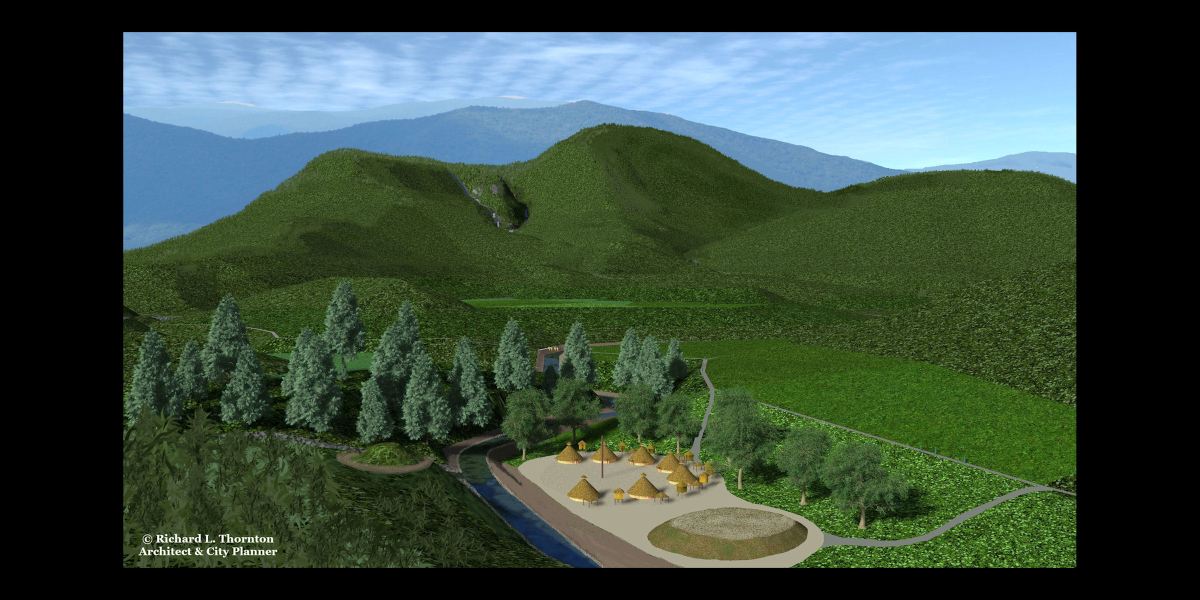
Known today as the Hiwassee or Towns County (GA) Indians, they are the descendants of Arawak immigrants from Peru, who arrived at Mandeville in the Lower Chattahoochee River Valleys around 400 BC . . . at the 9FU14 site on the Chattahoochee River near Atlanta around 250 BC and on the Upper Chattahoochee River Basin around 200 -100BC. Hiwalsi means “Highlanders,”
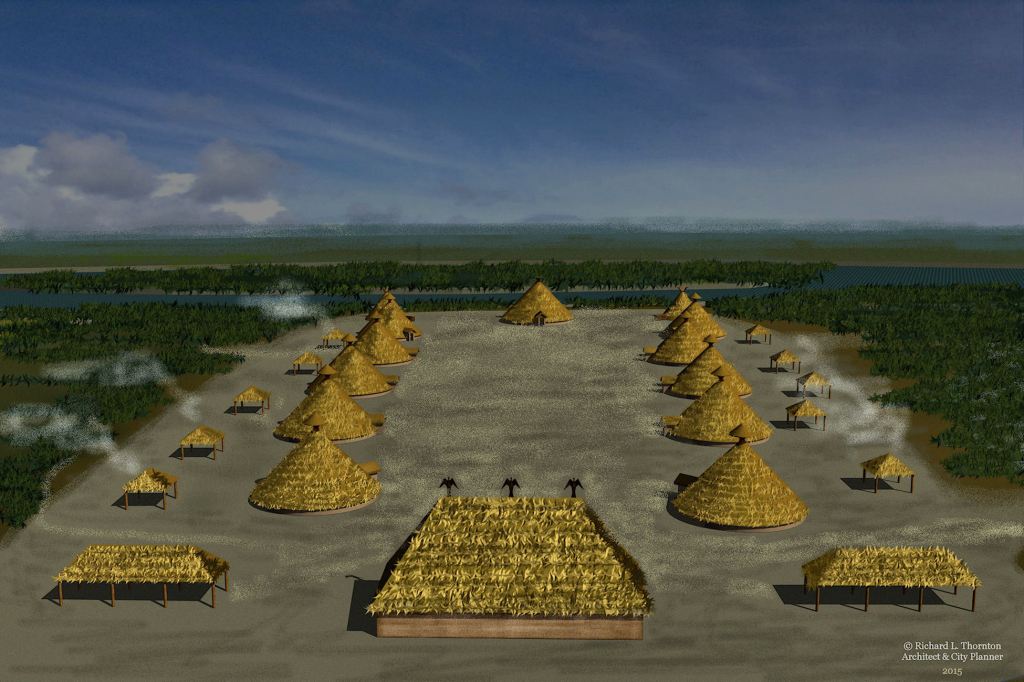
The Artlantis VR image above is of mounds located in Robertstown, GA near Unicoi State Park and Ana Ruby Falls. These mounds were originally constructed long before the arrival of the Hiwalsi by the people that archaeologists call “the Deptford Phase of the Early Woodland Period.” The Deptford Phase is named after the ancient Deptford Mound in Savannah, GA. Uchees, living around Savannah, told British officials that they built that mound after sailing across the Atlantic Ocean and first settling at the mouth of the Savannah River.
The Hiwalsi Arawaks introduced stamped pottery and the Stomp Dance to North America, along with yaupon holly tea, single tuber sweet potatoes, tobacco and more sophisticated cultivation of indigenous crops, previously developed by locals, such as sunflowers, squash, amaranth, Jerusalem Artichokes and pumpkins.
The Creek word for Yaupon and Yaupon Tea (asé) is a Peruvian Arawak and Panoan word. Stamped pottery and the Stomp Dance have an ancient tradition among the Arawak and Panoan Peoples of the Andean Region of South America, but were largely confined to Georgia and nearby regions of adjacent states in North America.
Descendants of the Hiwassee or Towns County Indians carry Asháninka DNA markers from Peru and Brazil or a combination Asháninka, Panoan (Peru) and Itza Maya (southern Mesoamerica) DNA markers.
Descendants of Georgia (Eastern) Creeks do not usually carry Asháninka or other Southern Arawak DNA markers, but instead carry a combination of Itza Maya, Soque (Mexico), Panoan (Peru), Sami (Sweden), Finnish, Scandinavian, Polynesian and Basque DNA markers. Muskogee Creeks typically also carry Iberian, Illyrian, Sardinian and Italic DNA markers.
The Creek languages are the result of core Indo-European languages from southern Sweden, the Adriatic Sea Basin and Galicia on the Iberian Peninsula, mixing with Chickasaw, Itza Maya and Panoan.
- The three Muskogee words for water are Illyrian, Archaic Galician and Latin!
- The Creek languages share many grammatical features such as formation of a plural word with an “en” suffix, with Archaic Anglisk. (when the English lived in southern Scandinavia)
- The Creek word for a doctor or herbal healer [alek] was exactly the same word in Anglisk.
- Both the Creek languages and Panoan contain words that sound the same and mean the same in Archaic Anglisk and Archaic Swedish.
- The Creek adjective for “high” [hilwa] is derived from the same NW Germanic/Indo-European root word as the English words high, hill and hovel.
- The Muskogee-Creek suffix for “tribe or people” [gKe] is the same word as the Archaic Galician/Irish Gaelic/Scottish Gaelic suffix for “tribe or people.”
In the late 20th century, archaeologists first gave an English name to Hiwalsi pottery, while working on sites in the Etowah River Valley near Cartersville, GA. Therefore, they are known to anthropologists as “the Cartersville Stamped Pottery Phase of the Middle Woodland Culture.” However, the oldest Cartersville Stamped pottery is found either in Peru or the Lower Chattahoochee River Basin.
by Richard L. Thornton, Architect & City Planner

Anna Ruby Falls in 1500 AD – Computer-generated {CADD] image
Discovering a secret Native American tribe
I first became aware of a “secret” Native American tribe in the Southern Appalachians in 2005, while hiking with my herd dogs in the high mountains that divide Towns and White Counties, Georgia. It was not a pleasant experience.
Mysterious Native American farmsteaders: We were exploring what I thought was a US Forest Service Jeep trail, when I encountered what looked like a pioneer farmstead from the 1700s or early 1800s. There were no vehicles . . . just two horses and two mules. Both the house and the barns were constructed of hand-hewn logs.
A long-haired Native American man, holding a shotgun, stepped out on to the porch. His Native wife and children peaked out the windows. He asked me if I was a hunter. I told him no. I was just hiking around the mountains.
I asked him if he was a Cherokee. He responded with an angry no and warned that he would shoot my dogs, if we didn’t get off his farm immediately. We walked away from there as quickly as possible. I figured that he was a Southwestern Indian, hiding from the law. He didn’t look like someone from the Northern tribes.
Towns County Indians: In June 2010, I had been homeless for six months, when camping out at the base of Brasstown Mountain. I drove into the town of Hiawassee to get a hair cut and provisions. At the Ingles Supermarket were two Native American ladies working a check out counter together. They looked Muskogean and spoke Southern accents, so I assumed that they were Florida Seminoles, working in the cool air of the mountains for the summer.
I asked them if they were Seminoles. They said no! They were Towns County Indians, who came to the mountains long before the Cherokees. They said that they had very different personalities than the North Carolina Cherokees and different cultural traditions. They had attended several Native American festivals and found, however, that they seemed to have a lot more in common with the Creeks and Seminoles.
DNA Reports: In 2012, an article that I wrote in my column in the the National Examiner asked readers if any of them, who thought their white ancestors came from northern Europe, received DNA reports, which said they had Native American ancestors south of the border. I received plenty of Creeks and Seminoles, who learned that their ancestors were from southern Mexico, but also got some surprises.
Several from Towns County, GA, southwestern Virginia, southern West Virginia and NE Tennessee responded that their Native ancestry had been from South America. They were not “famous” tribes like the Quechua. The labs said that their ancestors came from Peru or Amazon Basin . . . strange names like Ashaninka, Amuesha, Chamicuro, Apurinã, Piro, Caquinte, Conibo or Shipibo.
The Towns County Indians carried very high levels of Native American DNA . . . as high as 25%. It was either all Southern Arawak or a mixture of Southern Arawak and southern Mesoamerican. North Carolina Cherokees typically were 1-3% American Indian. Oklahoma Cherokees were typically 0-1%. All Cherokees tend to be more Semitic than Native American. My Cherokee co-author, Marilyn Rae, had twice as much Semitic DNA than her former husband, who was a practicing Sephardic Jew!
One college coed wrote me from the remote part of the Virginia Mountains, north of Ashe County, NC, where few tourists visit. She said that many of the people of her county were Indians, but not Cherokees. Her DNA report said that her family was Ashaninka.
When she contacted the University of Virginia Department of Anthropology for an explanation, the professors acted like she was mentally ill. She then posted a video about her South American DNA on Youtube to see if there were others with Northern European family names in North America, but with South American DNA
Eyewitness accounts in the 1600s: In 2013, Boston University linguist Marilyn Rae discovered the French language book, l’Histoire Naturelle et Morale des isles Antilles de l’Amérique by Charles de Rochefort (1658) in the Brown University Library. Initially, she thought that ten chapters were about the people living at the Track Rock Terrace Complex. However, as we began to translate the ten chapters about La Floride française (Georgia – not the present state of Florida) I realized that it was about a branch of Creeks in northeast Georgia, who called themselves Apalache or Apalachete.
De Rochefort stated that the Arawaks (which he called Caribs) had originated on the coast of La Floride française and were responsible for building the shell rings there. The tribe had split. Most began traveling southward as far as Peru then some of the Peruvian Arawaks had migrated northward as far as the southern Apalachians. The other band traveled northward through the Appalachians, intermarrying with other peoples, including several European peoples that had migrated to the New World.
They eventually turned southward and returned to the southern Apalachen mountains, where they intermarried with the Apalachete and Chickasaw – absorbing their languages and culture. He equated the northern band of Arawaks with the Muskogee-speaking branch of the Creeks. He said that their name was Cofitache, which means the same as Maskoki (Muskogee) – Ethnically Mixed People.
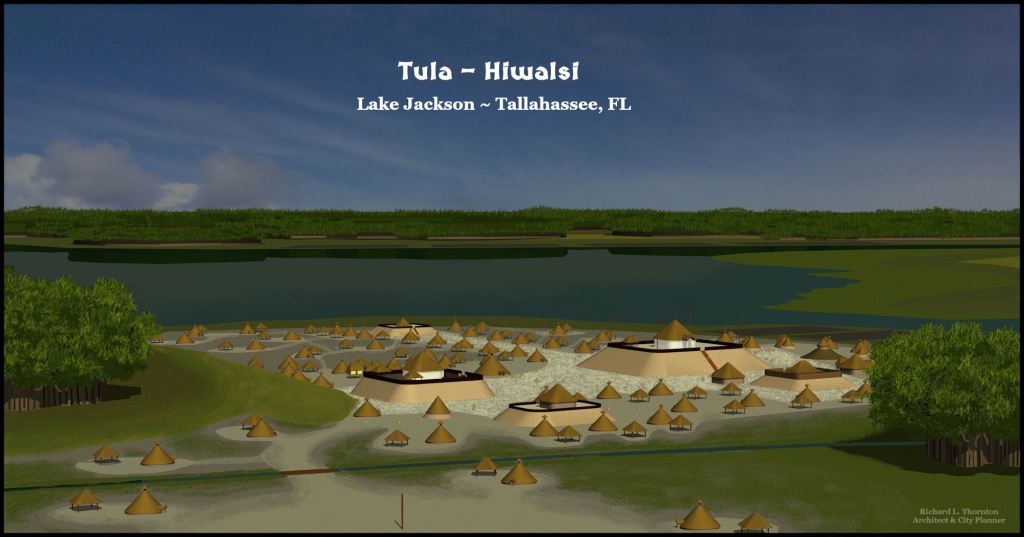
An architectural trademark of the Southern Arawaks were their massive teepee shaped houses – generally about 25-35 feet (7.6-10.8 m) in diameter. Entire extended families could live in these structures.
There is also discussion about one of the other members of the Apalachen Confederacy, the Hiwalsi. The Hiwalsi were descended from Arawaks, who had traveled north from Peru prior to the arrival of the Apalache and Mexicans (Itzas and Soque). They lived immediately north of the Apalache Capital (Nacoochee Valley) and soon absorbed both their advanced cultures and languages. After the King of Apalache built a road from the capital to the Gulf of Mexico, some of the Hiwalsi established a colony among the Arawaks, who had migrated to the Florida Panhandle. They built a great capital, named Tula Hiwalsi (Town of the Highlanders).
Later the real Apalache established a trading town in that province, called Apalachen (plural of Apalache, both in the Creek Languages and Old English!). The Spanish incorrectly thought that Apalache was the name of the Florida Indians, but The Florida Indians never called themselves by that name.
Note: Muskogee Creeks, who moved down into Florida in the mid-1700s thought that the Florida Indians were sayin Tulahassee, which means “Town of the Sun.” Anglo-Americans changed that to Tallahassee.
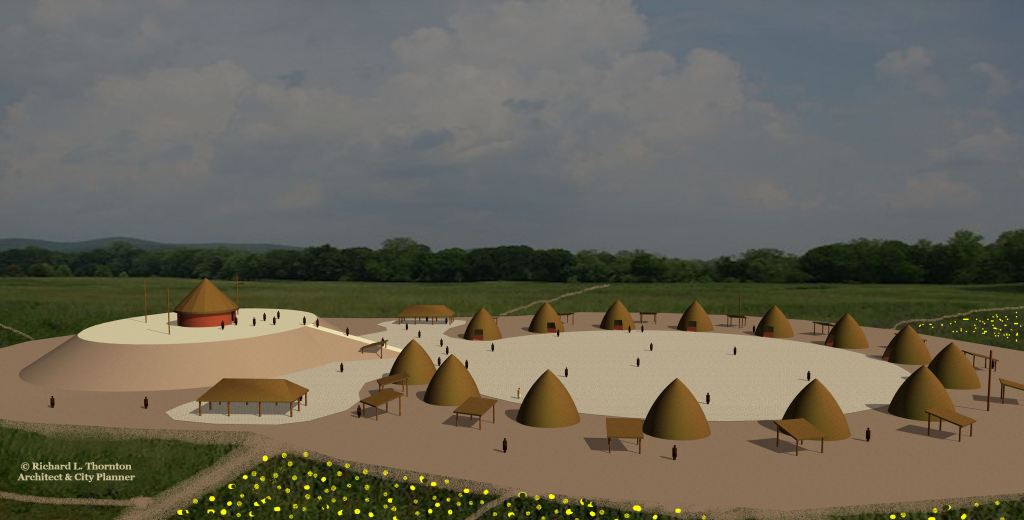
Original Deptford Culture village on the Chattahoochee at Robertstown
Archaeologist Robert Wauchope at Robertstown, GA
Wauchope identified two mounds on the Chattahoochee River in Robertstown near Ana Ruby Falls and labeled the site, 9WH1. There was a large oval platform mound that was built by the Deptford Culture People then later expanded some by the Cartersville Culture People. There was a smaller burial mound, which may have been much older, but radiocarbon dating had not been invented in 1939.
The Deptford Culture People built cone shaped houses that were identical to those constructed by the Southern Sami and later, the Caddo in eastern Texas and the Potawatomi in the Upper Midwest.
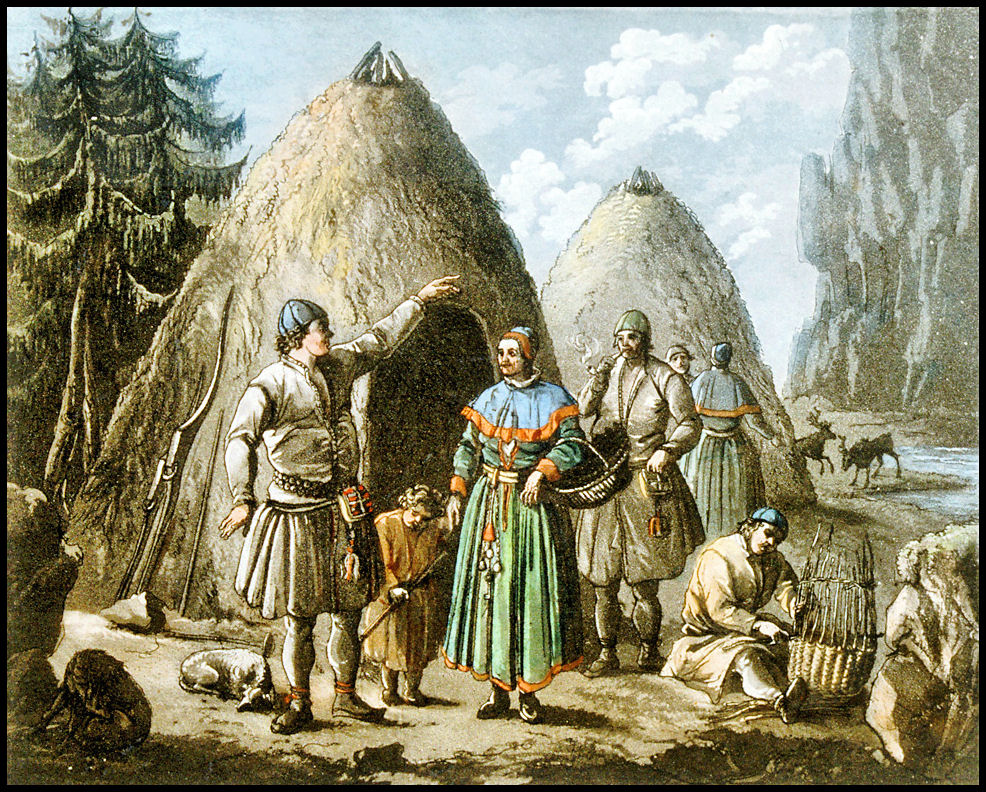
Southern Sami in Jämtland, Sweden – 1700s
During those periods, when its occupants were probably depended on hunting, fishing and gathering of wild foods, the village was fairly large. The last occupation of the site, during the Early Colonial Period was a much smaller village with round Arawak-style “teepee” houses, but artifacts similar to other villages and towns in the Nacoochee Valley and Ocmulgee River Basin. If used at all, the large mound may have been either a dance platform or a stage for ceremonies.
Afterward, Wauchope identified a general pattern in the Upper Chattahoochee and Upper Hiwassee River Valleys, once the region became dependent on agriculture for most of its nutrition. The majority of residents dispersed into small, almost evenly spaced villages, which were in easy walking distance of their cultivated fields. Beginning in the 1600s, they utilized an increasing percentage of European tools, cooking ware and weapons. No obvious Cherokee artifacts were identified.
During the 1700s and early 1800s, the population was even more dispersed along the rugged landscapes of the Chattahoochee and Hiwassee River Headwaters. Most people seemed to live in log houses within isolated farmsteads or extended family compounds. There was nothing to prove that these were ethnic Cherokees and very little proof that they were even Indigenous Americans.
In our next article, we will move downstream one mile (1.2 km) to the ancient town of Chote. In contrast to the remainder of Eastern North America, it evidently reached its peak size in the 1600s.
Thanks to the remote sensing study of the Ocmulgee Acropolis in 2012 by Dr. Daniel Bigman, we now know that the founders of the great megapolis in around 900 AD atOcmulgee National Historical Park in Macon, GA were Southern Arawaks! Mesoamerican houses did not appear on the acropolis until around 1000 AD, but by 1100 AD all houses on the acropolis were large square structures, typical of wealthy Soque merchants in southern Mexico. This radically changes our understanding of Ocmulgee.
 The Americas Revealed
Love this post Richard, such a lot to grasp. That was a frightening experience for you having a gun pointed at you. I also love the Native American names but would have difficulty pronouncing the. Thanks for sharing your well researched work.
LikeLiked by 1 person
As always an interesting read Richard. My 2nd great grandfather on my adopted mother’s side was born in Towns County, Ga. in 1840. His family came from the Shenandoah Valley to become some of the very first to settle near the Watauga River around 1760’s. Over time some family members kept on going south until they are in Towns County.
LikeLiked by 1 person
Colonel John Tipton, the builder of my former house in Shenandoah County, along with his friend John Sevier, led wagon trains from the Valley to NE Tennessee. Around 1785, he built a copy of his Virginia house near Johnson City. It is now the Tipton-Haynes State Historic Site.
LikeLike
Oh yeah, I am familiar with with the Tipton-Haynes site. Been driving right past it for 71 years. In fact these are my stomping grounds. I walked the fields along the Nolichucky with my father-in-law as he hunted native artifacts back in the 70s. He was very knowledgeable. That was not far from where Dear Ole “Chucky Jack” Sevier’s place was. In fact Tipton, Sevier and Robert Love had the trifecta going on with their homesteads surrounding the local mountain range that had the mines. It’s fact that the bullets produced here were used at the Battle of Kings Mountain. There is history all around and slipping away sadly.
LikeLike
Richard, In NJ, The Ramapo Indians have it together and the Lenapes have a group in Southern Jersey now. I live in Metuchen. Metuchen was the downtown area of the original Raritan Township. The entire area grew into Eastern European Catholic farms after the Indians left (now called Edison) . But the Main Street was where the banks and other businesses were sited, and they were mostly WASP with home office in Perth Amboy, at the port. The port is still there, whole area is awesome beautiful. Anyway, at some point the WASP out posters on Main Street in Raritan Township decided that they did not want to ride their horse and buggy all the way over to Perth Amboy to go to the Presbyterian Church and they needed a Church on Main Street in Raritan Township. Well, they couldn’t get it, so they ceded the Main Street and surrounding residential area from Raritan Township and named it Metuchen, of course, after the Chief that was gone. We have a Revolutionary Cemetery with 138 unmarked graves at the site of the original Meeting House. The founders put the new church across the street- it is now adjacent to the Metuchen Train Station. I have the feeling that there are some good dig sites in NJ and not many people like you. Last year, the city of Metuchen paid to have an arial detection company locate the graves and the original foundation of the meeting house underground inth e Revolutionary Cemetery. I think we might be able to get the history clubs and some of the city and state people together to do other digs. Let me know if I can assist you in finding them if you are interested. Maybe there are some sites around here- The History clubs are more than excellent- I learned a lot for them-and LOL, most of them will tell you straight up how the gov lied about everything, even the Bunker Hill Print, for which I have an original copy. My friend at the Healf Food Store knows the families who saw George Washing agree to the notes. Of course, all of the original people never went to the doctors- that is why NJ always had a strong health food community.
I am working on a piece to send the New Yorker informing the good literary community of NY that when they make fun of Southern NJ, they are making fun of the leftovers of stripped Native Culture that is not quite what it was due to cruelty and selfishness. Likewise, while the Southwest has a recognized culture (white, mexican, and indian). the Southeast is recognized only as the Bible Belt. Do you think the Southeast cultural brand is simply buried in other aspects like food, music, and Bible and could be drawn out and made a concept in itself? Is it possible that the overall concept was never developed for the general public because people could not go visit a teepee and a jewelry store? Or do you think that because it is a combination of Indian, White, Indian, and Black and the Lily Whites would never allow that combo to be recognized? Of course, the latter is ridiculous considering that the music is probably the biggest factor and there’s no keeping it down now. How has Country music gone forward without outright recognition of all the half breeds and other Indians? I was stunned upon listening to the Choctaw music on youtube to know that the chords were simply transferred to guitar. And listening to the 70s music on Sirius Radio makes it perfectly clear… all the names of people who made made the music we loved…. LOVE songs that we still love. LOVE is why the war protests were simply that back then. We had LOVE songs- It is perfectly clear to me why the hippies wore headbands and striped tops and had long hair. I always thought the Three Dog Night Song “Liar” was a little too emotional for crying over a girlfriend- now I know what they meant. I think the Southeastern Tribes should step up – and claim the Southern Heritage for the combo. The others are never going to do it. My husband is finally convinced that I am indeed part Indian- the hair dresser found black hair on the back of my scalp- that is what he needed to hear LOL Your fan, Denise
LikeLiked by 1 person