
In a few decades, it would become the famous “Indian city of refuge” . . . where the High King of Apalache allowed refugees and colonists of all races and tribes to settle. Chote had begun about 300-400 years earlier, as a modest hamlet, founded by a band of Cho’i-te Maya refugees from the Coastal Plain of Tabasco. By this time, however, it’s architecture and pottery were pretty much the same as elsewhere in the Apalache Kingdom.
Archaeologists call this era, the Lamar Culture . . . named after a French family from South Carolina, who stole part of the Ocmulgee Reserve from the Creeks then played a major role in forcing the Creek government into selling all of its remaining lands in Georgia. Yep! They were Injun-haters. Kind of ironic, isn’t it?
by Richard L. Thornton, Architect & City Planner

The site of Chote today

The northern edge of Chote aligned roughly with the row of large trees on the left of this photo. In 1939, archaeologist Robert Wauchope explored the surface of the town site after fully excavating the mounds a mile north in Robertstown. Wauchope was not allowed to excavate the main mound of Chote, but was allowed to pick up artifacts on the surfaces of pastures and plowed fields.
What he mainly found on the surface were pieces of very sophisticated Lamar Style pottery, plus European-style detritus from the Early Colonial Period and Gold Mining Period. Wauchope never found Cherokee style artifacts anywhere along the Chattahoochee and Soque Rivers. Oddly enough, archaeological sites in Helen do not have the deep layer of alluvial sand on them from about the year 1700 AD that Wauchope found downstream in the Nacoochee Valley.
The Apalache always allowed other Native Americans to settle in their lands. This is specifically described in the original Kaushete (Creek) Migration Legend that I found in 2015. Runaway bond servants, Native American slaves and African slaves from Virginia were welcomed, after Jamestown, VA was founded
From observations made by English explorer, Richard Brigstock, in 1653, we know that the Apalache began allowing French Protestant and Sephardic Jewish refugees to settle in their midst in 1566. The only conditions were that single adults marry Indigenous spouses and that they obey the laws of Apalache. In the early 1600s, the Apalache began allowing Dutch and English settlers, under the same conditions.
In 1646, the Spanish were allowed to build a fortified trading post and small mission in either Chote or the present day location of Sautee. Spanish colonial records only say that it was at the headwaters of the Chattahoochee River. Large numbers of Asturian gold and gem miners poured into the region. According to Brigstock, the Spaniards also established a large gem-mining village near present-day Franklin, NC.
During this period, the typical “Lamar Culture” town of Chote evolved into a European-like village, similar to Jamestown* and a regional trading center. Its inhabitants were multi-lingual mestizos. The Apalache leadership welcomed this new cultural influence, because it gave them access to European genes, technology and military tactics. Creeks have always encouraged mixing of different peoples, because it produced healthier, more progressive citizens. By the late 1600s Chote had expanded to the size of present-day Helen and had at least 500 residents, living in houses like those in Jamestown and St. Augustine.
*Log construction was introduced North America by Swedish and Finnish colonists in the Swedish colony of Nya Sverige in 1636, but did not reach the southern colonies until the 1690s or later. The earliest log houses in Georgia were introduced by Ulster Scots immigrants from Virginia in the mid-1700s.
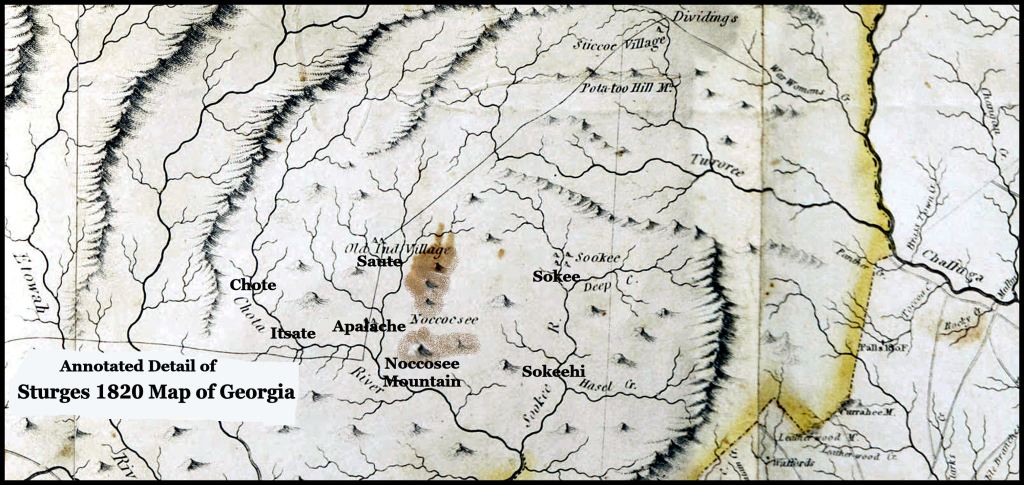
Maps from 1715 until 1820 only showed Native American villages in the Nacoochee Valley area with either Itza Maya and Soque names from southern Mexico or Creek names. Nokose, had a Creek-Chickasaw name, which meant “bear.” The Chickasaw village of Nokose was located on the northern edge of present-day Cleveland, GA. Settlers from North Carolina renamed Nokose Mountain to the Cherokee word for bear in the 1830s.
Helen today is thriving economically due to the construction of the two Cherokee gambling casinos in western North Carolina and the explosive growth of Metro Atlanta. Families and young adults on dates much prefer the G-rated environment of the Georgia Mountain towns, plus Georgia’s greater accessibility to the Appalachian Trail and canoeing rivers.
About a decade ago, the Eastern Band of Cherokees bought about 500 acres on the south side of Yonah Mountain to build a casino. Bad mistake! They bought land that was always within the boundaries of the Creek Confederacy until sold to the State of Georgia. The site was occupied by a Chickasaw village that was allied with the Creeks. LOL Between the hostility of locals toward the blighting influence of casinos and my extensive map collection . . . it will never be built.

In August 1971, Governor Carter took us interns to an unforgettable “think tank” retreat at nearby Unicoi Station – now Unicoi State Park. At that time, the heart of the former village of Chote was a public park. The largest mound and a low burial mound were visible. Local residents remembered the site as a “Cherokee” village and preserved its pastoral appearance. During the period of time when I was in either North Carolina or Virginia (1987-1995), the mounds were razed and the site leveled for parking. More recently, the archaeological site was developed into several motels.
Very few of the original families, who accomplished the original transformation of Helen in the late 1960s and early 1970s live in the area today . . . so there is no cultural memory. Both in the 1982 Reagan Recession and the 1991 Bush Recession, original property owners were either foreclosed on or forced to sell to investors from Florida.
Snapshots of 500 years ago
The Upper Chattahoochee River Basin Virtual Reality Model
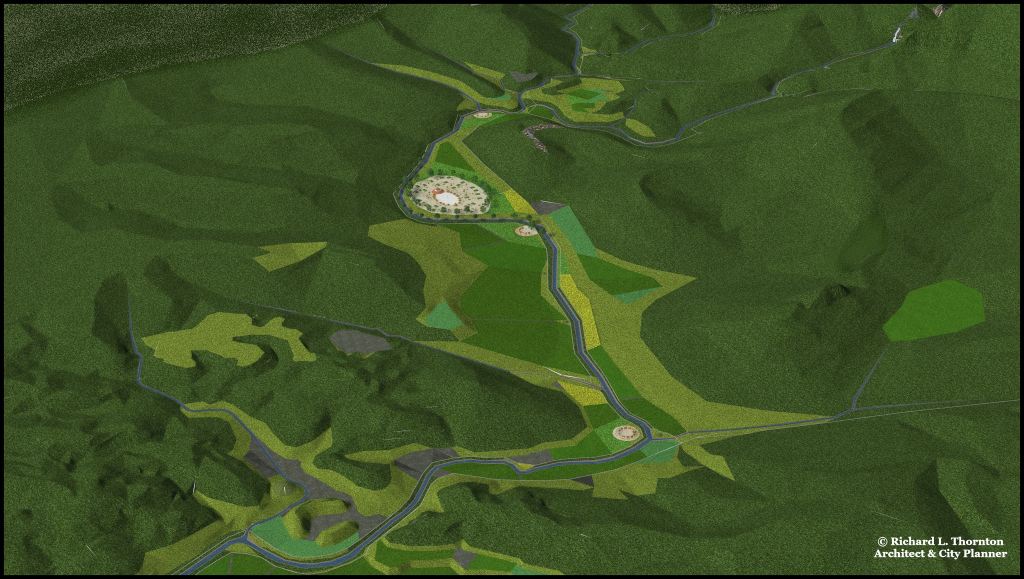

View looking northward
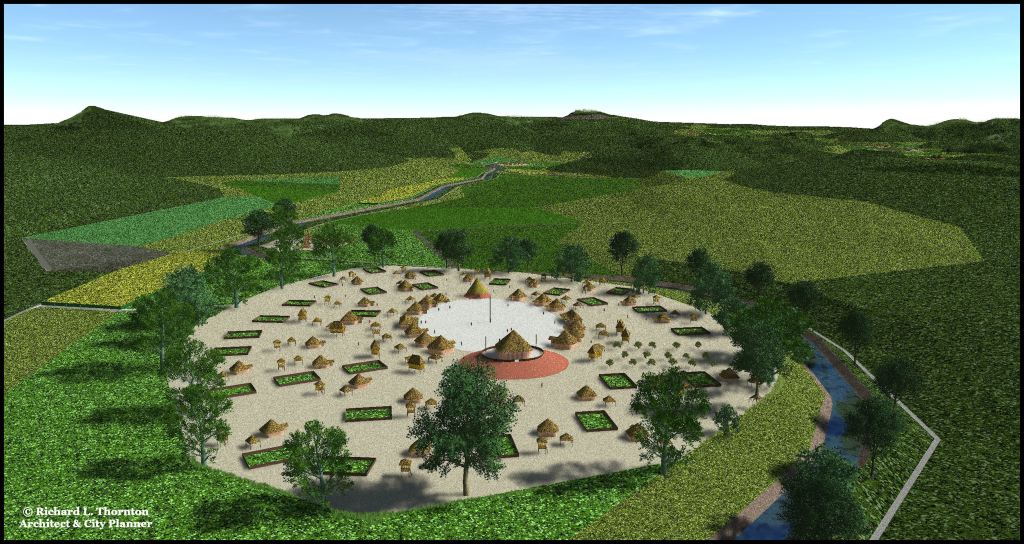
View looking southward

(foreground) It is known from accounts of the De Soto Expedition that Proto-Creek towns contained large fruit and nut orchards. Spanish Sephardic immigrants introduced European fruits. Asturian miners introduced apples and fine varieties of tobacco, used for making cigars. Sixteenth century Spanish cigar molds have been unearthed in the Nacoochee Valley,
What was especially popular were peaches. A distinct variety of peach, which was fully adapted to the climate of northern Georgia was well established and grown at a large scale by the Creeks, when Savanah was settled in 1733. All modern commercial varieties of both peaches and strawberries in North America are descended from Spanish peaches and native strawberries, selectively cultivated by Creeks and their Mestizo cousins in northern Georgia . . . probably in the Nacoochee Valley.
 The Americas Revealed