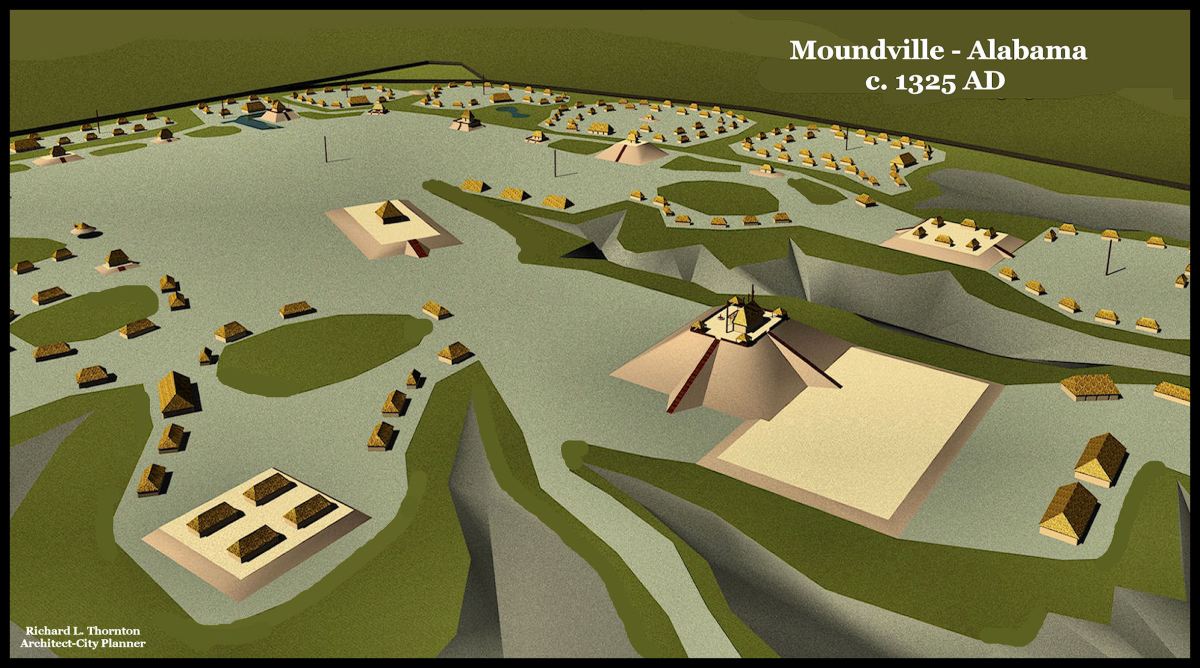
There is an astonishing similarity between the cultural traits of Moundville, Alabama and Toltec Peoples, who once lived in Hidalgo State, north of Mexico City. The similarity extends to physical appearance. Upper Creeks are almost identical to the surviving Toltecas in Mexico. The disappearance of surviving Toltec Commoner survivors from Hildalgo State, Mexico around 1150 AD coincides with the appearance of a culturally advanced people among the Chickasaws living on the Black Warrior River in Alabama. At least three of the earthen pyramids at Moundville are larger than any of the stone-veneered pyramids at Tula, capital of the Hidalgo State Toltecs.
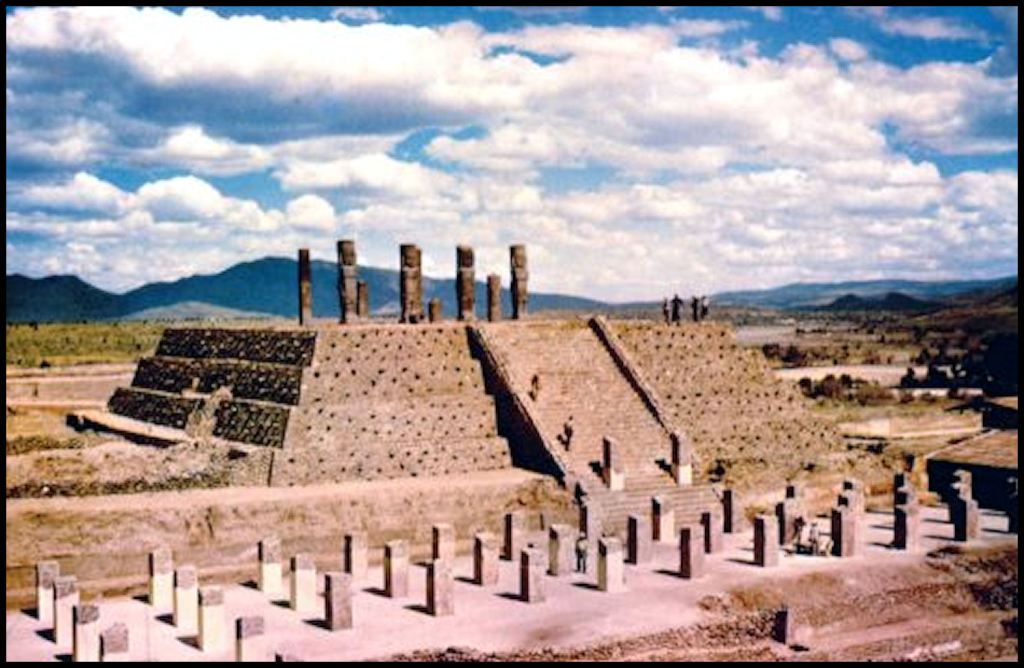
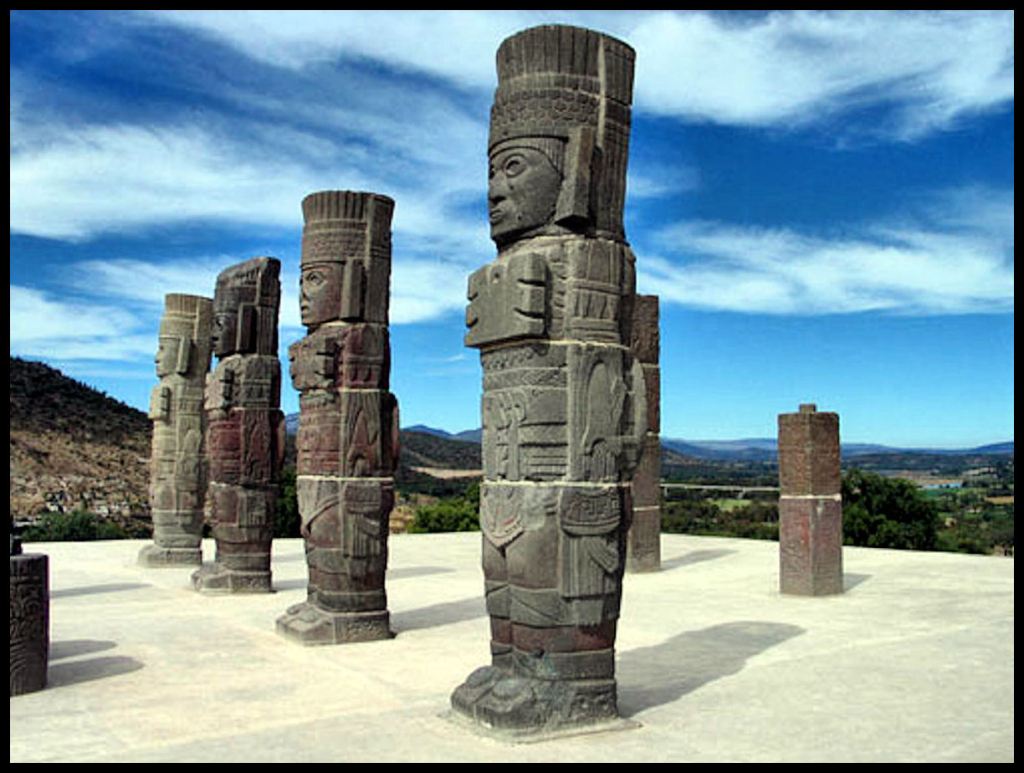
Between around 1200 AD and 1250 AD, there was another migration of less advanced Toltec tribes, such as the Yama, Alibaamu (Alabama), Taske (Tuskegee), Apeke and Kawshete (Coosatee or Cusseta) from the Yamapo River Basin in southern Veracruz State to the Mobile, Alabama, Coosa and Upper Tennessee River Basins in Alabama, NW Georgia and eastern Tennessee. Yamacraw is the Anglicization of the Apalachete-Creek words Yama Kora, which mean Yama People. Yamasee means “Descendant of the Yama.”
The Creek Migration Legend is a largely factual description of this second wave of immigration. It states that the Alibaamu, Kaushete and Apeke formed an alliance with the Chickasaw to create the first People of One Fire or Creek Confederacy.
by Richard l. Thornton, Architect and City Planner
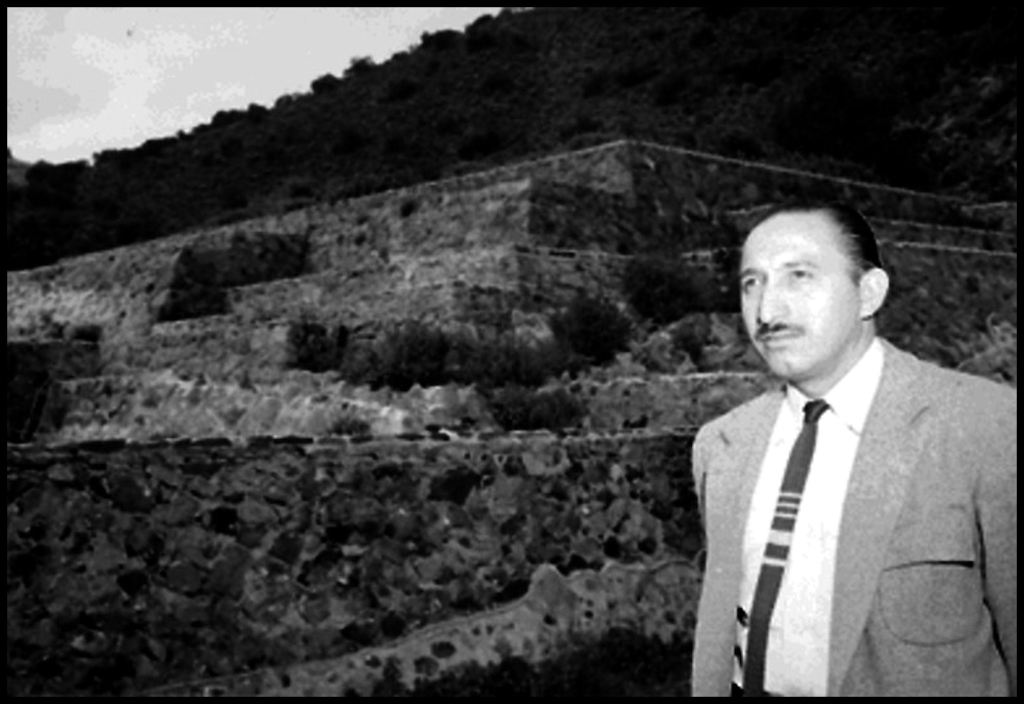
Dr. Román Piña Chán around 1970
It is strange how so much of one’s life becomes a blur, but then certain events stay vivid, as if they occurred last month. Such is the first meeting that I had with Dr. Román Piña Chán in his office within the “Inner Sanctum” of the Museo Nacional de Antropologia in Mexico City.
Dr. Piña Chán first explained that all of the pyramids of the Olmec civilization were earthen and the same shapes of those in Florida, Georgia and Alabama. However, actually . . . almost all of the pyramids in Mexico began as earthen structures, except the latter ones built by the Mexica (Aztecs). Over time, these earthworks were covered in a succession of stone veneers. Most of the pyramids in the Tabasco Coastal Plain never received stone veneers, because there were very few fieldstones.

As he scanned over the two books on the Southeastern Indians that I gave him, he quickly discerned that the advanced indigenous cultures of Georgia and South Carolina were continuations of the so-called Olmec Civilization, but their nobility was portrayed identically to the elite of Chichen Itza. The same scepters and human heads were carried by the nobility of both regions.
The shapes of the shell-tempered pottery in Ocmulgee and Etowah Mounds were identical to the shapes of contemporary shell-tempered pottery in Tabasco and southern Vera Cruz. However, the decorative treatment of the Georgia and South Carolina pottery was like that of northern and eastern Peru.
Dr. Piña Chán couldn’t explain that, but he would have known. He wrote THE books on Chichen Itza and the Olmec Civilization . . . which he preferred to call “La Cultura Madre” (The Mother Culture) because the Olmecs were nowhere around when this civilization flourished.
To be honest, though, at that moment, I knew very little about this brilliant man other than the fact that the Mexican Consul in Atlanta considered him the best archaeologist in Latin America . . . and also a very empathetic man from a middle class, Maya family in Campeche, who would be an excellent mentor for me.
He used the Socratic method for teaching . . . always asking Alejandra and me questions that would make us think. Until the late 20th century, almost all Mexican archaeologists were from aristocratic families and would have been snobbish toward me, like Dr. Ignacio Bernal had been earlier in the morning. After about five minutes into our tour of the national museum, Dr. Bernal looked at his watch, uttered, “idiotos,” and walked away . . . never to be seen or heard from again.

Moundville Siteplan
The mysterious origin of Moundville
Dr. Piña Chán moved to the sections of the two books on Moundville, Alabama. He began skimming the pages, glancing quickly at the photos of artifacts and the smaller earthen pyramids.
Suddenly, he twisted his moustache with his fingers and blurted out, “¿Qué? ¡Esto es imposible!” (What? This is impossible!)
Without saying anything else, he rose out of his chair, turned around and grabbed a book from the shelf. I glanced at its cover . . . Los toltecas de Román Piña Chán. I thought, “Geez, this man is THE MAN for the Toltecs.”

Artifact after artifact, the vestiges of the two cultures matched almost perfectly. Both cultures used polished and engraved discoid stones. One finds the eye and hand motif on the stone discs of both cultures.
Dr. Dr. Piña Chán pointed out that the earthen pyramids and platforms at Moundville were the same shape as the stone-veered public structures at Tula.
The timing was perfect. Around 1150 AD, Tula, the capital of the Toltec kingdom, was sacked by Chichimec barbarians. Probably, most of the Toltec elite and solders were eaten by the Chichimecs. The surviving merchants and commoners scattered to the winds.
Mexican anthropologists have never been able to determine to where these refugees migrated. The great indigenous city, now called Moundville, was founded shortly thereafter. My guess is that its real name was Tula, which is the Toltec, Totonac, Itza Maya and eastern Creek word for “town.” The original name of Etowah Mounds was Etula, which means Principal or Capital town.”
There were a few surviving Toltec bands in Central Mexico, when it was conquered by the Spanish conquistadors in the 1520s. By that time, most had been exterminated by the Mexica (Aztecs) who hated the Toltecs with a passion. Well, the Mexica did not call these other peoples, Toltecs. They did not realize that they were survivors of the people who built the City of Tula. The Mexica believed the builders of Teotihuacan and Tula to be gods. Tula was also the real name of Teotihuacan.
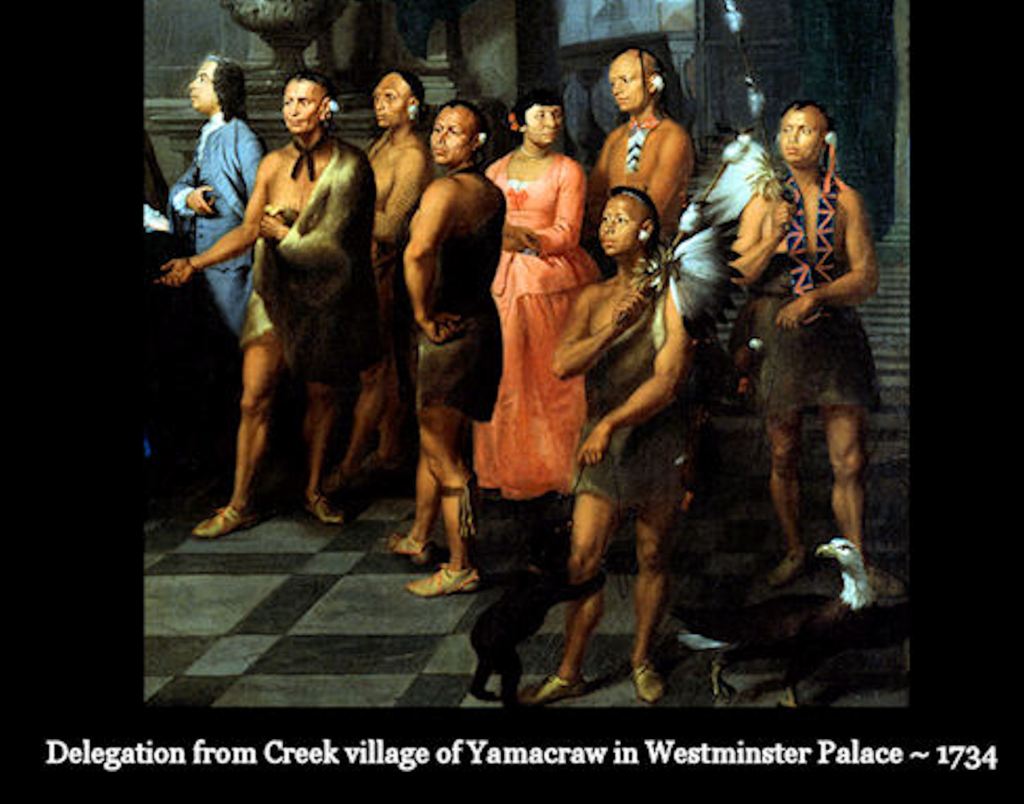
Spanish artists or their Aztec assistants painted a few of the surviving Toltecs. They were identical to the extremely tall, Upper Creek man, who accompanied the Creek delegation to England in 1734. He is on the right and stands behind the others.
Second migration of Toltecs
Shortly after the Toltecs in Hidalgo were either killed or driven off, Nahua-speaking warriors, such as the Mexica, began raiding the less sophisticated Toltec villages in the mountains and Yamapo River Valley of southern Veracruz. The primary objective was to obtain captive, predominantly children to be sacrifices and eaten in honor of the gods. As the Creek Migration Legend states, “wherever the people went, their children died.”
Eventually, the people became fed up with the situation and voted to migrate to a land, where children were not eaten. They followed the White Path northward along the edge of the Gulf of Mexico until they met a suitable uninhabited area, where they could plant crops. Not liking the climate of this swampy area, they eventually traveled toward the direction of the rising sun. They eventually settled in the Alabama, Coosa, Coosawattee and Upper Tennessee River Basins. Here, the Kaushete formed an alliance with the Chickasaw. They often built their towns side by side.
The Chickasaw and Kaushete formed an alliance with the Apeke and Alibaamu, which they called, “The People of One Fire.” This was the first Creek Confederacy. According to the Creek Migration Legend, the Sacred Fires used by its members were descended from a fire obtained from the Orizaba Volcano in southwestern Veracruz.
The Chickasaw were by far the most numerous member of the Creek Confederacy, formed at Ocmulgee Mounds in 1717. However, its representatives became highly irritated when the Muskogee-speaking tribes pushed through a law that made their language the official political, diplomatic and trade language. The actual word, Maskoki (Muskogee) did not exist until around 1748.
Most Chickasaw provinces eventually withdrew from the confederacy. The Coweta Creeks wanted the confederacy to make war on the Chickasaws, but the Upper Creek tribes stated that they would also leave the Confederacy, if this was done, and fight on the side of the Chickasaw. Tempers soon simmered down and so the Chickasaw became allies of the Creek Confederacy, but not members. The Chickasaw villages in Northeast Georgia remained in the confederacy.

A Toltec-style ceremonial knife was unearthed next to a skeleton at the base of the Nacoochee Mound in Northeast Georgia. I live near this mound. Was this person a priest, who traveled all the way from Central Mexico?
The Creek Migration Legend is real history, not a series of fairytales.
 The Americas Revealed
Thank you for the determined effort and your interesting, concise posts. The truth is slowing being heard and learned because of your unwavering work!
LikeLiked by 1 person
The problem in the past was that Gringo archaeologists always thought of the Mesoamerican elite coming to North America. They would always be killed or even eaten when an enemy conquered a kingdom. Ninety-five or more percent of the Mayas were illiterate. The Toltecs didn’t even have a writing system. What Dr. Pina-Chan stressed to me long ago was that there was very little difference in the life style of the commoners between Mexico and the lower Southeastern United States . . . except the commoners had a more peaceful lifestyle and didn’t have to worry about their children being sacrificed to the gods.
LikeLiked by 1 person
Do you have images or links to images of the copper artifacts found at Laguna de Los Cerros? I can’t seem to find any or papers related to the finds. I am deeply interested in the Olmec as a Master’s student in Cultural Anthropology, moving towards my PhD. My background is European (Iberian), Mexican (Oaxaca), Columbian, Peruvian, Taino native, Indian (India), Chinese, and Korean. If you know of any other metal artifacts from this region, and early dates, I would be greatly interested and appreciative. Warm regards, Sean.
LikeLiked by 1 person
Try googling, “Artefactos de cobre de la Laguna de Los Cerros” I get much better results with Spanish, Swedish and French key words than I get with English. Google in the USA has become more and more just commercial advertising for those willing to pay for being listed first.
That information came from my daily journal while I was on the fellowship in Mexico. I didn’t mention seeing copper artefacts in the museum, but again, I was a wet-behind-the-ears architecture student, who mainly noticed how similar the mounds were there to those in the Southeastern United States. I really didn’t know much about my own Creek heritage until I rented a townhouse near Etowah Mounds and then the Muscogee Creek Nation hired me to do very detailed research on our architectural heritage.
LikeLike