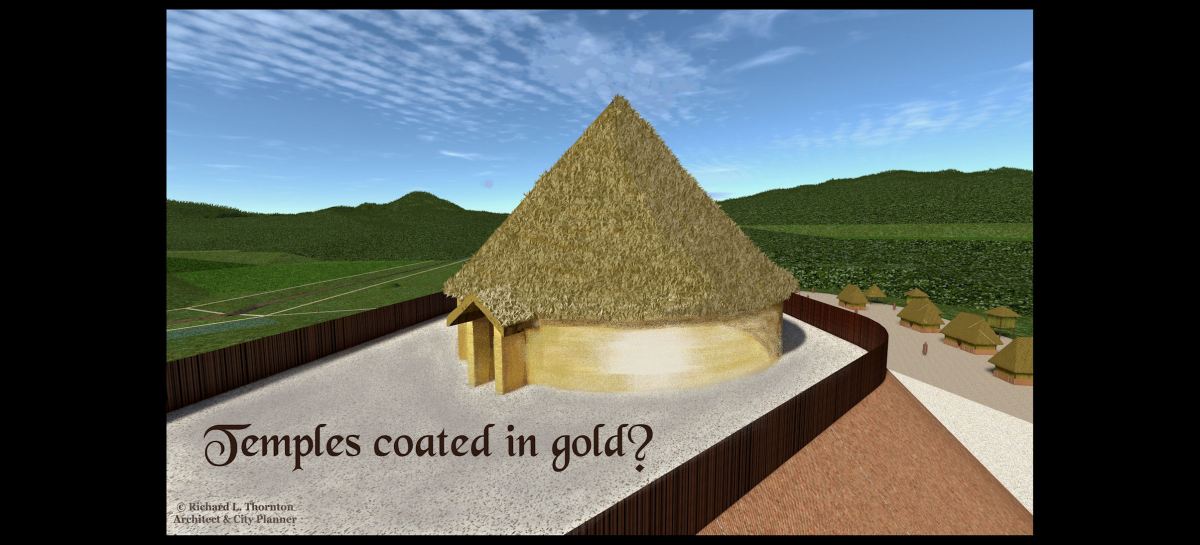
Early French, Spanish and British were not telling tall tales, when they described seeing temples and the house of elite indigenous Americans coated with gold. However, when Francisco Vázquez de Coronado explored the Southwest in 1540, he could find no such cities.
Later, when French Marines and British traders penetrated the interior of Southeastern North America in the late 1600s and early 1700s, the Golden Temples seemed to have disappeared into thin air. You will be surprised at the explanation for these stories.
by Richard L. Thornton, Architect & City Planner

French account
In 1564 and 1565, Lt. La Roche Ferrière led a small body of enlisted men from Fort Caroline up the May River in a generally northwestward direction. They picked out a site for the future capital of New France on a natural terrace, where the University of Georgia is now located then continued to its source in present day Gainesville, GA about two days walk from the Apalachen Mountains.
Once in the Apalache capital, which is now called the Nacoochee Valley, they conducted a treaty with the King of Apalache and proceed to explore his realm in northern Georgia. They noted that the temples, public buildings and homes of the Apalache elite were coated in either gold or silver grains.
The map above, painted by Fort Caroline’s resident artist and cartographer, Jacques Le Moyne, notes that grains of silver could be harvested from the pool beneath what is now called Anna Ruby Falls . . . near Helen, GA. There is another note above it, stating that gold could be generally found throughout the Apalachen Mountains.
Spanish accounts
In 1513, Juan Ponce de Leon landed on the Atlantic Coast of the Florida Peninsula. He was told by the Natives that there was much gold in the land of the Apalache, who lived in the mountains about 2-3 weeks journey to the north.
In 1527, an colonizing expedition, commanded by Pánfilo de Narváez, landed on the Gulf Coast of Florida near Tampa Bay. They were soon told about a land to the north, called Apalache, where there was much gold. The expedition became disoriented. Most of the group built rafts on which they planned to float to Mexico. They were hit by a hurricane in the Gulf of Mexico, which drowned most of the wannabe colonists.
A few rafts managed to reach land on the coast of the Florida Panhandle. Of those survivors only Álvar Núñez Cabeza de Vaca, Alonso del Castillo Maldonado, Andrés Dorantes de Carranza and the Moorish slave, Estevanico managed to reach Mexico. Cabeza de Vaca stated in his report to the Viceroy that Natives living near where they first beached had told them that there was a province to the north, named Cibola, where there were seven cities with buildings coated in gold.
Vázquez de Coronado was the Governor of the Kingdom of Nueva Galicia (New Galicia), a province of New Spain located northwest of Mexico and comprising the contemporary Mexican states of Jalisco, Sinaloa and Nayarit.
In 1539, he dispatched Friar Marcos de Niza and Estevanico (more properly known as Estevan), a survivor of the Narváez expedition, on an expedition north from Compostela toward present-day New Mexico. When de Niza returned, he told of a city of vast wealth, a golden city called Cíbola, whose Zuni residents were assumed to have murdered Estevan. Though he did not claim to have entered the city of Cíbola, he mentioned that it stood on a high hill and that it appeared wealthy and as large as Mexico City.
Coronado set out with twin expeditions, which traversed a vast area of the Southwester United States. The large village, which the friar had named Cibola, was called Hawikuh by its Zuni inhabitants. The buildings were not even gold-colored, much less covered with any material that looked like gold. Apparently, the cleric had “borrowed” the name from some book, which mentioned the Narvaez Expedition.
In 1539, the Hernando de Soto Expedition landed near on the Gulf Coast near present day Bradenton, Florida. The conquistadors asked where Apalache was and they pointed northward. However, the expedition took a northeastward direction then turned back westward. They recorded the name of the first village containing more culturally advanced occupants as Apalachen. However, this is merely the plural of Apalache. It was a trading post village for the Kingdom of Apalache. Most of the people of that province were Southern Arawaks, who traditionally wore grass skirts (men and women) like the Polynesians.
De Soto named all of the people in the Florida Panhandle, Apalache, even though that is not what they called themselves. The Spaniards found very little gold, so assumed that the stories of buildings being coated in gold to be myths.
In February 1540, as the De Soto Expedition was leaving the provincial capital of Anihaica, (“Elite-Place of” in Southern Arawak) De Soto asked its leaders where there was gold. Someone told him that the Province of Yupaha. He was told that it was about two weeks travel to the north. That would be a distance of somewhere between 190 and 220 miles (305-354 km). This is the region where the Georgia Gold Belt crosses the middle section of the Chattahoochee River.
De Soto followed the Flint River for a few days then veered North-northeast until he reached the Province of Okute on the Oconee River. There he was persuaded to turn eastward “toward the rising sun” toward the town of Cofitachequi in what is now South Carolina. Had he continued northward a few days, he would have reached the Kingdom of Apalache and the heart of the Georgia Gold Belt.
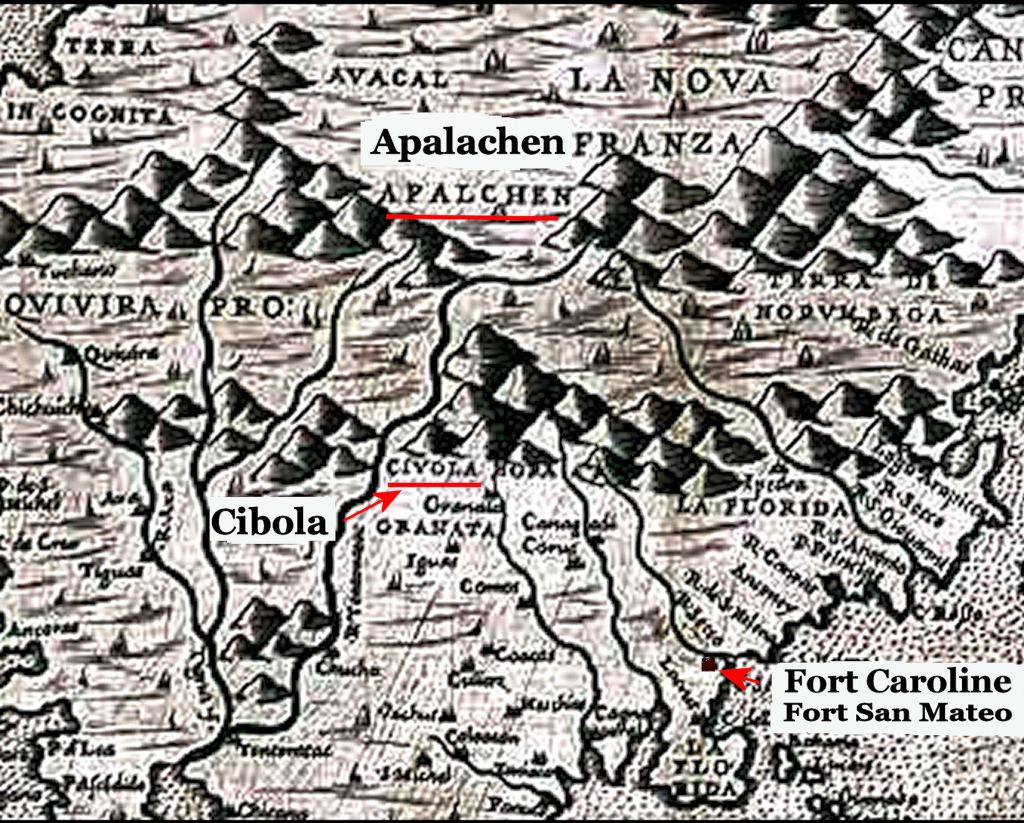
This 1567 Spanish map by Fortilini clearly places the province of Cipola on the Middle Chattahoochee River. It correctly places the Kingdom of Apalache in the southern Appalachian mountains and site of Fort Caroline, now rebuilt as Fort San Mateo, on the south side of the mouth of the Altamaha River. No map ever placed Fort Caroline or Fort San Mateo in Florida. Maps published in the United States as late as 1793, stated that the original name of the Altamaha River was the May River . . . the French name of the river that flowed past Fort Caroline.
In 1567, Captain Juan Pardo was going to lead his company of soldiers from Chiaha on the Little Tennessee River, near its confluence with the Nantahala River., to the provincial capital of Kaushe (Coosa) on the Coosawattee River in NW Georgia. That path would have taken his expedition through the Georgia Gold Belt and the capital of the Kingdom of Apalache in the Nacoochee Valley.
Pardo was tipped off that the warriors from four powerful provinces were going to ambush his company if they continued to Coosa. He turned around and headed back to Santa Elena on the coast of southern South Carolina.
Richard Brigstock and Charles de Rochefort
In 1653, English Royalist, Richard Brigstock, traveled to the Kingdom of Apalache, to determine if it was a suitable location for English Royalists to establish a colony that was not under the jurisdiction of the English Commonwealth. He spent almost a year in northern Georgia and the region of North Carolina near Franklin. The Apalachete did not permit slavery and required all single Europeans to marry indigenous spouses. For these reasons, Brigstock decided to relocate from Barbados to Virginia.
Later, Brigstock told of his experiences in what is now the State of Georgia to Huguenot minister and natural scientist, Charles de Rochefort. In 1658, De Rochefort added 10 chapters to his book, L’Histoire Naturelle et Morale des isles Antilles de l’Amérique about the inhabitants, history, flora and fauna of what is now the State of Georgia.
Among much valuable information on the ancestors of the Creek Indians, Brigstock told De Rochefort that the Apalache believed that golden mica was a form of gold and silver-colored mica was a form of silver. The Apalache coated the clay stucco on their daub & wattle buildings with crushed mica in order to make them more weather and temperature-change resistant. The Mayas added crushed mica, probably from Georgia, to their lime-based stucco for the same reasons.
After several rains had washed the clay film off the mica, the buildings with golden colored mica glistened like gold. Those with silver-colored mica glistened like silver.
Now YOU know!
 The Americas Revealed
Excellent article and makes perfect sense. However, I do remember going on a tour of the courthouse at Dahlonega, and being shown by the guide, the original brick, which stood behind the judges bench behind a closed door. He held a flashlight up at the top and pointed it down and it cluttered with gold specs from the ceiling to the floor. I was astounded. I had already, and all my life been told there was gold in the bricks of the courthouse, and it was true.
In your research and knowledge, have you ever run across a Native American named Tal Sizemoore? He is one of my ancestors. My mother was an avid genealogist. Thanks for your time, and have a nice day.
LikeLiked by 1 person
I am not a genealogist and my Creek family records go back to 1752 or earlier. However, in doing work for a Uchee tribe on the Savannah River, I ran into the Sizemore name. Mr. Sizemore was a trader, who married a Uchee woman. Some of the offspring assimilated into the white population, some lived with Uchees and some moved west and joined the Creeks. Those who joined the Creeks became a leading family of the nation out in Oklahoma.
LikeLiked by 2 people
Supposedly, there is a huge vein of gold running under Dahlonega’s Courthouse Square down to the Smith House.
LikeLiked by 1 person
Well, you just gotta love those shiny minerals Richard. Glittering golden pyrite and gold and silver mica makes quite a bit of sense considering pyrite and mica are both pretty plentiful in and around these hills in Georgia and Tennessee.
The presence of pyrite around clay, is also notable and it wouldn’t be least surprising to be mixed in with any clay construction.
https://howtofindrocks.com/where-to-find-pyrite/
Copperhill and Marion County, TN are noted for pyrite, it wouldn’t be surprising if it was sourced locally in Georgia as well. I know Suches, GA was noted at one time for real gold, and there was a bit of a gold rush in North Georgia. You might have better luck finding emeralds in Emerald Valley, NC
Very Respectfully,
Zac
LikeLiked by 1 person
Or sapphires in Sapphire Valley, NC . . . but for rubies? There are millions of rubies in the boulders in the upper part of the Track Rock Terrace Complex. They were mined commercially in the bottom of the gap, from 1893 until 1947.
LikeLiked by 1 person
https://geology.com/gemstones/states/north-carolina.shtml
Sapphire Valley, NC you are correct there, wrong name for the valley on my part, but correct mineral, it does have emeralds dotted about it as well.
I found a few when I was a kid panning in the creeks around the valley. They weren’t much to write home about, but it was fun finding a few here and there. Oddly we didn’t find any rubies or Sapphires as I recall.
LikeLiked by 1 person
Hi Richard
I have been to Trackrock several times and all the streams and hill side have a lot of silver color mica. I have found flat pieces as big around as a soda can laying on the surface.
I found pieces even larger at the Hog Mountain mine in LaGrange Georgia that had a blueish to a green tint like an old coke bottle
I have also found a lot of what I think is iron pyrite or something similar around Trackrock that is a gold shade and is soft and crumbly. Not sure if that material was used for building but it would be easy to mix into the stucco.
It’s almost time to go back to Trackrock, the leaves are beginning to turn.
The pictures from the newspapers was very cool. It’s hard to believe people used to go up there and use this area when you see what it’s like today. Last year when I has there I found one of the logging roads from the last time they harvested timber with heavy equipment many years ago.
They went straight down hill, through several walls crossing the water ways for the water control system and then over possible building foundations tearing them apart. There is no doubt for many years people in the position to stop this sort of destruction did not want to stop it.
Don’t worry someone who wants the truth to come out, that has the money and connections is out there, to bad its not me. Thanks again for your hard work.
LikeLiked by 2 people