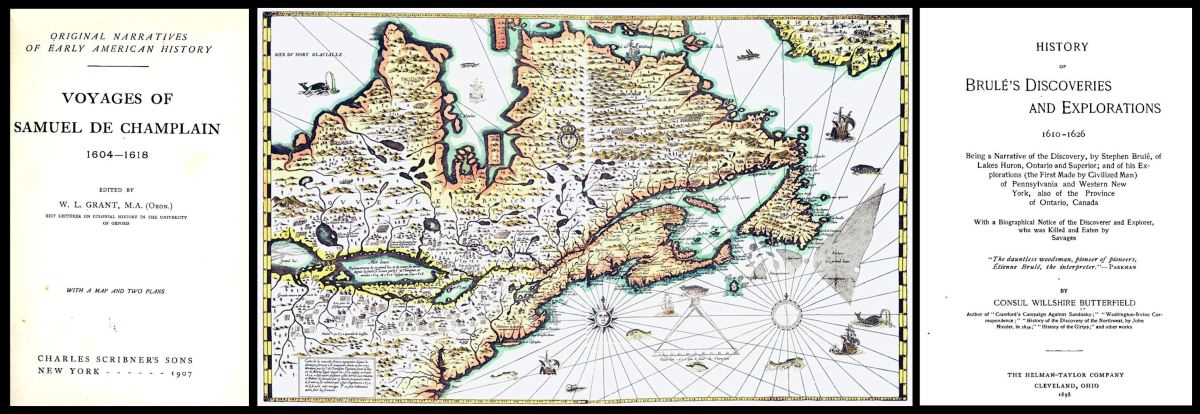
Both the English translations and the original French documents are accessible online. The English translations have been held by the Library of Congress for over a century, There is no excuse for the anthropology and history professors at the University of North Carolina, University of Georgia and University of Tennessee, who in the late 20th century, created a fictional history of the Cherokee prior to 17`15 . . . based entirely on speculations.
For at least six decades, archaeological teams have incorrectly labeled artifacts and misinterpreted Native American town sites, because of the sloppy archival research done by university professors, who somehow viewed themselves as superstars. These academicians completely ignored the reports of Samuel Champlain and Stephen Brule in the early 1600s . . . the explorations of René-Robert Cavelier, Sieur de La Salle . . . and then the numerous French civil engineers & Royal Marines, who mapped the rivers of Southeastern North America in the late 1600s.
by Richard L. Thornton, Architect and City Planner

This academic fraud reached its zenith, when in 1991, Congress adopted the NAGPRA map. It showed the Cherokee always occupying much of the Southeast’s interior, while didn’t show the Choctaw, Chickasaw, Uchee, Shawnee, Catawba and Alabama ever living east of the Mississippi. Late 17th century French explorers of that region never even mentioned the Cherokee. The first official map of the State of Georgia in 1785 showed virtually all of Northern Georgia as the territory of either the Creek Confederacy or the Chickasaw. However, there are many mentions of French interactions with the Cherokee in Canada during the first half of the 17th century.
Because North Carolina anthropology professors and archaeologists have deceived the Cherokee by telling them that they were “full participants in the Southeastern Ceremonial Mound Culture” the Eastern Band of Cherokees bureaucrats think it is okay to portray traditional Chickasaw and Creek (Pre-Columbian) art as their own. The Museum of the Cherokee Indian uses a spider gorget from Moundville, Alabama as its logo. The new official Cherokee dictionary uses a gorget found in Columbus, GA as its logo. That logo has also always been the official seal of the federally-recognized Alabama-Koasati Tribal Town of the Muscogee-Creek Nation. It has also been used for years by the Tama Muskogee-Creek Tribal Town in southwest Georgia.
Perhaps the height of ludicrosity occurred in 2012 during the “Maya-Myth-Busting-In-The- Mountains” political campaign by the Cherokees and US Forest Service. The Eastern Band of Cherokee Indians Cultural Resource Preservation adopted as its logo a shell gorget, unearthed in Mound C at Etowah Mounds National Historic Landmark in Cartersville, GA. It portrays an Itza Maya priestess of the god Kukulkan. Almost identical portrayals can be found in Chichen Itza in Yucatan.
There was no excuse
In a preliminary article on this subject last week, I somewhat excused the sloppy research of the 20th century anthropology professors, who followed my first mentor, Dr. Arthur Kelly, because of cultural factors. Perhaps no one in North Carolina, eastern Tennessee and northern Georgia could read French or afford a French dictionary. Perhaps they didn’t know that the archives for France’s North American colonies are held by Canada or maybe they didn’t know that Canadians have telephones, computers, fax machines and even know how to send and receive emails.
This past weekend, an extremely dedicated subscriber to The Americas Revealed searched the records of the Library of Congress. He discovered that both the French and English translations of the most important 17th century archives are there. The English language ones were digitized in 2010, so you can type in search words to quickly access pertinent information.
He discovered that the first contact with the Cherokee by the French was in 1610, when Stephen Brule paddled up the St. Lawrence River to its source. Brule returned to Montreal, accompanied by 200 Cherokee canoes. During the time that he traveled with the Cherokees, Brule learned their language. There are 47 mentions of the Cherokee in the book on Brule’s journey.
Differences between original French books and English translations
There are slight differences between the French language and English translations of these books. French authors consistently called the Cherokees either Charioqui or Charoqui. The translators of these books into English used the Iroquois name for the Cherokees – Charioquois. You must use the Iroquois version as a search word.
Also . . . Samuel Champlain clearly described the Charioqui as a distinct ethnic group that was a vassal of the Tianontateca that was a vassal of the Huron. The Charioqui and Tinontateca were immigrant tribes, who did not own the land, where they lived. Apparently, they were allotted a specific territory, where they could hunt and fish.
The English translations describe the Charioqui and Tianotateca as being bands or divisions within the Huron Tribe. Typically, the translators wrote Charioquois (Huron).
Enjoy your digital journey into North America’s real history!
 The Americas Revealed
My name is Dana James Carlson, everybody knows me is DJ and very interested in the stories how I found you. I was googling a judge in Pickens County, Georgia by the name of Allen Wiggington to whom I know personally amazingly enough a story by either Alec mountain or Richard El Thornton arechitect and city planner. I’m not sure. If these are the same person or what? But his accounts were very accurate so accurate that it’s almost my history. His story also I do have a daughter by the name of Sarah Carlson. Very accurate depiction of the folks associated. I may know more. I do believe that my in-laws were placed down there. On whi was just around. I can’t tell a story. I have very accbritney. It’s a story I have been reset recently. Got my 2 part series news clip from channel 11 up here in Minnesota.
I’ve been trying to get this Al Rankin from the Atlanta constitution. Do my story, and he refuses to even get back to me. At be song for you to pick up on. Also, there’s a lot of things with the native Americans up here. That weren’t accurate by the goveremember. I don’t want place that. The government said a big war took place by a Lake, and all these soldiers were killed in about 10 miles away, they found a bunch of native Americans buried in one grave. Nothing was accurate about that. But now you’re playin out the grave. And that tells the story keep up the good work.
LikeLiked by 1 person
I couldn’t get anywhere with obtaining justice for what was done to me. Multiple laws were broken by numerous persons. They threatened women I had dates with and architecture clients living outside the county. The irony is that I am an award-winning architect-city planner, known nationally for my downtown revitalization and historic preservation work. I could have made Jasper and Talking Rock into tourist meccas. The Pickens swine literally drove me out of the county.
LikeLike
I remember several years ago you gave us the link to numerous Canadian archives written by French Jesuit priests of the 16th and 17th centuries. Lots of reading but it was very informative that has faded into the past. I find that it’s the older books and reports that I have come across that have more factual information than the modern ones do. That’s why you shouldn’t believe them or those that spread the fictional accounts of history and prehistory.
Thanks to you Richard for the hours of research and sharing it with us.
LikeLiked by 1 person
And thank you! Right now I don’t have time to do research on the French archives, but really need to learn more about their activities in eastern Tennessee. They built a large fort at the confluence of the Tennessee and Little Tennessee River. It was labeled a “Cherokee town” by Smithsonian archaeologists, who excavated it in 1886, but contained only French manufactured goods such French china and tableware.
LikeLike
https://www.google.com/url?sa=t&source=web&rct=j&opi=89978449&url=https://mcclungmuseum.utk.edu/wp-content/uploads/sites/78/2019/05/ArchaeologyCollectionsGuide.pdf&ved=2ahUKEwjklb6kz92BAxV0kmoFHcHdDvcQFnoECBEQAQ&usg=AOvVaw0X8zhfjThPj6qFaFvWfJnm
https://www.google.com/url?sa=t&source=web&rct=j&opi=89978449&url=https://core.ac.uk/download/pdf/71464322.pdf&ved=2ahUKEwjklb6kz92BAxV0kmoFHcHdDvcQFnoECBIQAQ&usg=AOvVaw0eWi6FxT-kfLACHQy7aRkI
Richard you need to check out all the WPA/TVA photography collection. University of Kentucky Library site. These are from numerous dig sites in East TN.
Sounding like field trip time in my neck of the woods. Lolol
LikeLiked by 1 person
I am very familiar with the McClung Museum in Knoxville, but didn’t know about the photography collection at the Kentucky Library site. Thank you!
LikeLike
Richard,
Thank you for unearthing the Charioquois information discovery. Greatly appreciated, and very glad to know the LOC had documentation readily available and translated in English for download and rediscovery of French and Canadian history dating back a few years after the Jamestown Settlement.
To this end, the Cherokee should inevitably and invariably thank the French for preserving their very real and true Canadian history, purported by Samuel de Champlain and Brule, preserving and vividly depicting early Cherokee legend.
Im glad the French and later Canadians, learned the subtle art of record keeping, especially preserving record of Brule’s and Champlain’s several excursions down the St. Lawrence River and beyond.
If it was actual US history, it would have probably been slashed and burned by 3 or 4 letter entities and swiftly swept under the rug and sold/ bought off for a hefty sum.
Thank the US Library of Congress for preserving these early French records too, they represent very real and sometimes graphic North American history… that just cannot be denied. Champlain and Brule’s noted discoveries in North America, are priceless and recognized contributions, despite Brule meeting a rather untimely and canabalistic death.
Chapter 3 and 4 of Champlain’s journey give some great portrayals of the Canadian Charioquois located downstream on the St. Lawrence River, past the falls (or Lacine rapids) with interactions with the Algonquins and their feuds with the Iriquois.
Those times were certainly not stable with the Charioquois, who were all but ready to fall prostrate to the French with Champlain’s vowed protection, willing and ready to trade goods and Castor for French protection (or basically anyone else who would form alliance with them without a care of outcome so long as they were preserved, which sounds somewhat familiar (Chickamauga Cherokee and Dragging Canoe, Revolutionary War/Overhill skirmishes 1782ish, alliances with the British, and later on alliances with America in 1812).
Richard, Cherio may also have Welsh origins meaning “friend” or may be related to the Spanish meaning for puddle, and the French Quois distinctly means “what”
Might that possibly be construed as Friend of what? Puddle of what? or maybe, as suggested aligned with the early French interpretations Charioquois, Charioquet, or “Chariot of what”, or just close phonetic interpretations by Champlain and/or Brule (who would have been more familiar as one who learned their language)?
The Charioquois were noted by Champlain for shooting the rapids, taking them head on in canoes, and since they got the short end living below the rapids they probably had to port upstream. It was a pretty violent ride down the Lacine Rapids, at least one of Champlains crew drowned while trying to shoot the falls/rapids
The Cherokee were familiar with rivers, living along the St. Lawrence, so adapting to and eventually settling on the Nolichucky, Tennessee, Little Tennessee, Ocoee, French Broad, and Hiawassee Rivers, would come naturally and at no surprise, but just not until they got kicked out of Canada sometime after 1611.
A later noted haughty resolve, was distinctly noted by Champlain after the Cherioquois felt he and the French abandoned them in trying to preserve peace among the Algonquin and Charioquois (Huron) people.
Brule was the first documented European to see the Great Lakes, working in conjunction with Champlain, but never formally mentioned by Champlain. His accounts are fascinating as well.
This was all documented around 1610 and 1611, and are extremely fascinating accounts during a tremendously combative resolve of 6 Nations, the Charioquois used nearly synonymously with Huron.
I guess the next part of the puzzle should be available from the Charioquois locale on the St. Lawrence River, to the extension of the border of the colony of Virginia /(North Carolina) (Tennessee) border in 1715.
Only about 115 years to pinpoint with references, which would most likely be French fur traders/hunters/trappers how they ended up in Tennessee and North Carolina, and the fascinating French connection of Champlain and Brule might certainly help in answering the mysterious mystery of how the Canadian Cherioquois (Huron) also lived in the South for: “thousands of years”
Largely, this may or may not be helpful for Cherokee members searching for some earlier ancestry ties with DNA, noting an early Huron affiliation as attested by Brule and Champlain. I hope this valid early French discovery and connection truly helps.
Very Respectfully,
Zac
LikeLiked by 1 person
Is it possible to send a private message to the author?
LikeLike
Yes, use the Contact tab to sent email to me directly.
LikeLike
Howdy, Could you post citations for these…would like to obtain copies
LikeLiked by 1 person
In the next article, I give the citations for English translations for these documents, which are in the Library of Congress.
LikeLike