
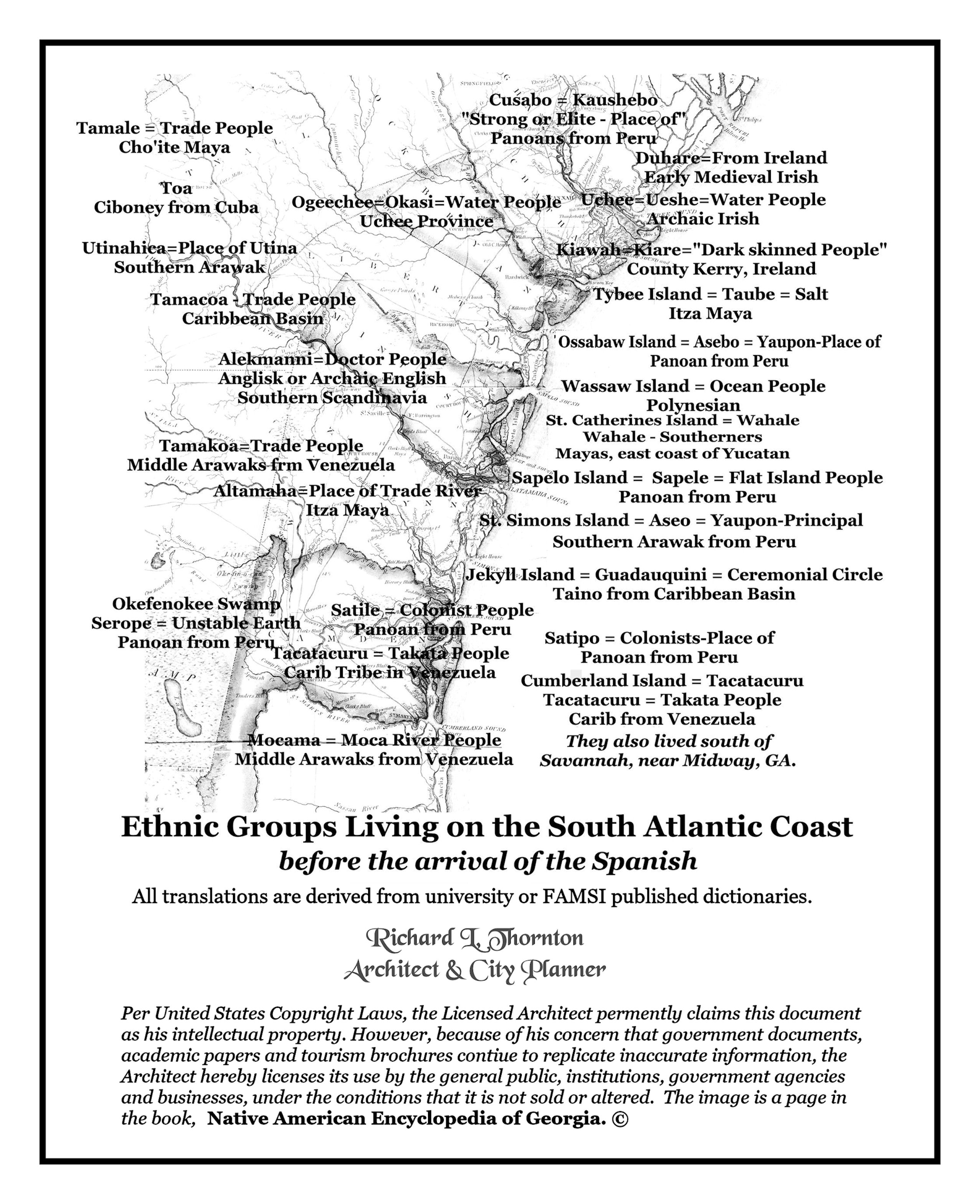
This map also contains the meanings and ethnicity of these words. It is a JPG file that you can download to your computer and use freely. It is a page in my book, Native American Encyclopedia of Georgia. I worked on the etymology of the 423 indigenous place names in Georgia for over a decade, using university-published dictionaries. The translations may seem far-fetched to some, but I am confident of them.
When doing architectural graphics work for the American Museum of Natural History in 2007 and 2008, I because aware that the archaeologists, who had worked on this site in the past, had labeled all on the indigenous places names as “Creek”, plus often provided meanings of these words, which had been concocted over a century ago by academicians or Smithsonian Institute employees, who “nothing about the subject.” Very few of the words were Muskogean words. Those that were, had been borrowed from Itza Maya or Chontal Maya.
While working on the translations of these words over the past decade, I was astounded by the ethnic diversity on the Southern Atlantic Coast Plain. Why these Sea Raiders swarmed the coast of Florida, Georgia and South Carolina at about the same time? I don’t know. It must have something to do with ocean currents and sudden climatic changes elsewhere.
Notes
*Serope – The original name of the Okefenokee Swamp until the 1700s is a Panoan word that applies specifically to earthen banks that are steadily crumbling into an adjacent swamp, lake, pond or river.
** Alekmanni – I suspect that some academicians will go bonkers, when they see that a Northern Germanic tribe, which was the ancestor of the English-speaking peoples in Britain, settled at the mouth of Altamaha River and where I live now (Alec Mountain). Of course, by the time the French Huguenots arrived, these early Vikings would have intermarried so much with American Indians that they probably seemed to be that only. However, I am 100% certain of this.
The Muskogee Creek word for a medical doctor is alek! Captain René de Laudonniére stated in his memoir that Alekmanni meant “Doctor People.” It is from an ancient Indo-European word, found in most Germanic and Slavic languages.
There is only one language in the world, where Alekmanni could mean “Doctor People,” Ald Anglisk. In its grammar, “A” was added to a noun, verb or adjective to create a proper noun or adjective. In Appalachian English, you will hear things like “I am agoing.” That’s a vestige of the past. In Ald Englisk, Leka meant “herb.” Manni meant “noblemen.”
I am also 100% certain that the Anglisk were still living in Skåne (extreme Southwest Sweden, where I lived) when they departed for the New World – not southern Denmark, near the Danes. The same word in Ald Svenska (Old Swedish) would be Lekmänni. Swedish today is the only northern or western Germanic language that still uses leka as the root for their word for a medical doctor.
Factual history can be stranger than fiction, can’t it?
 The Americas Revealed
Here’s another big “THANK YOU,” Richard!
LikeLiked by 1 person
You are most welcome!
LikeLiked by 1 person
Thank you for sharing this! Sr. Ricardo, where can the dictionary be purchased? I have a love for language that I didn’t have in my youth. I know the dictionary you published will be a great tool for learning.
LikeLiked by 1 person
Here is the publisher’s website for the book – https://www.lulu.com/shop/richard-thornton/native-american-encyclopedia-of-georgia/paperback/product-njg8dd.html?page=1&pageSize=4
LikeLiked by 1 person