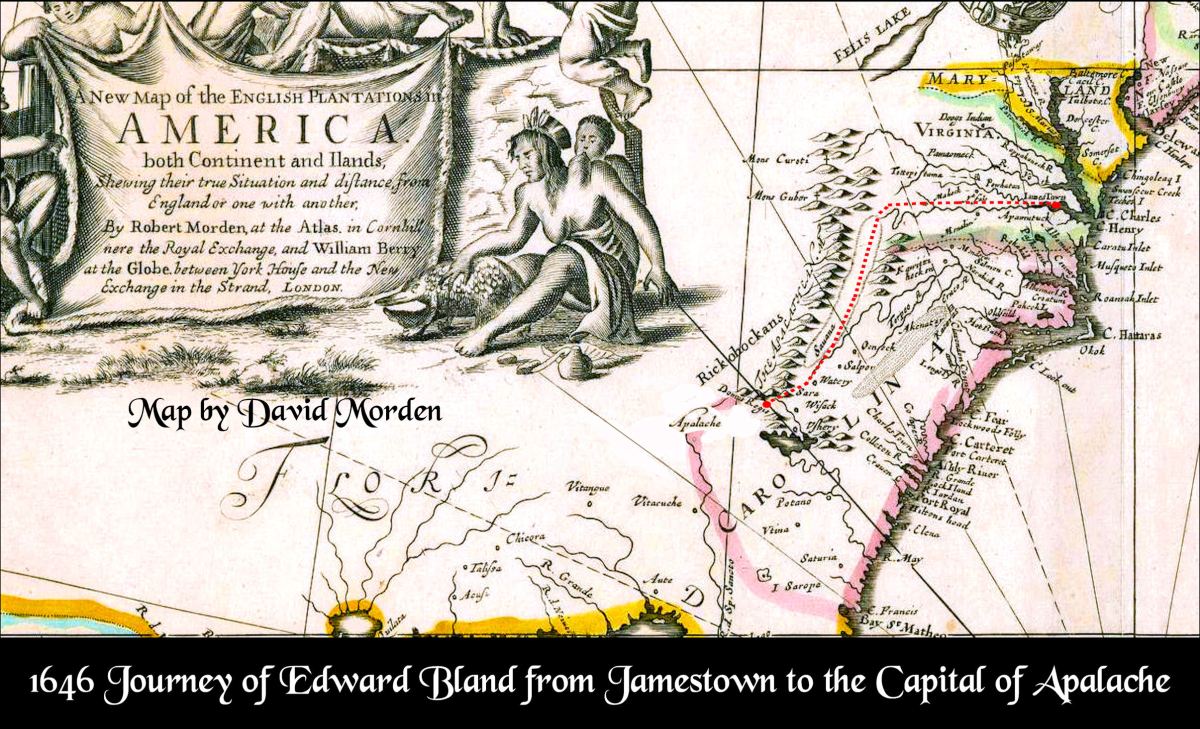
Virginia’s Royal Governor, William Berkeley, cut a deal with the Rickohockens to attack white settlers in the James River Valley in Virginia then sell Native American slaves, furs and deer hides to him en masse, while British Royalist, Edward Bland, and Spanish Florida Governor Benito Ruíz de Salazar Vallecilla constructed a fortified, trading post at the headwaters of the Chattahoochee River in what is now Northeast Georgia.
None of this information can be found in “American” history textbooks, but is well documented and mentioned in the state history textbooks of Virginia and Florida. The existence of the Spanish trading post was confirmed by French author, Charles de Rochefort in 1658, but Georgia textbooks are completely silent about the presence of large numbers of Spanish-speaking colonists in the northern part of the state during the Colonial Era.
Background
My first research articles on Native American History and Virginia’s Early Colonial History were published in Virginia, after I was trapped in Georgia, while on a weekend visit to my parents. As soon as I got back on my feet financially, I was trying to get back to Virginia. It was a very complex time in my life. To understand the wierdness of those times, you will have to read The Shenandoah Chronicles.
The essence of the plot, relevant to this article is that 30 years ago this week, I was staying in Winchester, VA while delivering drawings to a Virginia client and visiting the psychologist of my estranged wife. After finishing that business, I ran into a familiar face, while visiting the Winchester Octoberfest. She was the daughter of a professor at Virginia Tech’s College of Veterinary Medicine. He had taught small livestock classes on our Shenandoah Valley farm for several years, but I first met her three months after moving to Virginia in January 1988, when she was a senior at Virginia Tech.
While her father was examining my livestock, I had given her a tour of the construction work on my 1754-1770 house. She had suddenly pounced on me and kissed me. She afterward apologized that I was the only man, other than her father, who ever spoke to her like she had a brain. She went on to get a Ph.D. from Johns Hopkins University!
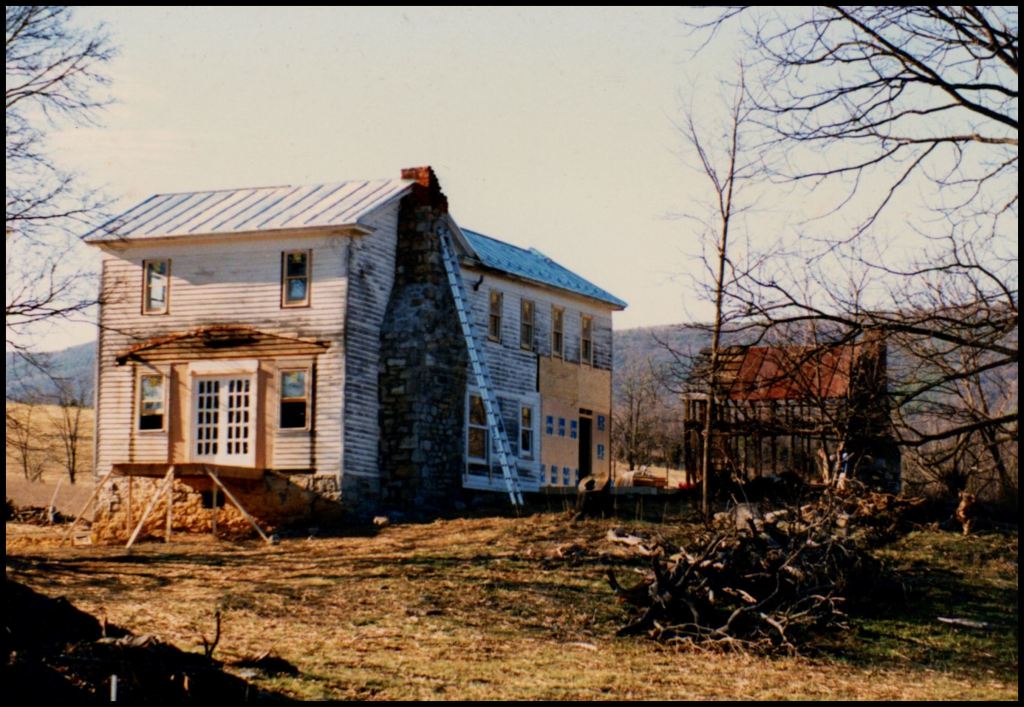
My house under construction on the day that the Virginia Belle kissed me.
We did not start seeing each other, however, until October 1993. I stayed with her for week in November then we visited back and forth as time would allow afterward. She spent the last week of December 1993 with me in Georgia, while my parents were vacationing in New York City. We became disconnected in December 1994 then reconnected in 1997 for about a year.
By that time, I had worked as Principal Planner of one of Metro Atlanta’s most populous counties. Her father said that because I had been the architect of dozens of Colonial and Federal Period building restorations in Virginia, he could now get me a position as a full professor in Virginia Tech’s School of Architecture, if I could get some professional articles published in Virginia periodicals . . . which showed that I had an academic side to me. The first ones were on the Native American history of the Shenandoah Valley, the Civil War battle on my farm there (Custer (USA) versus Rosser, CSA) then I did a series on western Virginia in the mid-1600s. Perhaps her parents liked me too much, because the daughter unilaterally terminated the long distance relationship, over their strong protest, before I could assemble sufficient cash reserve to move back up there.
What the Virginia Colonial archives tell us
When the English Civil War broke out in 1642, communications with North American colonies broke down. In 1644, the Powhatan Confederacy took advantage of the political chaos to stage a third uprising. Most of the ship captains sided with Parliament. Virginia planters and farmers began relying increasingly on the much better ships of the Netherlands that were also able to market their products to the world. Refugees from the strife in the Mother Country poured into Virginia. Many moved to the frontier . . . a situation that thoroughly upset the Native American tribes, who had not been massacred or enslaved at the end of wars.
Meanwhile, Virginia functioned almost like an autonomous nation. Governor William Berkeley and his buddies became exceedingly wealthy by awarding themselves virtually free land along the major rivers and then establishing massive plantations. As a result, there was a severe labor shortage . . . well, slave labor shortage.
In the early 1640s, the majority of laborers in Virginia’s tobacco fields were still Native American war captives and indentured servants. Up to that time, the availability of Native American slaves peaked during times of war. Youth, women and children were seized as punishment, whenever a tribe was defeated. Most of the white indentured servants were either felons given an option of “Transportation to Virginia” rather than being hanged . . . or else impoverished folks, who were working off debts in the British Isles.
At the close of the Third Powhattan War in 1646, Berkeley’s treaty defined the tribes and chiefdoms of Tsenacomoco as tributaries and subject to English rule, requiring yearly payment to the crown and dictating where Indians could live, hunt, and trade. To coerce Indians to comply with the treaty, the English also demanded that Indian children “shall or will freely or voluntarily come in and live with the English”—serving as hostage-servants in English households. From then on, with little or no pretext, Virginians regularly raided all of the tribes, hostile or not, to obtain women, youth and children for working in the fields.
Teenage Indians were prone to escape back to their tribes, unless their legs were chained 24/7. Virginia slave owners then began getting the girls pregnant via rape as soon as possible after puberty. At least the females would remain with their children.
Berkeley had secretly persuaded the Rickohockens to enter the war on the side of the Powhatans, but they only attacked yeoman farmsteads along the James River, not the plantations. Afterward, he cut a deal with them. He would furnish them with firearms and munitions, if they would raid remote Native American tribes, then bring back large numbers of captives. Smaller tribes began to disappear from the maps of eastern North America.
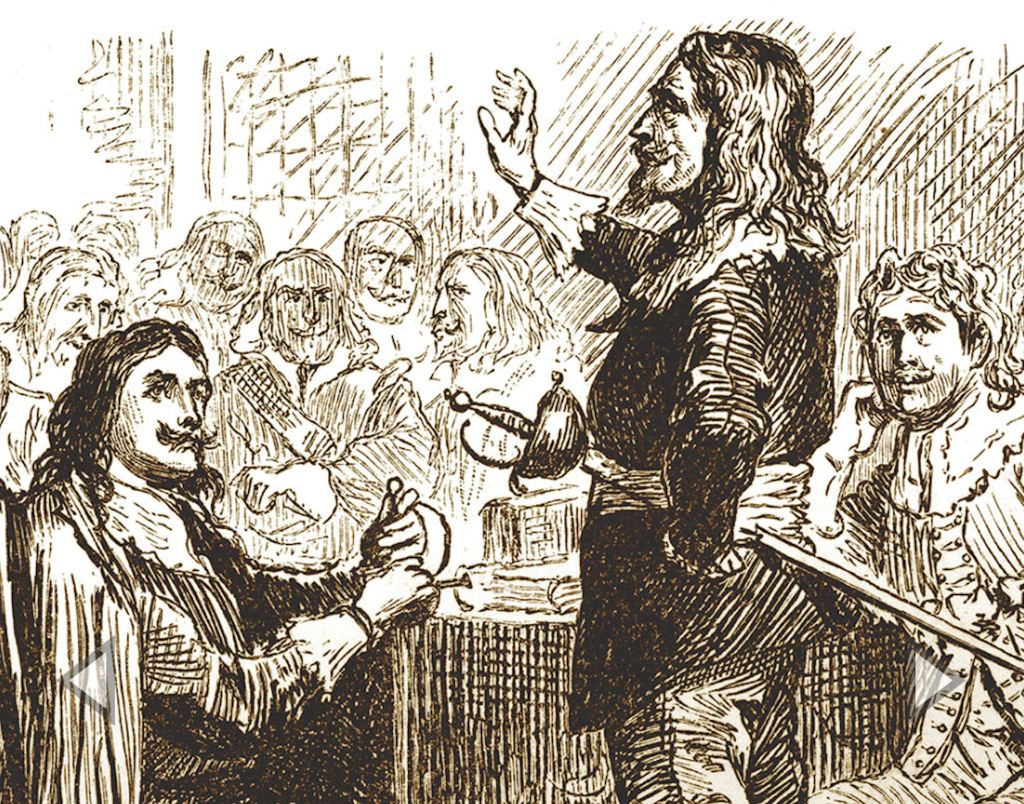
William Berkeley in the Virginia House of Burgesses
In 1663, Berkeley learned from King Charles II that he would be one of the eight Lord Proprietors of the new Colony of Carolina. He then passed through a series of laws by the House of Burgesses, which institutionalized the slavery of Native Americans and Africans. They and their offspring remained the permanent property of their owners. Among this legislation was a treaty with the Rickohockens whereby Virginia would arm all of the men of the tribe in return for a massive increase in the supply of Native American slaves.
In the early 1600s the Shenandoah Valley contained the densest and most culturally advanced indigenous population north of Georgia. In one military action soon after, the Rickohockens killed or enslaved virtually the entire population of the Valley. Broad swaths of the Carolinas and east central Georgia were depopulated by slave raiders in the late 1660s and 1670s. It has been estimated that over 600,000 Native Americans in eastern North America were enslaved during the early and mid-colonial era. At least as many were killed by the slave raiders. They always killed adult males, children and babies too young to walk to slave markets and the elderly.
Edward Bland: The Virginia history textbook tells us that as soon as Master Edward Bland arrived in Jamestown in 1646, he met privately with Governor William Berkeley then left immediately with a small party for the southern tip of the Appalachian Mountains to look after commercial interests there. For the previous five years, Bland and his wife had lived in Spain and the Canary Islands, where they exported wine to England. Johann Lederer took a similar route in 1670, but is given credit in “American” history books for being the first resident of a British colony to see the Blue Ridge Mountains.
What the official North Carolina history textbook says
First contact between the Cherokees and English-speaking explorers: Having heard in Europe about the power and size of the Cherokee Nation in Europe, Edward Bland traveled immediately to western North Carolina after arriving at Jamestown to meet with Great Cherokee chiefs.
Fact Check: According to the French Colonial Archives in the Downtown Toronto Library, the Cherokee were living in Quebec until 1650, when they were forced southward by the Iroquois. The first map to show the Cherokee living south of West Virginia was published in 1715.
What the official Georgia history textbook says
It says nothing about events in northern and central Georgia during the 1600s!
What the official Florida history textbook says
In 1645, Spanish Governor Benito Ruíz de Salazar Vallecilla led an expedition up the Chattahoochee River as far as present-day Columbus, GA. There he burned several Apalachicola towns (Spanish name for the Georgia Apalachete (Creeks). He established a small mission and a large ranch, where he began raising cattle.
Seeking to establish a deerskin trade with the Apalachen Indians, in 1646, Spanish Governor Benito Ruíz de Salazar Vallecilla ordered the construction of a road between St. Augustine and the headwaters of the Chattahoochee River. There he built a large trading post.
What Richard Brigstock encountered in 1653
Brigstock spent most of 1653 in present-day Georgia, plus the area around Franklin, NC. Edward Bland was his cousin. He told author, Charles de Rochefort that the Spanish had established a large trading post near the Capital of Apalache, adjacent to the Chattahoochee River and Unicoi Trail, about five years before his visit. He also said that a small mission had been constructed near the trading post.
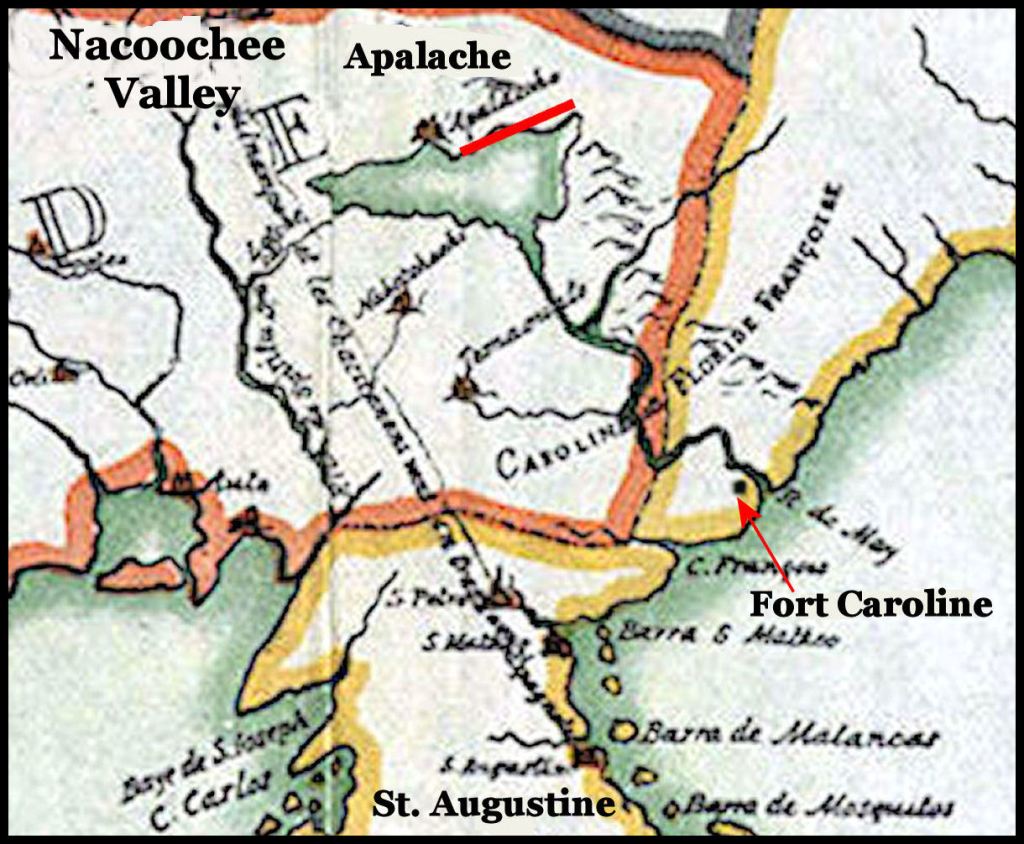
1684 French map showing the road built by the Spanish in 1646. It later was extended to the Tennessee River. That newer section is now called the Unicoi Turnpike.
Now you know!
 The Americas Revealed