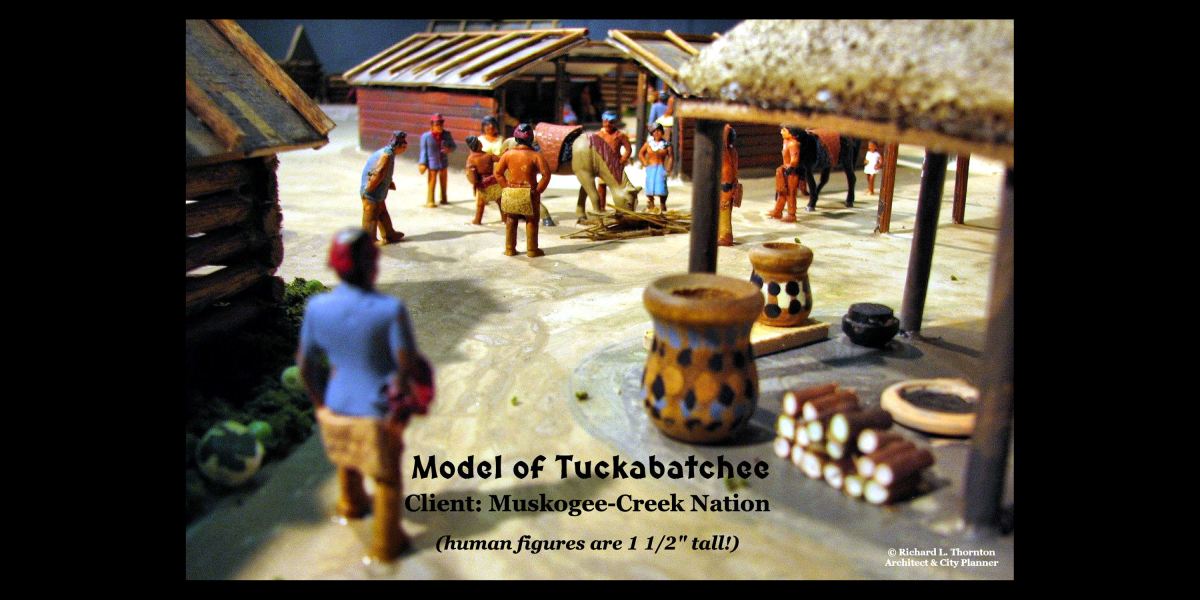
Realistic, three dimensional models for private sector clients are largely a thing of the past in architecture offices, However, they are still the most effective means for museums to portray communities and peoples from the past. Children, especially, love to look at models of towns, which are richly detailed with humans, animals, trees, shrubs and realistic water.
by Richard L. Thornton, Architect and City Planner

Like many aspects of my professional career, the building of models for museums and Native American tribes began in a happenstance manner. Back in the Mesolithic Period, when I was attending architecture school, being able to construct precise scale models of buildings and sections of cities was a mandatory skill for all graduates.
That changed during the next decade, however. Computer Aided Design and Drafting (CADD) made it possible for architects to turn out three dimensional ink line and later, full color drawings, at a fraction of the price of an architectural model. This technological innovation caused most clients to opt out of paying for the traditional craft-built models.
While living in Virginia, I built a model of Fort Loudon in Winchester, VA. The fort was designed and its construction supervised in 1754 by Colonel George Washington. Later that year, he designed a log blockhouse fort on Toms Brook in Shenandoah County. That structure evolved into my Virginia farmhouse.
Twenty years later, a client in Metro Atlanta saw a photograph of the Fort Loudon Model then asked me to build a model of Fort Peachtree on the Chattahoochee River in present-day Atlanta. Both that project and the model in Virginia were outgrowths of conventional architectural services. I built the models more for the fun of it rather than the financial compensation.
I began doing architectural research for the Muscogee-Creek Nation in 2003. In 2005, I was contacted by the MCN Justice Department and asked to help them out. They had been getting complaints by Creek descendants in northern Georgia that there was a group of men selling Creek grave artifacts and skulls at flea markets. The items seemed to be coming from burial mounds near reservoirs owned by the US Army Corps of Engineers and Georgia Power Company. The MCN was getting no cooperation from Georgia and federal law enforcement. I began working with Judge Patrick Moore of the MCN and his staff in tracking down the grave robbers.
Judge Moore noticed photographs of Fort Peachtree in a report on Creek architectural history that I had sent him. He asked me if I could build models of Creek towns. I said “Yes, if I have adequate information in an archaeological report to determine the site plan of the town and the footprints of the buildings.”
Judge Moore called me about a week later to tell me that the National Park Service had provided him the archaeological report on Ochesee . . . known to archaeologists as the Lamar Village. He asked me for a written proposal and cost for building the model. I told him that the model would cost $1200. That was a low bid, but again, I was doing the labor-intensive work more for the fun than for the money. A few days later, he called to tell me that the model could easily be funded by the furniture and furnishings budget and gave me the go ahead to start work.
About two weeks later, MCN Principal Chief A. D. Ellis received a Cease and Desist Order from the Georgia Council of Professional Archaeologists. It demanded that the Muscogee Creek Nation cancel its contract with me for building an architectural model and then award the contract to an archaeological firm in Georgia. It was signed by six Georgia archaeologists.
Of course, very few, if any, archaeologists would know how to build a museum-quality architectural model. The archaeologists would merely sublet the contract to an architectural firm. There was another problem, though.
Principal Chief Ellis had no clue who Richard Thornton was and had no record of any contract for an architectural model being let. Eventually, Second Chief Berryhill remembered that Judge Moore had personally funded a model. Judge Moore laughed that this letter marked the first time in history that a Georgia archaeologist had communicated directly with the Creek Nation. The silly letter was ignored, but then mounted on the wall of the MCN Administrative offices.
The MCN Department of Justice was not so amused. Ninety-eight percent of my telephone conversations with Judge Moore and the Justice Department were associated with an active criminal investigation. The eavesdroppers in Georgia and their archaeologists-clients had violated a page long list of very serious federal crimes. However, the MCN received zero cooperation from Georgia state law enforcement officers.
When the grave robbers were identified, they turned out to all be state or local government employees. Two were cops. Nobody in this crime gang were ever arrested. They merely stopped digging up mounds on federal property.
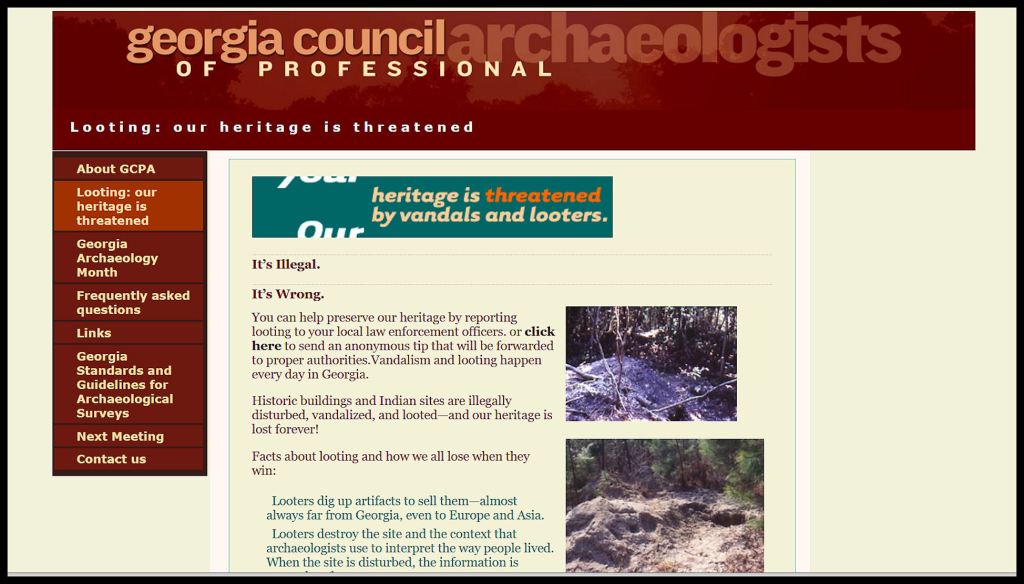
All of us Creeks involved in shutting down the grave robber gang were highly amused at the irony of the situation. The Georgia Council of Professional Archaeologists website features a condemnation of Native American grave desecration, yet the self-styled leaders of this organization got in bed with the vilest form of grave robbers . . . in a failed effort to keep me from earning $1200. It was really about a $5000 project.
Despite all the drama, the first model was well received in Okmulgee, Oklahoma. I went on to build seven more models for the Muscogee-Creek Nation and eight for other museums in the Southeast during the first decade of the 21st century.
The Great Recession hit Georgia in 2006 . . . before any other state. Many prominent architectural firms in Atlanta that had survived the Great Depression in the 1930s, soon went bankrupt. The model building kept me alive financially for another three years. However, by 2009 museums and tribes were having to cut their budgets. I only was hired to build two models in 2009 . . . which was not enough to keep me afloat.
The following video will let viewers see my favorite models, if they haven’t already.
 The Americas Revealed
Utterly fascinating and compelling. Really well written story too! Love those models! One day would love to work with you on a Bilbo representation and others nearby!
LikeLiked by 1 person
Do you have a copy of the 3D virtual reality birdseye image that I did of Savannah Harbor, which shows the locations of all the mounds and shell structures? If not, give me an email on the “Contact” tab and I will send you a copy. Don’t use the comment window for this. You do not want the public to know your email address.
LikeLike
Love this interesting post Richard and the model pics are lovely. Thanks for sharing.
LikeLiked by 1 person
Thank you madam!
LikeLiked by 1 person
Hi there. Would you post a photo of your mom all of Fort Peachtree? I did a social science fair project on a mini mini mini years ago. That is many not mini.
LikeLiked by 1 person
My photos from that period were destroyed when a tornado tore off the front of my cabin in Lumpkin County, GA – March 2017. Are you saying that you want me to also post a photo of my mother. I have those.
LikeLike