
Melting snow during March and early April caused massive flooding along rivers and created permanent lakes in the coastal plains. Higher peaks in North Carolina, Tennessee and Georgia stayed snow-capped most of the year!
Climate change is REAL and NOW!
by Richard L. Thornton, Architect and City Planner
Take a look at maps of the South Atlantic Coastal Plain from the late 1500s and 1600s. They show lakes that are no longer there, rivers that resemble the Mississippi Delta and a much larger Okefenokee Swamp. Historians and anthropologians have consistently assumed that the mapmakers of that era were just fantasizing physical features. Probably not.
I am extremely busy with professional work right now, but wanted to pass on a reliable eyewitness account from 1653, which describes a very different climate than today. His statements reinforce those made by La Roche Ferriére in 1565, Juan de la Bandera in 1567 and William Bartram in 1776.
Richard Brigstock, was an English planter and explorer, who stayed in northern Georgia most of 1653 and the winter of 1654. Since moving to the Nacoochee Valley, I have been able to verify virtually all of Brigstock’s observations that were published in ten chapters of a book by Charles de Rochefort in 1658. He described deep coatings of snow on the ground during the winter that he stayed in present-day northern Georgia. As displayed in the excerpt below, he also stated that many of the higher mountains in Florida (Georgia) had snow caps much of the year.
Notes: Until the mid-1800s, the term Apalachen or Appalachian only referred to the mountains in northern Georgia. From the 1500s up until the founding of Savannah in 1733, Georgia was called French Florida. The Spanish called the Chattahoochee River, “El Rio del Espirito Santo.” The English and French measured latitude northward from the equator in the 1500s and 1600s.

–
1565 – Lt. La Roche Ferriére
Ferriére and a few companions paddled up the Savannah River in the summer of 1564 then spent about six months in northern Georgia and western North Carolina. In the spring of 1565 his party paddled down the Oconnee and May (Altamaha) River to Fort Caroline. He found the entire area near the modern confluence of the Oconee and Ocmulgee Rivers covered by a large, shallow lake, at least 21 miles in diameter that the Natives called Lake Tama. He stated that during the spring, the portion of the Ocmulgee River near present day Macon, GA . . . now called Ocmulgee Bottoms . . . was also a lake during spring floods.
1567 – Juan de la Bandera
The Juan Pardo Expedition was trying to reach Chiaha on the Little Tennessee River near where I took the photo above. They reached the Blue Ridge Foothills of present-day northwestern South Carolina. In mid-December, heavy snow fell on the Apalachen Mountains and did not melt. More snows made the trails impassible throughout the winter.
1776 – William Bartram
Bartram was racing back home to Philadelphia from Pensacola after learning that the American Revolution had broken out. When he had departed Philadelphia the previous year, the turmoil had been limited to the region around Boston, Massachusetts.
Bartram learned that melting snow in the Appalachian Mountains had caused the Okefenokee Swamp to triple in size. The Altamaha River had also spread across the landscape, making land travel impossible in what is now southeastern Georgia. Even in that era, the North Satilla River was an outlet of the Altamaha River throughout the year. However, the flooding of the Altamaha and Okefenokee Swamp made that part of Georgia one continuous lake. He stated that the Appalachian (Georgia) Mountains received much more snow than the Mid-Atlantic Colonies because damp air from the Gulf of Mexico constantly collided with cold air from the North over these mountains throughout the winter.
The Little Ice Age
All three of these accounts occurred during the Little Ice Age. The Little Ice Age was a period of wide-spread cooling from around 1300 to around 1850 AD, when average global temperatures dropped by as much as 2°C (3.6°F), particularly in Europe and North America. The abandonment of Moundville, AL and of Etowah Mounds around 1350 AD may be related to the onslaught of the Little Ice Age. Etowah Mounds was reoccupied 25 years later. Moundville never rebounded.
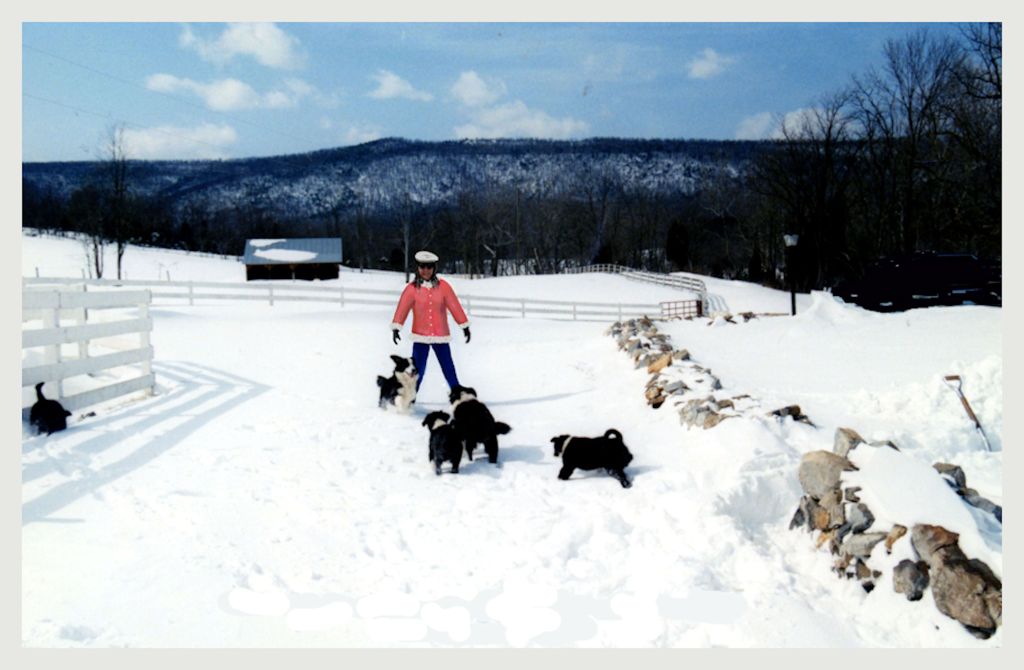
Vivi meets my puppies on December 19, 1990. The Shenandoah Valley of Virginia never gets this much snow now . . . not even in January or February. There has not been enough snow for me to cross country ski here in the Georgia Mountains since 2010!
Change in the past three decades
Both on my farm in the Reems Creek Valley near Asheville, NC and in the Shenandoah Valley in Virginia, I was able to cross-country ski on my pastures much of the winter. On January 15, 1985 the thermometer dropped to -25 F. at my farm in the Reems Creek Valley and -38 F. on top of Mount Mitchell. We had 24″ of snow on May 8th! That same year, we had snow flurries on June 6 and a killing frost on September 9.
On November 3, 1988, we had 12 inches of snow on our farm in the Shenandoah Valley. On March 15, 1993, we had 38″ of snow with 15 feet high drifts against the barn. Our first floor windows were covered in snow on the north side. We couldn’t get out of our driveway for two weeks because the snow plows had blocked it with a 12 feet mound of dirty road snow. Many of my neighbors in Virginia owned snowmobiles at that time, so heavy snows were no problem for them.
When I lived in the Shenandoah Valley, we received most of our precipitation in the winter in the form of snow and sleet. July was the driest month, so we had to feed our livestock hay in July and early August. Most farms had cisterns that stored rainwater underground so it could be used for watering livestock and gardens in the summer.
Alfalfa was one of our most important fodder crops back then. Now, July is the wettest month in the Shenandoah Valley and there is too much rain in the summer months to harvest and cure alfalfa properly. However, corn grows much better because of the regular summer rainfall.

October 15, 1995 – Chestatee River Valley – Lumpkin County, GA
Note that frost has already killed the grass!
The most stark bellwether of rapid climatic change is in the autumn. When I returned to Georgia in 1995, all of the Mountain Fall Leaf Festivals occurred in the middle of October, because for at least a century or more, the peak mountain leaf color always occurred around October 15-16. By the beginning of November, the trees were bare.
Each year after the Perfect Storm (Winter Hurricane) of 1993, the peak leaf color has occurred about a day later. This past year it occurred around November 14. However, now the leaves hang on the trees longer. Last year, some of my oaks had leaves on them until December 24th, when the temperatures suddenly went from 72 F. to -1 F. in a day. The times . . . they are changing.

November 14, 2022 – View outside my bedroom window.
 The Americas Revealed
Very interesting. Thanks for sharing
LikeLiked by 1 person
Bonjour Richard, Good summary.I can testify about that «Winter Hurricane of 1993» because I then lived very happily on my 41 acres on the Québec/Maine border and the storm was so bad that I thought the roof would fly away. It took me the whole next day just to shovel that heavy hard packed snow in my driveway and access to the shed where I stocked my firewood. Indeed, the weather is very unstable. Up here, in the Eastern Townships where I’ve been for the last 10 years, the cold has set in later each year and we’ve been getting either polar or unusually warm Winters. J.-J. Sent using Hushma
LikeLiked by 1 person
My neck of the woods is not quite to the 37th degree N. In the 50’s there were times we’d be out of school for a week or two at a time for snow storms worse January and February. January 85 it was -21 in town around -30 in the mountains. Blizzard of 93. Up to 36″ fell from Fri evening to thru Sunday. Only emergency vehicles on the roads everything else was illegal to be out there till Tuesday. By the time my son was in school in the early 2000s there were winters with no snow days. As for the leaves. In the late 80s my daughter would play in piles of raked leaves before Halloween. Right now leaves are starting to turn and some have fallen. Can y’all say Global warming ???
I reckon so.
LikeLike
PS there have been big snow storms in March and April in the pasttoo.
LikeLiked by 1 person