
High school “World History” textbooks . . . even college anthropology textbooks continue to churn out caricatures of North and South America’s past. For example, the Olmecs had nothing to do with with the Olmec People. They were late arrivals to southern Mexico. The label was a misnomer, created by Gringo archaeologist Mathew Stirling, who initially had photos made of himself next to stone sculptures, unearthed by Mexican archaeologists.
The oldest pottery in the Americas is found in the heart of the Amazon Basin and in eastern Georgia . . . not Mexico and Peru. Ancient peoples excavated almost identical canals and ports in Uyamel, Campeche and Savannah, Georgia. The DNA of the tall, egg-headed people of the Paracusa (Paracas) Plain in Peru was traced to southern Ukraine. Archaeologists Joseph Caldwell and Robert Wauchope excavated a large town on the Etowah River in the Allatoona Mountains in North Metro Atlanta, occupied by the same people. Northeast Georgia abounds in petroglyphs that are identical to Early Bronze Age petroglyphs in southern Sweden, Ireland, Scotland and Galicia. We could go on.
The Americas Revealed will be featuring this autumn a series of articles on the mysterious early history of mankind in The Americans. There will be more questions than answers.

Pak Mul Bay in Uyamil, Campeche
Deja vu (seen before)
Two weeks ago, I received a telephone call from Mexico. It was from my professional contact in California, who was visiting his family in Campeche State. He said that he was in a small town on the coast near the border with Yucatan State that I would have never heard of. Knowing that there were virtually no towns north of Ciudad de Campeche on that coast,
I asked him, “Does the town have white sand beach with boulders protruding out of the water?” He responded, “Yes! How did you know?”
I answered, “It’s name is Uyamil, isn’t it? The first color slides that I made in Campeche were taken there.”
Back in the Mesolithic Period, when I was on the fellowship in Mexico, virtually no North Americans or Europeans ever visited Uyamil. Very few even visited Ciudad de Campeche. There were only a handful of people in the hotel, where I stayed the first night, who were not Latin Americans.
My original syllabus from the professors at Georgia Tech did not have me visiting any archaeological sites in Campeche. That did not make my coordinador in Mexico, Dr. Román Piña Chán, a happy camper. He grew up in Campeche. He tossed my Georgia Tech syllabus in the trash can and told me to come back to the museum the next day to pick up one that would prepared by his favorite graduate assistant, Alejandra Mendez. I would end up spending more time and seeing many more archaeological sites in Campeche than in any other state.

The main state highway between Labna and Calakmul, Campeche is shown at rush hour. Ana Rojas took advantage of the tree blocking this expressway to pretend that she was Lauren Boebert in the 21st century.
Alejandra was a lovely, intelligent young lady, but she didn’t know diddlysquat about Campeche. She added a list of 16 Maya city sites in Campeche, but didn’t realize that most of the “state highways” within the interior of Campeche were one lane or at best, 1 1/2 lane dirt roads! When I visited the tourist information center (an office desk in the lobby of city hall) I was shocked to learn that Edzna was the only archaeological zone in the state that had bus service. It was a third class jitney that also carried pigs, chickens and turkeys.
The sympathetic tourism director sent me over to the office of Señor Rojas, who owned a company, which supplied logistics to scientific and archaeological expeditions. After learning that I had turned 21, ten days earlier, he announced that his daughter, Ana, had turned 21 in late July and didn’t get along well with Mexican men. He invited me over to dinner. Oh did I mention that her mother was formerly Miss Campeche . . . and that Ana took after her mother?
Sr. Rojas told me about a interesting archaeological zone and planned national park north of Campeche City. The good news was that the town of Uyamil had tourist-oriented bus service from Downtown Campeche.
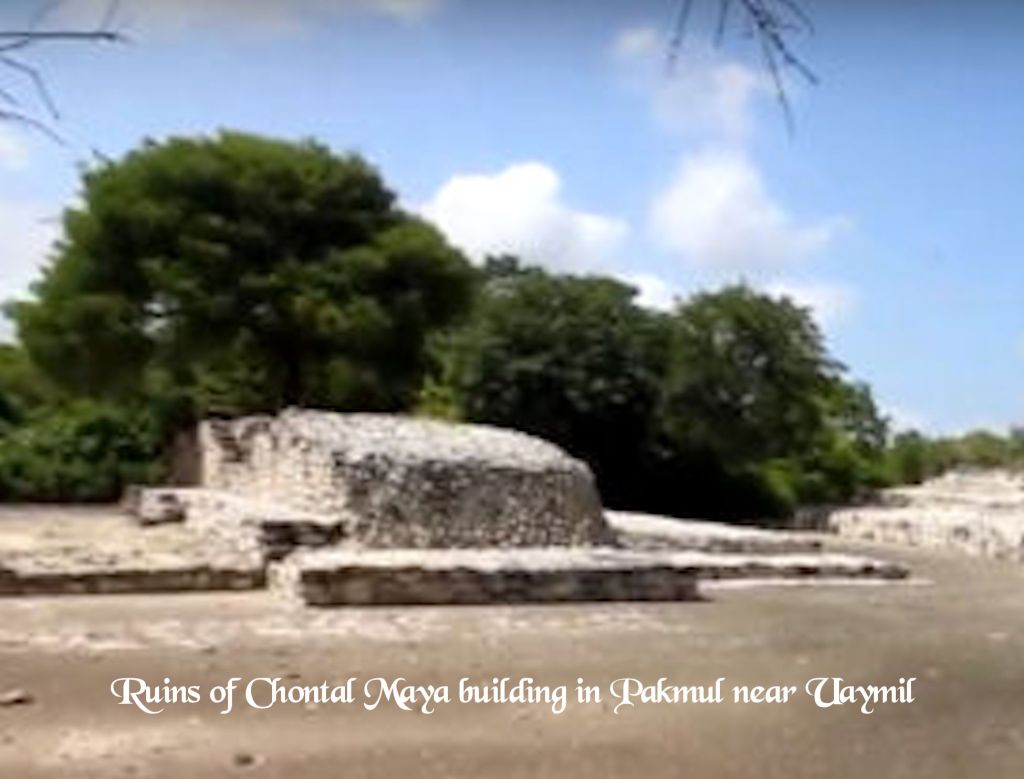
Tulane University archaeologists had discovered evidence that the man-made inner harbor long predated the arrival of Maya tribes in the northern Yucatan Peninsula. During July, there were briefly, headlines in Mexican newspapers about their discoveries. The Louisianans had also discovered a stela, which portrayed a man with Mediterranean features, wearing a conical cap and carrying a “lantern” anchor, which was typical of Phoenician, Carthaginian and Iberian ships.
Uaymil in Classic Maya times, was the bustling seaport for Uxmal. There is no attapulgite, mica, or kaolin in Campeche. . . very little in Central America and the Yucatan Peninsula Any of these items, imported from Georgia, would have come though the port of Uaymil.
The population of Campeche, south of Uxmul, dropped about 50% in the latter half of the 500s AD. Simultaneously, immigrants appeared in the Nacoochee Valley of the Georgia Gold Belt, building Campeche Maya style houses and erecting southern Mesoamerican-style mounds. Tabasco only has earthen pyramids – no solid stone structures.
That afternoon I ran into the archaeological team from Tulane at Uaymal’s only restaurant, while getting a light lunch. It was led by none other than Robert Wauchope.
I chatted briefly with the folks from New Orleans. They said that the Mexican government had forbidden them from discussing their discoveries with reporters. They refused to answer any of my questions about the stela . . . whose photograph had appeared in Mexico City’s newspapers in July.
I introduced myself as an architecture student from Georgia Tech, but Dr. Wauchope made no mention of the time that he lived in Georgia and studied hundreds of archaeological sites there. Now, Wauchope’s An Archaeological Survey of Northern Georgia is my most important reference.
Life is stranger than fiction
 The Americas Revealed
That’s astonishing! Like the Rothschild’s elongated heads!
LikeLiked by 1 person
Yes, the Burgundians were descended from eggheads, who developed into a distinct tribe in southern Sweden then migrated to eastern France. I had a French girlfriend in Mexico who was an Burgundian egghead.
LikeLike
Richard, Thank you! In my search, I discovered from the census records that my ancestors moved from mound area to mound area after 1800. Can you let us know how the genealogists think of these movements? 1) Are you related to the now deceased Ray Thornton of Arkansas, married to a Stephens Sibling? 2) Did Duncans arrive with Tecumseh in his work with the Creeks at Black Warrior that you know of? What an incredible story- the genealogy services have the Tandy Walker story posted, but not the other side of the story – that Tecumseh was married to a Lower Creek. Is this correct? Haha, was it your ancestor?
LikeLiked by 1 person
No, all the Thornton’s (of my namesake) stayed in the Southeast. They started out in the Thornton Valley on the Rhappahannock River then moved to Georgia then moved westward to Alabama and Texas. However, I am no relation to man on my birth certificate. Both of my parents were Creek Indians.
LikeLike