
The Secret History of the Georgia Gold Rush
Quiz: Where were the first gold mines of the Georgia Gold Rush?
by Richard L. Thornton, Architect & City Planner
The fourth of four full-length documentary videos, funded by foundations in California, Alabama and Campeche, Mexico will be released in a couple of days. It is about the secret histories of the Georgia and California Gold Rushes. You will be in for some real surprises. Like . . .
Myth: Every Cherokee History film, book and play since the dawn of mankind has opened by whining that “white men trespassed on the lands of the Cherokee People in 1828, where our ancestors have lived for thousands of years, found our gold and then forced us off our ancestral lands.”
Fact: Until 1785, all gold deposits in the State of Georgia were either within the boundaries of the Creek Confederacy or on lands ceded by the Creeks to Great Britain in the 1763 and 1773 Treaties of Augusta. Only sections of the northern end of the Georgia Gold Belt was temporarily within Cherokee jurisdiction, between 1795 and 1832. Most of the Cherokee section of the Gold Belt had been sold by 1822.
It was the Creek Confederacy that was screwed by Georgia officials as they systematically chipped off sections of the Georgia Gold Belt then promised Creeks that they could live on their new lands in Alabama for eternity. The governor of Georgia, George Troup, did not announce that there was gold in Georgia until after the Creeks ceded the southern part of the Georgia Gold Belt in the 1827 Treaty of Indian Springs. Troup was Creek mikko William McIntosh’s first cousin. That is significant.
Myth: No one knew that there was gold in Georgia until a farmer in the Nacoochee Valley found a nugget in Duke’s Creek, near its confluence with the Chattahoochee River in 1828.
Fact: Creek Mikko William McIntosh established four underground gold mines in Carroll County, GA at least as early as 1817. Carroll County is southwest of Atlanta.
Fact: In 1821, real estate speculators from Burke County, NC, which is that state’s prime gold mining area, purchased almost all of the Nacoochee Valley from local mixed-blood Native Americans. The sellers of the land tracts either moved to white areas of Georgia or to Creek lands in Alabama. They were NOT ethnic Cherokees. The land was within the new boundaries of the Cherokee Nation, but Cherokee leaders had no role in the transaction. Burke County was never in Cherokee territory.
Fact: In 1824, a gold-mining company, owned by Vice President John C. Calhoun, began buying large tracts of land from farmers and real estate speculators in Northeast Georgia. Calhoun then hired geologists and mining engineers to plan his mining operations in Georgia.
Myth: The first underground mining of gold in the Southeast occurred in and around Dahlonega, GA in the early 1830s.
Fact: Geologists have radiocarbon dated or tree ring dated structural timbers in ancient gold mines of northern Georgia and silver mines in western North Carolina, which were cut in the period between 1585 and 1650 AD. Chief McIntosh supervised construction of the first modern mines in western Georgia immediately after the War of 1812.
At the top of the article is an early 1900s photo of the McDuffie Gold Mine in Columbia County, GA . . . immediately north of Augusta . . . that’s about 130 miles from the Blue Ridge Mountains. It was first excavated in 1823!
Myth: The Georgia and California Gold Rushes provided an opportunity for many thousands of White, blue collar Americans to raise their economic status.
Fact: Although in sheer numbers the majority of miners in both Gold Rushes were Caucasians, wealthy South Carolina and Georgia planters created corporations, which assembled large numbers of African American slaves AND Freemen to mine gold at an industrial scale in Georgia. There is an enormous, until recently, unmarked cemetery in back of the Nacoochee United Methodist Church in the Nacoochee Valley for African-Americans, who died during the mining operations in that area.
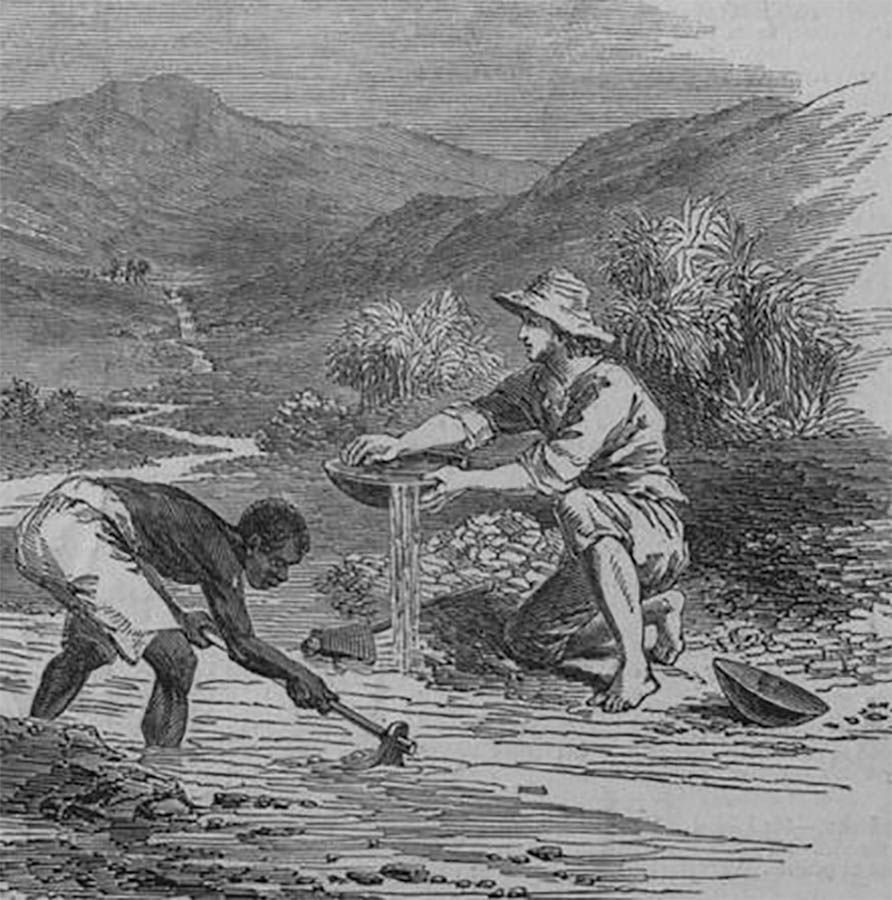
Black slave, working for a Georgia gold miner.
Fact: Many Southerners brought their strongest slaves with them to California. Wealthy Southerners purchased male slaves, who had worked in the Georgia gold fields and brought them with them to California. Northern and Midwestern gold miners often kidnapped Native Americans along the route to California or even, California to work as their slaves.
Fact: The new California legislature passed a law in 1850, banning slavery, but this law also exempted miners, who brought African-American or Native American slaves with them to California. The miners merely had to promise to take the slaves back home with them, when they left California.
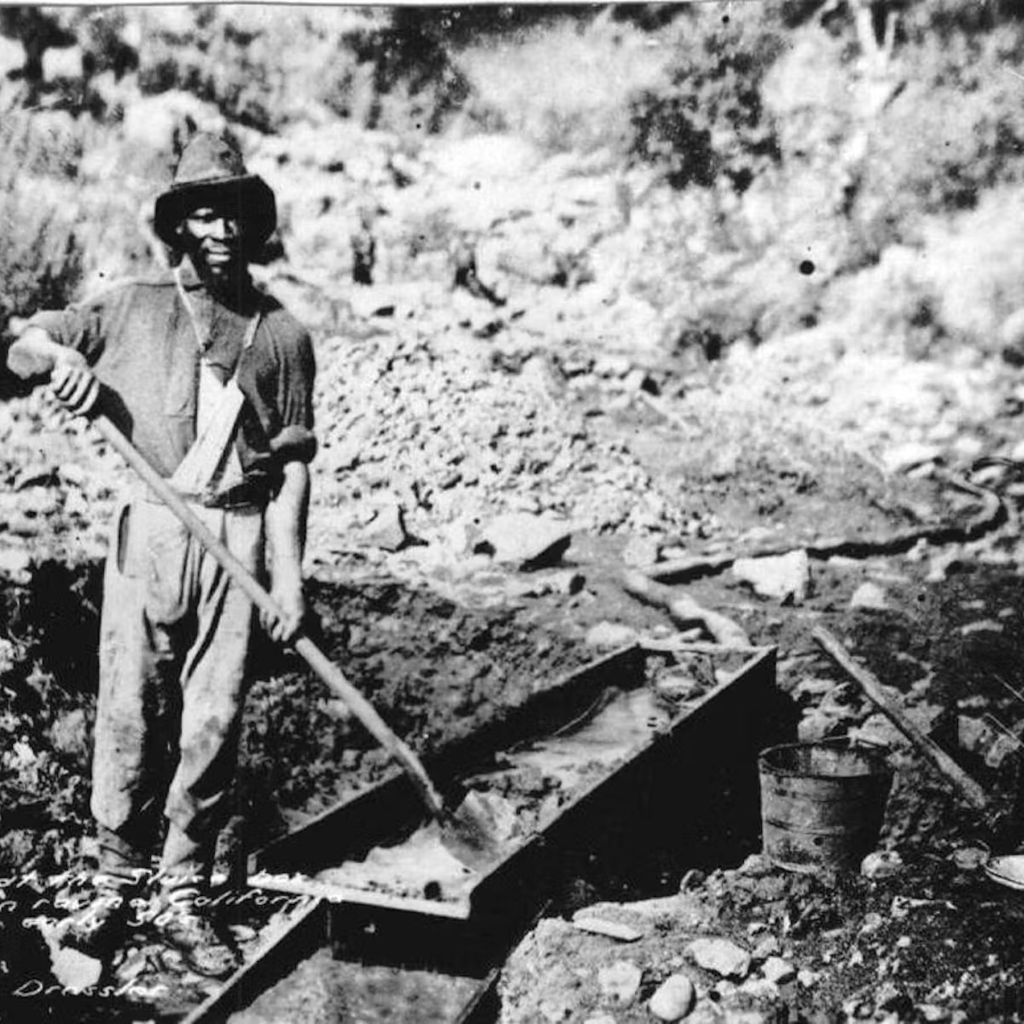
Photograph of a slave working a company’s gold claim in California
Now you know!
 The Americas Revealed
Nice little video regarding gold Rush From Dalonoga to Villa Rica.
Happy Thanksgiving Richard
LikeLiked by 2 people
Apalachen is the plural of Apalache. The capital of the Kingdom of Apalache was in the Nacoochee Valley.
LikeLike
Interesting video Richard. Thankyou.
LikeLiked by 1 person
I did not know that Governor Troup was William McIntosh’s cousin. Hmmm../
LikeLiked by 1 person
nice article
LikeLiked by 1 person