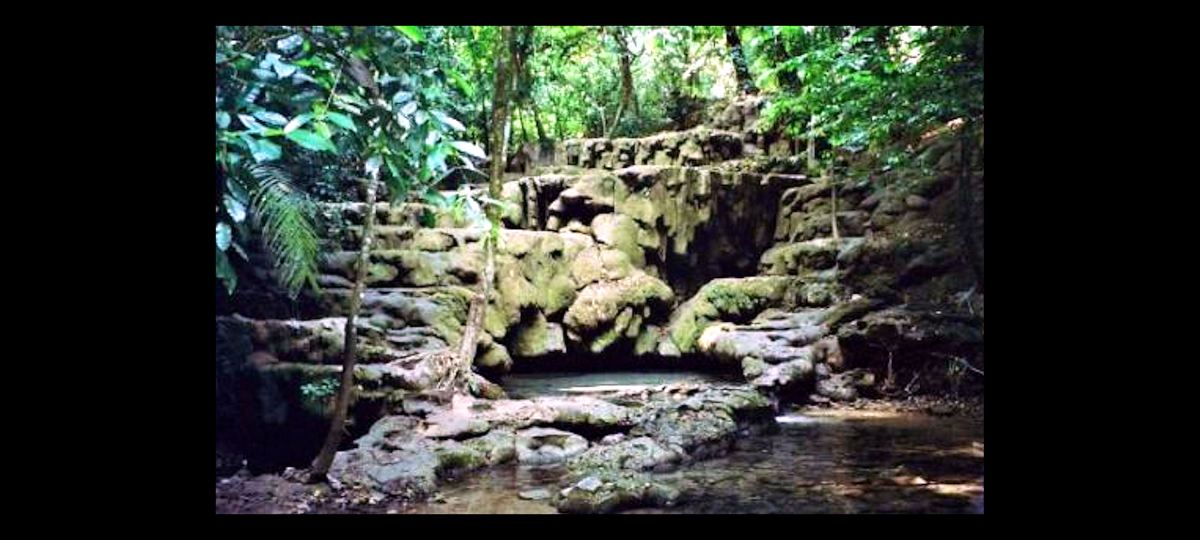
It is a 53 year old color slide of a 1400 year old Maya shrine that virtually no tourists ever see. However, it overlooks a very magical place in the mountains of Chiapas State, Mexico . . . Palenque. Here, is a surrealistic saga about Palenque.
by Richard L. Thornton, Architect and City Planner
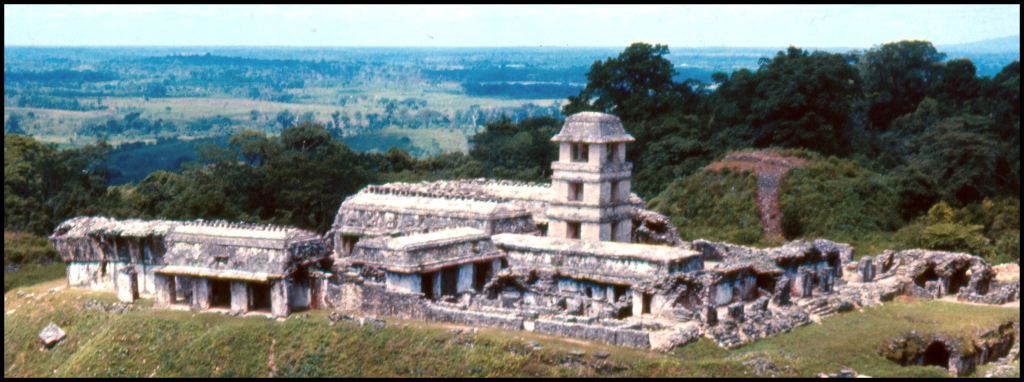
It was the morning after my first day at Palenque in the mountains of Chiapas. It was a beautiful Maya city, perched on the edge of the Chiapas Highlands . . . but there was also something special about this place that I couldn’t put my fingers on . . . as they say. I had spent the night at the La Canada Hostel, run by my guide, Moisés Morales Márquez and his Canadian wife. At the time, he was the only guide, who spoke English. On the site plan of Palenque, the hostel was labeled “The Palenque Inn,” so at least some English-speaking tourists would stay there.
Palenque was a different place back then. The town was merely a hamlet and the austere La Canada was the only place where you could sleep at night under a roof. Most of the handful of Gringo tourists traveled to Palenque on package tour buses and returned back to civilization the same day.
Linda and David from Mobile (as I always recorded their names in my journal) were headed back to Alabama. I was taking the mid-afternoon Second Class bus to eastern Chiapas. Senora Morales cooked me a hardy breakfast, served by their adolescent son, Alfonso.
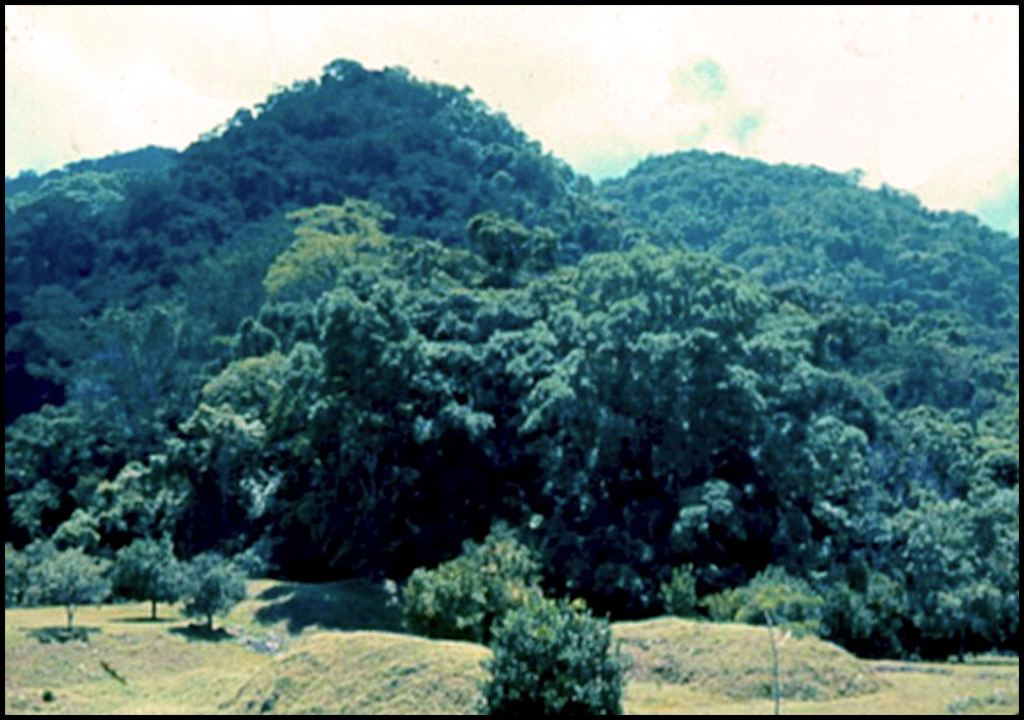
Rather than spending any more time in the ruins, I decided to follow a beautiful creek, running through Palenque, up into the mountains. I wanted to see what the natural environment of Chiapas looked like. I now know that the shallow stream splashing down the escarpment is called the Rio Otulúm. It’s hardly a river, but maybe Southern Mexican call all streams, rios. Whatever . . . it reminded me of the creeks in the Georgia Mountains.

I quickly noticed that the bed of the creek was littered with large, purple snail shells that looked like the shells that you normally only find in the ocean or on trees in southern Florida. I filled up a two gallon plastic zip-lock bag with these shells. I still have that bag, with some of the shells never used for making necklaces for female relatives and favorite females. The shells have now faded to a bone color.

Eventually, I reached the stair-stepped Maya temple, built around the source of this creek. It was so different than the Maya temples, one sees in the larger city sites. Maybe it harkened back to an earlier folk religion, which long predated the ritualistic religion established by Teotihuacano princes and priests, who ruled Chiapas from 200 AD to 600 AD. Soon, it was time for me to head down the mountain and catch a bus.
1985 – Fifteen years later
Vivi had just graduated with honors from the Sorbonne with a diploma in Early European History. Not much one can do with that other than teaching in a Lycée (Upper two grades of high school) – unless one wants to go for a PhD. She decided to visit her relatives in Mexico for a few weeks, while deciding what to do with her life. One of her grandmothers was a Tamulte Maya from Tabasco, who married a dashing French petroleum engineer and returned with him to France after World War II. Vivi was the nickname given to this mademoiselle by her Tamulte grandmother, who only I have been also allowed to use.
Vivi fell in love with Mexico. She pretended to be a famous French singer and obtained a Musician’s Visa and work permit. She traveled around Mexico, visiting many of the same archaeological sites that I visited, but supporting herself by singing French and American pop songs at night clubs.

Then she arrived at El Pancheon Inn in Palenque. It had just been opened up by the Morales Family at the site of the Canada Inn. She charmed Moises Morales into also thinking that she was a famous French singer and got to stay free, plus some money, for singing in the restaurant. She quickly had a crush on his son, Archaeologist Alfonso Morales.
The movie, “Indiana Jones and the Temple of Doom” was then a blockbuster all over the world. Vivi fantasized about Alfonso and her becoming Sr. and Sra. Indiana Jones and going all over the world together in great adventures.
Vivi decided to follow the Rio Otulúm to its source, while deciding what to do with her life. She also noticed the purple snail shells and put some in her backpack. She came down off the mountain, determined to apply for (and certainly be accepted) for the doctorate program in anthropology at the Universidad Nacional Autónoma de México. By this time, she was almost fluent in Spanish. Life, though, would have another path for her.
At El Pachon Hotel was a telegram from her relatives in Tabasco. At age 18, she had competed in a musical talent competition in France, which chose France’s entry in the Eurovision Contest. Vivi was a finalist, but not the winner. She did get to perform with an orchestra on French national television, however. She sang the 1973 hit by a Spanish Basque group – “Eres Tu.” Someone had cut a record from her performance. It was now outselling the original version in the Americas and Europe. She had a big check waiting for her in France.
Furthermore, a French director was trying to locate her in order to offer a role on a new comedy movie about an experimental mixed gender college dormitory. She would play a naive girl from a small village in rural Spain . . . in the big city (Paris) for the first time.

1990 – Twenty years and four months later
It was the annual Christmas party for senior administrators at the Smithsonian Institute, National Geographic Society and Library of Congress. I was invited officially to sample Shenandoah Chevre goat cheese, but the hostess wisely knew that “nice guy” husbands would stay in a toxic marriage until it destroyed them . . . unless another women, suitable for a long term relationship, came along. The hostess invited several available Washington “professional” women to the party to introduce to me. She did not feel guilty. My wife had bragged to her about never loving me and only keeping me around as a “plow horse” to do chores around the farm.
The primary conversation at the party was the new book published by Linda Schele, A Forest of Kings, which translated many of the inscriptions at Palenque. Linda’s team had cracked the “Maya Code.” All were Southerners, who had graduated from Southeastern universities.. I owned the book also, but because she was now at the University of Texas, I didn’t realize who she was. Eventually, from hearing comments from others, I realized that this was David and Linda from Mobile. We had toured Palenque together, with Moises Morales as our guide.
French ambassador Jacques Andreani showed up at the party with an exotic young woman, wearing a $125,000 Russian sable coat. She looked like an Upper Class Latin American, but spoke French, plus English with a French accent. I had escorted her in, however. She constantly starred at me afterward. I tried not to gawk, because it was obviously a case of the princess and the commoner.

Photograph of the Shenandoah Cheeses at the party in the Washington Post
Suddenly, the exotic lady pounced toward me, shouting, “Richard, it is time to give your girl some attention.” She led me to the living room, where she had set up a spread of my goat cheeses and the ambassador’s expensive French wines. She was amused that I didn’t know her name, but told me that I could call her Vivi . . . because she instantly liked me. Later that magical evening, we shared Christian communion with expensive French wine and Swedish platbrod crackers . . . after she complained that she was not allowed to take communion in French churches, because she was divorced. I read her the passage in the Bible, where Jesus said to to do this, when two or more of you are gathered together. He said nothing about priests or divorce. That was after we had watched the National Geo Special, “Realm of the Alligator” on the TV.
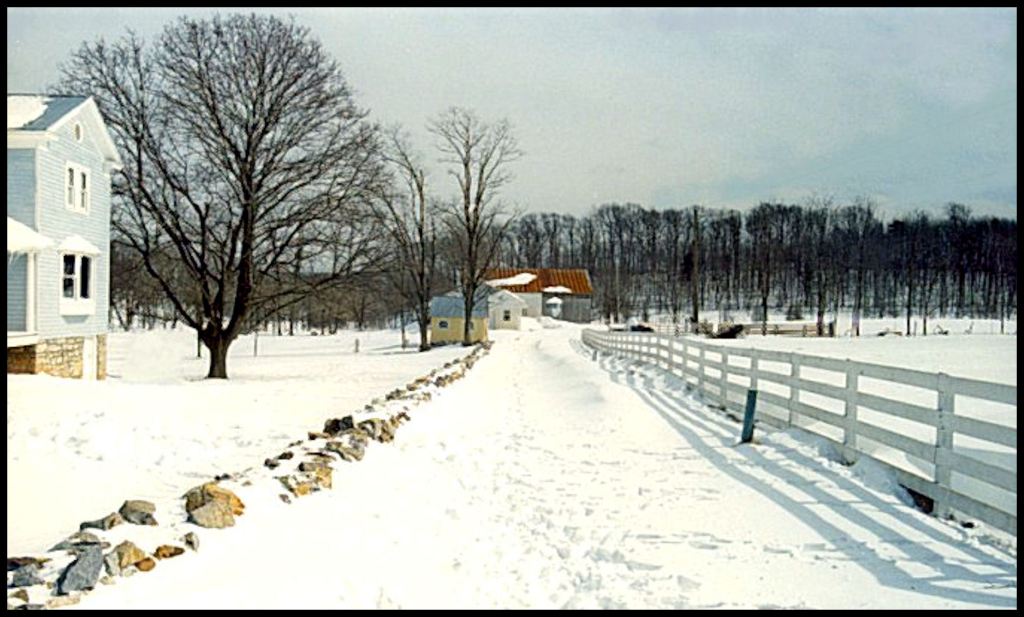
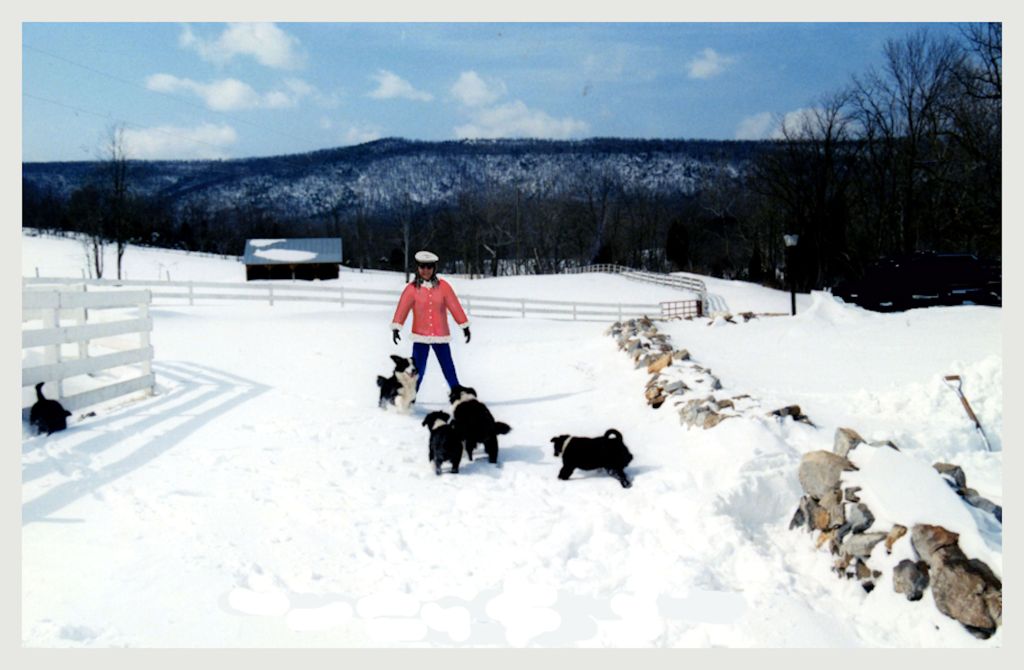
I drove back to my farm in the Shenandoah Valley late Sunday afternoon, assuming that I would never see Vivi again. It would be yet another beautiful memory like with Ana Rojas in Campeche. However, on Wednesday, December 19, 1990 there was Vivi standing in the snow in front of my house. She had auditioned for singing songs for a Hollywood movie’s sound track. The director then had tried to rape on his desk. She got away, but swore before God to walk away from the entertainment industry and place her first priority in being a good mother for her sweet daughter. Vivi wanted me to baptize her with the waters of Toms Brook, which flowed past my house. I had to microwave the water first.
When I dropped her off at Dulles Airport that evening, I again assumed that I would never see Vivi again. Therefore, I made her a necklace of purple snail shells from the Rio Otulúm, so she would never forget our relatively brief moments together and the vow that she had made to God to be born again into a life of love, where her daughter would come first – not money.
December 21, 2012 – 42 years after seeing Palenque
The History Channel had requested from the Institutio Nacional de Antropologia E Historia a sample of Maya blue stucco. Its staff decided on getting a sample from a single structure at Palenque. They assigned the chief archaeologist at Chichen Itza, Alfonso Morales, to work with the film company, because he had grown up near Palenque. When asked in his TV interview about the theory that some Mayas had visited North America, Alfonso responded, “It is not a theory, but a fact. We now know that Indian chiefs from Florida and Georgia also visited Chichen Itza.”
The climax of the premiere of America Unearthed was the announcement that there was a 100% match between the Maya Blue stucco at Palenque and attapulgite, mined in Georgia. Life is stranger than fiction.

August 2020 – Vivi saw me, on a PBS TV documentary with French subtitles on the development of agriculture in the Americas that I had been in.
February-March 2021 – 51 years after Palenque
Vivi had a temporary nervous breakdown after discovering that I had not been murdered in 1993. She was now a member of the fast-growing French Protestant Church, but did not want to confide her past to her minister or the truth to her husband of 20 years . . . and most importantly, her daughter and our son. Her daughter had called me “Papa” during the six weeks that she stayed on my farm in 1992.
She eventually went to a psychic. She told Vivi that we had been husband and wife long ago in southern Mexico. We would be married again in future lives, but might not ever be together again in this one.
To learn more about her Native American past, she next obtained DNA tests for herself, her daughter from her first marriage and our son. Vivi and I DO carry almost the same Southern Mesoamerican DNA. No wonder, we were instantly attracted to each other, without hesitation, as if we had long been together.
December 15, 1991 – 21 years after Palenque
Vivi made sure that we would remain in contact almost daily, using the then new technology of encrypted fax transmissions. We also were together in person again several times until spring of 1993. In December 1991, she paid a recording studio to produce this special one anniversary Christmas gift for me. I thought that it might be a nice way to start your holidays.
 The Americas Revealed
Thank you for your stories and the beautiful Christmas music ! It is appreciated.
LikeLike
Hi Richard
I was in France in 09 visiting a family outside of Paris. We hosted their youngest daughter twice as an exchange student. And they invited us to come vist them. We were touring the Sacre Cour, the beautiful white cathedral on the hill in Paris, one afternoon. There was a service going on,about 100 worshipping and 200 touring in the outer areas. All of a sudden the most amazing angelic voice from Heaven started singing in French. Everyone stopped and listened and bowed their heads. A small older French nun was, I found out later, singing the Lord’s Prayer. The acoustic was so good any mistake or off key note would have been glaring. You could have head a pin drop when she finished and their was not a dry eye in the house as the catholics made the sign of the cross. It was a truly amazing experience.
This recording reminds me of that day. Vivi has a beautiful true voice.
Thanks
LikeLiked by 1 person
Yes, she does. It even got better after she left the entertainment industry. The recording of Silent Night was made a year after she decided to walk away from professional singing and live on an old farm. in rural NE France.
LikeLike