
It was once a massive regional trade center and inland port with suburbs of several distinct Indigenous American tribes, stretching around 40 miles along the Ocmulgee River.
My first memory of Ocmulgee was at age six. We were making our annual journey at Christmas time from the Okefenokee Swamp to North Georgia to visit relatives. My parents bought barbecue sandwiches, French fries, fried pies and ice teas from the Pig ‘N Whistle Drive In Restaurant. We then drove over to Ocmulgee Park and feasted at the picnic tables.
My mother then led me to a shed, which covered the burial of a seven feet tall Creek king or priest. She said, “Richard, this could be one of your ancestors. Remember that our ancestors were an intelligent, civilized people, who erected great structures.” I think it was at that point that I started wanting to be an Architect.
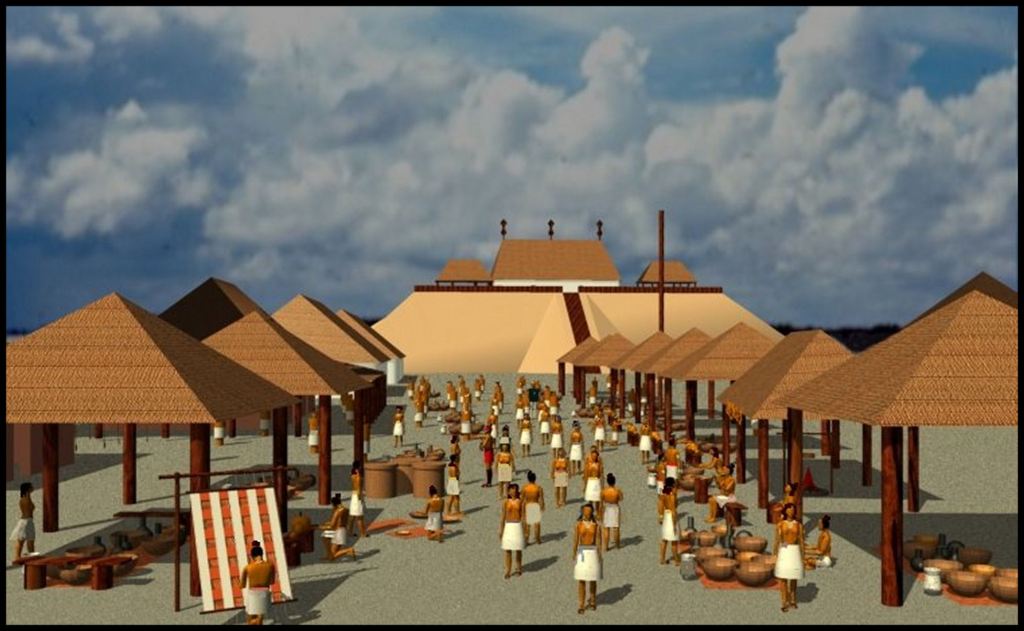
In its time, this multi-ethnic, Indigenous American megapolis had the same regional economic role as Atlanta does today . . . which is 90 miles (145 km) to the north. Several major trade paths, connected with other parts of the continent, intersected with the Ocmulgee River, which from there southward, was navigable by large trade canoes to the Atlantic Ocean.
Unfortunately, for most of its existence since 1933, Ocmulgee has been ignored by the archaeological profession. Many of the North American archaeology books in my library don’t even mention it. For over a century Gringo archaeologists lived in a delusional world in which “pottery, mound-building and agriculture were invented in Ohio and then the same people moved to the Mississippi River in Illinoi and invented towns. ” That is why an advanced indigenous culture that originated in Florida and Georgia is called the Mississippian Culture.
As late as 2010, in the book, Cahokia: Ancient America’s Great City on the Mississippi, its author, Dr. Timothy Pauketat described Ocmulgee as “small site with a few small mounds in an out of the way place that does not seem to have a reason for existing.” Say what? The chroniclers of the De Soto Expedition stated that they never lost sight of houses or cultivated fields, while in what is now the State of Georgia.

Front and back cover of the original Ocmulgee Museum brochure
But then there is the museum at Ocmulgee. It is a very unique, attractive building, but for most of its existence, its exhibits and art told generations of visitors fairy tales that did not jive with the discoveries on the Ocmulgee River by Dr. Arthur Kelly in the 1930s, a team of NPS archaeologists in the early 1970s or Dr. Daniel Bigman in 2012. I still have the brochure that was given our Georgia Tech architectural history class, when we visited Ocmulgee. You will be rolling in the floor laughing, when I tell you what it says.
If it wasn’t for the years of hard work by the people of the Macon, GA area in close cooperation with the leaders of the Muscogee-Creek Nation in Oklahoma, I have no doubt that Ocmulgee would have remained a little known, under-staffed National Monument with steadily declining visitation.
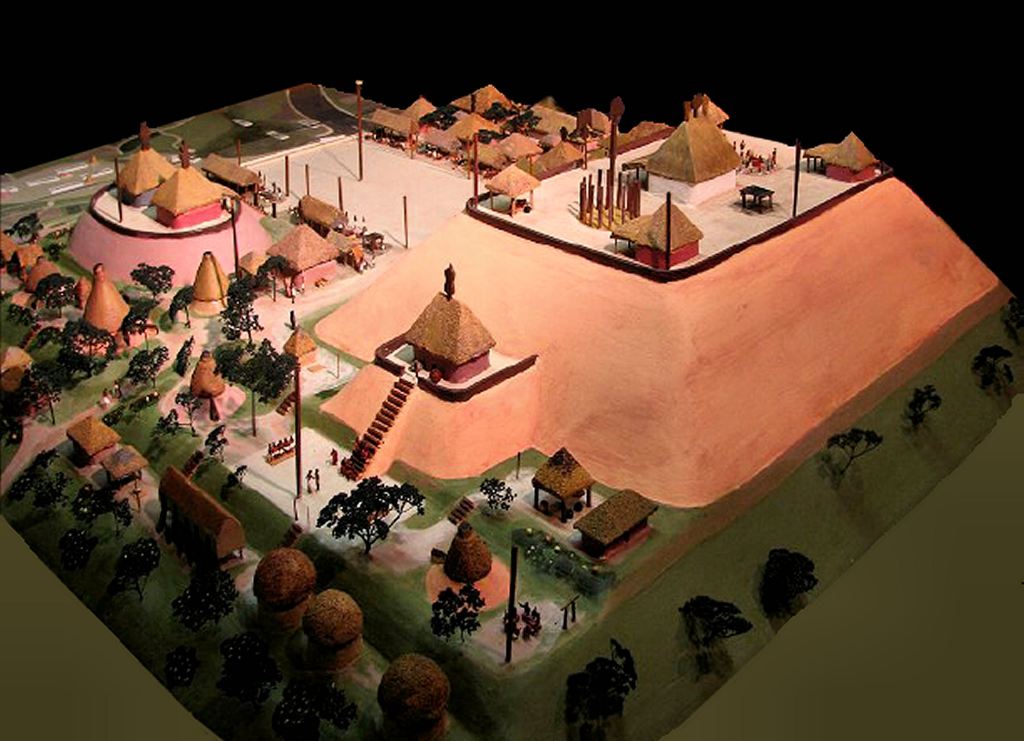
An orphan child of the National Park System
In February 1993, I applied for several positions in the Department of Interior. I had learned absolute proof that my marriage had been a farce for most of its existence. The previous five years in the Shenandoah Valley of Virginia, my wife had made me sleep in another bedroom, hoping to force me into having an affair, so people would think that I was the “bad guy” instead of her. I needed a more stable income than architecture provided to pull off the transition without losing the Shenandoah Valley farm.
Since I had friends at the NPS Center at Harpers Ferry, I was certain of getting a position there, but was shocked that I also scored first out of 138 candidates on an exam for Architect of the National Capitol. Immediately, I was appointed a member of the advisory committee for the new American Battlefield Protection Program. My Shenandoah Valley farm was the site of one of the largest cavalry battles of the Civil War. It was designated a key property in the proposed Shenandoah Battlefields National Park.
Also, appointed was Jay Monahan, first husband of journalist Katie Couric. They had visited our colonial era farm several times in previous years. Jay and I traveled together to the April kick-off ceremony for the program at Arlington Cemetery. Jay suggested that we sit next to National Park Service Director, Roger Kennedy, and his wife Frances . . . because it would be good for my career. He didn’t know that I had already applied for several positions with the NPS and had met Roger and Frances at a Christmas party in 1990. (See The Shenandoah Chronicles below)
Jay was shocked when Roger recognized my face, but did not remember my name. LOL He did remember that the party for senior Smithsonian Institute administrators had featured my goat cheeses, but especially remembered Vivi, the French actress, who I met at the party. She had been very demonstrative of her instant affection for me. Roger talked on and on about how impressed he was of Vivi’s intelligence, education at the Sorbonne and charm.
Jay was doubly shocked when most of the conversation was between Roger and me. By this time Katie was co-anchor of NBC’s Today program, so their income dwarfed mine . . . equating them to being nobility and me being a commoner.
Roger mentioned that he had just taken a grand tour of NPS facilities in the Lower Southeast and had been surprised by the scale of the man-made structures at Ocmulgee National Monument. It obviously once been a very large Native American town.
Several of his senior staff considered Ocmulgee to be a Podunk facility that should be decommissioned and given back to the State of Georgia. After visiting Ocmulgee, Roger nixed that budget-cutting proposal, but had very limited funds for expanding the staff and promoting the park.
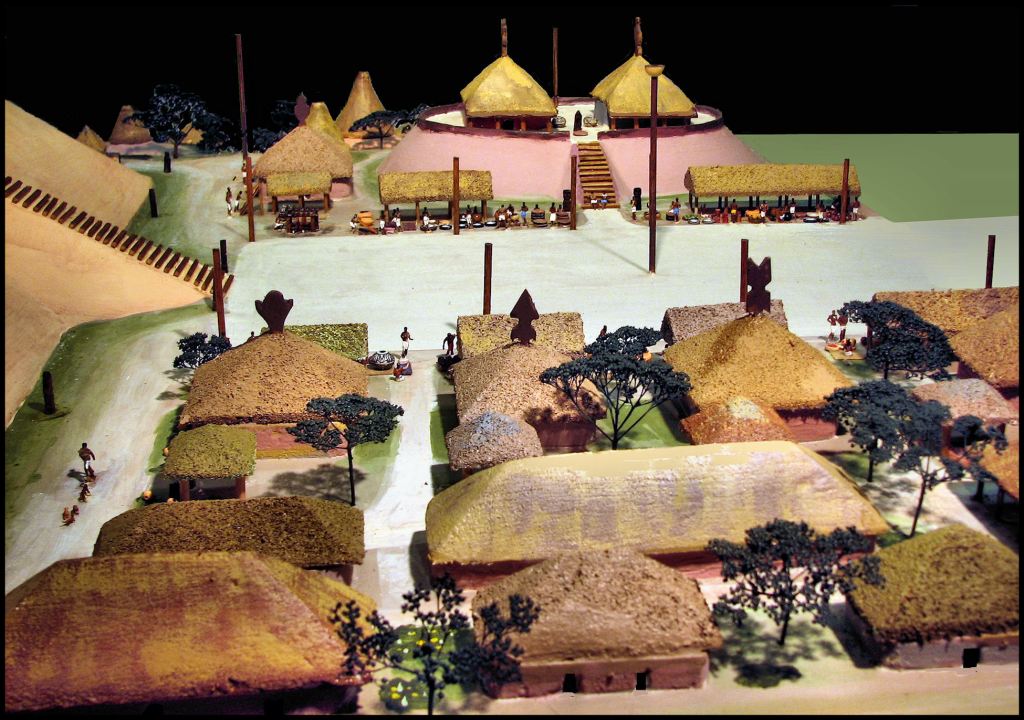
Ocmulgee Timeline
So, how did things devolve so badly at Ocmulgee National Monument over four decades that the National Park Service considered abandoning it? Here is an abbreviated timeline of major events.
1930-1933 – The citizens of Macon, GA . . . including its school children . . . donated their nickels and dimes during the worst of the Depression days to purchase 2000 acres around a large cluster of Native American mounds and earthworks in order for the site to become a National Park.
1933 – The National Park Service only accepted less than 800 acres then Congress designated the land, a National Monument. The remainder of the land eventually became public housing projects, state office buildings, state museums and the Macon Coliseum. The Roosevelt Administration designated WPA funds to hire over 100 unemployed laborers to excavate the archaeological zone.

1933-1941 – Archaeologist, Dr. Arthur Kelly, a native of east Texas and a Harvard University graduate, was hired to supervise all WPA-funded archaeological work in Georgia. The Ocmulgee Project was to become the largest archaeological excavation in the history of North America. Joe Tamplin, a Civil Engineering graduate of Georgia Tech was hired to be supervising archaeologist for the project.
Dr. Kelly was gone much of the time . . . either at his office in Atlanta, in Washington, DC or visiting other archaeological sites in Georgia. Joe Tamplin couldn’t possibly keep watch over 100+ laborers. It is long believed in Macon that the archaeological site’s finest pottery and statuary went out the gate under workmen’s overcoats.
On the positive side, being a professional civil engineer, Tamplin designed the scientific excavations to be safe for workers and created precise as-built drawings, which very few people have ever seen. Throughout the 1930s, Kelly and Tamplin were the only college graduates working at Ocmulgee. Tamplin went on to be a civic leader in his adopted home town.
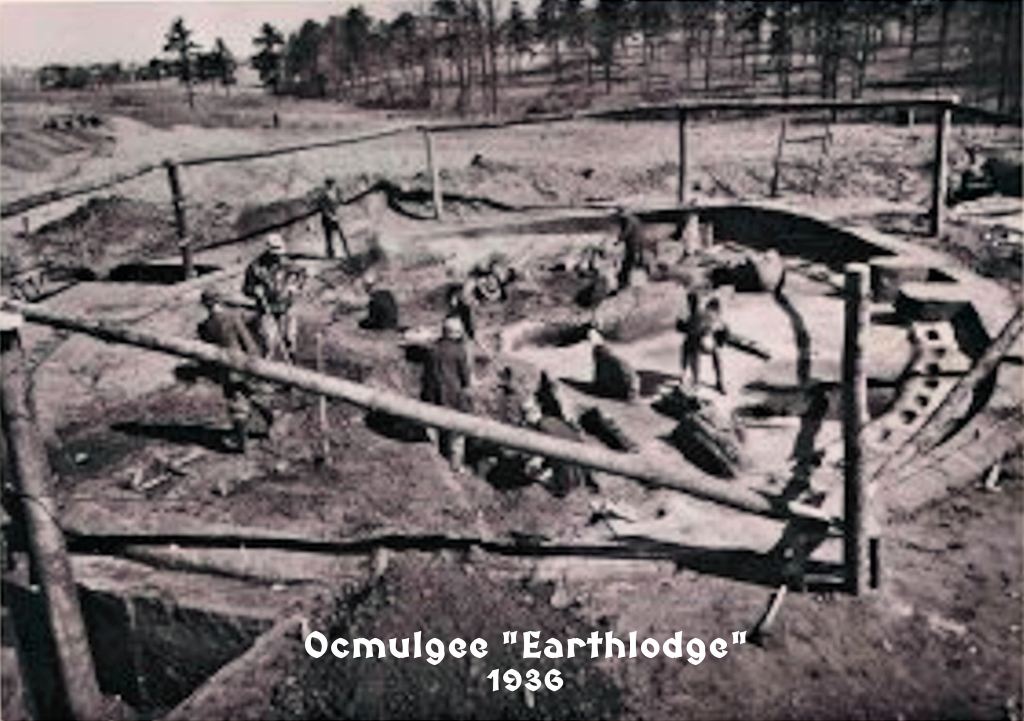
James Ford had attended a year and a half of liberal arts classes at a college in Mississippi before being hired as an Assistant Archaeologist. He was assigned the eight round structures on the main plaza and grossly misinterpreted them. He reconstructed the most famous one as a Mandan Earth Lodge, when in fact, it was a large cone shaped structure, typical of northern south America. It was not an Earth Lodge, even though, it is still called that by Georgia Archaeologists.
–

Actual appearance of the so-called “Ocmulgee Earth Lodge.”
The National Park Service made no provisions for curating the artifacts. Most of the 30,000+ boxes of artifacts were not opened until the early 21st century! There has never been a book published about the contents of those boxes.
Worse still was the influence on the exhibits in the museum, because of the provincial bias of the Midwestern archaeologists. They were trained to recognize the artifacts of the Woodland cultures of the Midwest, but Ocmulgee abounded with artifacts typical of artifacts of cities in southern Mesoamerica. These included tools for applying and repairing stucco and artifacts associated with the salt industry, which seemed to be the most important component of Ocmulgee’s economic vitality.
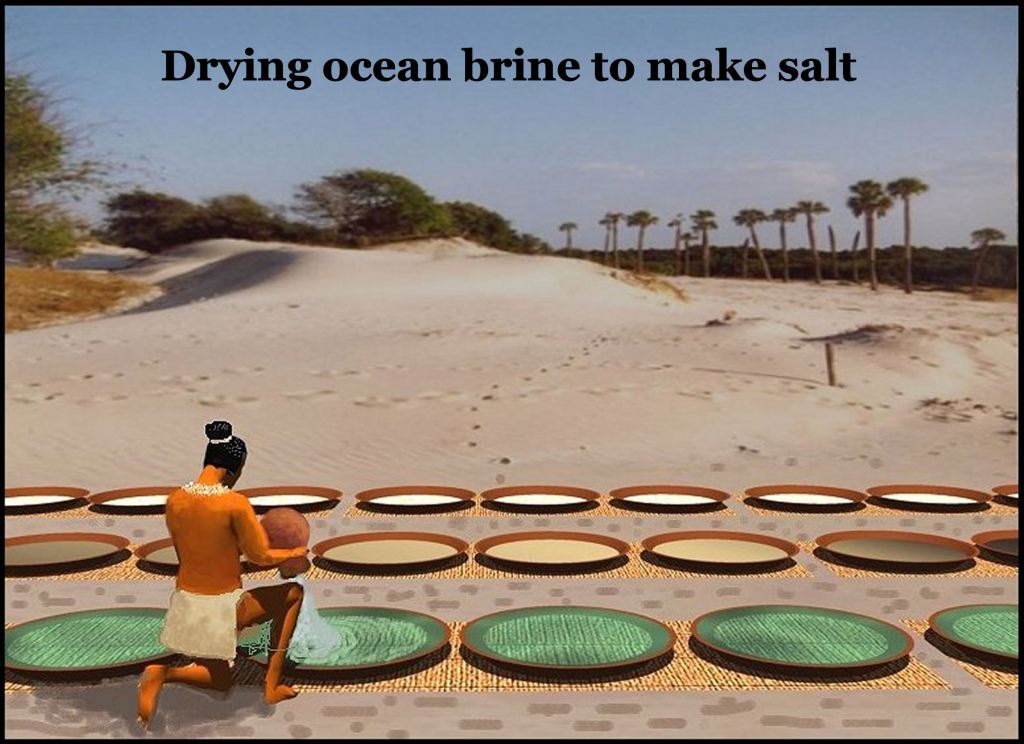
I last saw Dr. Kelly at a slide lecture that I gave at Georgia State University after returning home from my third visit to Mexico in 1974. It was sponsored by the Atlanta Archaeological Society. He told me that he had finally completed his archaeological report on the 1930s dig, but could not find many of the larger artifacts unearthed there. He specifically mentioned that they had encountered hundreds of ceramic brine-drying trays up to three feet in diameter and some in perfect condition. No one in the National Park Service seemed to know where they were. I told him that ceramic brine-drying trays were a common artifact at Maya cities near the coast. He looked surprised, but did not respond.
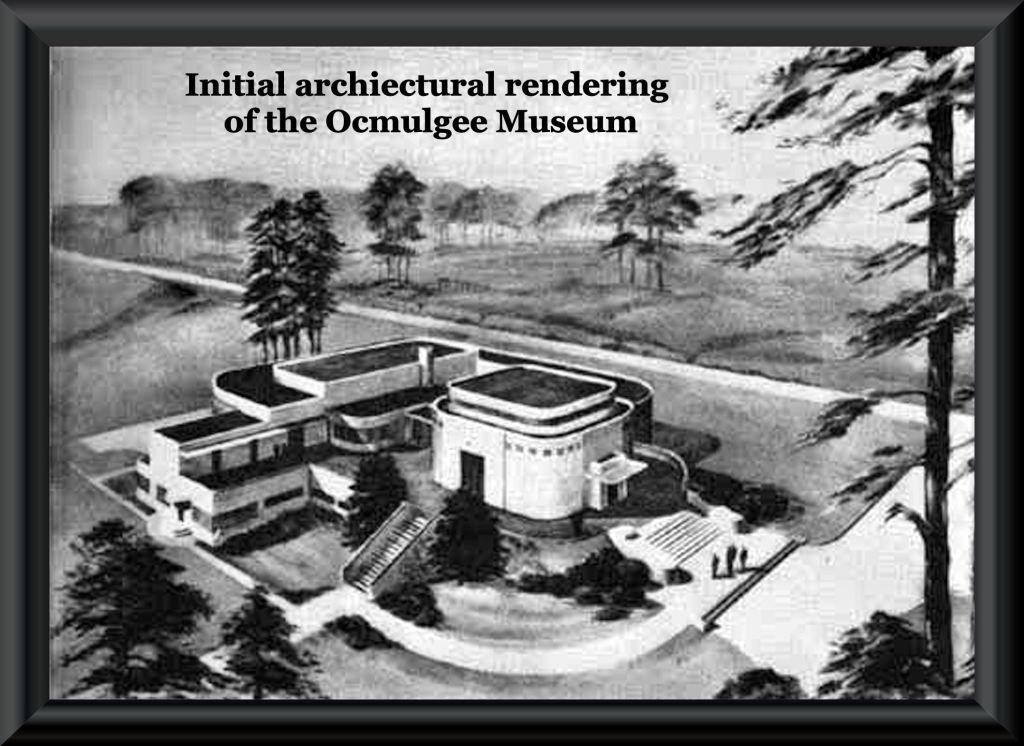
The main museum building ended up being much larger.
Begun in 1939, the Ocmulgee Museum was the first “Modernist” museum constructed by the National Park Service and still remains one of the few “Modernist” structures. It truth, though, it was not at all typical of mid-20th century public buildings, because it incorporated many details of traditional Puuc Maya architecture from Campeche State, Mexico. I am still amused by the irony of that design decision.

The beautifully restored museum in 2007
1942-1945 – Dr. Kelly and a part time maintenance man remained the only staff at the Ocmulgee National Monument during World War II. Kelly, for unknown reasons, did NOT prepare the archaeological report for the previous decade’s excavations, even though he obviously had plenty of time on his hands.
1946-1951 – The new Director of the National Park Service, Newton B. Drury, was a Landscape Architect from California and was primarily interested in preserving the natural wonders of California. He reneged on the U.S. Government’s promise to expand Ocmulgee to a 2,000-acre national park. Arthur Kelly moved to Athens, GA to become the first director of the University of Georgia’s Department of Anthropology.
Drury replaced Kelly with two young archaeologists from the Midwest. Their primary activity was designing the exhibits for the museum. Not having an archaeological report to go on or radiocarbon dating, plus only having a few artifacts curated from the warehouse full of boxes, they created a mythology, based on the assumption that everything was better, north of the Mason-Dixon Line. If South had lagged behind much of the nation since the Civil War, obviously its Indians were also more primitive than any tribes elsewhere in North America. Their version of America’s past was enshrined in the booklets that were given to Ocmulgee’s visitors for the next four decades.
- The Ocmulgee Basin and Georgia as a whole was thinly occupied by primitive hunter-gatherer peoples until advanced Indians from Ohio introduced pottery, burial mounds and villages to the region around 500 AD. Actually, the oldest known pottery in North America is found in Georgia. It was being made for about 2,000 years before appearing in Ohio. The Bilbo Mound in Savannah dates from about 3550 BC . . . 3,000 years older than any mounds in Ohio.
- A tribe from around Boston, Massachusetts introduced Swift Creek pottery to the Ocmulgee Basin around 1000 AD. Swift Creek Style pottery was introduced to the Lower Chattahoochee River Basin by Panoan immigrants from Peru around 100 AD. It was being made on the Ocmulgee River by at least 200 AD or earlier.
- Master Farmers from Cahokia, Illinois introduced the cultivation of corn and the building of pyramidal mounds to the Ocmulgee Basin around 1200-1400 AD. Most of the mounds at Ocmulgee were begun in the period of 900 AD -1000 AD. They predate the mounds at Cahokia.
- Farmers (Creek Indians) migrated from the Lower Mississippi River Basin around 200 years after the main part of Ocmulgee was abandoned then founded the Lamar Village. (See 1973-1974 below) The Midwestern archaeologists hired artists, who produced grossly inaccurate portrayals of both the Creeks Indians and the peoples, who preceded them. Specifically, they were shown wearing breach cloths and mohawk haircuts like the Iroquois.
1951-1973 – Conrad L. Wirth followed Drury as the Director of the National Park Service. He created the Southeastern Archaeological Center and placed it in the Ocmulgee Museum Building. Thus, the park contained a staff of professional archaeologists, but they did virtually no work at Ocmulgee. They accepted the version of the past created in the late 1940s and stated it as fact.
1973 – Angry at the role of Georgia Senator Herman Talmedge in the Watergate Scandal Hearings, President Richard Nixon sought to punish Georgia by moving the Southeastern Archaeologist Center to Tallahassee, FL, where it located to this day. No professional archaeologists were left at Ocmulgee after 1974, due to budget cuts.
1973-1974 – The last archaeologists, based at Ocmulgee, carried out a comprehensive excavation of the Lamar Village. They discovered that it was founded around 990 AD by the same people, who founded Etula (Etowah Mounds) a few years later. Its real name was Itzasi. Itchesee was its Anglicized name. Unfortunately, Georgia archaeologists don’t know who the Itza Maya words were and are unaware that both towns had Itza Maya names. I seem to be the only person in the Southeast with an Itza Maya dictionary.
Around 1200 AD massive floods swept over both towns, which were quite large and on horseshoe bends on their respective rivers. Both towns were converted into islands as new channels cut through the horsehoes.
Arthur Kelly did not dig through the three feet of muck to discover the large town, dating from around 990 AD. Even though the NPS archaeologists published their report and presented it at conference of Southeastern archaeologists in 1974, the sign saying that the Lamar Village was founded around 200 years after Ocmulgee was founded remains in the museum.
1980-1993 – The Reagan and George H. Bush Administrations repeatedly put greater budget restrictions on Ocmulgee, causing staff reductions and inadequate maintenance. The Clinton and George W. Bush Administrations did not continue those draconian measures, but also did not return funding for the national monument back to the levels of the Carter Administration, allowing for inflation.
Since 1980, Ocmulgee has increasingly been dependent on support from the Macon Area for maintaining adequate educational programs. This is coordinated by what was originally called the Ocmulgee Monument Association. Its primary source of funding are the museum store and the Southeastern American Indian Festival.
2012 – While carrying out a remote sensing study of the acropolis area of Ocmulgee and FINALLY being the one who comparatively analyzed the pottery from each on the central neighborhoods, Dr. Daniel Bigman, then a doctoral student at the University of Georgia, developed a radically different understanding of Ocmulgee’s development.
The original occupation of the acropolis was by people living in large teepee shaped houses, typical of northern South America and the Tekesta of the Miami, FL area. Only after around 1000 AD, did MesoAmerican-style houses appear at Ocmulgee. Bigman’s remarkable discoveries have not been applied to the exhibits within the museum.
2017 – Designation of Ocmulgee as a National Historical Park has radically changed the image of the massive archaeological zone to academicians outside of Georgia. However, the massive town site still does not have adequate funding to support continued archaeological studies and educational programs that such an important chapter of America’s history deserves.
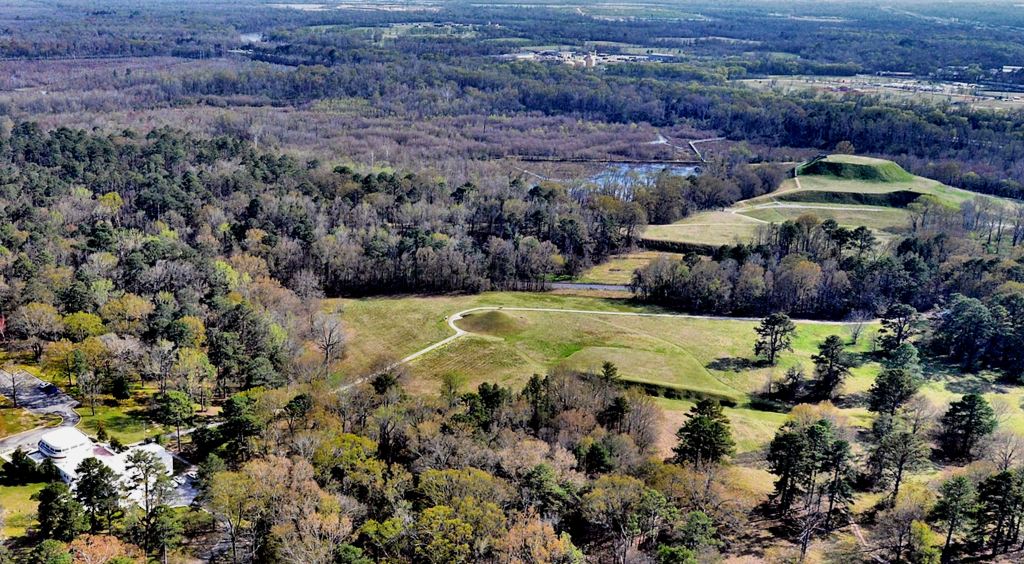
Ocmulgee National Historical Park in 2019. At the top center is the swampy vestige of the inland port, which was the equivalent a thousand years ago of Atlanta International Airport.
 The Americas Revealed
Richard, another fascinating peek into Georgia’s relativity and widening understanding of connectivity and being an epicenter to so much history about ancients. I only wish that we could take “public education” in Georgia and turn it more “inward” to these subjects so that it lived and breathed on the tips of every youth and interested person. I’m certainly here in my role to do more in this direction in days to come. In part, I chose to move to The South from The Midwest because of the way my school history books, all published out of Boston and by Macmillan no less, had cheated me of valuable history relative to The South. Little did I know that the academic control front of so many subjects ran this deep of course and credit your valuable writings and others to my own greater awakening. I find it fascinating that you compared the “inland port” to a modern Atlanta airport. Would you mind elaborating on that some more? The reference reminded me of the town of Vernonburg here in greater Savannah was once a larger and more thriving town with a port larger than the nearby cities until burned during the Revolutionary War but other than the foundation remains of 300 homes sitting in a wooded area and a couple of obscure historical markers, it might as well have not existed and you hear all but nothing of it. No stories, no names, no real renderings exist. All the talk is only “Savannah” as it survived to tell its own story more. And like Ocmulgee, it’s about who decides to tell what stories and why. Merry Christmas & Happy 2024.
LikeLiked by 1 person