
A new series coming in Winter 2024
by Richard L. Thornton, Architect & City Planner
What really happened from the time of first contact in the 1500s between the indigenous peoples of the Southeastern United States and European explorers and the 1970s, when the descendants of those indigenous peoples, first in the Southeast and then in Oklahoma began reconstituting tribal governments?
These essays and reports will then be polished into compact, affordable booklets to be published and distributed to the public. In this text message era, consumers in North America and Europe are no longer buying big, expensive, scholarly books.
There are far too many people in the Native American world today, born before the advent of the desktop computer, who are promoting themselves as “wise elders” then dreaming up caca de toro and calling it “the history of their people.” Ignoramuses and jackasses grow old, too. Wisdom only comes from decades of hard work, comprehensive study and especially in my case . . . happenstance. We will start with an amazing story of happenstance.
–
Happenstance on Toms Brook
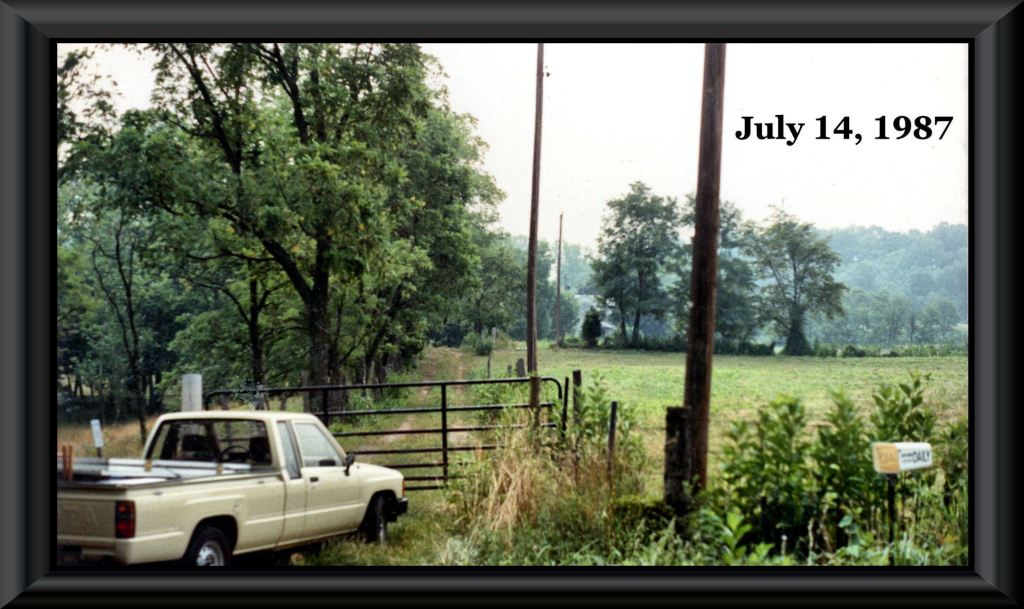
In early July 1987, our farm in the Reems Creek Valley near Asheville, NC suddenly had a sales contract on it. The following weekend, I was scheduled to hawk my goat cheese at a wine festival near Winchester, VA. You can see the fold-up tables and cheese coolers in the back of the pickup.
On the way home, I decided to take the Old Back Road to see if I could find a farm for sale that was suitable for conversion into a world class goat cheese operation. The restored historic houses in the Shenandoah Valley generally had very little pastureland attached to them, or were else unaffordable.
Just after driving over the Toms Brook bridge, a massive herd of deer passed in front of me, leaped over the fence then ran down the old farm driveway. There were at least 25-30 deer in the herd. I pulled the pickup into the abandon farm’s driveway entrance out of curiosity. The gate was unlocked, I took the camera along, hoping to photograph the huge herd of deer.

The farm was not officially for sale, but had not been lived on for a long, long time. Hay was being stored in the Keeping Room. (large living room with massive fireplace)
I beheld an ancient cluster of farm buildings in dilapidated condition. The house had a security light outside, but no kitchen appliances, electrical wiring or plumbing inside. The last occupants had cooked their meals in the fireplaces. The hearths still had pot cranes, typical of the 1700s and early 1800s. I eventually learned that the earliest part of the house dated from 1754 and had been built by Colonel George Washington as a frontier fortification against Indian war parties, allied with the French. Locals called it “the old Wisman Civil War House.”

The farm was littered with the debris of battle. The third largest cavalry battle of the Civil War was fought there on October 9, 1864. The two armies were led by two of the most famous cavalry commanders of the Civil War . . . George Custer and Tom Rosser.
The “Thornton Farm” was designated a key property of the proposed Shenandoah Battlefields National Park. For over a year, archaeologists and historians from the National Park Service’s Harpers Ferry Center. Several became close friends. I learned a wealth of information about archaeological techniques during that period.
After a contractor sanded the 200+ year old heart pine floors, I discovered multiple blood stains. Some were in the shape of human torsos. The date October 10, 1864 carved on the dining room floor. The hospital had been used as a hospital throughout 1864 and early 1865.

We bought the farm and I restored the house and farm buildings. I then built the finest goat dairy and creamery in the nation. The US Department of State sponsored the grand opening and furnished the National Champion Yodeling Choir from Switzerland as entertainment!

In 1990, Toms Brook Farm was named National Residential Restoration of the Year. However, my marriage had become living hell. My wife treated me worse than dirt. In fall, 1993, when being treated for poisoned tea that she gave me, the doctors determined that I had also been repeatedly exposed to arsenic for at least seven years.

While I thought being temporarily stuck in the Atlanta Area, I took a position as Principal Planner of Cobb County, which then had a population of over 600,000. I was responsible for administering staff land use planning and archaeological projects, plus personally doing the county’s historic preservation and urban design projects. The divorce judge had given me possession of the farm, but I needed a year or two at this job to pay off debts and be in a position to move back up to the Shenandoah Valley.
What I didn’t know was that my estranged wife had secretly filed for bankruptcy in December 1994, then stated under oath on her divorce papers affidavit that she had not filed for bankruptcy and had no plans to file for bankruptcy. I ended up being robbed blind by the Federal Bankruptcy Court of Western Virginia, even though I was not bankrupt.
My big historic preservation project in Cobb County was the Brushy Mountain Defense Line . . . an 11-mile Confederate fortification erected during the Battle of Atlanta. It was the largest fortification in the Americas and was the model for German defenses in World War One. My application for federal assistance was awarded the largest grant in 1995 by the National Park Service American Battlefield Protection Program.
While preparing the grant application, I had access to all manner of archives associated with the Civil War and the Battle of Atlanta. Out of curiosity I looked up the names of my Civil War ancestors. A Caucasian gg-grandfather was in the Confederate Army of Tennessee. I could determine the exact spot where he fought in the Battles of Smyrna, Kennesaw Mountain, Brushy Mountain Line and Atlanta.

The battle flag of Cobb’s Legion is now the State Flag of Georgia, with “In God We Trust” added to the state seal. The flag is featured at the beginning of the movie, “Gods and Generals.”
Big surprise . . . all of my Creek ancestors in Georgia were in one of the most famous units of the Civil War . . . Cobb’s Legion, Army of Northern Virginia. It was featured in the movies, “Gods and Generals” and “Gettysburg” . . . filmed while I lived in Virginia. My Creek ancestors were not slave owners and some had been a part of the Underground Railroad, which helped slaves escape to the North. Guess they didn’t have any choice about the matter. None were killed . . . which is amazing in itself. Most of Cobb’s Legion were killed or seriously wounded by July 1863.
My great grandfather, Jackson Bone, was 78 and my great grandmother was 28, when my grandmother, Mahala (Ruby) was born. He later became a Creek mikko (chief) and lived to 102. One of his lower legs had been cut off by artillery shrapnel in the Devil’s Den at Gettysburg. Afterward he played an instrument in the Army of Northern Virginia Band. He surrendered at Appomattox.
Then the biggest surprise appeared. What was left of Cobb’s Legion after Gettysburg was distributed to several regiments. A gg-grandfather was transferred to the Shenandoah Valley. He fought in the Battles of Third Winchester, Kernstown, Fisher’s Hill and Cedar Creek. He was captured in early November and spent the rest of the war in a horrid federal POW prison. The place where he was captured is surrealistic, beyond belief.

Somehow, the Grandfather Spirits of Native Americans DO guide their righteous descendants along a spiritual path with unforeseen consequences.
The Truth is stranger than fiction.
 The Americas Revealed
Richard,
That is a really interesting irony in History Richard, especially stumbling upon, buying and restoring the farm where your gg was captured while standing picket duty in the Civil War. Coincidentally, a relative of mine, GW (3rd cousin via my Grandma’s side) constructed that site in 1754.
So I had some Virginia confederate lineage as well. My Grandpa grew up along the banks of the Rappahannock River, his family hailing near Winchester (sleepy creek) and Martinsburg (later WV) and my Grandma grew up in Culpeper, VA.
We can trace her lineage to both Jamestown and Yorktown, George Washington being a 3rd Cousin on her side (my Mom’s side)
On Grandpa’s side we can trace back to a relative who died in Goldvein, VA and was part of the CSA Virginia 23rd Calvary.
https://civilwarintheeast.com/confederate-regiments/virginia/23rd-virginia-cavalry-regiment/
LikeLiked by 1 person
You do realize that your ancestor in the 23rd Cavalry fought in the Battle of Toms Brook? Lomax’s Division was stationed immediately to the east of our farm. Rosser’s division was on our farm.
LikeLiked by 1 person