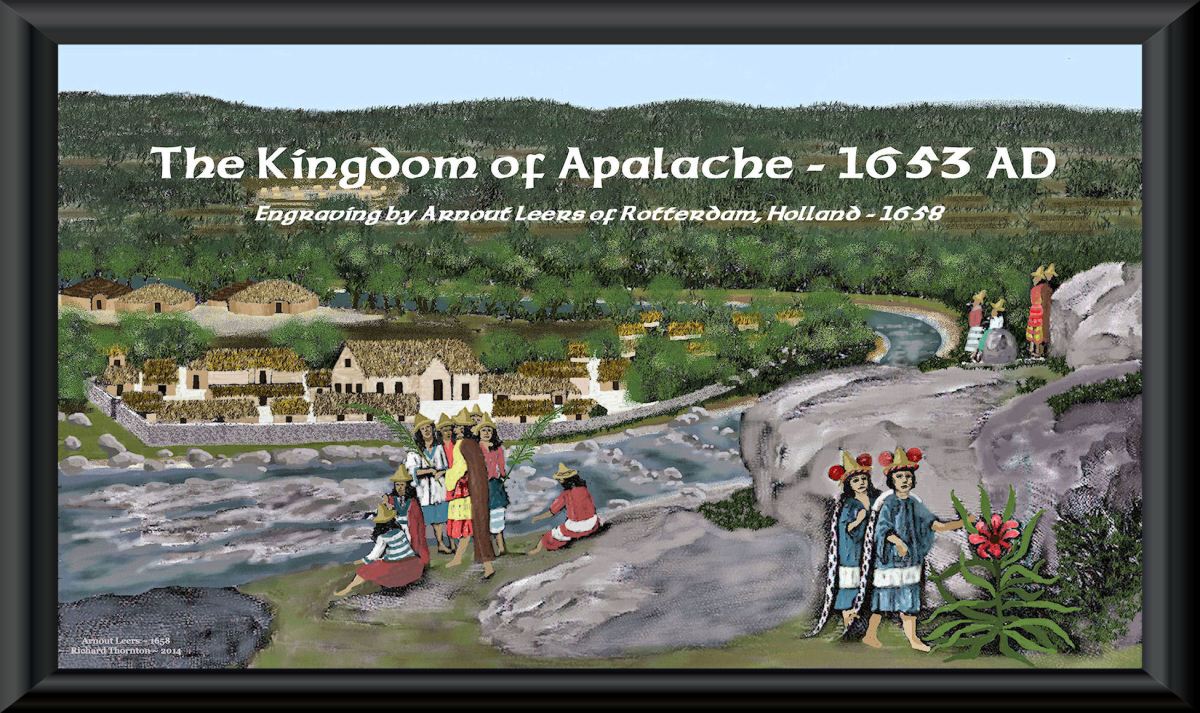
This 1658 lithograph was based on a sketch and written description by Richard Brigstock, made in 1653. The South American style tunics, seen here. evolved into the Creek Long Shirt worn by men and the Creek ribbon dress, worn by women. Those split cane hats were very practical in the summer months and appear in Pre-Columbian Creek art . . . but their use apparently died out in the 1700s . . . or maybe colonists in Georgia just didn’t think them significant.
Much of the sophisticated and ancient cultural practices of the Creek People was lost during the traumatic period of the 1800s, encompassing the Red Stick War and Trail of Tears Period. This apocalypse was climaxed by surviving members of the western tribes of the Creek Confederacy being forcibly mixed together along with several bands of animistic Shawnees. This, along with 200 years if life on the Southern Plains, adjacent to other tribes, has produced a hybrid cultural tradition in Oklahoma.
The location is the confluence of Dukes Creek and the Chattahoochee River in the Nacoochee Valley of Northeast Georgia. Ironically, this site is also the official location where a white pioneer discovered gold nuggets, which triggered the Georgia Gold Rush.
I have a very strange feeling, when I stand at this spot today. Not only was it the place of my ancestors for many centuries, but it is also where Eleanor Dare, a survivor of the Roanoke Colony, stood many times. She lived the last 10 years of her life on top of the temple mound in the architectural rendering below.
by Richard L. Thornton, Architect & City Planner

Birdseye view of the location of the lithograph above
When Georgia was settled in 1733, the Creek Indians used the generic ethnic label of Apalachete (Lower Mountains and Piedmont) Creeks, Kusate (Tennessee-NE Alabama-NW Georgia Creeks) or Itsate (Higher Mountain and Ocmulgee Bottoms Creeks) in political meetings with the British, but their primary ethnic identity was still, whatever tribe they were born into. The term Apalachete or Palache was also used for all members of the Creek Confederacy.
The Creek Confederacy in 1733 consisted of most members of the former Apalachen Confederacy. Many Chickasaw towns, which originally were members of the Apalachen Confederacy, dropped out of the Confederacy formed in 1717 at Ocmulgee, because of conflicts with the Koweta Creeks.
The ethnic label, Mvskoki (Muscogee) did not appear until 1748, when proposed by the new high king, Malachi Bemarin., who had a 100% Sephardic Jewish name. It has as its root, the Sephardic word, masko, which means “mixed ethnic background” - mated with the Irish “Gaelic suffix for “people or tribe.” Muskogee, thus, is a direct translation of the Itsate Creek word for Muskogee language speakers, which is Kofite. The town of Kofitasheki (Cofitachequi, mentioned in the De Soto Chronicles) was definitely a Muskogee Creek town.
Now you know!
 The Americas Revealed