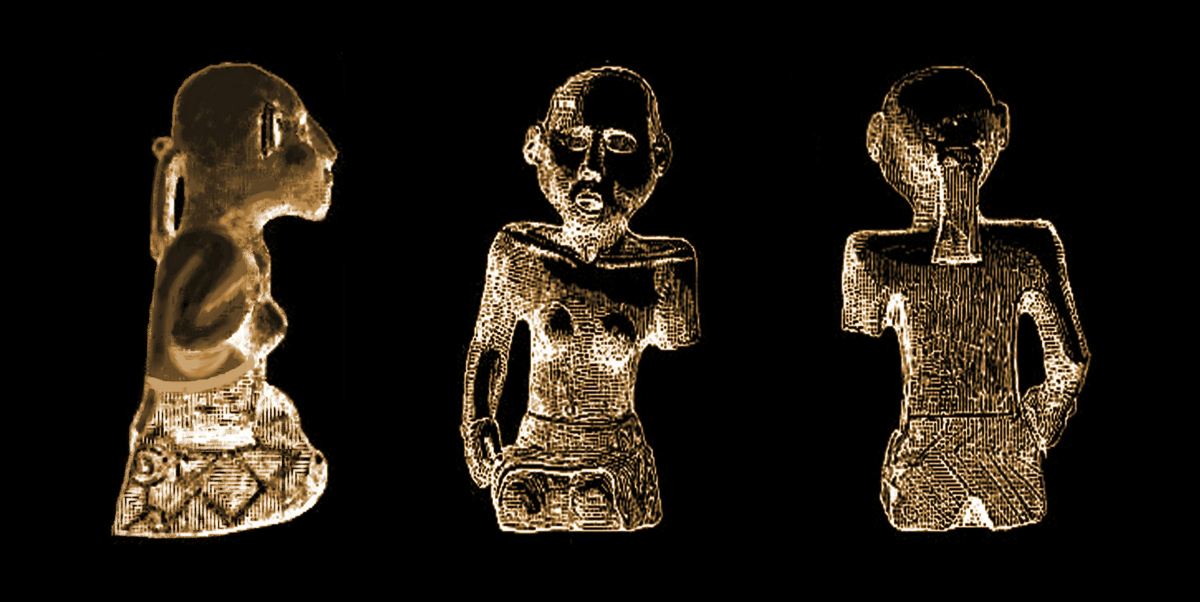
No museum in the United States, including those at the Smithsonian, Etowah and Ocmulgee, portray a Southeastern Native American woman, wearing indigenous-woven cloth or a pony tail!
As requested by a reader, this detailed view of a large ceramic statue from Etowah Mounds, clearly proves that the ancestors of the Creek Indians were wearing ornately patterned, woven clothing long before the arrival of Spanish and French explorers in the 16th century. The statue was excavated from Mound C by archaeologist Warren K Moorehead in 1926, but is not on display in any museum.
The chroniclers of the De Soto Expedition stated that the inhabitants of what is now the State of Florida wore crude leather or grass skirts, but as soon as they entered the homeland of the Creeks, Chickasaws and Uchees in the present State of Georgia, the occupants wore either tunics, dresses or skirts, made of complexly patterned, bright colored, cloth.
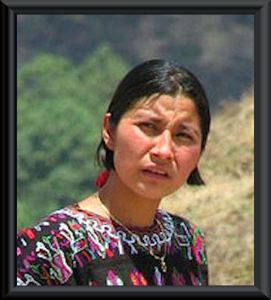
Remember the Itza Maya teacher in my previous article? Note that this young lady from long ago had a head and facial proportions, almost identical to those of my Itza friend, ”Natalie.” The only difference is that the Etowah lady had an artificially flattened forehead.
By the way, that is a terribly unflattering expression on Natalie’s face. She was really quite pretty, but my other color slides of her were faded, fuzzy or taken from a long distance.
The real name of Etowah was Etula, which is an Itza Maya word meaning, “Capital town.” In both Southern Mesoamerica and the Lower Southeastern United States, women in statuary are always kneeling, while men are sitting with crossed legs. I have noticed that anthropologists in the Southeast don’t seem to know this, but their Mexican counterparts do.
Now you know!
 The Americas Revealed