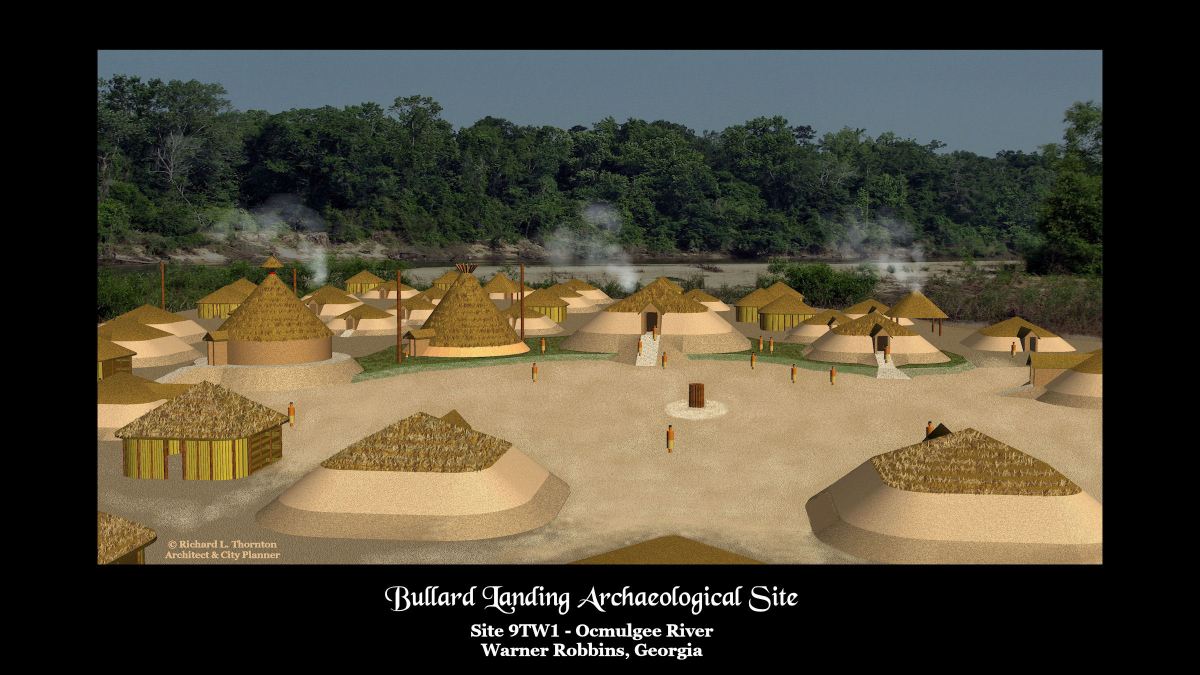
As an Architect, I thought it was quite peculiar that in two distinct periods, many commoners in Georgia were living in “pit houses” with thick earth berm walls. Such “earth lodge” houses were thought to be associated with the bitterly cold winters of the Northern Plains?
The Secret Native American History of the Southeastern United States – Part 7
by Richard Thornton, Architect & City Planner
In the previous article of this series, I provided personal glimpses of what it was like to be a professional farmer, so readers would understand why so much of my research over the past 20 years has been focused on recent geological and climatological research. Of course, modern architects are very much concerned with climatic and solar exposure conditions for building sites, but having one’s livelihood being dependent on the temperature and rainfall makes such concerns even more poignant.
Throughout my career, I have noted riddles, identified by archaeologists at specific occupation sites, which they could not solve, merely by classifying artifacts and giving them English names. In the 21st century, most of these riddles have been solved by geologists and/or historians, analyzing eyewitness accounts of the past. These riddles included:
- While taking an introductory course in Anthropology, required in advance by the Barrett Fellowship and taught by the famous archaeologist, Lewis H. Larson, he mentioned the biggest riddle of his career. All of the Swift Creek Culture villages and towns in southeastern and south-central Georgia had disappeared suddenly around 550 AD. Swift Creek villages, north of the Fall Line had not suddenly been abandoned, but showed signs of population decline. Yet, there were some Swift Creek villages that continued on until around 1000 AD in the northeastern tip of Georgia, where the climate is the coldest. If the culprit was cold weather, the longest lived Swift Creek villages should have been along the Atlantic Coast.
- At the orientation meeting for my fellowship at the Museo Nacional de Antropologia, its curator, Dr. Román Piña Chán, and I discussed how weird it was that the Southeastern United States would boom with population growth and cultural advancement at the same time that the population of southern Mexico was collapsing.
- While on the Campeche phase of my fellowship in Mexico, Ana Rojas and I visited Edzna. A team of architects and archaeologists were restoring a major temple pyramid there. They were puzzled. Then, the common belief was that all of the Maya Civilization disappeared at the same time. However, they had found proof that cities and villages in central and northern Campeche had continued to thrive until around 1500 AD, when a smallpox epidemic hit the Yucatan Peninsula. YET, they had just dug down to the level of around 550 AD at Edza, where it appeared that the population had declined by around 50 % within a few years. There was no evidence of mass deaths. The people just left for unknown places.
- About 10 days later, I was in Palenque. The famous guide, Moises Morales, was leading David and Linda Schele, plus myself, on a tour of the ruins. The Temple of the Inscriptions was being restored at that time. Moises told us that there was something odd at Palenque. Beginning around 550 AD and continuing for about 50 years, nothing was built there. Also, Palenque seemed to have been abandoned about a century before any other major Maya city.
Fifteen years later, Linda Schele would become the first person in the world to be able translate the full text of a Maya inscription. She chose those inscriptions in the Temple of Inscriptions as her first challenge.
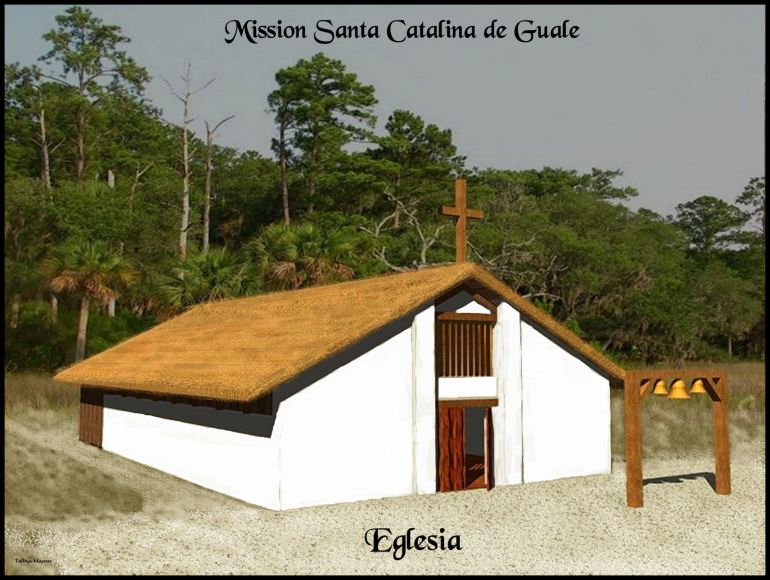
- Then in 2007, I was working with the archaeologists at the Museum of the American Indian in New York City in the creation of architectural drawings of the Mission Santa Catalina de Guale on Sapelo Island, GA. Either the island was not inhabited during the Early and Middle Woodland Period or “something” had scoured away the archaeological record. Yet, there was a ridge up to 85 feet (26 m) tall, roughly paralleling the Georgia Coast in which artifacts from many periods, including the Woodland, were found jumbled up out of chronological context.
Until next time . . .
 The Americas Revealed