
The Towns County, GA Indians are just one band of descendants, among many, of peoples who somehow migrated from northern South America into the heart of North America long ago.
Hints . . . the oldest known “Hopewell Culture” pottery (c. 600 BC) was found at the confluence of the Chipola River with the Apalachicola River in the Florida Panhandle. The oldest known “Swift Creek” pottery (c. 100 AD) in the U.S. was found at the Mandeville Town Site, about 85 miles to the north on the Lower Chattahoochee River in Georgia. However, “Swift Creek” Pottery was made long before then and up to the 1800s in the Satipo Province of Eastern Peru. Until the late 1600s, there was also a Satipo Province in Southeast Georgia!
The Secret Native American History of the Southeastern United States – Part 11
by Richard L. Thornton, Architect & City Planner
FOOTNOTE: The existence in Northeast Georgia of Native Americans with Peruvian ancestry opened up a whole new can of worms, twelve years ago, which academicians still don’t want to talk about. There are absolutely no mentions of South American immigration in university-published anthropology textbooks or professional papers.
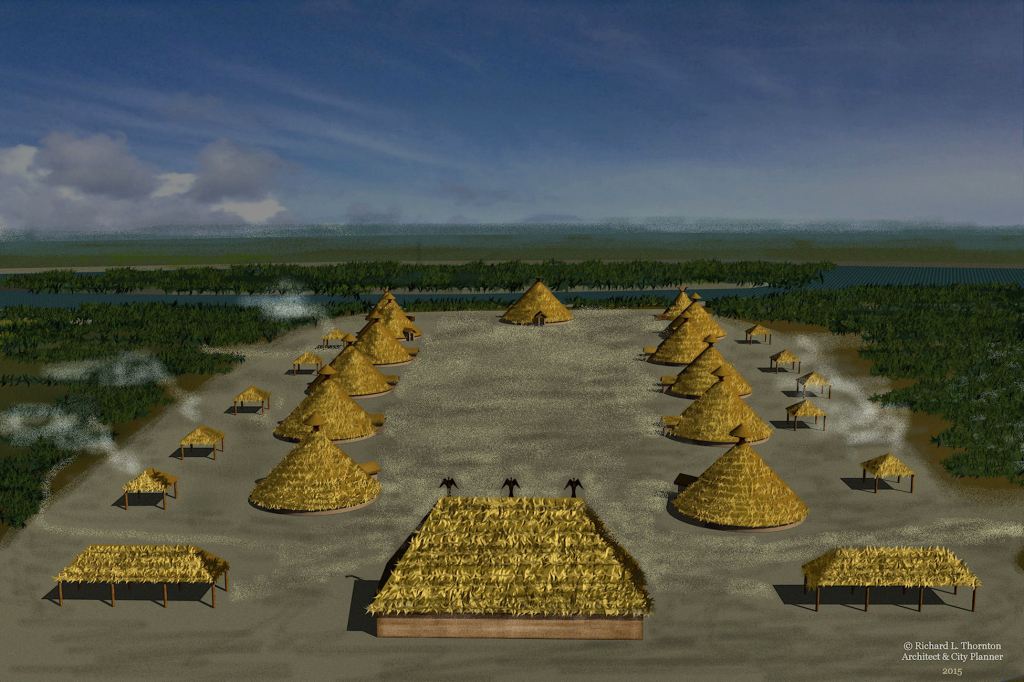
Remote sensing scans by Dr. Daniel Bigman in 2012 revealed that during the first century of its occupation, the Ocmulgee Acropolis was dominated by large conical houses, typical of northern South America. Ocmulgee was founded by South Americans! This information is not being given to visitors. My first mentor, Dr. Arthur Kelly, did not have access to radiocarbon dating in the 1930s and so misinterpreted the earliest phase of the acropolis as belonging to a Woodland Period “Swift Creek” village. But, then again, we now know that the Swift Creek People were Peruvians, who probably intermarried some with the locals, but their DNA is still carried by Eastern Creeks in Georgia, South Carolina and Florida.
Anthropologists are still adjusting to the reality of immigrants from southern Mexico messing up their orthodoxy and so, the South American “thang” has not even become a controversy. How can you explain rivers in Alabama, Georgia, Tennessee and Western North Carolina with Itza Maya names, unless there were Itza Mayas living on them? But then, there are also rivers and place names with South American origins. Part 10 was getting too long, so I saved that info for this follow-up article.
The essence of the story is that because of the huge numbers of readers that my column in the National Examiner received during 2012 and 2013, I was able to identify a genetic fact that had been overlooked by university faculties. Much of what textbooks labeled as homegrown Native American culture in Eastern North America actually was imported by multiple influxes of South American indigenous peoples. Most likely, climatic conditions were a major factor in these migrations, but that is not certain.
The astonishing information forwarded by Examiner readers was reinforced with the simultaneous discovery by botanists that the original varieties of corn, cultivated by Native peoples in Eastern North America and the commercial varieties of corn cultivated in Eastern North America today, are descended from a South American ancestor. The varieties of corn cultivated in the past and present in arid regions of Western North America are descended from a Mexican ancestor.

The so-called “Biltmore Mound” on the Biltmore Estate in Asheville, NC . . . was supposedly visited by De Soto in 1540 AD, according to some late 20th century North Carolina and Georgia professors. A 2001 dig revealed the “mound” to be a South American-style temple or communal structure, first constructed around 200 AD. The occupants were most likely Arawaks from northern South America. The archaeologists from Appalachian State University then reinterpreted the structure for the news media as “the earliest known Cherokee architecture.” Nope, that honor goes to the Temple of Athena in Athens, Greece, <joke>
It all began at Dave and Busters
A few weeks after the initial article on the Track Rock Terrace Complex in the Examiner, I received an email from the manager of a Dave and Busters Restaurant in North Metro Atlanta. He grew up in Towns County, which is on the other side of Brasstown Bald Mountain from the Track Rock Terrace Complex . . . which was then very much in the news. He was a Towns County Indian. They are labeled “Cherokees” by the Federal government, but know that they were living in the Georgia Mountains long before the Cherokees or even the Creeks, arrived.
I wrote back that I was actually familiar with the Towns County Indians. While homeless and camping near Brasstown Bald Mountain in June 2010, I had gone into Hiawassee, the county seat, to buy groceries. The only two cashiers at the supermarket were two young Native American ladies with Eastern Creek features . . . which are quite different from the Cherokees and Muskogee Creeks. Because their ancestry seemed mostly Native American and they spoke with distinct Southern accents, I assumed that they were Florida Seminole college students, working in the Georgia Mountains on summer vacation.
Nope! They were Towns County lassies, whose ancestors had lived there for at least 2000 years. Their families had avoided deportation to Oklahoma because they were not on the lists of Cherokee tribal members, carried by the soldiers . . . but hid out in the high mountains between there and the Nacoochee Valley, just to be sure. They told me that personality-wise, they seemed to be most closely related to the Creeks in Georgia and Florida, but had some different traditions.
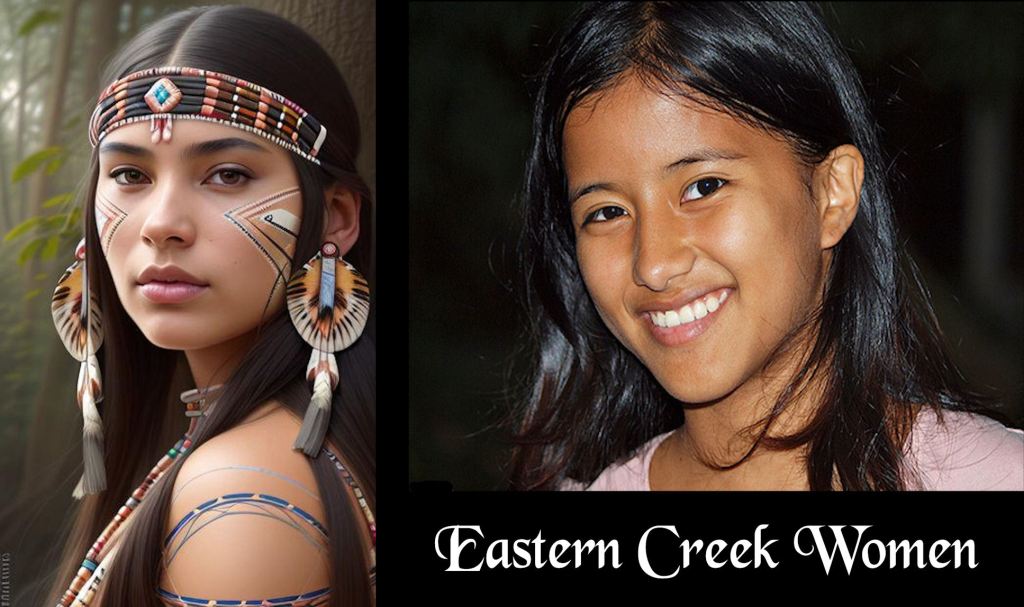
Like the Shipibo lady in the composite image below, these young Eastern Creek women have a protruding chin, pronounced cheekbones and a heart-shaped face.
He had taken a DNA test, hoping to prove that he was Maya. Nope! He was 25% Indigenous Peruvian, with a combination of DNA markers from several Peruvian tribes. That is extraordinary. A typical citizen of a federally-recognized Cherokee tribe runs between 0 and 2% Native American.
Other Towns County Indians took DNA tests. They also carried extremely high percentages of Native ancestry. Some only carried South American DNA, while others were a mixture of Peruvian and Maya.
I took a more precise DNA test in 2014. My Asian ancestries are also a mixture of Southern Mesoamerican (Itza Maya, Tabasco Maya, Zoque) and Panoan from Peru, plus Polynesian and Sami from Scandinavia.
The letters to my Examiner column from Towns County, attracted the attention from Native American descendants throughout the Southern Appalachian region and Oklahoma. All had the same story. They were descended from small tribes in the isolated mountain valleys of Virginia, West Virginia, Maryland, SW Pennsylvania, Kentucky, Tennessee, Alabama and Georgia. Their DNA tests said that they were from a mixture of Peruvian tribes or a mixture of those tribes with Southern Mesoamerican tribes. There were also some federally-recognized Shawnees in Oklahoma and the Midwest, who were mostly Peruvian.
My research in the years since then has identified numerous Peruvian place and tribal names in the Southern Appalachians. I also suspect that the elite of Cahokia were South Americans, because of their custom of burying sacrificial victims in the foundations of temples.
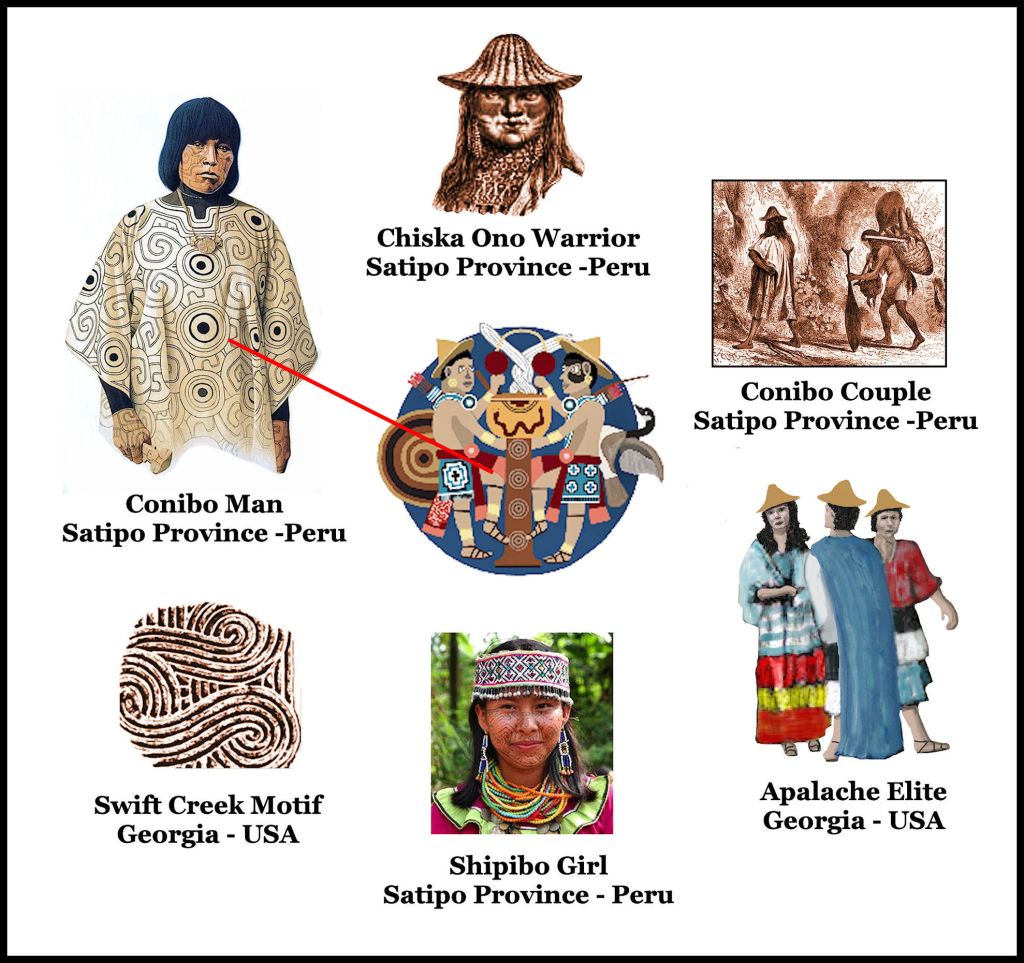
Several of the tribes, like the Chiska, Kusabo, Shipibo and Konibo, had the same name in North America as in South America. The Chiska even wore the same clothing in both locations. They also wore the conical straw hats that the Apalache Creeks in NE Georgia wore. The Apalache Creeks said that their ancestors came across the Great Waters from the South.
There are numerous Panoan words in the Muskogee Creek language. Asé is the word for Yaupon Holly and Yaupon Tea among the Creeks in the United States and the Panoans in Peru. Most of the “core” traditions of the Muskogee Creeks are South American in origin. That includes the Stomp Dance, Green Corn Festival, New Year’s Day on the Summer Solstice and the Sacred Black Drink ceremony.
In the past, I have published several, more detailed articles in The Americas Revealed on the South American connection. Just use the search word, “South America” at the bottom of its web pages to locate them. However, I wanted readers of this current series to know that I had not just pulled this topic “out of thin air.”

One of several, large, round house foundations, discovered by archaeologists from the University of South Carolina in 2012. The archaeological site is located in extreme northwestern South Carolina. This type of house is quite unusual in Eastern North America, but typical of the Andes Mountains. It was also the primary type of house constructed initially at the Devil’s Backbone near Charlestown, Indiana.
 The Americas Revealed