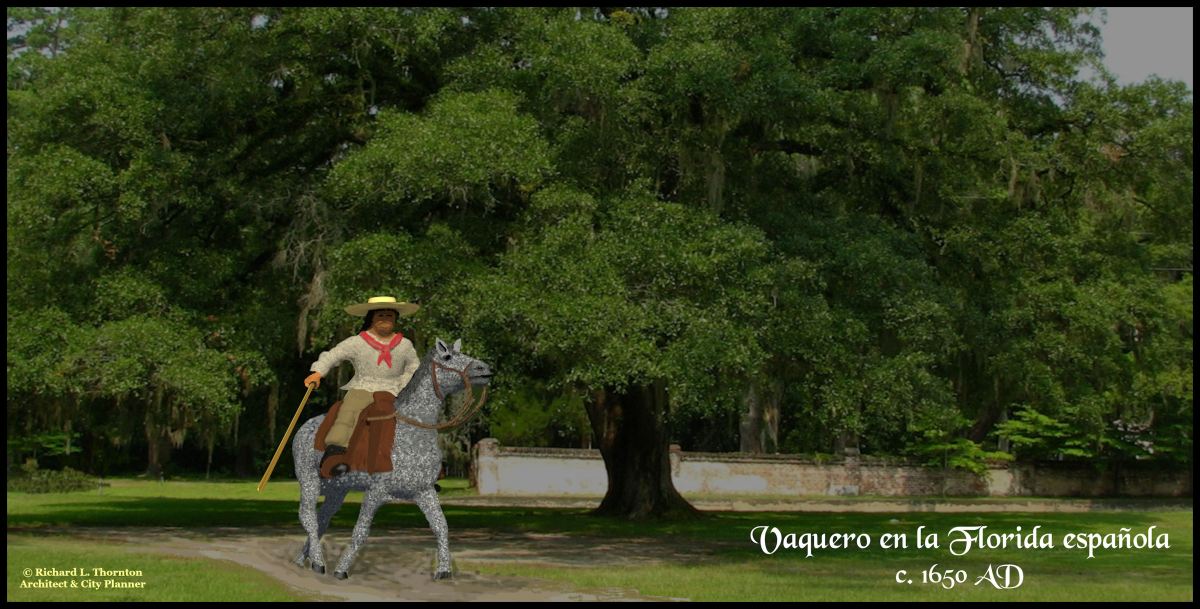
First test of my new equipment and software for creating precise architectural CADD models of humans and animals from any culture and any time period in the past! It is quite simple to insert them into my digital 3D CADD models of buildings or towns.
The is an extraordinary additional service that I will be able to offer museums, archaeological firms and government agencies.
by Richard L. Thornton, Architect & City Planner
From 1565 until the mid-1600s, St. Augustine, La Florida was almost entirely dependent on the free labor of mission Indians on the coast of Georgia for its corn , vegetables and fish. However, by 1640, the mission Indian population had so starkly collapsed from overwork and European diseases that the Spanish switched to making the Apalachee in the Florida Panhandle grow their corn, while wealthy men from St. Augustine established ranches in north-central Florida.
Hollywood never told us this, but the first American cowboys were in Florida, not Texas, New Mexico or California. Georgia and Florida were colonized by Spain over two centuries before California. Georgia originally had twice as many missions and mission Indians than California ever did.
In 17th century Spain, it was illegal for commoners to ride horses, but the owners of haciendas in Mexico, Cuba and Florida quickly learned that vaqueros were an absolute necessity in order to keep herds of cattle from going feral in the vast, unsettled expanses of the Americas. Thus, the vaqueros immediate had much higher status that peon farmers.
I did a bit of research before creating the Vaquero computer model. The horse is a gray Andalusian, It is a medium-sized, compact breed, accustomed to hot weather. This made the Andalusian well-suited for herding cattle in Florida.
The earliest vaqueros in Florida wore a woven-straw Cordobès sombrero, a loose-fitting , unbleached linen shirt, leather or deerskin pants and leather buckle-up boots. The lariat (herding rope) had not yet become a standard fixture of vaqueros. Typically, they use a long River Cane (American bamboo) pole and bull-whips to herd cattle in that era.
Seventeenth century Spanish Colonial saddles were a bit different than those in Europe. Almost the entire flank of the horse was covered by a sheet of calf-skin leather. This protected horses from bull horns, wild animals and thorns. The actual saddle was rather small and carved from wood then covered in leather. Attached to the calf-skin leather were pockets for holding grain for the horse, an arquebus or less-commonly, pistol, knives, unperishable food for the vaquero, a water cantena, a serape and a semi-waterproof poncho.
My computer model for the Spanish fort, trading post and mission in the Nacoochee Valley, visited by English explorer, Richard Brigstock in 1653, is nearing completion. After the publishing architectural renderings of several more French colonial habitations, I will give readers a grand tour of the Spanish complex . . . complete with all manner of critters and humans in period costumes! .
 The Americas Revealed
That’s cool! 1st cowboys were American Indian but mestizo. Fullblood slaves tended to take back pay in the form of horses and cattle and disappear. Yeah, how vile of them to not love the one who put whip scars on their backs and raped their wives and daughters. What’s not to love.
First trail drive to market was in colonial Massachusetts. If memory serves, the farmer trailed several cattle, sheep, geese and turkeys to boston Commons, maybe 5 miles from home. Hispanics sold hides and tallow and in California, 1830s, China clipper captains were trading equal to about 2 dollars US per hide. Smoked tongue was more. Pig hides more per hide. Florida cracker cattle are from the cattle rent charged to Ponce de Leon’s men, those that survived raiding towns down that way. My ancestors borrowed horses from some of those folks but never did get to return them. Well, they would have been shot, anyway. some people, no sense of humor! niio
LikeLiked by 1 person