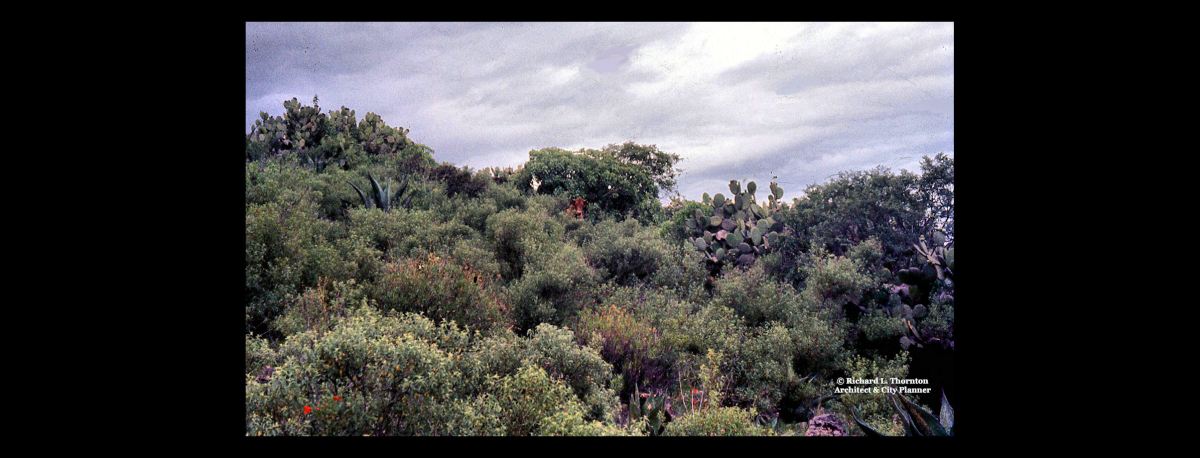
It was a “close encounter of a third kind” for an explorer, hiking alone on a mountainside.
by Richard L. Thornton, Architect and City Planner
Long, long ago in a time, known as the Neolithic Period, I was a college student. It was a strange time when people were generally happy and optimistic for the future, spacious houses were affordable, rock music played constantly, wherever you were . . . Georgia elected people to Congress, who the constituents thought were their sanest, wisest, most moderate and best educated citizens. Young women and men really liked each other . . . thought that was normal . . . and a lot of fun! It’s a proven fact that my generation in 1970 carried 250% more reproductive hormones in their bodies than today’s young adults. Young American adults today are essentially drones. Also, anyone, who wanted to attend college, could afford to do so . . . somewhere.
Unfortunately, the only practical means that architects and architecture students had in that era for documenting large numbers of buildings were color slides. Color prints were expensive to develop and tended to deteriorate rapidly, unless stored at a low temperature. Very few of my color prints from that era are even legible now. The big problem with slides was that the only way to see the details was to place them in a projector, whose intense heat and light, would eventually destroy the slides.
The fact is that until I moved to this house in the Nacoochee Valley in 2018, I never even looked at most of the 3000+ slides that I took during my four trips to Mexico. Over 2,500 of them were taken during my first trip on the fellowship from Georgia Tech. That’s a good thing, because most of the slides that I used constantly in slide lectures are now so fried that they couldn’t be salvaged.
From the autumn of 1970 until the autumn of 2000, I was frequently asked to give lectures on Mesoamerican architecture at universities, high schools, archaeological societies and historical societies . . . especially when I was living near Washington, DC. To save time, I kept the slides for my short lecture and long lecture in Kodak carousels. I gave the programs so many times that they were memorized.
Suddenly, in September of 2000, Georgia “law enforcement” officers began to attack ever aspect of my life . . . constantly spreading slanderous lies about me, because I had been branded a proponent of democracy and a dangerous enemy of fascism. Until mid-2006, Susan in her multiple disguises, plus several other women, were frequent guests in my home, so about all they could say with any credibility was that I was a librul . . . didn’t stay indoors all the time and watch TV like all good Christians . . . and had worked for that evil man, Jimmy Carter.
Nevertheless, that was enough for the brilliant folks in Pickens County, Jawja, No one every invited me to talk about Mesoamerica again, until I was on a prime-time History Channel show in December 2012. By then, numerous archaeologists in Georgia had forgotten that they attended my slide lectures and that I was the expert on the subject, not them.

Color slide of Teotihuacan and Cerro Gordo on June 21, 1970
Another discovery made while creating a video
Over the past five years, I have made many discoveries, while digitizing the surviving color slides. You see, I am preserving those memories of long ago by converting them into educational videos on Youtube. I have seen many details of buildings that were invisible on projector screens. For example, when the clouds sudden cleared as our Eastern jet was coming into Mexico City, I took a photo of the landscape below. I unknowingly photographed Teotihuacan and Cerro Gordo!
While creating the video on Tabasco and the Olmec Civilization, I discovered to my horror that in the batch of copied slides given to the Georgia Tech Library in the autumn of 1970, I had included one of a 25-year-old French archaeologist in her rental home near the Laguna de las Cerros Archaeological Zone . . . tout en étant très naturel!
I currently working on a video about the agricultural terrace complexes in Mesoamerica and Georgia. I now realize that many were designed to obtain water from passing clouds. Ten thousand feet high, Cerro Gordo, overlooking Teotihuacan, is completely covered in Pre-Columbian terrace walls. To illustrate my point, I am showing digitized slides of the desert landscape at the base of the mountain and the progressively greener slopes, which absorb moisture from passing clouds.

Here is the base of Cerro Gordo Mountain in July 1970 – looking southeastward. This area is now fully developed. There is a Walmart standing at this same spot now. I found several mounds, many ruins and artifacts on the surface of the ground here. My understanding is that NO archaeological survey work was done prior to the construction of the Walmart.

Here is the landscape inside the extinct volcanic crater at the top.

Here is a detail of the color slide of the crest of Cerro Gordo. The entire image is at the top of the article. It portrays foliage about 9,500 feet up the mountain. What a minute! All along, an extraterrestrial cow was watching me from deep inside the dense shrubbery. No, this is not Photo-shopped.

Here is a color slide at the same location, looking southward.
Old color slides are like a box of chocolates.
 The Americas Revealed
“I believe…” – that Wal-Marts are the E.T.s
LikeLiked by 1 person
I am beginning to wonder myself. LOL I am going to post another view of the Walmart site. You can see the lime plaster and collapsed stone walls on the landscape.
LikeLiked by 1 person