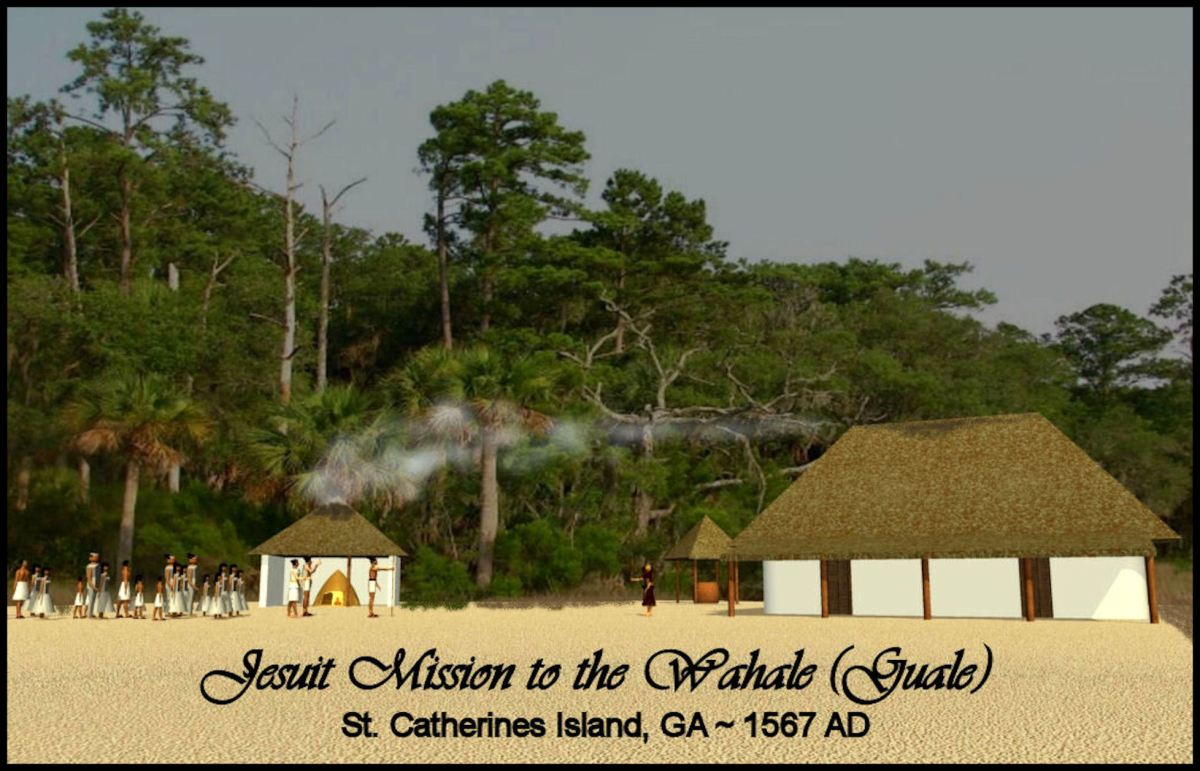
It was pure Campeche Maya vernacular architecture.
by Richard L. Thornton, Architect & City Planner
After the destruction of Fort Caroline, the Spanish quickly consolidated their control of the South Atlantic Coast of North America by building Fort San Mateo near the site of Fort Caroline, a compact coastal fortification at the mouth of St. Augustine Bay, Florida, a small village on the west shore of St. Augustine Bay and the first stages of the capital of La Florida on what is now Parris Island, SC. It was named Santa Elena. We will talk about these projects in later articles.
The Spanish hoped to pacify the dense Native American population on the present day Georgia coast in between Santa Elena and St. Augustine with a robust mission system. The headquarters of the mission system was to be near the mouth of the Rio Secco . . . called the May River by the French and after 1721, the King George River or Altamaha River by the British . . . on what is now St. Catherines Island, GA. Florida history textbooks leave that little detail out!
Jesuit missionaries were brought in from Havana, Cuba to preach in Spanish to the Native peoples. That went over like a lead balloon. However, in 1567, a permanent mission station was established on Isla de Santa Catalina (St. Catherines Island). Its staff was instructed to learn the languages of the natives and create dictionaries of said languages. Soon smaller Jesuit missions were established on Isla de San Pedro (Cumberland Island) and Santa Maria (St. Marys, GA) for the Mocama, plus missions for the Taino Indians on what is now St. Simons and Jekyll Islands.
The Jesuit missions on the Georgia Coast did not last long. Several missionaries were assassinated. The others barely got out with their lives. Georgia Indians frequently killed any Spaniards, who were castaways from ship wrecks, but gave refuge to French and English castaways. On some occasions, entire groups of Spanish soldiers were massacred, if they tried to travel by land from Santa Elena to St. Augustine.

The architecture of the Wahale buildings & missions
Origin of Tabby architecture
An architectural engineer in the Spanish army, who supervised the construction of Fort San Mateo and the first mission station made a fascinating observation. He said that the Guale (Wahale) buildings “glistened like pearls.” The cores of their buildings were wattle & daub like most Native AND Spanish colonial buildings in the 1500s and 1600s.
However, the Indians imported white clay from far upstream on the Rio Secco, which they mixed with hydrated lime, made from burning sea shells, sand and gravel to made a lime stucco, which was applied to the wattle and daub walls to make them more waterproof. Crushed oyster shells were then pressed into the damp stucco, with the “mother of pearl surfaces facing outward.”
I was stunned when I read the archaeological reports from the American Museum of Natural History. The convento or main mission station at Santa Catalina was identical to the houses of Wahale oratos (village chiefs), plus those of village makos (village chiefs) in eastern Campeche and the Chiapas Highlands of Mexico.
Both the village chief houses and the conventos contained three rooms, serviced by two doors. An expansive portico roof, served as a shaded meeting space for the structure. The roofs were much higher pitched than standard Wahale and Campeche Maya houses.
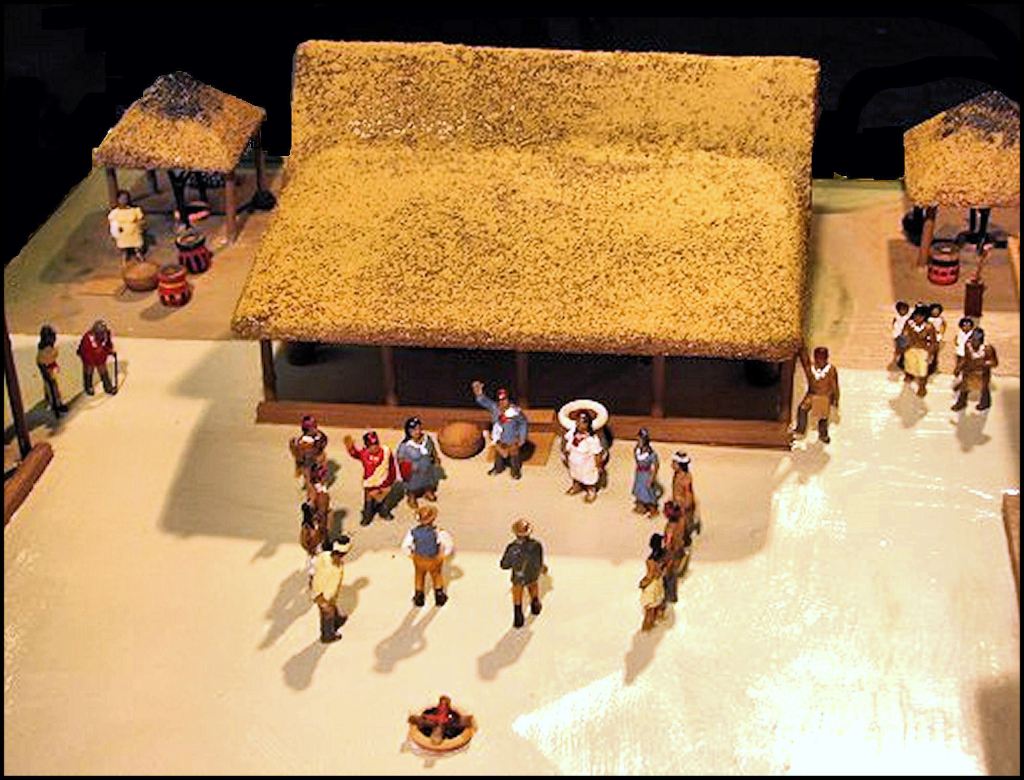
Detail of a model that I built for the Muscogee-Creek Nation, which portrays William Bartram meeting with Apalachicola Creek leaders near Pensacola, FL.
While traveling through Georgia, Alabama and northern Florida between 1773 and 1776, William Bartram sketched these same style village chief houses in Creek towns. I do not know if this architectural tradition was brought into the interior of the Southeast by Mesoamerican immigrants or was copied from the Coastal Natives/Spanish missions.
 The Americas Revealed