All Infrared images provided by the Georgia Coastal Commission, Darien, GA
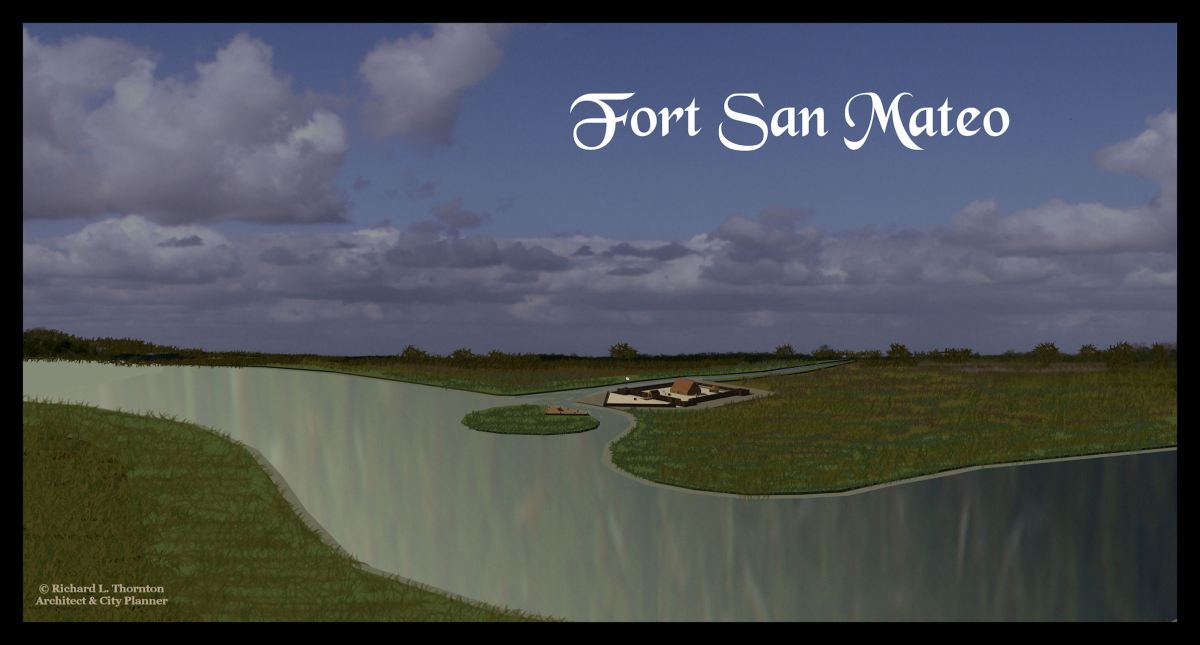
Expecting an attack by French Protestant ships from La Rochelle, France at any time after the massacre of Fort Caroline, Spanish engineers erected identical Fort San Felipe on Parris Island, SC and Fort San Mateo on the South Channel of the Rio Secco (Altamaha River) in what is now Georgia.
The construction plans for these forts are preserved at the Archives of the West Indies in Seville, Spain. This enabled me to create precise architectural drawings of the structures. They were rendered by an early version of the Artlantis Virtual Reality program from Paris, France.
Slide Show
by Richard L. Thornton, Architect & City Planner
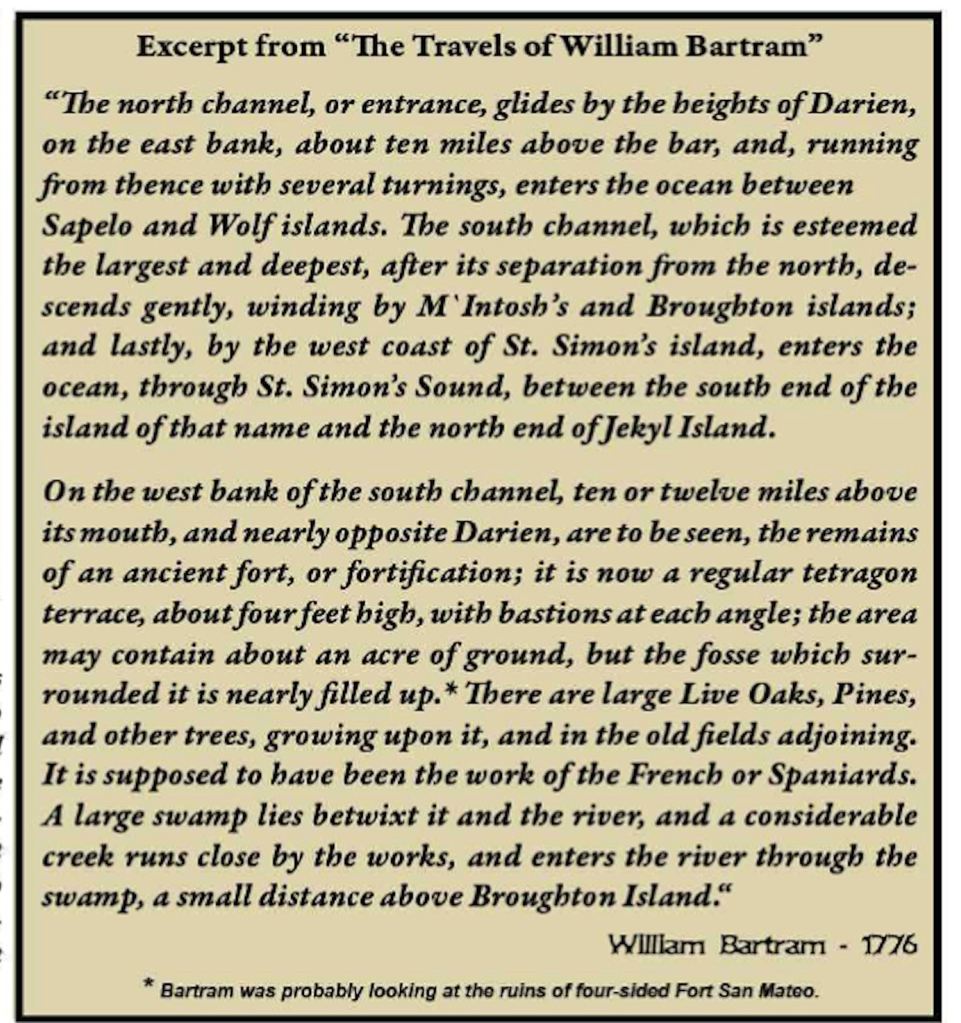

In 1934, Smithsonian archaeologist, James Ford, excavated a dense deposit of 16th century French and Spanish domestic/military artifacts to the south and east of these earthworks. He did not excavate the earthen ruins, thinking them to be “an Indian mound of some sort.” The 16th century artifacts were exhibited in the museum at San Domingo State Park for about a decade. Their current location is unknown.
This information enabled me to quickly pinpoint the location of the Fort San Mateo earthworks in 2011. Eighteenth and nineteenth century rice cultivation has seemingly concealed the massive triangular palisade of much larger, Fort Caroline. Fort Caroline stretched 1800 feet (549 m) east-west.
NO 16th century European artifacts have been found in the vicinity of the “Fort Caroline National Monument” site in Jacksonville, FL.

Full infrared spectrum image of south side of Altamaha River near Darien, GA
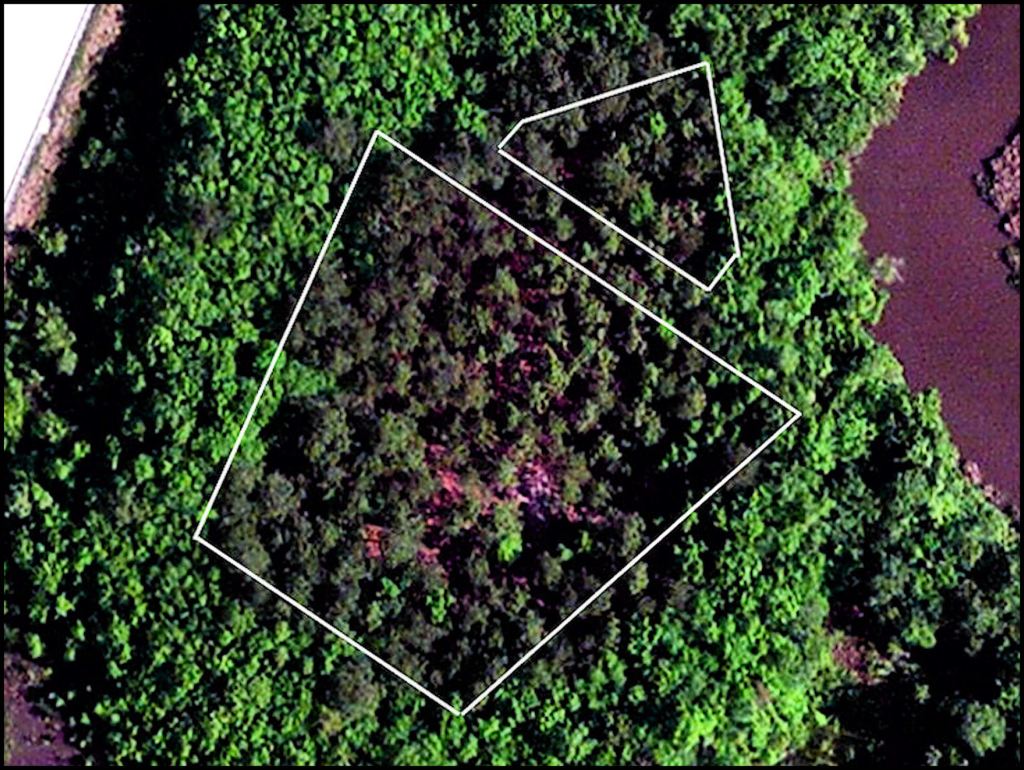
Near visible infrared scan of Fort San Mateo earthworks.

Fort San Mateo was constructed near the site of Fort Caroline with recycled lumber from the demolished French fort. It was a compact, stoutly built fortifications, theoretically capable of repulsing large scale naval or infantry assaults. Whereas, Fort Caroline was a hastily erected ditch, reinforced with timber palisades or stakes, Fort San Mateo’s construction involved erection of heavy earthen ramparts, which are still visible today.
Two smaller forts were erected on the north and south side of the mouth of the Altamaha River, where it enters Altamaha Bay, They were equipped with heavy coastal artillery, capable of sinking any ship, but were vulnerable to infantry attacks from the mainland.
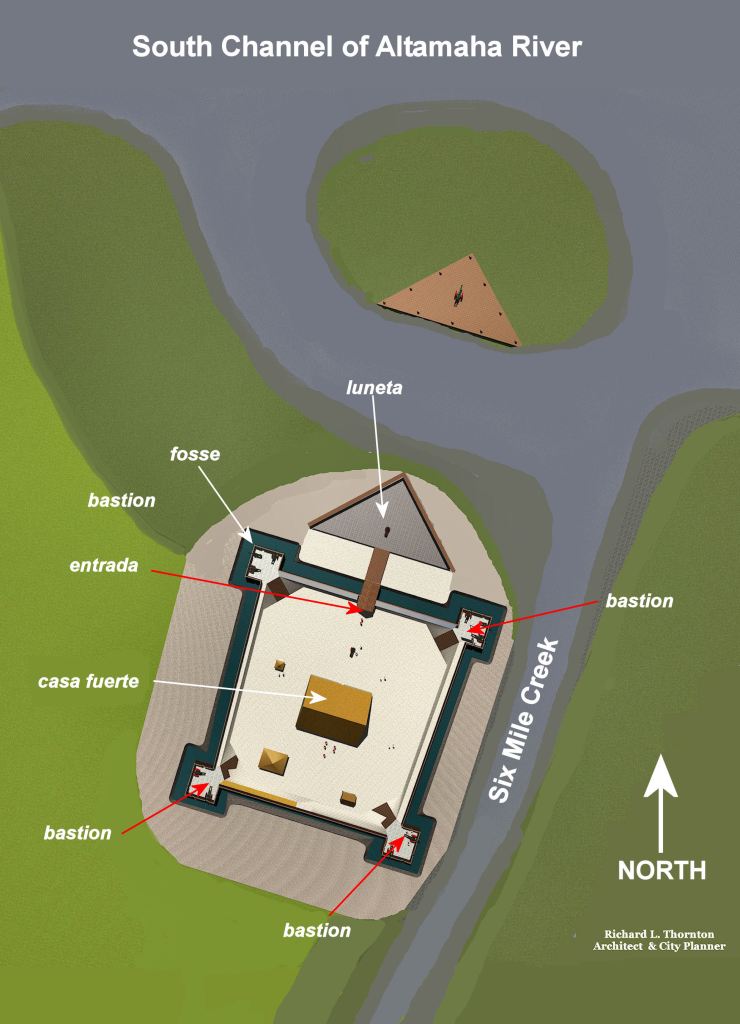
Plan of Fort San Mateo based on construction drawings
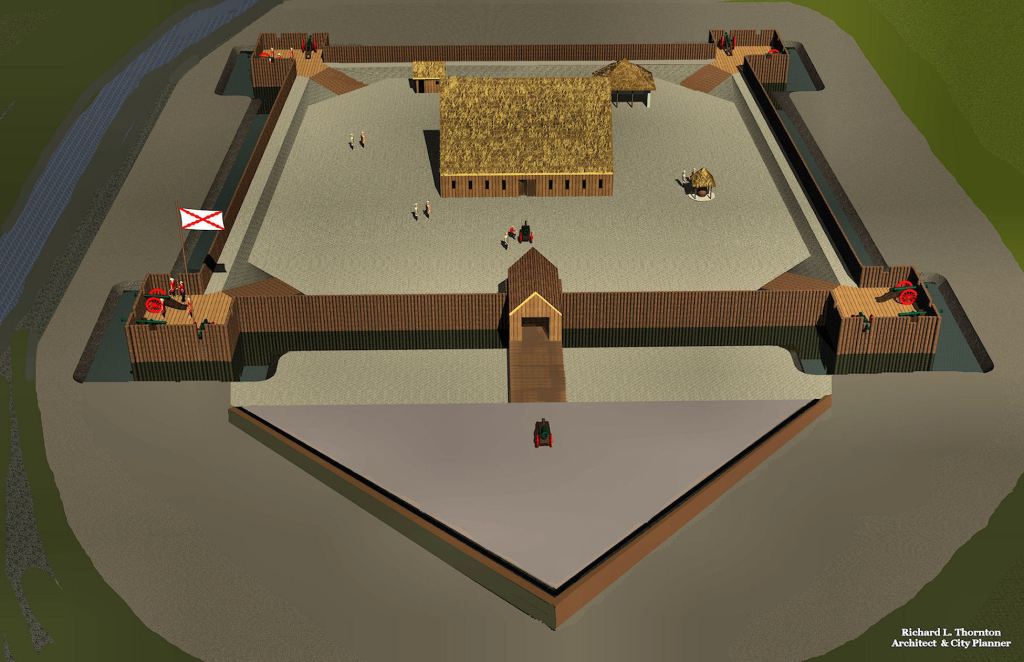
The lunette in the foreground protected the fort during unusually high tides.
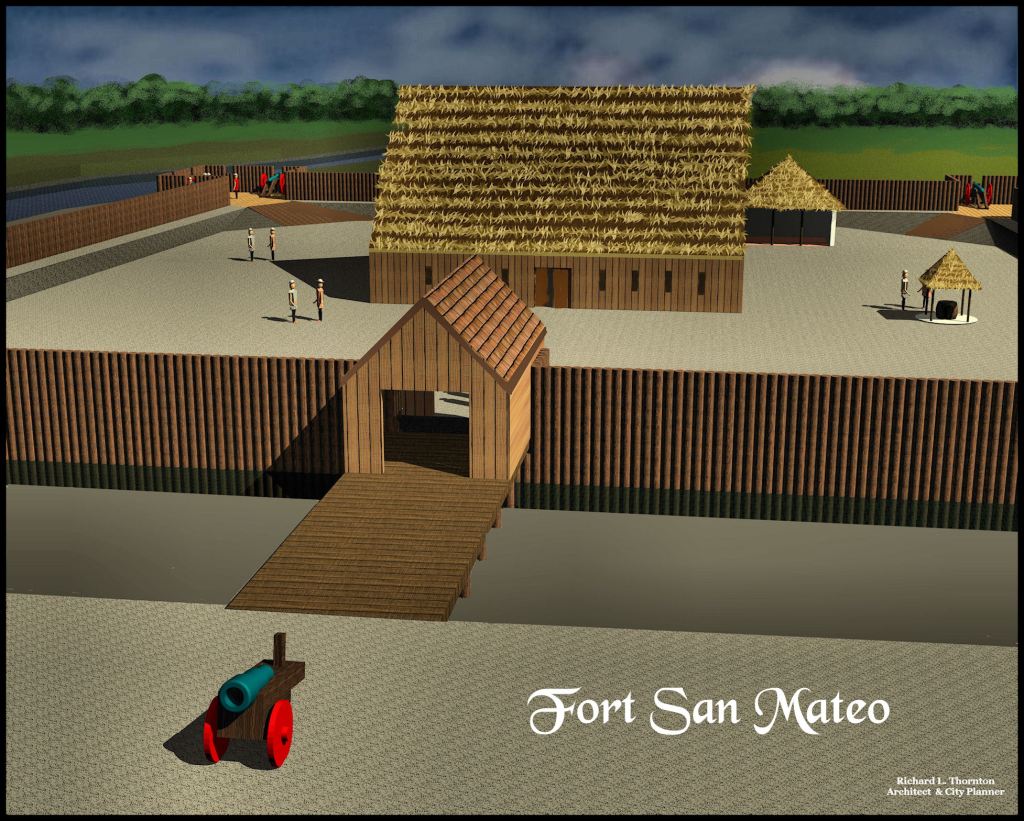
This type of cannon was essentially a big shotgun!

Six Mile Creek is in the foreground.

San Mateo’s bastions enabled cannon fire in all directions.

The flag of Spain during the 1500s
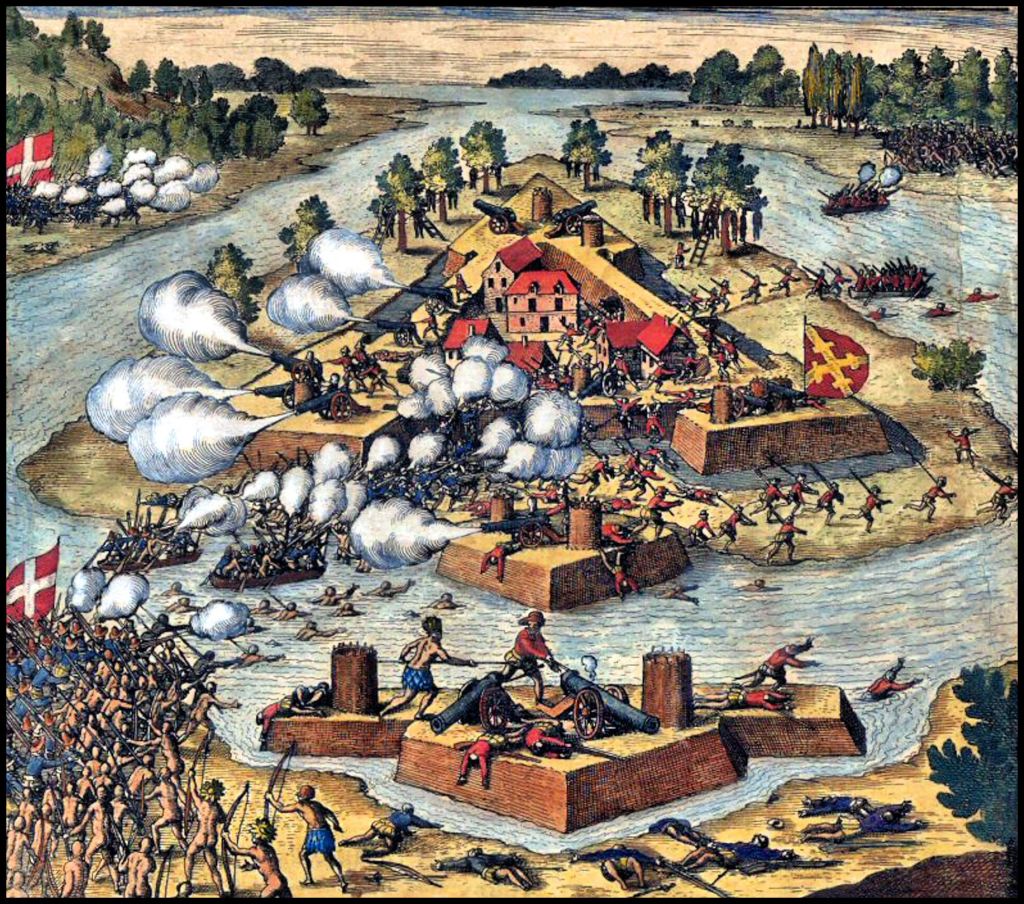
Dominique de Gourgues, a French nobleman and military officer, became outraged when he heard of the massacre of virtually all inhabitants of Fort Caroline and of the ship-wrecked survivors of Jean Ribault’s fleet. He sold all of his belongings and equipped a three ship fleet that sailed to the Americas to seek revenge. He did not tell his crews what the purposed of the voyage was until they landed in southern Cuba. At the time, the southern coast of Cuba was occupied by a mixture of Sephardic Jews and Maya refugees, who hated the Spanish government and sold supplies to ships from other nations.
De Gourgues’ fleet slipped past Spanish fortifications in St. Augustine and the Altamaha River and established a fortified base on the Medway River, near present-day Midway, GA . . . south of Savannah. This is more powerful evidence that both Fort Caroline and Fort San Mateo were in Georgia, not Florida.
The French began contacting Native American allies along the Georgia Coast, not the Florida Coast. They partied and planned their attack on Ossabaw Island, GA. De Gourgues’ small army then disappeared into the interior of the Southeast throughout the winter. Official records are silent, but it is documented that all four forts erected and garrisoned by Captain Juan Pardo during the summer and autumn of 1567, were massacred that winter.
The Frenchmen then reappeared at their base in March 1568 and called together their Native allies. This army then marched and paddled quickly to the Altamaha River and attacked Fort San Mateo from all sides without warning. They first massacred the garrisons of the small forts at the mouth of the Altamaha . . . apparently before they had a chance to fire warning shots.
The Satile warriors then dashed to the guardhouse and killed the sentries before they could close the gates. Alecmanni warriors speared the soldiers near the “shotgun” cannon on the lunette (see painting) before they could fire the cannon.
Most of the garrison was killed in the assault. Those who surrendered were hung from the same trees that Pedro Menendez hung French prisoners on in October 1565. The Frenchmen were given a heroes welcome when they arrived back at the coast of France. However, De Gourgues was shunned by the king and threatened with punishment for the unauthorized attack. He lived in poverty for several years before again being given command of royal ships and troops.
It is interesting that Franciscan missionaries based at missions near the mouth of the Altamaha (Secco) River in the 1600s, thought that the ruins of Fort San Mateo were the ruins of Fort Caroline. They visited the supposedly haunted site, periodically. The massacre of Fort San Mateo was so embarrassing to the king and nobility of Spain that they officially “erased” its memory.
 The Americas Revealed