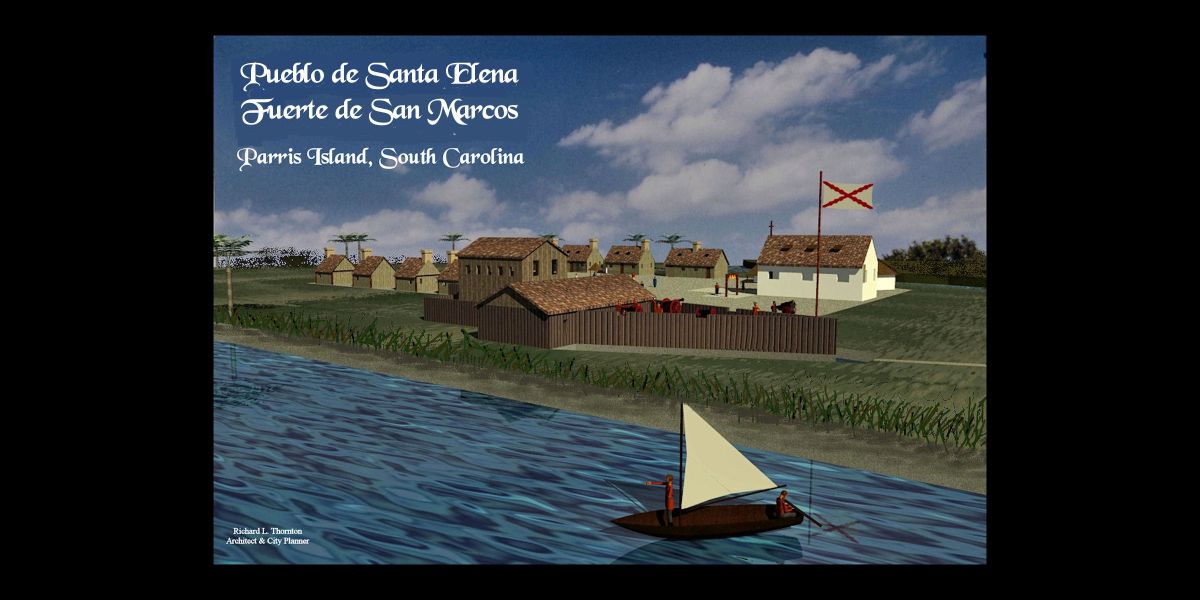
Parris Island, South Carolina . . . 1566-1587
As explained in earlier articles in this series, the Spanish first planned to build their provincial capital on the Bahía de los Delfines (Bay of Dophins), which is now Saint Andrews Sound in Georgia. The is because it had the deepest and one of the largest harbors on the Atlantic coast of North America and its Natives grew large crops of corn, beans, squash and pumpkins.
San Agustín was moved to its current location in the State of Florida in March 1566, However, vegetable crops did not grow well along the coast, south of the St. Marys River, unless cultivated in raised beds of biochar soil, like the Mayas on the Coastal Plain of Campeche. The Spaniards were not inclined to do this, so its residents would always be required to import much of their food from elsewhere . . . grown by indigenous “mission Indians.”
Also, Nuevo San Agustín’s harbor was too shallow for large warships and cargo galleons, so Gov, Pedro Menendez immediately began planning a provincial capital on Bahia de Puerto Royal in present-day South Carolina. Already under construction were two identical, robust forts at the mouths the Rio Secco (Altamaha River in Georgia) and at the site of France’s Charlesfort on Isla de Santa Elena (Parris Island, SC), to establish Spain’s military dominance on the South Atlantic Coast.
by Richard L. Thornton, Architect and City Planner

Excerpts from the book, Earthfast . . . the Dawn of a New World
The first Santa Elena

In the spring of 1566, Governor Pedro Menéndez established initially peaceful relations with the Orista and Guale Indians near Port Royal and built a casa fuerte, called San Salvador, on Parris Island. He left a 71-man garrison under the command of his kinsman Esteban de las Alas.
In June of 1566, while Menéndez was in the Caribbean to acquire more supplies for his colony, 43 of the soldiers at Santa Elena mutinied, seized a ship and fled to Cuba, leaving Alas and 28 men at San Salvador. A mid-16th century Spanish casa fuerte can be seen on the images of Fort San Filipe.
In July of 1566 royal warships arrived at Port Royal with additional supplies, along with the 250-man company of Captain Juan Pardo. Pardo’s company began construction of a Fort San Felipe, which incorporated and expanded what remained of Charlesfort. The wooden stake walls of Charlesfort were replaced with raised earthen gun platforms. Two bastions near the water were expanded, while two more were added on the landward side that replaced the single landward bastion at Charlesfort.

There was a secret reason for establishing the Capital of La Florida on Port Royal Sound. It and the Savannah River’s mouth were the closest points to the Appalachian Mountains from the Atlantic Coast. Spanish spies within Fort Caroline had informed Menendez that the French had made contact with the most advanced indigenous people, north of Mexico . . . the real Apalache (Apalachen in the plural form). There were large deposits of gold and precious stones within their realm. Hernando de Soto had labeled a tribe in the Florida Panhandle with that name, but they did not call themselves, Apalache.
Menéndez arrived back at Santa Elena on August 11 of 1566. A zocalo or plaza was laid out near the bay. According to the National Historic Landmark nomination of Santa Elena, archaeologist Chester de Pratter, stated that the church, government buildings and residences of the leaders of the colony were constructed on this plaza. However, the archaeologists’ site plan of Santa Elena I has never been made available to the public. We must rely on statements by Spanish army architectural engineers that Santa Elena I and II had the same plans . . . and hope that is what they built!
The National Historical Landmark nomination for Santa Elena describes the houses at Santa Elena as being very similar in construction to Native American houses. They were earthfast buildings! Timber posts were places in the ground. When a three-dimensional timber framework was completed, vegetative materials such as corn stalks and husks were packed between the posts. These were covered with several layers of clay plaster, the stuccoed with hydrated lime. It is believed that most of the houses at Santa Elena had thatched roofs, but this is not certain.
The archaeologists commented that the largest houses seemed to be clustered on the plaza of Santa Elena. It was theorized that yeoman farmers built homes away from the plaza and adjacent to cultivated tracts. However, since the archaeologist apparently did not locate such houses, the comment can only be considered speculative.
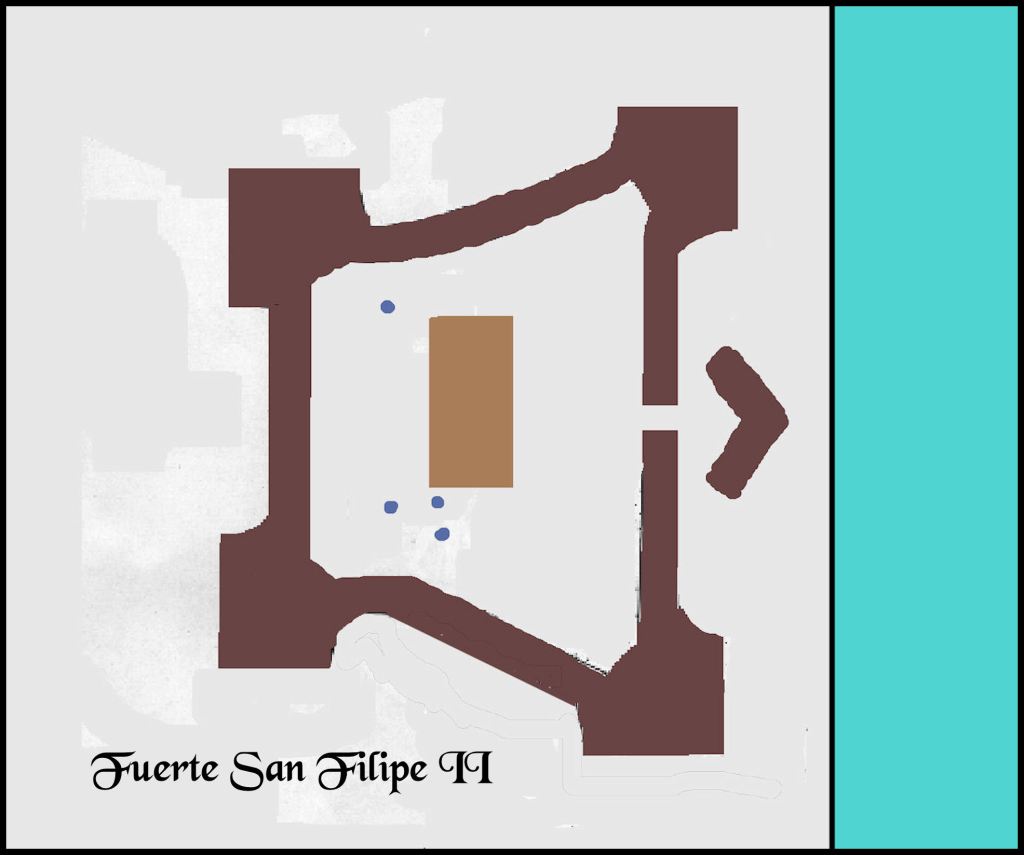
As the relations between England and Spain evolved from a clandestine naval engagements to open warfare, insecurity plagued the relatively few European inhabitants of La Florida. Fort San Felipe was rebuilt to strengthen its defenses against the cannons of English ships.
Also, an infantry fort was constructed closer to the town of San Elena. Theoretically, it would be able to protect the town from attacks by smaller warships and English raiders on foot.
During the early 1570s, Santa Elena grew to a population of from 400-450 colonists, with approximately 60 houses. However, the Spanish inevitably began doing the same naughty things they had done in the Caribbean and Mexico . . . with the goal of turning South Carolina’s Natives into Mexico peons (serfs.)
Nearby Native provinces rebelled against the attempted subjugation in 1576. All colonists, who weren’t initially killed, were driven into their boats. The two fortifications, occupied by professional Spanish soldiers, were ill-prepared for the type of guerilla warfare, practiced by Native Americans. As they sailed out of Port Royal Sound, the surviving Spanish colonists watched their homes and forts being burned to the ground.
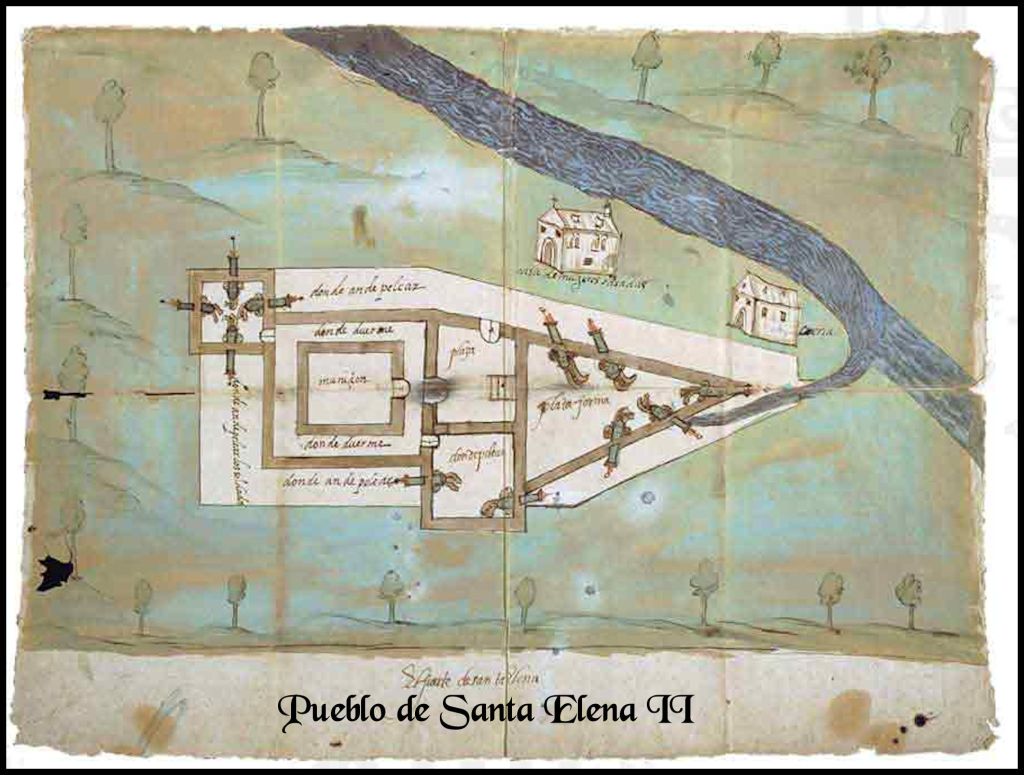
Water color rendering by Spanish Architectural Engineer Alavaro Flores de Valdes . . . from the Spanish Colonial Archives of the West Indies in Seville, Spain. Flores also provided me valuable information on the indigenous architecture of the Georgia Coastal Islands in that era.
Second Santa Elena and Fort San Marcos
The Spanish returned to the site of the first Santa Elena in 1577. The villages that attacked the town in 1576 were attacked without mercy. The second occupation was a time of brutal suppression of the nearby Native peoples, which caused many to flee inland.
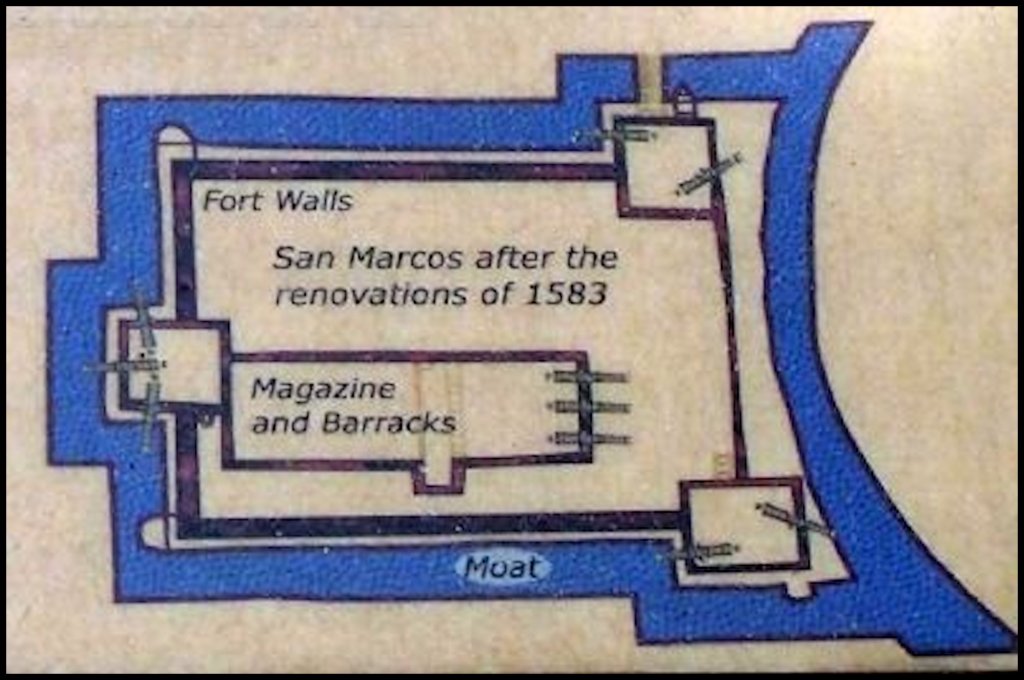
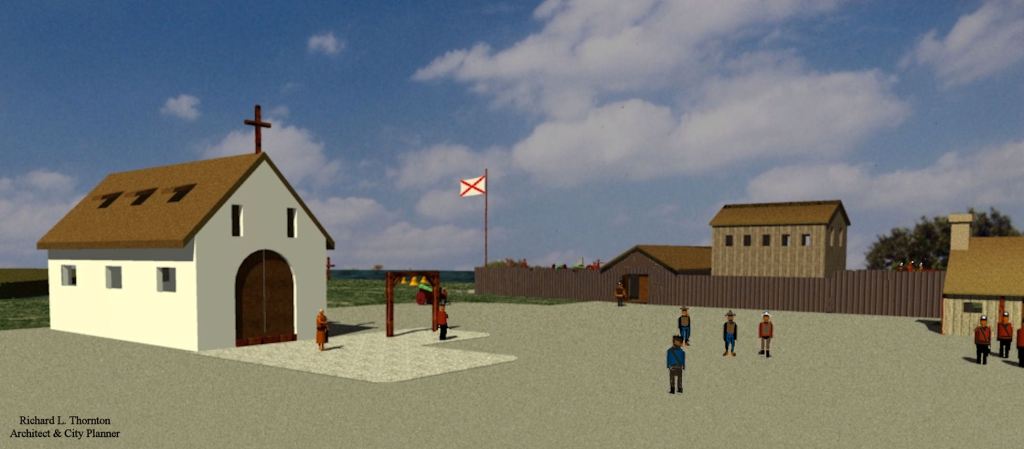
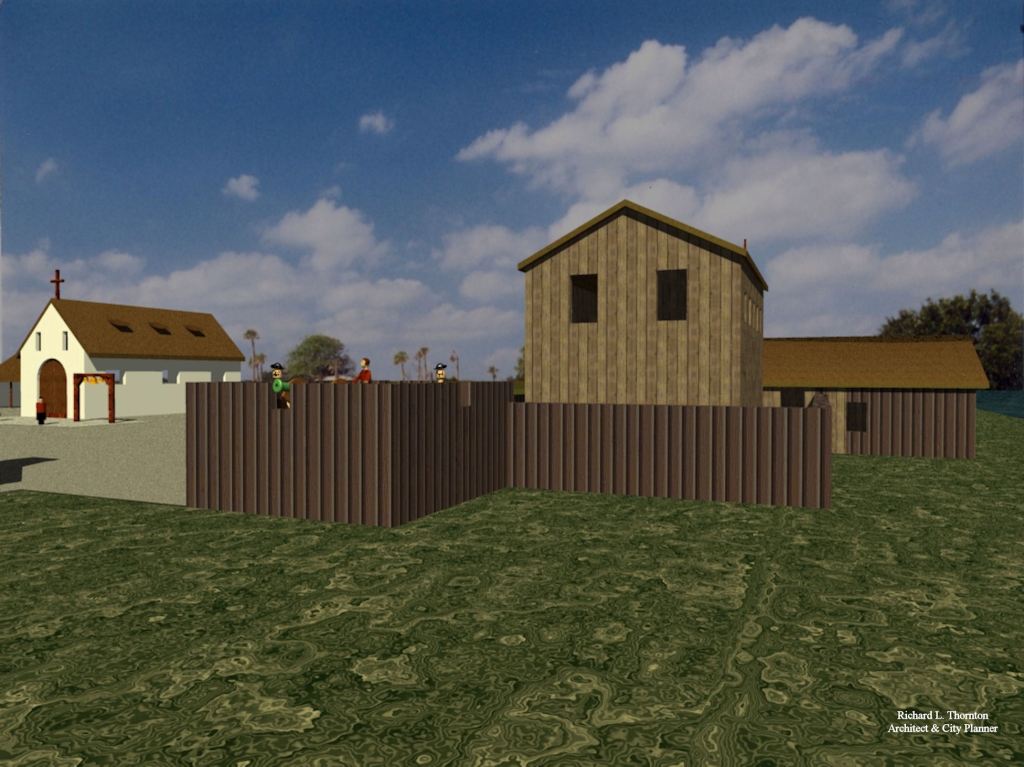
While the site plan of the many years of archaeological studies on Santa Elena evidently are not public information, drawings of a fort built at Santa Elena in 1577 are available. The sketch by Captain Alvaro Flores de Valdés has enough detailed information on it to create a virtual reality image.
The core of the fort may be a reconstruction of Casa Fuerte San Salvador that was built when Spanish soldiers first arrived at Parris Island in the spring of 1566. A contemporary structure was built at that time in St. Augustine that had approximately the same footprint and was portrayed by the draftsman as having two stories.
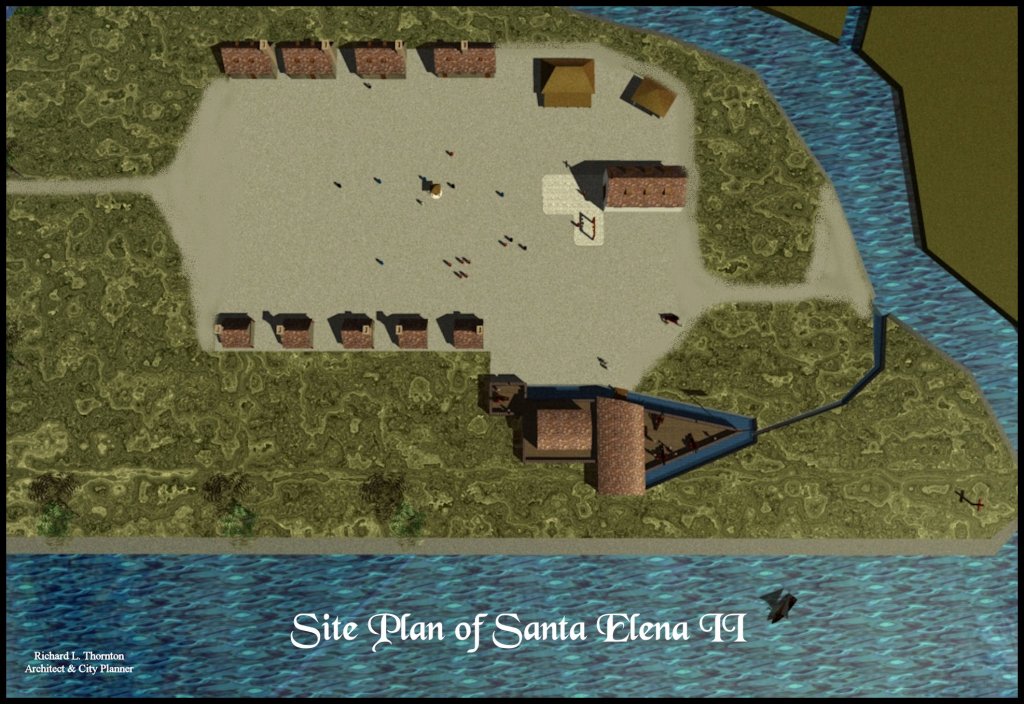
While the Great Armada was being constructed in Spain, a royal command reached Santa Elena and San Agustin to strengthen their defenses in preparation for English attacks. The last major construction project at Santa Elena involved expansion of Fuerte San Marcos into a facility in which all residents could take immediate refuge, if attacked suddenly by land. Residents could only flee to the sea, when Native Americans attacked without warning in 1577.
England and Spain were at war. A fleet commanded by Sir Francis Drake burned the town of St. Augustine in 1586. Drake freed several men, who had been captured over 20 years earlier at Fort Caroline. At the time, they were spared because they were either adolescents or French Catholics.
Prior to allowing the Frenchmen to return home to France, Queen Elizabeth directed scholar, Richard Hakluyt, to interrogate them under oath. The freed captives informed Hakluyt that throughout its existence, Santa Elena had carried on a covert trade with the Kingdom of Apalache. Not only was there an abundance of gold in the Apalachen Mountains, but also diamonds, rubies and sapphires. One Santa Elena trader had acquired a large diamond, which he had sold to the Governor of La Florida for 5,000 crowns (about $350,000 in 2024).
Spanish authorities thought that the Roanoke Colony, south of Chesapeake Bay, was much larger and more successful than was the actual situation. They assumed that a fleet of English warships were based in Chesapeake Bay and that the colony was garrisoned with professional soldiers.
Continued fear of an English attack on Santa Elena II from the Roanoke Colony caused Santa Elena to be abandoned in 1787. The buildings in Santa Elena were dismantled and shipped to St. Augustine. St. Augustine instantly grew to about 400 residents. It remained the only real town in “La Florida” until occupied by Great Britain in 1763. France claimed the region between the St. Marys River in Georgia and Wilimington River in North Carolina as Florida Française until 1763.
Slide Show of Santa Elena II

–
–

–
–

 The Americas Revealed