
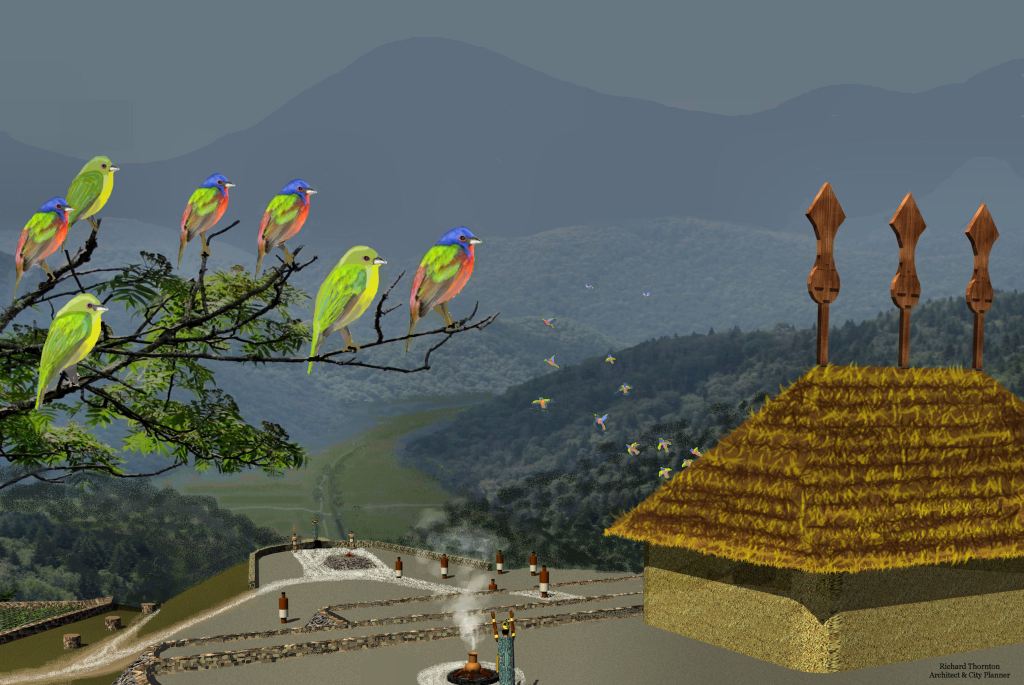
Above is an accurate portrayal of Troyville Mounds in northern Louisiana. Its architecture was quite similar to that of the so-called “Olmec” Civilization and the later “Gulf Coast” Civilization in southern Veracruz and western Tabasco States, Mexico.
by Richard L. Thornton, Architect & City Planner
In the previous article, I mentioned that virtually all artists’ paintings of Native American towns in the eastern United States are inaccurate. In addition to the structures invariably having the wrong dimensions and proportions, the artists always portray the earthen pyramids as if they were constructed out of limestone in the Egyptian desert!
Because the artists see the mounds today, protected by dense grass sides, they often portray the mounds as always being covered in sod. There are no grasses, indigenous to the Southeastern United States, which form sod or lawns. Standard red clay was used as an undercoat, but if left unprotected, the red clay or raw earth would have quickly washing away.
The final surface coats of earthen pyramids, plus wattle & daub-walled houses were finished with special, rain resistant stuccos, which varied with the region. These were composed of special, high-density clays, sand and other ingredients. The temples in northern Georgia were coated with mica, which made them glisten like gold. Those on the South Atlantic and Gulf Coasts were finished with a mixture of white clay, sand, crush shells and burned shells (hydrated lime.)
The mica on ancestral Creek temples started the myth of cities, “built of gold.”
Raw clay and dirt cannot be shaped into sharp, steep edges . . . especially in the climates of Eastern North America, which are characterized by rainfall or snow year-round. From Atlanta and Birmingham northward, winters will also freeze the clay or soil. This causes the clay to crack and decompose.
We also know from eye-witness Spanish and French accounts that the Southeastern towns and villages were densely developed with neighborhoods, streets, plazas, courtyards, vegetable gardens, fruit tree orchards and shade trees. They were not vast expanses of hard packed, red clay.
Below are “official” artist’s paintings of Troyville and Etowah Mounds, so you will see what I mean.

Artist’s conception of Troyville Mounds

Artist’s conception of Etowah Mounds
This is a somewhat schematic view of what Etula (Etowah) looked like during its final occupation in the 1600s. I left out the gardens, trees and commoner’s houses. Permanent abandonment occurred after the 1696 Small Pox Epidemic. The Mound B and Mound C that tourists see today are inaccurate reconstructions by state employees during the late 1950s. Both mounds were completely destroyed by artifact collectors and archaeologists.
Dr. Alfonso Morelos, former chief archaeologist at Chichen Itza, stated in 2012 that he had translated engravings, which described visits of prominent leaders from Florida and Georgia to Chichen Itza. I suspect that the final expansion of “Mound A” to a 110 feet tall pyramid was an effort to emulate the Pyramid of the Sun at Chichen Itza. Much of the last expansion was removed in the 1800s by artifact collectors, who paid the owners $200 a month to dig there. The large earthwork was also altered by the First Ohio Volunteer Regiment in 1864, when stationed at Etowah Mounds. They converted the top to an artillery fort.
The public is not told this. Neither were the artists, who have painted Etowah Mounds.

 The Americas Revealed
What is the ‘Pyramidal Empire’?
The questions of who built the Pyramids of earth, and why, represent the biggest unsolved mystery of human construction projects in history. In times of cataclysm, humans on each planet would uncover natural electromagnetic ley lines and built Pyramids and Ziggurats upon those locations. There are hundreds of pyramids the size of Giza or bigger built along the Earth’s Equator, including hundreds of thousands of smaller pyramidal structures. In less than 200 years, humans built all pyramids in Egypt, Sudan, Mesopotamia, England, China, and in South America Andes.
This network of pyramids allowed the Deep State to rule earth by employing real-time communication between each location. This enabled the critical function of simulating gods and other visions at each location. The concept of a simulated deity appearing within a temple has been redacted into the children’s story Wizard of Oz. Nevertheless, simulated deity worship became the primary instrument of Deep State control and allowed them to establish the Egyptian Empire which lasted 30 centuries. In addition to communication, each pyramid enabled quantum teleportation between locations during periods of planetary alignment.
LikeLike