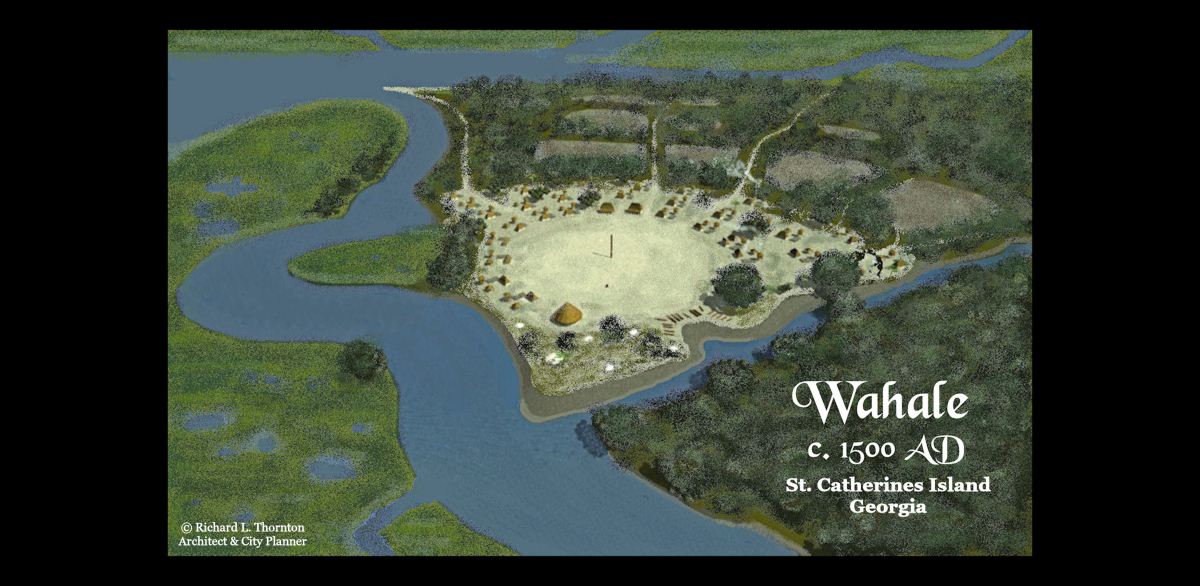
Headquarters of the Franciscan missions on the Atlantic Coast of North America . . . c. 1591-1680
The present-day State of Georgia once contained over twice as many Spanish missions and mission Indians than the much larger state of California. In 1524, the first attempt by the Spanish to colonize North America was at the mouth of Georgia’s Altamaha River. In 1934, Smithsonian archaeologist, James Ford found numerous PRE-COLUMBIAN bronze and iron weapons and tools along the banks of the mouth of the Altamaha, suggesting earlier, apparently forgotten, efforts by Europeans to colonize the South Atlantic Coast.
Yet, the only investigation of a Spanish mission and surrounding Native American village in Georgia was carried out by archaeologists, associated with the American Museum of Natural History during the late 20th century and currently by the University of Kentucky on Sapelo Island. In 2007, the AMNH asked me to prepare architectural drawings of what its archaeologists had discovered.
by Richard L. Thornton, Architect & City Planner
SLIDE SHOW
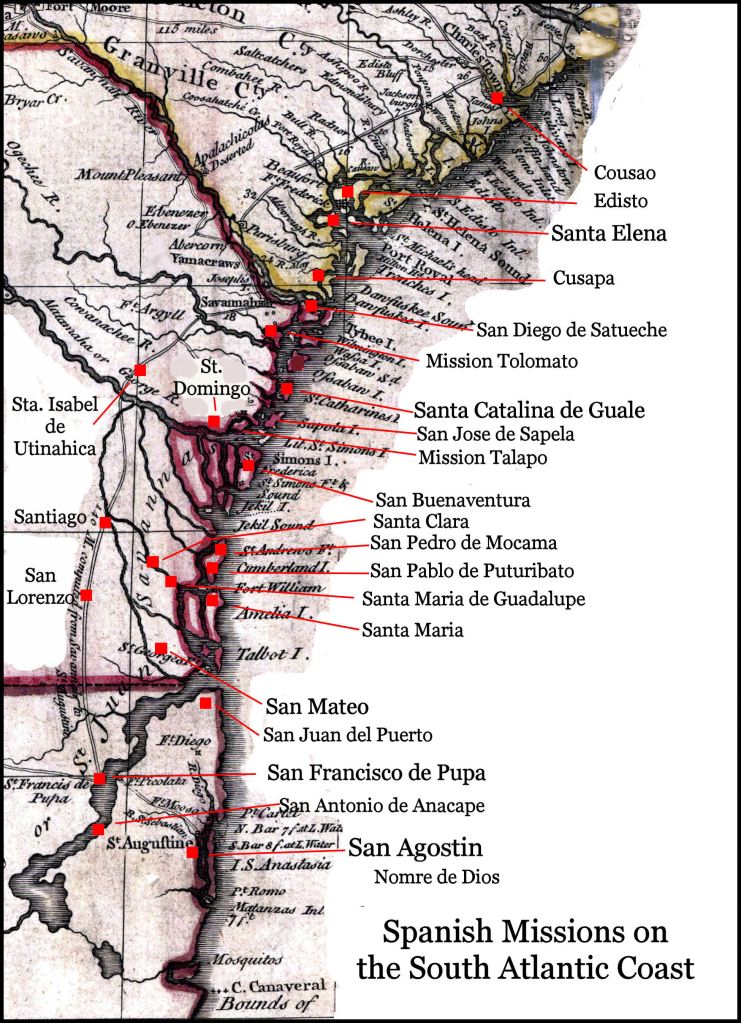
The Spanish also established about ten missions within the interior of Georgia. Most were short-lived because it was difficult to supply them from St. Augustine and impossible to defend them from hostile Native American tribes.

St. Catherines Island is separated from the mainland by a broad expanse of tidal marshes, a deep estuary and meandering creeks.
Guale is the Late Medieval Castilian spelling of the Coastal Muskogean word, Wahale . . . which means “Southern People.” The Wahale moved southward from near the mouth of the Savannah River to St. Catherines Island, Georgia around 1500 AD. All other tribes along the Georgia Coast, south of the Ogeechee River, had names, which are translated with Itza Maya, Guarani (South America), Taeno (Caribbean), Panoan (Peru), Middle Arawak (South America) and Southern Arawak (South America) dictionaries. Their architecture was quite similar to a non-Maya people, who lived on the coast of Campeche, until they were decimated by Spanish diseases and weapons.

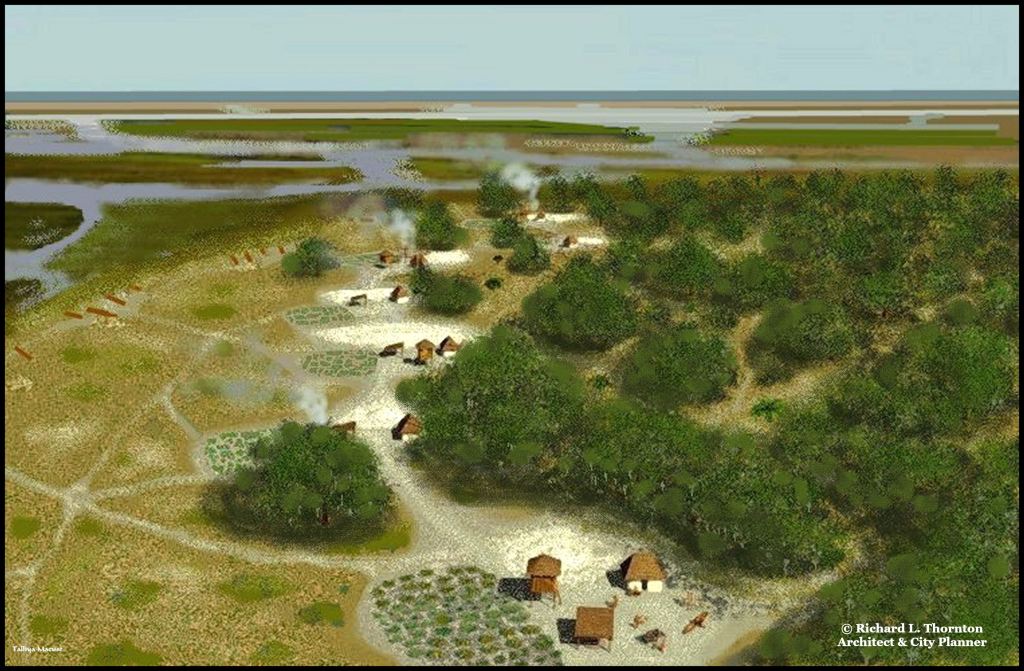
Most Wahale families had multiple homes. There was one in a formally planned village on a large estuary in the western edge of the island as portrayed in the rendering at the top of the article. Only certain sections of the island were suitable for agriculture. During the warmer months, the families would live on scattered farmsteads like the one pictured above. The houses were timber framed with wattle and daub walls, which were stuccoed with a hard lime-based stucco, reinforced with crushed oyster shells. This is the ancestry of “Tabby” architecture.

Late fall, late winter and early spring were ideal times for fishing and collecting shell fish. Extended families maintained fish camps near the tidal marshes for these times of the year. During hurricane season, the Wahale paddled up the Altamaha River to similar camps within the interior, where they hunted large game, made pottery from Georgia’s famous ceramic clays and traded with local tribes.

Arrival of Spanish invaders
All Georgia tribes, which submitted to the Spanish missionaries became extinct.
Early Sixteenth century Spanish slave raids along the South Atlantic Coast, plus the bad behavior by Spaniards at the unsuccessful San Miguel de Gualdape Colony on Sapelo Island caused the indigenous peoples to be extremely hostile to the Spanish, when Conquistadors returned in 1565 to make a serious effort of colonizing the region. Shipwrecked Spanish seamen were killed on sight, while great hospitality was generally shown French and English sailors.
There was a poorly documented effort to convert Natives around the mouth of the Altamaha River with conventional priests, when Fort San Mateo was built in late 1565 and early 1566. Apparently, these priests were killed, when Fort San Mateo was massacred in April 1569. The following year, Jesuit missions were established on Cumberland and Sapelo Islands in 1570, followed by other Jesuit missions on several nearby islands. All of the Jesuits were either killed by the locals or barely got out with their heads intact.
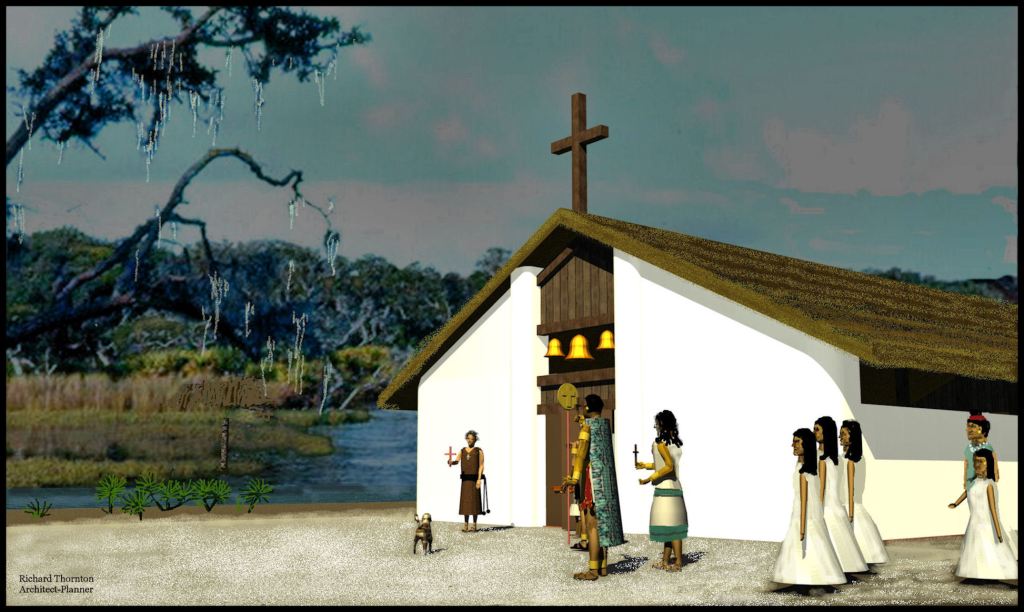
Franciscan friars were then introduced to the region. They were more accepted by the locals, but some them were also murdered eventually. Like in the Hebrew Torah and Christian New Testament, a Wahale man was required to marry his wife’s widowed sister, if she could not quickly find some other man to marry her and provide food for her children. Five Franciscans were killed, when a priest spoke out against this tradition and ridiculed the king of the Wahale in a church service.

The Spanish intentionally replaced the plaza with a mission, to assert domination.
There was extreme resentment by the Wahale men from the beginning. The Spanish placed the missions in the center of the town’s round plaza . . . both asserting the dominance of the new friars and making it impossible to play stickball in the plaza. Most of the friars were very hostile toward Indian Stickball in general . . . thinking that their Native American serfs should work all the time for the benefit of the Spanish. Basically, it was overwork and inadequate food that propelled the Wahale to extinction.
- The men had to clear large areas of forest to grow corn and squash for the stomachs of Spaniards in St. Augustine. The island’s soil was ill-suited for corn, so men, women and youth had to toil long hours in order to meet their overlords’ needs. The men and women received no pay. They were essentially slaves . . . but were told that they would go to heaven for feeding St. Augustine.
- The Wahale men then had to haul the corn and squash in dugout canoes 114 mi (183 km) to St. Augustine. The people of St. Augustine didn’t even have the decency to send a cargo boat to St. Catherines Island to pick up their free food.
- The men and boys then had to return to St. Augustine during the period of the year, when they formerly fished or hunted, in order to construct public buildings or the houses of the elite. It was believed that they were paid a token amount of Spanish coins for this labor . . . enough to pay for the food they ate while working for their masters.
- Of course, the women and girls had to maintain the convento and cook the meals for the friars . . . again for no financial compensation . . . just religious trinkets and perhaps simple cotton tunics to wear. They also maintained the fruit orchards and flower gardens for the friars.
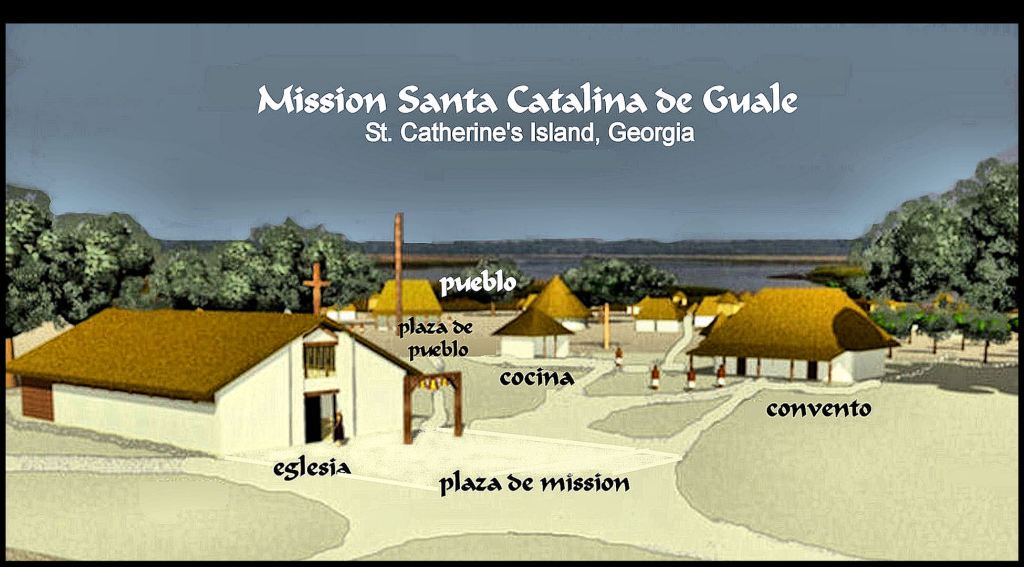
Mission Santa Catalina de Guale was the Mother Mission for the Franciscan parishes on the South Atlantic Coast. It probably had the largest church . . . sufficient in size to also hold leaders from other Wahale villages. This church, along with the convento and ancillary structures were designed by Spanish architects, but AMNH archaeologists were surprised to discern that they were constructed by the local inhabitants, using traditional Southeastern Native American construction technics.
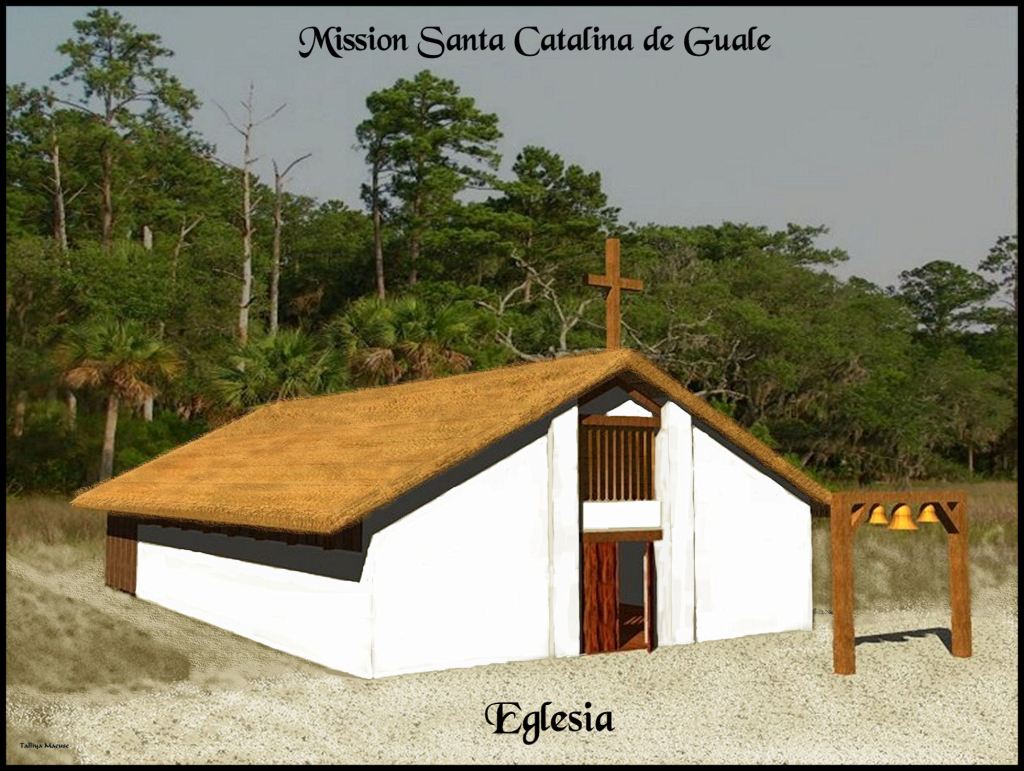
The church could hold all of the residents of Wahale, plus the leaders of other villages.

The 35″ by 53″ sanctuary was complete filled with skeletons of the mission’s communicants. Most like the raw dirt was normally covered with split-cane maps. Most indigenous cultures in Georgia covered their floors with split-cane mats. They also sometimes finished the walls with ornate, basket-weave pattern mats.

Structures associated with friars’ residence: Convento (parsonage), Cocina (kitchen) and Pozo (well). The convento was identical to the homes of Maya district administrators and town chiefs in the Yucatan Peninsula. It contained three interconnected rooms with a wood frame storage shed attached to the rear.
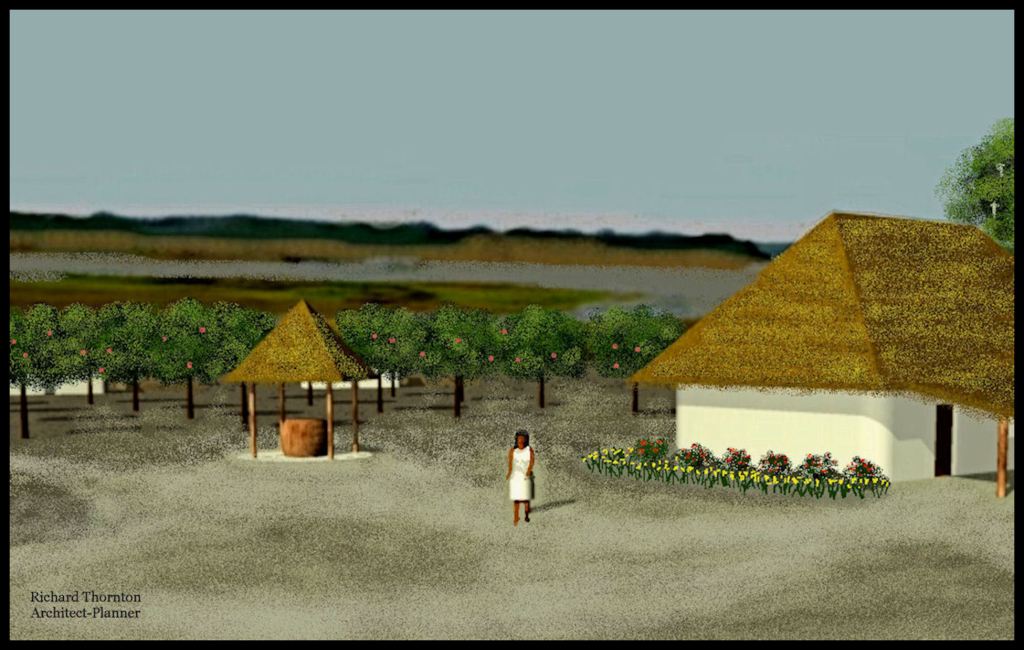
Immediately, upon arrival of the Spanish friars, the Wahale population began to drop due to exposure to European diseases and the wise ones, fleeing Spanish tyranny. Then overwork and general lack of protein in their diets began to take their toil. For the first 20 years of the mission’s operation, the empty house lots in the principal town were filled by people from satellite villages on the mainland or other islands.
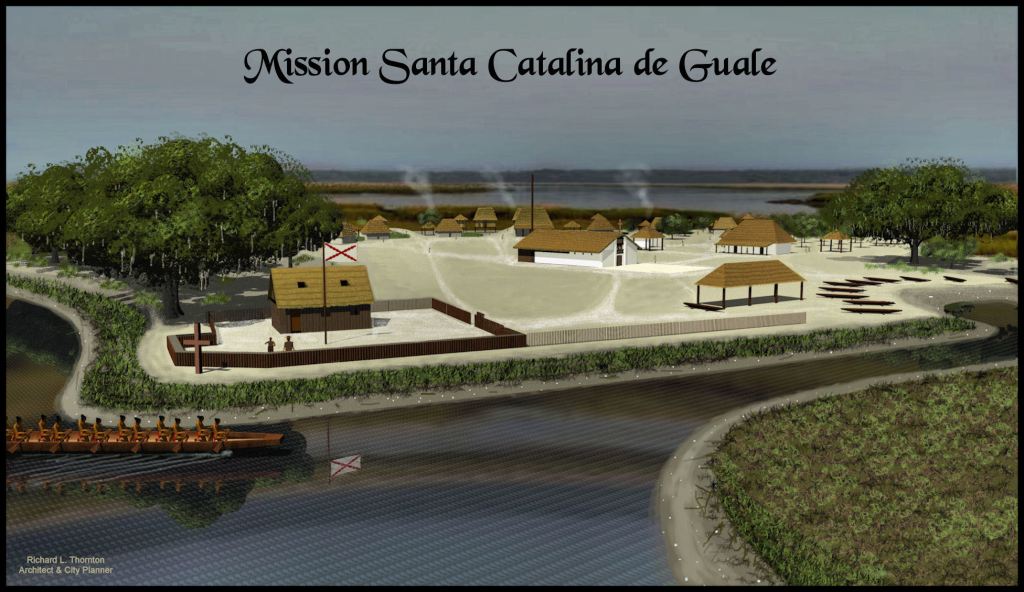
The fort would have provided little protection against ships, armed with cannon, but did discourage attackers arriving by canoe or on foot.
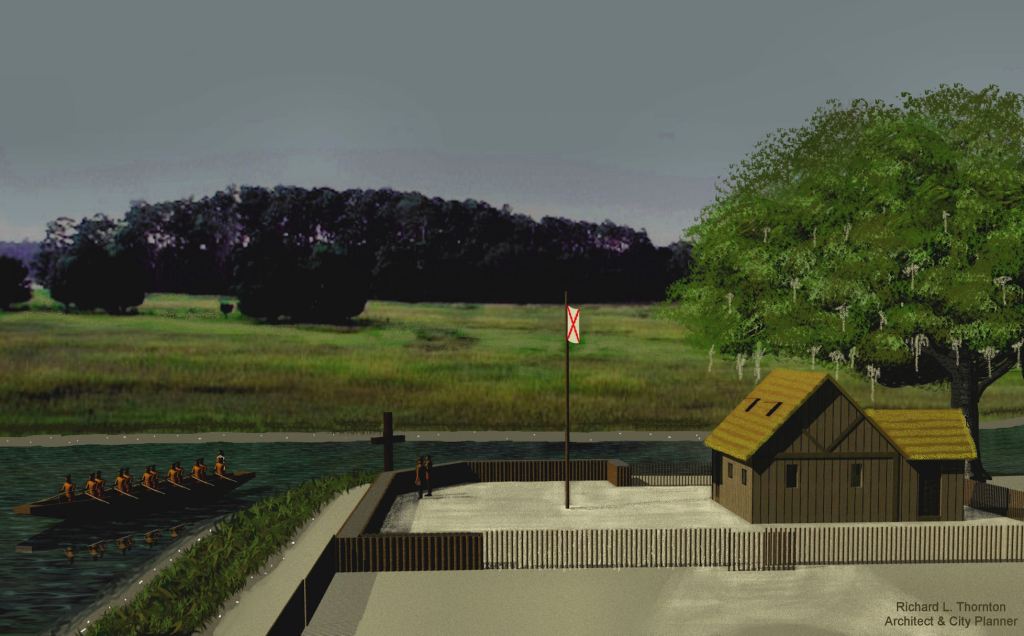
As the Wahale population continued to decline, the Spanish were forced to build a fort and furnish soldiers to protect one of the few remaining mission stations on the Georgia coast. The mission Indians were easy prey for pirates, slave raiders and other tribes, who want to punish the Wahale for collaborating with the Spanish. The fort is in the foreground on the left.
Around 1646, Virginia planters began arming bands of Native American slave raiders to attack Native towns elsewhere. Eventually, though, there were no satellite villages and the population of the main town dropped down to about 50 people. In the early 1680s, after Wahale was attacked by Carolina militiamen, the remaining Wahale were relocated to near St. Augustine. It was an end to an era.
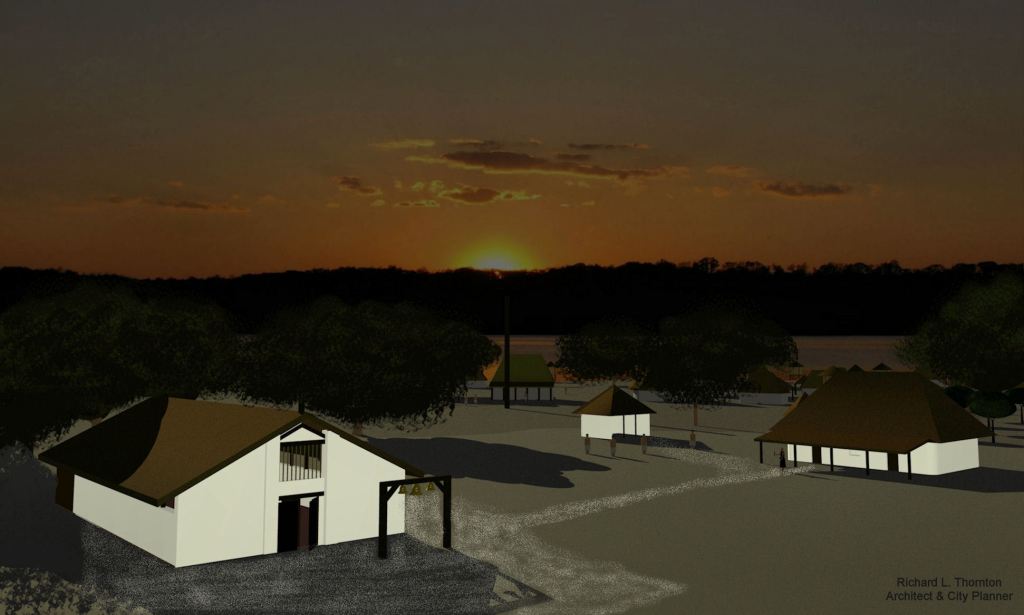
The Georgia coast remained virtually uninhabited until Savannah was founded in 1733. Protection by the English lured small bands of Creek and Uchee Indians to the uninhabited lands and islands. They were not to remain there very long.
 The Americas Revealed
Vital information, Richard! Thanks, again!
LikeLiked by 1 person
You are welcome!
LikeLike