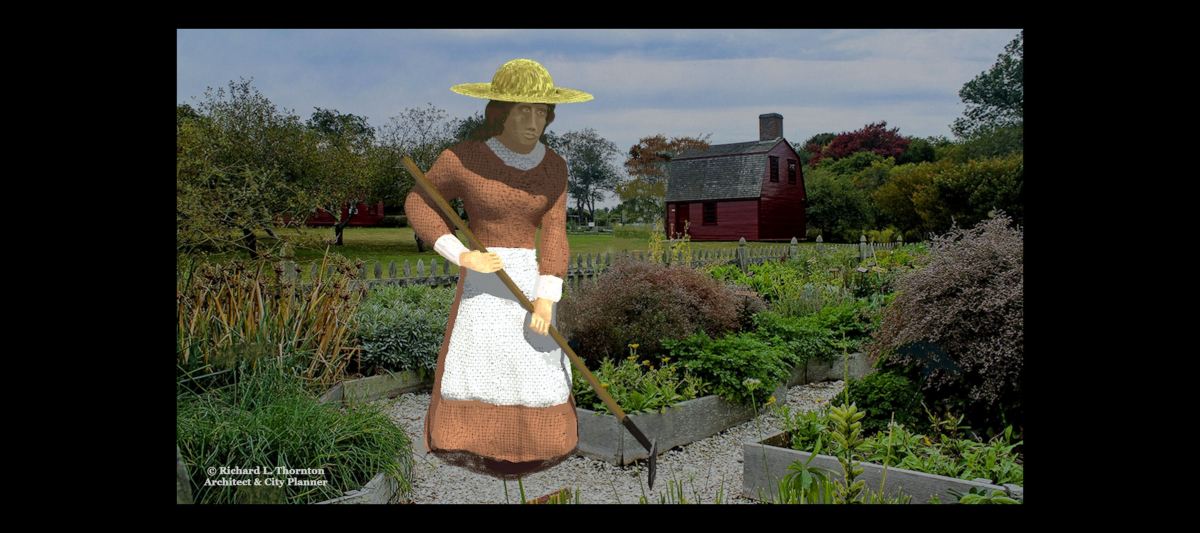
Until the 20th century they were endemic among the middle class and yeomen farmers of Nouvelle France, the Southern British Colonies and Louisianne, plus Mestizos and Indigenous women in Latin America. My Creek grandmother’s sisters wore them, while working in their gardens and fields until their passing in the late 20th century. You will almost never see them in a museum, however. Sombrero is derived from the Spanish word for “shadow.”
by Richard L. Thornton, Architect & City Planner
Meet Mistress Eleanor Wythe of Wythe’s Hundred Plantation on the James River in the Province of Virginia. She is working in the kitchen garden, where she personally cultivates herbs and exotic vegetables. In that era, the word, plantation, meant a newly established farm in a region that was being colonized . . . i.e. the Natives had been pushed out or enslaved and a new ethnic group had taken their lands. As you can see, the original “plantation house” was no larger than a typical pioneer log cabin. In subsequent generations the cottage would grow into a sprawling mansion.
This image was created entirely with architectural software, formerly only used for describing proposed new buildings. Mistress Wythe is just one of dozens of realistic Native Americans and Newcomers that I have created in the past six months with special software to make my 3D virtual reality digital models more realistic. During the past two decades of using architectural software to describe architectural history, I have been very frustrated by my inability to create realistic “close-up shots.” That will no longer be a problem.
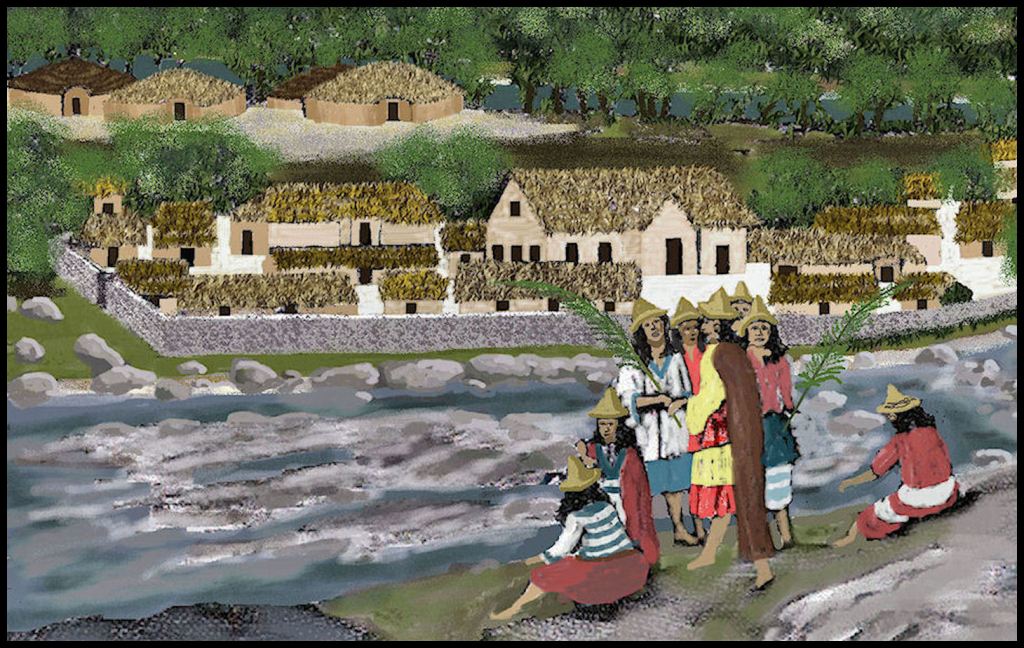
Both male and female Creeks in Georgia wore sombreros with conical caps and brims that did not extend as far out as Mexican sombreros. This is a 1658 lithograph made from a 1653 sketch by Richard Brigstock, while he was staying in the Nacoochee Valley of Georgia. The straw hats worn by Indigenous peoples of northeastern Tennessee, the Andes Foothills in Peru and on the Northwest Pacific Coast were quite similar.
Native American sombreros
Only certain regions and tribes in North America wore hats prior to the arrival of European settlers. There are no artistic portrayals of sombreros with brims as wide as those worn by Medieval and Colonial Period Europeans. All of the sombreros portrayed in their art were woven from vines or split river cane. For unknown reasons, the Creek Indians in the Southeast ceased to wear woven hats in the early 1700s.
After numerous tribes from the Southeast and Midwest were forcibly relocated to Oklahoma, the men of many tribes started wearing felt hats with exaggerated dimensions, typical of Mexican vaqueros and Gringo cowboys. I have never seen a photo of an Oklahoma Native woman, wearing a sunhat, but the tradition continued until the late 20th century with my Creek female relatives in Georgia and Florida.

17th century Middle Class women in England (left) and France (right)
History of the wide-brimmed hat

The use of a wide brim attached to a cap in order to shade the entire torso seemed to have originated in Classical Greece, but this is not certain. It was called a petasos. Ancient Greek historians said that the petasos originated among the shepherds, who lived near Thessaly then spread throughout Greece to ultimately being adopted by the Etruscans in Italy
In Roman times, this type of head cover spread westward along the northern rim of the Mediterranean Sea, but strangely, never caught on in the desert regions of northern Africa and the Middle East . . . where one would assume that it would have been most beneficial. Certainly, by the Middle Ages in Continental Europe, both peasants and town dwellers wore such hats during the warmer months. You see them in contemporary paintings of working folks in England, but not in Scotland or Ireland.
The colonists in Virginia began wearing wide brim hats, woven like baskets . . . during warm months almost immediately. The straw hats shaded out the intense southern sunlight, but allowed air to circulate around the head.
Back then, a sun tan was a sign of doing manual labor and therefore of being lower class. Shading out the direct sunlight reduced the tanning effect of working in gardens. From Virginia the custom of women wearing wide brim hats spread southward and westward. Museums and movies typically show Southern women wearing bonnets, while working in a garden or in the fields, but bonnets would have held in the heat around their heads . . . most impractical.

French language websites such as this one by the Hudson Bay Company, plus retail stores in Quebec and Louisiana market a wide variety of traditional “chapeaux de soleil” to female customers. They are much harder to find these days in other parts of North America.
The rural women of Nouvelle France wore “chapeaux de soleil” in the gardens and fields, just like their counterparts in France. The tradition continues to this day in rural areas of Quebec and France, but not in other parts of Canada. As seen below, French women today continue to wear sunhats.
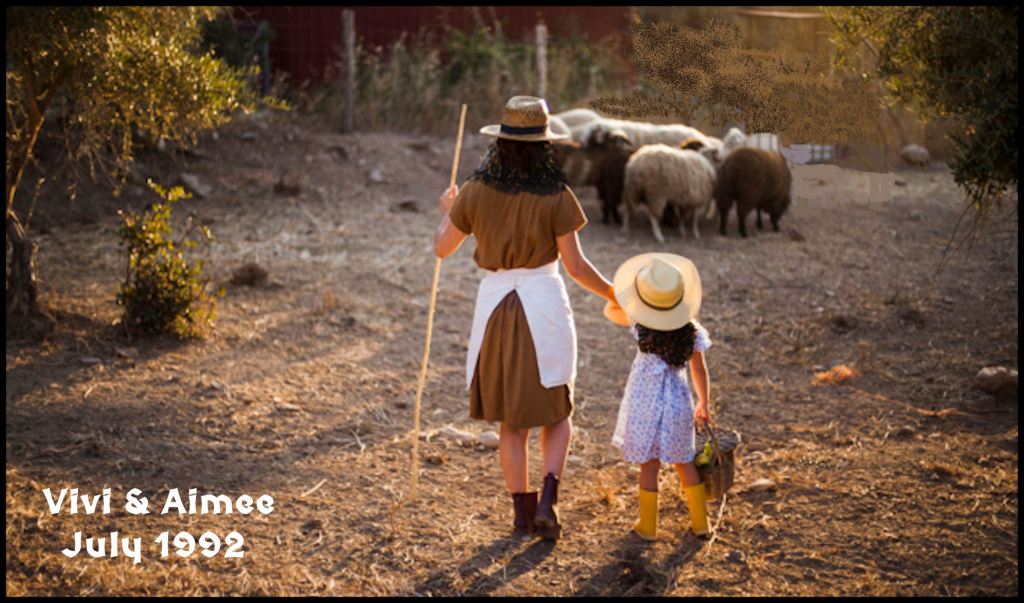
My French soulmate and her daughter on my farm in Virginia’s Shenandoah Valley.
Even though, theoretically New England and the Middle Atlantic colonies receive more intense sunshine than Quebec, one never sees paintings of women of these regions during the Colonial Era wearing sombreros. This is hard to explain, since such hats were endemic in rural England during the 1600s and 1700s. Virtually, all men are portrayed wide brim hats, however. It could be that the paintings, although not modern, still reflected the bias and ignorance of the artists, who created the paintings.
Mexico, Cuba and La Florida

One of my new 3D models, portraying an oxen driver in La Florida
During the 1600s and early 1700s, most sombreros worn in Mexico, Cuba, Florida and Northern Georgia resembled the one worn by El Zorro, but with a wider brim. This is called a sombrero de cordoba. The middle and working classes could not afford felt hats from Spain, so relied on the more practical straw hats, woven like baskets.
It is very difficult to make a stiff, flat crown on a straw hat, using traditional Mexican Indian basket-weaving techniques. This is the reason that the flat crown and brim on Sombrero de Cordoba evolved into the sombrero de charro (over-sized cowboy hat) that has become stereotypical of Mexico. The high crown on these hats function as natural cooling towers.
During my trips to Mexico, I never saw a Mexican woman wearing a sombrero, but they definitely were a tradition among Indian and mestizo women up until the mid-20th century. I did encounter some Maya tribes in remote areas, where both men and women wore something akin to a sombrero de cordoba, but these traditions probably are not Pre-Columbian and date from colonial times.
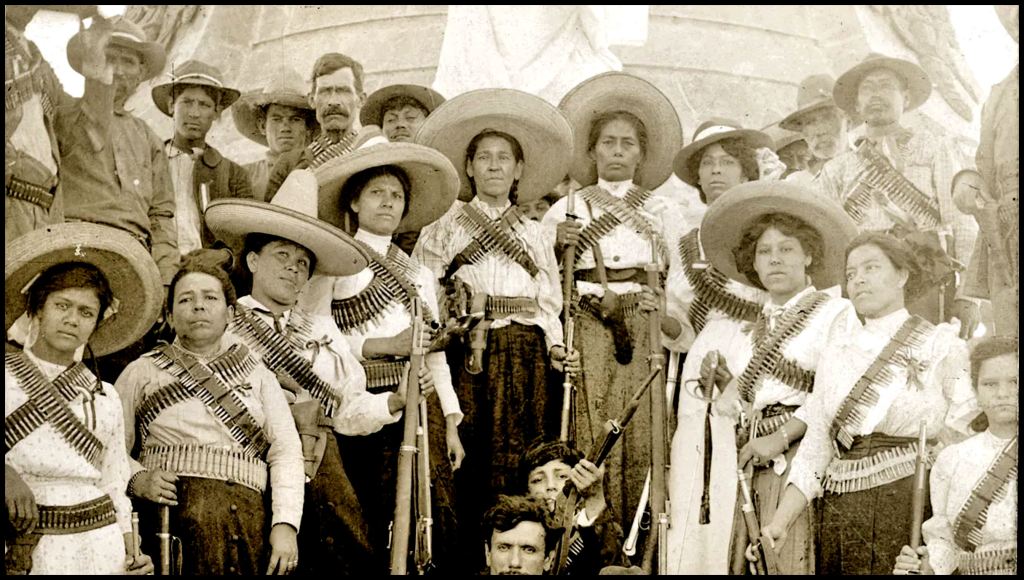
In this photo of some of Poncho Villa’s soldiers during the Mexican Revolution, note that the women are wearing sombreros de charro, while all but one of the men are wearing more conventional cowboy hats. I wouldn’t want to get into an argument with these ladies!
 The Americas Revealed