
Strange beasts roam the jungle at night then wreck their camp. The next night . . . Craig and Richard should have been killed, while both Woody and the sailboat had completely disappeared.
In 1971, there was no “guidebook” to Cumberland Island, GA and it was not even mentioned by World Book Encyclopedia. Of course, there was no internet, either. Every exotic or dangerous animal that we encountered on the island was a complete surprise.
by Richard L. Thornton, Architect & City Planner
Part Four of the Series
Neighborly cows at sunset

Just before sunset on the second night, a small herd of cattle pushed through the forest, near our camp then grazed on the native grass that grew between the edges of the forest and the marsh. We were terrified at first. The ruckus made by the cattle sounded like about a 100 Russian soldiers were attacking us. However, a moo from the queen of the herd let us know that her herd was passing by. We mooed back.
In 1971, herds of semi-feral cattle roamed Cumberland Island. They apparently were removed prior to the National Park Service taking possession of the island in 1972. The current NPS website does not mention cattle in the list of feral animals on the island.
Strangers in the night

This is a time lapse photo of the moonlit jungle near our main campsite on Cumberland Island. This image is very close to what it actually looked like to our eyes, after adjusting to night vision. On cloudy or moonless nights, nothing was visible, even the hands in front of our eyes! Scary!
Exactly a year earlier, I had been camping with Ana Rojas in the Tierra Incognita of the Puuc jungle in eastern Campeche State, Mexico. Cumberland was much more intimidating (ie frightening). In all but one night Ana stayed in Maya huts. We had several bright electric lamps that could be recharged by her JEEP. Of course, the JEEP had headlights, plus a bright search light. I kept an M-4 carbine at my side at night in case a jaguar came around hungry.
Growing up, Ana had camped out with her father at archaeological sites several times. She was quite unusual for Mexico in that era . . . an outdoorsy, nature loving. Well, she did bring along a box of wine bottles . . . which tended to fortify one’s courage at night time.
Below is the same view at noontime.

Running out of ice!
Back in 1971, picnic coolers didn’t keep your food cool very long without unless you added fresh bags of ice every few hours. Ice bags were stored in fragile white, Styrofoam coolers, which did a much better job of keeping things frozen or cool, but would crack from the slightest amount of stress. Our Styrofoam cooler didn’t crack. It floated out to sea, when the high tide flooded our first camp site!
Under the original concept of our grand adventure, that would not have been a problem. The three nurses from Darien, GA were coming over Saturday morning in Daddy’s big cabin cruiser. It had a refrigerator-freezer, PLUS an ice machine and an enormous ice box for storing fish caught, while deep sea fishing. We assumed that we would be based on the cabin cruiser, most of the time while exploring the southern end of Cumberland Island.
Now that assumption was not a given fact. The high tide had shorted out our marine radio, so there was no way to contact the gals to tell them where we were. The pork chops had completely thawed out, so we decided to cook them and any other spoilable food the second night then grill the steaks to accompany baked potatoes and corn on the cob the third night . . . in case we connected with the ladies.

It was dark, when we finished supper. No one wanted to venture down to the edge of the water in the dark to wash the skillets and pots. That is exactly what the alligators would want us to do.
About an hour or so after all of us had gone to sleep in our separate pup tents, we were awakened by a ruckus. It sounded like drug-crazed hippies were ransacking our camp. They were tearing apart our fourth, canopy style tent, where we stored our coolers and ate meals. At any moment, we expected to have the Georgia equivalent of the Manson Family drive daggers through our hearts.
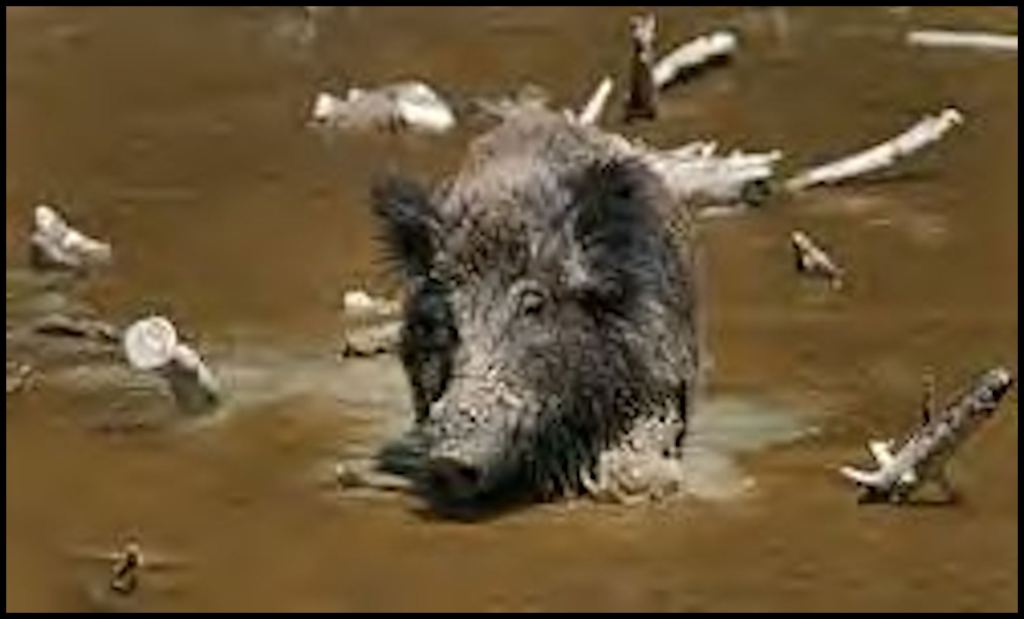
Then we heard a blood-curdling scream . . . followed by something akin to pigs squealing, but more guttural, as a group of some sort of animals crashed through the palmetto thicket to escape our camp. So the sounds were critters, not hippies. The next morning, we figured out that one or more wild boars had been attracted to the odor of pork chop grease around the edge of our campfire. They had ventured into the hot coals and quickly were in the process of becoming fried pork chops themselves. Fortunately, they had not been able to get the lids off our food coolers, before stampeding out of the camp.
We would see the boars again, but kept them at telephoto lens distance. Fifty-three years later, I now know that these critters were actually the descendants of Black Spanish pigs introduced in the 16th and 17th centuries . . . who look a lot like a wild boar . . . crossed with European wild boars, which 19th century plantation owners introduced to the island for hunting purposes.
Cumberland Hybrid Boars Slide Show
+

+

The day of infamy
After cleaning up the campsite to make it presentable to our female guests, we held a council. Woody volunteered to sail the catamaran southward to the Cumberland Island Dock, where he would wait until their cabin cruiser arrived. The cabin cruiser would tow the catamaran back to our campsite.
Craig wanted to see if he could get the motor on his “prototype jet ski” working again. I was to first catch small fish to use as bait in our crab traps then catch larger fish to cook for lunch, when the gals arrived.
I immediately caught the necessary small fish near the water’s edge then baited the crab traps. I set them in deeper water by paddling one of the personal life rafts into the Cumberland River.
Craig soon got the little gasoline engine running, but it would go dead within a minute or two of operation.
We then watched in astonishment as Woody sailed PAST the dock and continued southward. What in the heck was he doing? None of the nurses knew Woody and would not know that the dinky plywood mini-catamaran was the sailboat that I described to them. We assumed that he had “a plan,” but we couldn’t figure out what it was.
After catching enough larger fish for all us to have for lunch, I headed inland to explore the interior of the island for Governor Carter. Craig continued to work on his boat engine.

I soon entered a strange terrain, consisting of rolling, white sand dunes, with stunted Live Oak trees and Palm Trees scattered about. It looked something like the images of Sahara Desert oases that I had seen on National Geographic specials.
Soon something shot like a bullet from one tree to another. Soon, dozens of these strange creatures were jumping up to 25 feet between trees in spontaneous excitement. Eventually, I was able to see close at hand that the critters were giant spiders, about the size of a tarantula, but without the long hair. Spooky!

These giant spiders can jump 25 feet (7.6 m), but are not dangerous to humans.
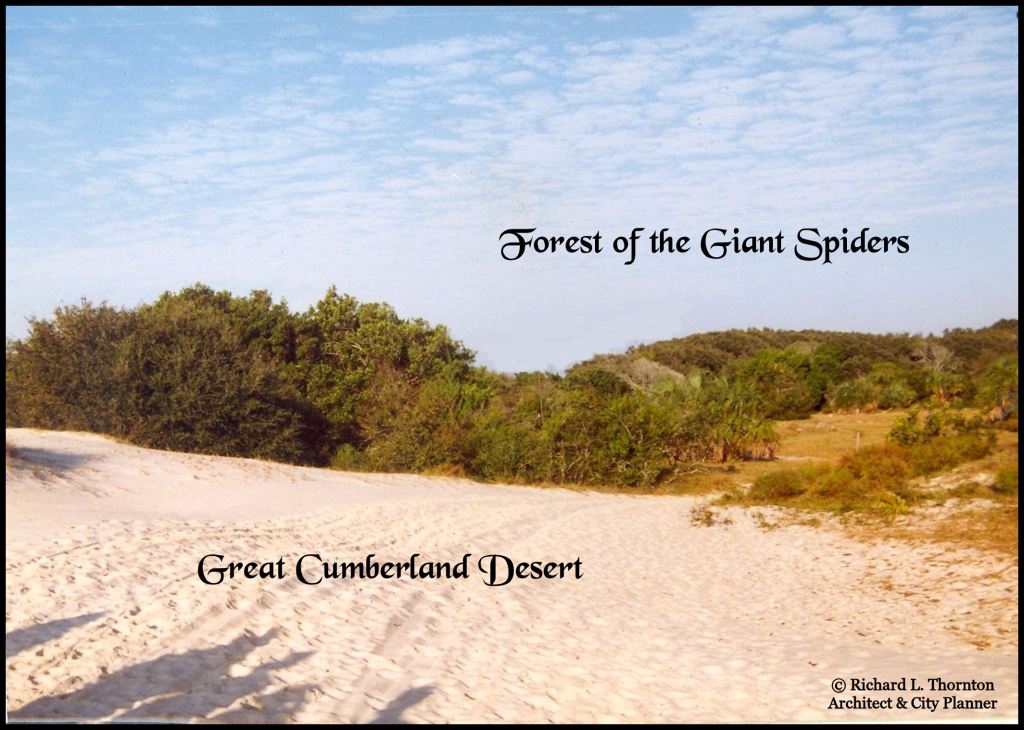
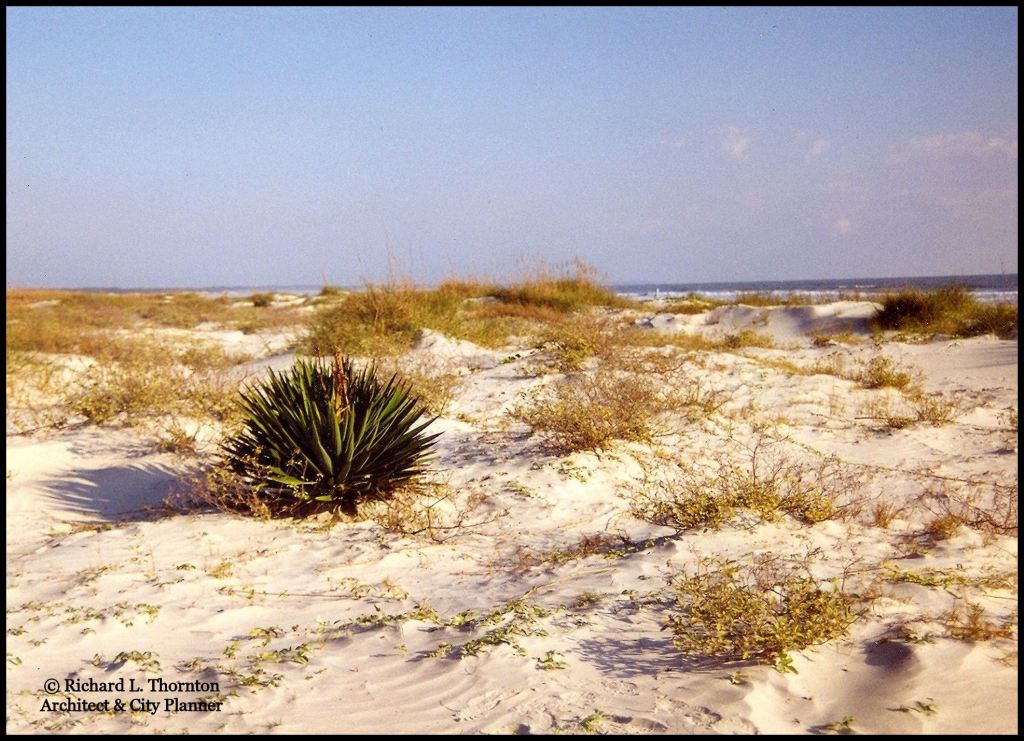
Eastward from the Forest of the Giant Spiders I encountered a real desert. The terrain and vegetation did not look like anything that one would expect to see in the Southeastern United States. The only plants growing there were cacti and yucca plants. It was time to go back to camp to greet the gals from Darien.

+
When I returned, Craig’s engine still was not working properly and the gals were not there . . . neither was Woody. Craig said that he had been watching the Cumberland River with binoculars, but had not seen either his catamaran or any cabin cruiser. We decided to cook some of the fish and hope for the best.
“The best” turned out to be pretty durn bad. The winds began blowing northward, making it difficult for a sail-driven boat to travel southward, They then suddenly shifted southward, but at almost gale force, which would be too much for the skimpy mast on Craig’s catamaran.

By mid-afternoon, evil-looking black clouds were approaching rapidly over the marshes from the south. That did not make sense. I was born in Waycross. Storms in Southeast Georgia always come from the west . . . with the exception of hurricanes. When we left Atlanta, the forecast for the Georgia Coast was for beautiful weather . . . at least for August . . . hot, but no storms. A hurricane had headed out to sea from near Miami, so presumably it was no threat.

By late afternoon, the rain was so heavy that one could not see more than about three feet beyond the mosquito nets on our tents. The high winds were even forcing water to penetrate the net and spraying a fine mist into my tent. Craig and I put on rain ponchos long enough to make some sandwiches under the canopy tent, then ate them inside our little pup tents.
The only thing more scary than being inside a modern, spacious camping tent is to be inside one of those tiny pup tents, which is about the only affordable tent sold by Sears-Roebuck in 1971. Sears was also about the only source for camping equipment in 1971. The nation’s largest retailer in 1971, now, the company barely exists. Well, Rich’s in Atlanta had some camping equipment, but their prices were higher. Rich’s, once the Southeast’s largest retailer, ceased to exist in 2005.
It was very difficult to fall asleep in such conditions, but apparently we did. Both Craig and I were awakened a few hours later, by lightning and roaring thunder that caused the ground to vibrate. The rain had slowed to a drizzle, but non-stop lightning immediately to the south of us illuminated our campsite like a search light.
I pulled my camera out of its waterproof case, unzipped the mosquito net then tried to make a artsy photo of the lightning display. Only in the few seconds, it took to put the camera back into the case that I realized that I had also photographed a waterspout or small tornado. That’s the last I can remember before waking up in the morning.

Neither Craig nor I were fully conscious until around 8 AM this next morning. We were both wrapped like a burrito by our tents and sleeping bags . . . planted at least a hundred from our campsite. The morning sun had cooked us until we woke up.
We both were sore from head to foot, but not particularly injured otherwise. Quite grateful to be alive, we were quite grateful to be alive. The whirling funnel had swept the campsite clean of almost everything else. We easily could have been tossed into the Cumberland River and quickly drowned. The prototype jet-ski and one life raft was unscathed. The other two were crucified upon fallen trees. Most of our camping equipment was swept into the water, except the hatchets and knives. The only food and water we had was what happened to be in our little pup tents.
It took us a couple of days to come to grips to the fact that Woody was dead and the catamaran was spread across the Georgia marshes as wood splinters. By then, Woody’s body had been totally consumed by local alligators, crabs and baby sharks. How were we going to explain what happened to Woody’s parents and Governor Carter?
In the meantime, we had to survive in 90° F. + temperatures on an uninhabited island with no potable water.
 The Americas Revealed
What a cliffhanger! I’m still hoping Woody woodpecked his way home with the nurses who in my mind look like mermaids! The cow herd reminds me of those still on Sapelo roaming wild and one mythical bull that is ninja like less his giant dung piles which were always fresh and yet his trail sly and we left in the cold. While I never ran into those spiders on Cumberland that “desert” you described all too accurate and one summer got lost on those dunes and they were true burners!
LikeLiked by 1 person
The nurses never left Darien. We had agreed on a maritime radio frequency for communications. When we didn’t respond to several attempts to contact us by radio, they cancelled the voyage, I will have more photos of the Cumberland Desert and the Giant Sand Dunes in the next article.
LikeLike
Mermaid nurses can be temperamental
LikeLiked by 1 person
LOL
LikeLike