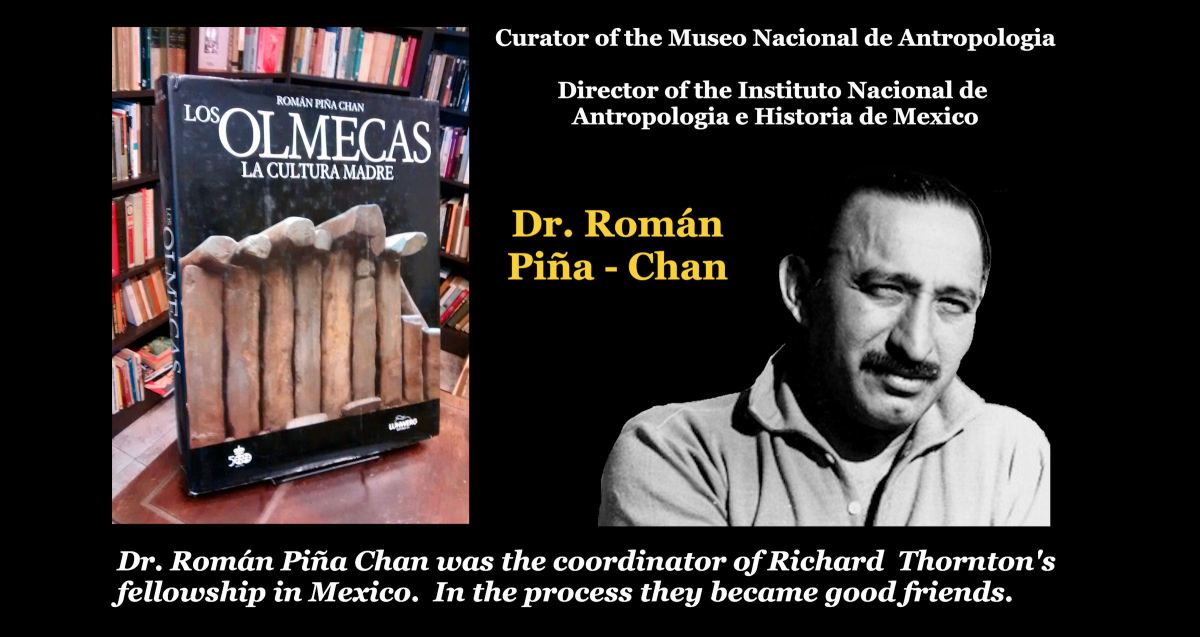
Advanced indigenous civilization did not suddenly appear and then disappear in southern Mexico, as a legion of TV and Youtube documentaries would have you believe. Culturally and genetically. . . the Creek, Seminole, Chickasaw, Alabama and Koasati Peoples of the Southeastern United States are the direct descendants of the earliest civilizations in Mexico.
The Olmecs had nothing to do with the “Olmec” Civilization. In fact, their invasion of southern Mexico is what caused the migration of refugees to present-day Georgia, Florida, Alabama and Louisiana. Creek and Seminole Indians today carry the DNA of the real founders of “La Cultura Madre.”
I first learned about the Olmec Civilization the good ole fashion way . . . while having my first casual lunch in the office of one of the most enlightened archaeologists of our time . . . Román Piña Chan – Curator of the Museo Nacional de Antropologia! He was a Maya from Campeche State. During that surrealistic time in my life, I also put my feet on the ground at ancient town sites that then were seldom visited by North Americans.
by Richard L. Thornton, Architect & City Planner
Fact One: The diverse, but realistic stone and ceramic statuary in Tabasco southern Veracruz portray ethnic groups in southern Mexico, whose descendants live in Mexico and the Southeastern United States today!
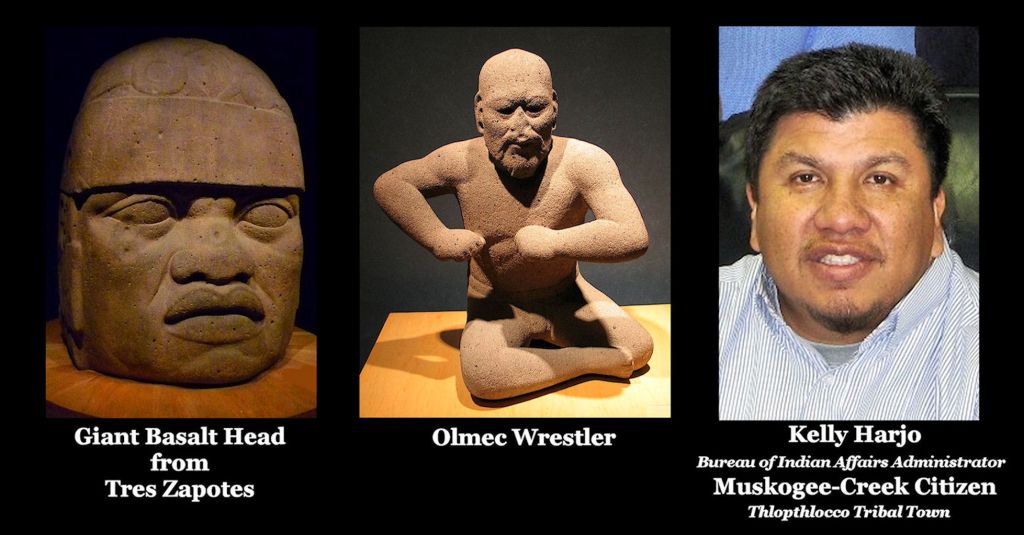
Eyewitness accounts of the Creek Indians during the Early Colonial Period state that their men wore mustaches and beards. Kelly Harjo’s Thlopthlocco Creek Tribal Town is descended from the Soque People, who until 1818, occupied the section of Northeast Georgia, where I live. There are still many Soque (or Zoque) in western Chiapas and Tabasco. Some branches of the Soque look Polynesian, while other branches look like Southeast Asians.
There they go again. Yet another interpretation of the “Olmec” Civilization and accompanying video is being promoted currently. The premises of this video are based on false history promulgated on television documentaries during the past 40 years. Each video takes the previous video as factual then uses it as a stepping stone to go further out into lala land. This video contains “proof” that Egyptians sailed to Mexico and “founded” the Olmec Civilization. The civilization supposedly collapsed suddenly, when its Egyptian elite departed for elsewhere.
Skip to other videos and you will learn that Chinese, Sub-Saharan Africans, Extra-terrestrials, Phoenicians, Libyans or Celts “founded” the civilizations in Mexico. Nope, Mesoamerican, Amazonian and Andean civilization gradually developed over a period of over 5,000 years from indigenous American societies that were profoundly skilled in agriculture . . . the domestication of indigenous plants and trees into nutritious food crops.
According to the National Science Foundation, the domestication of maize (American corn) began at least 8,700 years ago in western Tabasco. This region of Tabasco, which became an American Garden of Eden, looks very much like the Bond Swamp in Ocmulgee National Historical Park. Unlike the agriculturalists in the Middle East, who focused on converting edible grasses into cultivated grains, American agriculturalists domesticated a vast array of vegetables, fruits and nuts, which now feed the world.

Poverty Point, NE Louisiana – c. 1700 to 1100 BC
Fact Two: Mexico lagged technologically and architecturally far behind Southeastern North America and the Upper Amazon Basin until around 900-800 AD.
All of these TV documentaries and Youtube videos would have you believe that their favorite ethnic group from the Old World introduced civilization to Mexico then it spread outward to other parts of the Americas. Nope, the oldest known architecture in the Americans is an earthen mound on the LSU campus in Baton Rouge, Louisiana – roughly 8,500 BC.
- The oldest complex public works in the Americas is found immediately east of Downtown Savannah, Georgia – a man-made canal, harbor, mound and wooden platform village radiocarbon dated to 3545 BC.
- The oldest pottery in the Americas is found in the Upper Amazon Basin and in the eastern part of the State of Georgia – roughly 2500 BC. The people in Southern Mexico did not start making pottery or building mounds until around 900-800 BC.
- It was the genius of southern Mexican agriculture, which allowed indigenous societies there to leap ahead of the Southeast, once they started living in larger communities.

Fact Three: The Olmec Civilization did not disappear around 500 BC
A few of the largest “Olmec Civilization” cities lost much of their population, at some point between 500 BC and 200 BC . . . but the people did not disappear as stated in almost every TV documentary. These were cities that were not sustainable, due to limited cultivatable land nearby. Some towns, originally associated with the “Olmec” civilization, remained occupied until the arrival of Spanish conquistadors and diseases.
In fact, most of the more sophisticated art that you see on the TV documentaries date from the period between 500 BC and 200 AD . . . but they then tell you that the civilization died around 500 BC. The Olmec writing system, which resembles the Maya system, did not appear until around 36 BC. There was an earlier system, using pictographs, which dates from around 300 BC. Dr. Piña Chan found many symbols from this system in the art, unearthed at Etowah Mounds in northwest Georgia.

Mathew Stirling, posing with an altar, excavated by a Mexican archaeologist
Fact Four: Mexican anthropologists were forced to go along with the name, “Olmec Civilization” because of the cultural dominance of academicians in the United States.
From their discoveries, beginning in the early 20th century, Mexican archaeologists were convinced that there was a multi-nodal civilization in southern Mexico that pre-dated the Maya Civilization. They called it “La Cultura Madre” (Mother Culture), but had no way to prove its age until radiocarbon dating became available in the 1950s.
In the late 1930s, Smithsonian archaeologist, Mathew Stirling, took a vacation in southern Mexico and intentionally had himself photographed beside large stone sculptures, unearthed by Mexican archaeologists. He wrote several professional papers and an article in National Geographic, which inferred that HE had unearthed the stone sculptures and discovered a new civilization. Not knowing much about the ethnic history of Southern Mexico, he gave it the name, Olmec Civilization.
In 1966, Dr. Piña Chan was asked by the INAH to write a heavily-illustrated book on the newly discovered civilization in Tabasco, which would be sold to the millions of tourists coming to Mexico because of the 1968 Olympics. He planned to call it, “La Cultura Madre.” That was nixed by his bosses, since they knew full well that far more English language editions of the book, would be sold than the Spanish version.
Gringos would have no clue what “The Mother Culture” meant, but were more familiar with the label, “Olmec Civilization” because of articles in National Geographic Magazine and several U. S. newspapers, which publicized the discoveries made by Piña Chan and fellow archaeologist, Ignacio Bernal, in southern Mexico, as if they were “rock stars.” Thus, at that point, Mexico, conceded to the false name of that civilization in order to sell books.
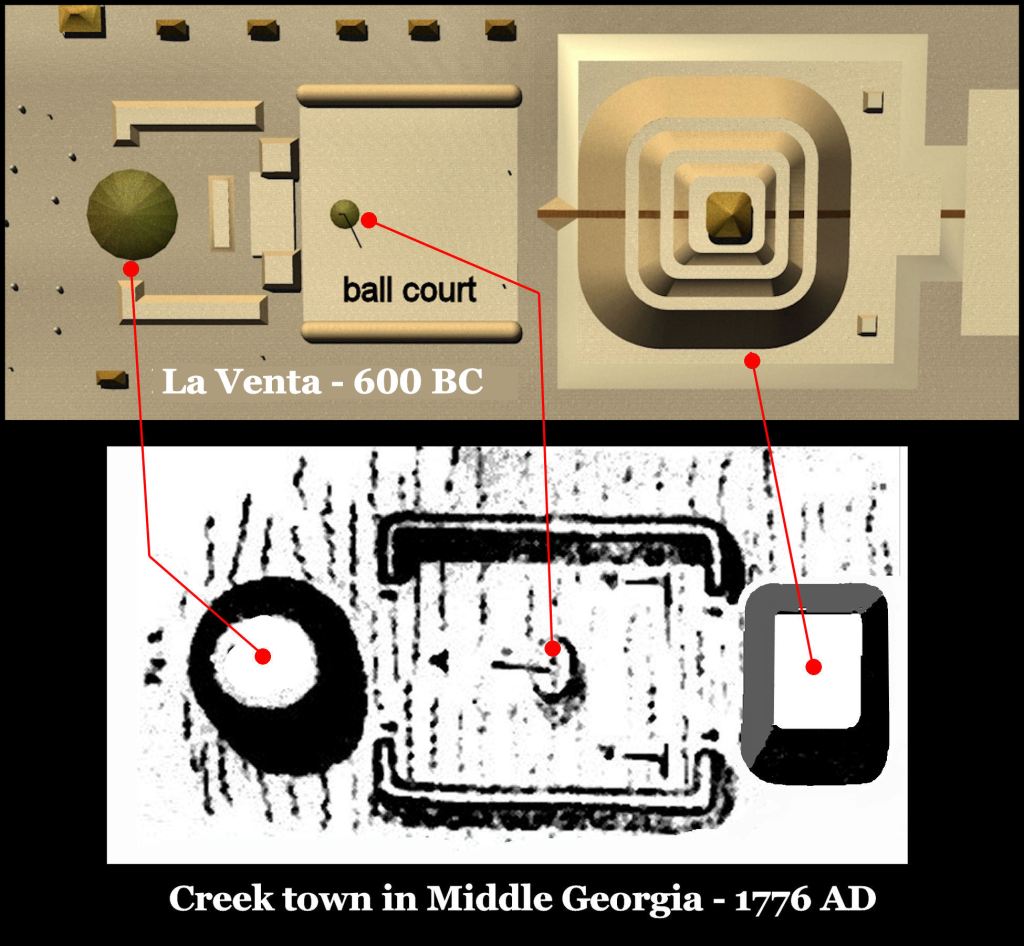
Site plan by William Bartram – 1776
Fact Five: Back in 1970, both Archaeologist Arthur Kelly in Georgia and Román Piña Chan in Mexico believed that there had been extensive contacts between Georgia/Louisiana/Alabama/Florida and Mesoamerica in the period from around 100 AD to 1350 AD.
In 2012, speakers representing the Georgia Council of Professional Archaeologists and US Forest Service, went around Georgia telling civic groups and college classes that I had dreamed up out of thin air the ridiculous idea that Mayas had immigrated to the Southeastern United States. The Eastern Band of Cherokee Indians went a step further with that myth and added that I had never been in Mexico, never met a Maya Indian and wouldn’t know a Maya if I saw one . . . in a nationally distributed press release, which then was published verbatim in the Atlanta Journal-Constitution.
Actually, Dr. Piña Chan was half-Maya, my former girlfriend in Campeche, Anthropologist Ana Rojas, is 1/4th Maya and ALL of my Native American DNA was classified as being Southern Mesoamerican. In fact, a 2005 DNA test labeled me a Mexican Mestizo, even though I am about 3/4th Nordic. I have made four trips to Mexico, since the three month fellowship there.
That being said . . . I didn’t know diddlysquat about Mesoamerica or the Southeastern Indigenous Peoples, when I began the fellowship in Mexico. The previous year, Dr. Kelly had mentioned to me that he had found Mesoamerican style artifacts along the Chattahoochee River in Georgia . . . but at the time, I hardly knew what “Mesoamerican” meant.”
My orientation session with Roman Piña Chan and Ignacio Bernal was delayed two weeks because I came down with Salmonella food poisoning the day after arriving in Mexico. Nevertheless, I immediately began studying sites in Mexico City as soon as I recovered. After the tour of the National Museum, Piña Chan invited me into his office for a “talking lunch”. He discussed his theories and evidence for his theories that the Indians in Georgia were descendants of the Olmec Civilization and that Maya Commoners had immigrated to the Southeast in small bands later on.
Piña Chan changed my fellowship syllabus to shift emphasis onto southern Mexico. He also nixed the package tours and directed me to travel by bus, so I would have more funds to immerse myself into the rural cultural environment and see lesser known ruins that had not been restored. I followed his suggestion in making the research objective and thesis title – identifying shared architectural traditions in Southern Mexico and the Southeastern United States.

Legal Proof (LOL)
When I returned to the Soto home in Colonia Nueva Santa Maria, Mexico City after the first lunch with Dr. Piña Chan, I excitedly told Ruth and Gianella that the famous archaeologist believed that my Indian ancestors in Georgia had migrated from Mexico and had been part of the Olmec Civilization. I was a guest at their home, whenever based in Mexico City.
I then wrote a summary of the meeting in my daily journal, while Ruth and I were seated at the dining table. Ruth was more interested in the progress of my romance with her neighborhood friend, Alicia. I have remained lifelong friends with Ruth and Gionella. Both are members of LinkedIn! Here is a photo of part of my journal from July 6, 1970.


Archaeologists Beatriz and Roman Pina-Chan saying “adios” to me in early September 1970. While I was in extreme southern Mexico in August 1970, Dr. Pina-Chan was fired by the new totalitarian president of Mexico, Luis Echeveria. Echeveria thought that Roman was on too good a terms with Pro-Democracy students at the Universidad Nacional Autonimo de Mexico (UNAM). Echeveria was directly responsible for the infamous Tlatelolco and Politecnico Student Massacres, while he was Attorney General in 1968.
As might be expected in our era, the fictional and sensationalized Youtube videos on the Olmec Civilization get far more viewership than my factual one. An honest feller jest can’t get no respect!
 The Americas Revealed