
The history of the beautiful song, “Y Volvere” . . . and a true story of international romance and heartbreak . . . a Pan-American Dr. Zhivago
In late December 1970, a 23-year-old man with mixed Native American and European heritage led his rock band from Chile to perform at Mexico City’s version of the Copa Cabana night club on the Saturday after New Years Eve – January 2, 1971. Not knowing what to expect from a Mexican audience on this odd date, he procrastinated till the end of the night to sing a challenging song. Germain de Fuentes had written Spanish words to a tune by French singer-composer, Alain Barrière, then modified the song with a Latin American rhythm.
So tormented by the constant bombardment of political propaganda that you want to escape to through the nearest doorway? May we suggest a healthy alternative escapism to downing a whole bottle of Jim Beam whiskey? This trip into nostalgia is also a chapter of a love story . . . which was a Mexican version of “Dr. Zhivago.”

by Richard L. Thornton, Architect & City Planner
A Time of Change
It was a time of rapid social change in Mexico, especially for the role of women in Mexican society. From 1945 onward, Mexico was the main source of progesterone, the primary ingredient in birth control pills, which was extracted from the Mexican wild sweet potato. Yet, the Pill was only made legal in Mexico for married women in time for the 1968 Olympics. It would be officially illegal for Mexican single women until 1973. I was shocked when after only dating Alicia about a week, 19-year-old Alicia announced that she wanted to move to the United States so she could get birth control pills.
No one knew at the time that both the Mayas in Mexico and the Creeks in the Southeastern United States had made a birth control tonic for perhaps 2,000 years or more from their respective wild potatoes.
Both my loves in Mexico . . . Alicia in Mexico City and Ana in Campeche were highly intelligent young rebels, who planned to obtain advanced education in order to practice a profession. Both really, really liked men, but not most Mexican men . . . because in that era of their controlling nature and fondness for prostitutes and mistresses. I came from a Creek tradition of men and women being socially equal . . . but really, really liking each other. That made me an ideal candidate for both ladies.
By late August 1970, Ana had seemingly won the contest. Her parents liked me, while Alicia’s mother didn’t. Like most affluent Mexican parents, they had arranged for her to have a female doctor in New Orleans to look after her reproductive health. Ana’s parents had invited me to spend the Christmas holidays with them. Already, they had encouraged Ana and I to stay in the guesthouse together. They had already suggested to Ana that if she moved in with me in Atlanta, maybe she should become a Methodist, since most of their clients were Methodist universities in the Southeast and Southwest. It would be good for business. Meanwhile, Alicia’s mother tried to control Alicia like she was a 15-year-old and called me “diablo protestante,” when she was in a good mood.
Ana couldn’t wait till Christmas, then dumped me, because she imagined that I had lots of girlfriends in Atlanta. I didn’t, I had to study or draw seven days a week. She complained that she was not going to sit a home throughout her senior year at the university, while I partied all the time.
A short time later, Alicia invited me to spend Christmas at her house. She would turn 20 in December. and promised that by then her mother would be treating her like a woman, not a little teenage girl. I was to bring along my 10-year-old sister to show that Alicia was fully accepted by my family and not considered a Latin American Trollip.
An upscale finale to the Christmas holidays
By the time Fall Quarter ended at Georgia Tech, all of Mexico City’s college student-oriented night clubs in safe neighborhoods were booked for the holiday. Real night clubs are pretty much gone with the wind in the United States today. Back then, the drinking age was 16 in Europe and Latin America, 18 in Georgia. The night clubs were upscale restaurants, where “nice” young couples could enjoy a gourmet meal, have a couple of alcoholic drinks, but not get drunk . . . then dance the night away to a live band.
Eventually, Alicia’s friend, Pilar, told us that the Club Cristobal Colon at the hotel of the same name in the Zona Rosa was having a rock band on the Saturday night after New Years Day and still has a few openings. Normally, this club catered to the old folks with mamba bands from Cuba and mariachi bands from Mexico. When Alicia made the reservation, she discovered that there was no cover charge, but diners were encouraged to buy records from the young band members.
That gave Alicia the bright idea that we could afford to stay at the hotel so we could finally have her “becoming a woman” ceremony. Her irate mother nixed that idea and yelled that I would never step in her house again, if we did.

The Copa Cabana of Mexico City
Walking into the restaurant-dance club was like entering a time machine. We were instantly transported to the set of a glamorous Hollywood movie from the 1930s or 1940s. That’s when the hotel was built. The large stage, where in earlier decades a big band had played, now contained multiple platforms for smaller groups of performers.
We were seated next to a table, held by an obese, middle-aged Mexico City policeman, with two teenage girls as his escorts. By the way that they were stroking him with their hands, the girls were obviously not his daughters. Alicia snipped softly, “Now that is one of the reasons that I want to leave Mexico!”
We dined on delicacies, left over from New Years Eve, but at week-day restaurant prices. A mariachi band walked from table to table, serenading us as we ate.

Los Angeles Negros in 1971
Then, when all of the tables had been cleared of plates, the band from Chile came on. The five men were about our age, but dang, they were good. They had created most of the songs, which they performed. Their fast-dancing music was not quite the quality of the best bands in the U.S., but their slow-dancing music was world class. And really, if you are young and in love, it is slow-dancing music that you long for . . . to be as close as possible.
This enchanting evening had about come to an end, when Germain de la Fuente announced that for the last dance, Los Angeles Negros was now going to perform their latest song. Most couples got up to dance that last dance. Then we became mesmerized by the beauty of “Y Volvere” (And I will return). Most couples stopped dancing and stared spellbound at De Fuente. The song ended with De Fuente blasting out “Y nuestro amor renacerá (And our love will be reborn).
The whole song was about us. A young man was about to travel to another country and did not know when he could return, or if his beloved would be able to join him in that country. Unanimous pleas by the audience persuaded Los Angeles Negros to perform the song two more times.
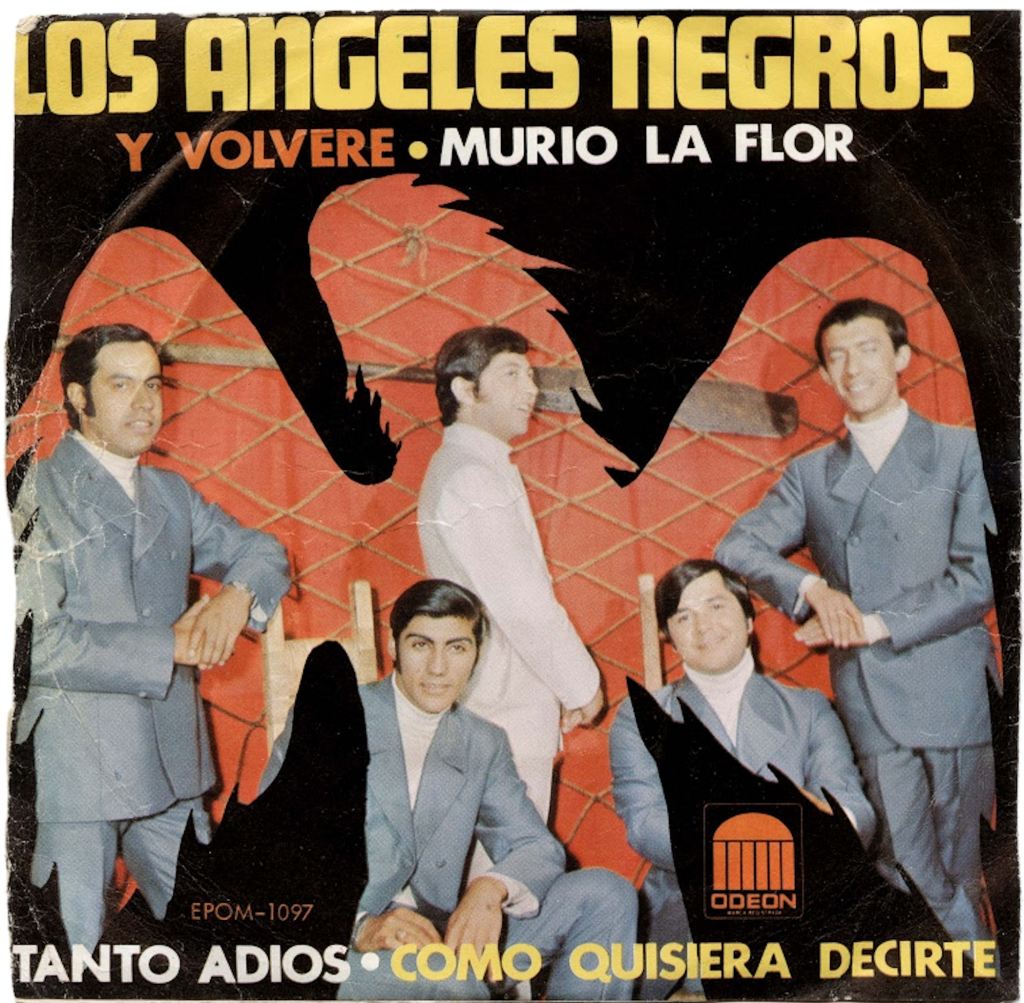
The record cover and record are in surprisingly good condition.
On the way out of the restaurant-dance club, girl friends of the band members were selling tape diskettes, plus 45 rpm and 33 rpm vinyl records. I bought a 45 rpm of “Y Volvere”. I wanted to show the guys at the fraternity house what a Mexican record looked like. After returning to Atlanta on Jan. 4, I played it a couple of times for my fraternity brothers then tossed it into the box, where I stored Alicia’s love letters.
Eventually, the cardboard box held 26 of her beautiful letters and some very personal mementos of Alicia, like a lock of hair, plus some letters I received from other young women during my first single days. The sealed box stayed concealed within another box of “memories of Mexico” for 50 years. While recovering from a disease that had not yet been name COVID, I transferred the contents of moldy cardboard boxes to waterproof plastic containers, then discovered the record.
I looked up “Los Angeles Negros” on the internet and was shocked to discover that after moving to Mexico, the band became “The Beetles” of Latin America. There are dozens of Los Angeles Negros videos on Youtube. The band still exists, but has changed members several times over five decades. How popular is Los Angeles Negros today? The band was invited to sing “Y Volvere” at the 2024 national celebration of Mexican Independence Day at the Zocalo in the heart of Mexico City.
In 2014, surviving members of the original band were brought to together to perform with an orchestra in a standing room only night club. That may be a remodeled Club Cristobal Colon. Whatever the case, in the full video, the announcer stated that there were several couples in the crowd, who fell in love while dancing to “Y Volvere” at their first performance! A video of “Y Volvere” from that concert, follows this essay.

Nueva Santa Maria Park, near Alicia’s house. We liked to walk and hold hands there at sunset.
Remembering Alicia
When we came home from the unforgettable experience of dancing to “Los Angeles Negros,” everyone was asleep, including my little sister. We cuddled for awhile then Alicia announced that it was the hardest thing that she has ever had to do, when she walked alone to her bedroom.
She started walking then uttered, “¡No más!” (No more!) She grabbed my hand and led me to the guest bathroom. One door opened to the hallway. The other opened into her bedroom. She locked the hallway and bedroom doors. If someone knocked on the hallway door, she could quickly slip into her bedroom and feign innocence.
Years later, I learned that my 10-year-old sister learned the facts of life the good ole fashion way . . . by peeking through the keyhole of the hallway door.

Alicia’s house in 2024
The next evening . . . the last night before my sister and I flew back to Atlanta . . . Alicia and stayed up late and chatted over two bottles of Cidre de Tehuacan . . . a champaign-like wine made from especially sweet apples. It is the traditional elixir of lovers in Mexico. This time, we went reluctantly to our separate bedrooms.
Then . . . some time during the night, I was awakened by silken black hair stroking my face. Alicia, in an au naturale state, put her finger to her lips and said “Sh-h-h, we cannot make a sound.” She then whispered into my ear, “Last night we had no time. Tonight, I will give you a memory that will last for a lifetime. We do not know if God will let us be together again, but if you are ever with another woman, tonight will always make you think of Alicia first.”
Perhaps it was in a way, a curse, but Alicia’s promise came true.
Later that winter, a visit to the United States Embassy revealed that because she was born in San Diego and her father is a citizen of the United States, after turning 21, all she had to do to be an American citizen was to fly to Atlanta and once she stepped on solid ground announce that she was an American citizen. However, if she decided to move to Atlanta before then, she would be automatically given Permanent Resident status until she turned 21, if she was a college student or employed.
She then visited the offices of Eastern Air Lines in Mexico City to see if she could get a job as a part-time interpreter, while a student at the University of Anahuac. Instead. they suggested that since she was already fluent in four languages, she should apply to become an International Passenger Service Agent . . . which would pay more than I would make after graduation from Georgia Tech.
Eastern Air Lines would also pay 100% of the cost of finishing her bachelors degree in Linguistics, plus pay for a Masters Degree in International Commerce. Eastern recognized that Alicia was a sharp cookie. However, Alicia would have to apply for that job in Atlanta after getting U.S. citizenship or at least a work visa.
In April 1971, Alicia stopped answering my letters. When I called her home, the servant, who answered, slammed down the phone.
In June 1971, Alicia’s friend, Pilar, sent me a brief letter. Alicia’s evil uncle had paid her mother’s servant to steal all the letters I mailed and that Alicia put in her mailbox. He then paid a translator to convert them into Spanish. He told her mother that Alicia planned to move to Atlanta in June. She stole Alicia’s California birth certificate and Mexican passport. When Alicia applied for a new passport and ordered a new birth certificate from California, her uncle paid a group of criminals to kidnap Alicia and take her to a ranch in northern Mexico.
Alicia had a nervous breakdown while imprisoned at the ranch. Everyone in her neighborhood adored Alicia and despised her weird family. They were trying to persuade the Federal Police to raid the ranch and free Alicia.
In early November 1972, I was stuck in Paris, France during a French rail strike. While walking into the Louvre Museum, two young women in front of me were speaking French. One sounded like Alicia, had a figure like Alicia and had long curly black hair. I was hesitant to speak to her, from just the rear view, so I eventually maneuvered at one venue, so I could see her face. It was like Alicia’s but she had a French nose, while Alicia had a Semitic nose, which she hated. That mademoiselle stared at me as intently as I stared at her, but I had a mustache now, was wearing a Swedish sweater and was wearing a large a back pack. Neither one of us said anything to the other. Both of us looked back at each other as went in opposite directions . . . each of us wondering if they should have spoken.
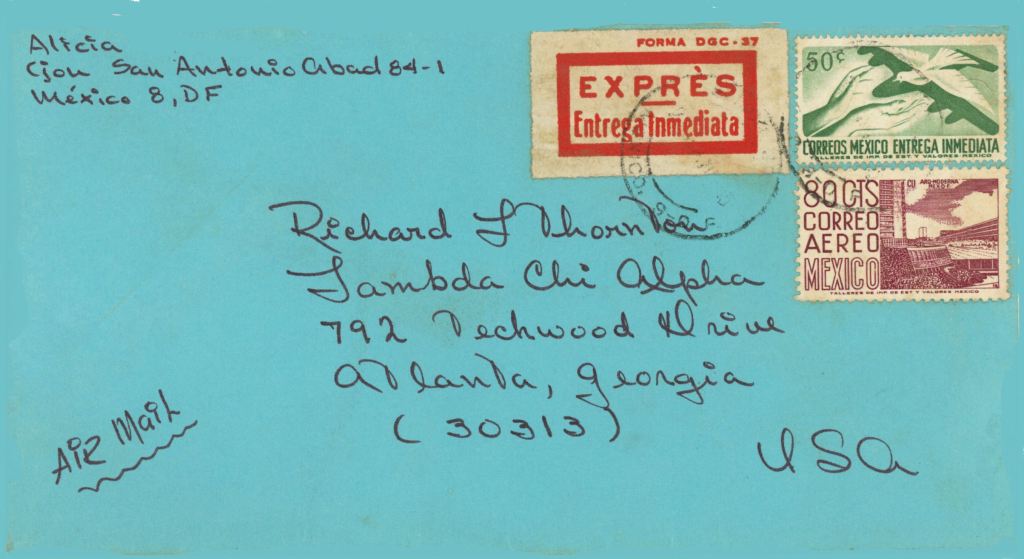
In April 1974, I received a letter from Alicia that had been originally mailed in late May 1972, but had arrived at the fraternity house a few days, after I graduated and immediately flew off to Landskrona, Sweden. Somehow, she knew that I was about to graduate and congratulated me. Alicia announced in the letter that she was a woman now legally and loved me more than ever.
The only things that kept her from committing suicide in northern Mexico was her constant prayers to God and memories of me running my hands through her hair and us dancing to “Y Volvere”. She prayed that the song was a sign from God that someday soon, I would return to Mexico and rescue her.
Her American birth certificate and Mexican passport had been returned to her. If she did not contact me, her mother offered to pay for her nose surgery and for her to get a Masters Degree in Paris, France. Alicia was ethnically a French Sephardic Jew, but had been baptized a Roman Catholic in California.
She added that all I had to do was to say the word and she would fly immediately to Atlanta to be in my arms forever. If not, she was flying to Paris in late August. So, we did see each other at the Louvre.
I called the Sotos in Mexico City, who lived two blocks from Alicia’s house. They said that they had not seen Alicia since she was kidnapped in 1971. She had stopped by the house, while they were gone, to thank them for helping free her, but they did not know where she was now.
On August 7th, 1974, I was seated in the front yard of Soto’s house in Mexico City, chatting with Jose and Lupe. Their daughters were out shopping with my new bride, who was not Alicia. The Soto’s confided in me that while inebriated, my bride had exclaimed that she was drinking to get through the honeymoon. She did not love me, but had been “assigned” to me. I was the only guy she knew, who had a good job, so she accepted my proposal.

Shortly thereafter an absolutely gorgeous Alicia drove by slowly in her red Plymouth Barracuda and waived at us, not knowing I was there. I couldn’t stand the temptation and so a couple of minutes later called her home. She answered the phone.
After I told her that it was Richard. Alicia screamed with joy, shouting, ”God has answered my prayers! I have been dating a dentist, since I got back from France, but he is nothing to me. We can go tonight to my cousin’s hacienda near Pueblo then fly back to Atlanta tomorrow to start our new lives together.”
Then I had to tell her the truth. “Alicia, I am on my honeymoon. I did not receive your letter from May 1972 until April 1974. Even then, I tried to find you, but no one knew where you were.”
Alicia broke down into loud sobbing. I felt like caca, but there was really nothing I could have done differently, except not marry the future wife from Hell.
Alicia did say, “It is my fault. I should have called your parents, when I was free or sent my letter to your parents, but at the time, I was a very broken, confused girl.” The call ended with both of saying “Vaya con Dios mi amor.”
While vacationing in Mexico in December-January 1980, I learned that a broken-hearted Alicia had moved back to France then met and married an Italian chef. They moved to Naples, Italy to stay as far away as possible from her family.
In December 1998, I was attending a party at a private club in Rome, GA. Near the entrance door, a gal in her mid-20s, who looked almost exactly like Alicia the last time I saw her, was sitting at a table with a middle-aged Georgia Bureau of Investigation agent. Out of the blue, my date said, “That is Alicia’s daughter. She can be yours, if you join our cult.”
My date barely knew me (I thought). She shouldn’t even have known that I had been in Mexico. The club turned out to be a Satanic Cult. I didn’t join it and never saw Alicia’s daughter again.
In 2007, according to the internet, Alicia was divorced and living in Cancun, Mexico under her maiden name. The following year, a legal notice was posted by a bank in the City of Cancun that her house had been foreclosed on. This was during the Great Recession.
In late 2010, there was a series of notices on a Roman Catholic website that Alicia had paid for prayers for her mother, who had cancer. In the notice, Alicia begged forgiveness for keeping her children away from their grandmother for three decades.
In 2011 or 2012, Alicia’s mother died. Alicia made one more plea for forgiveness on the Roman Catholic website then her name disappeared from the internet permanently. I tried to contact her via the organization that sponsored the website, but a woman emailed me that Alicia did not want to communicate with me. This was the exact time period, when my name began sprouting up all over the interne, due to the History Channel program on “the Mayas in Georgia.”
And now, for your entertainment, Los Angeles Negros, singing “Y Volvere” in 2014.
 The Americas Revealed
Love this story Richard although I found it so sad at the end. Thanks for the video and I would have danced a lovely slow foxtrot to that music. very romantic !!
LikeLiked by 1 person
We tried to dance, but when Germain was young, his voice was mesmerizing. Like most everybody else, we just there in awe. The corer members of the band were Mestizos from a small, rural town in Chile. My understanding that they taught themselves how to play musical instruments and sing professionally.
Think of it this way . . . it had a sad ending for Alicia, but I would not be writing you today, if we had married. We would have stayed in Atlanta or moved to Washington, DC, because that’s where the jobs for linguists and translators are. I never would have dived whole hog into culture of my ancestors, and instead probably would have taught university level classes on the Mesoamerican architecture of Mexico and Central America. On the other hand, she would have had a much happier life with me.
LikeLiked by 1 person
They say that your life is planned for you. For instance, many years ago I came to Crete with my late husband for a holiday never thinking that I would end up living here .
LikeLiked by 1 person