Why Creek, Chickasaw and Seminole descendants have such weird DNA profiles.
In 1653, English explorer, Richard Brigstock, encountered numerous gold and gem miners from Asturias and Galicia in the Southern Appalachians. They were required to marry Creek, Chickasaw, Soque or Uchee women in order to get a “green card.” This explains why until after the American Revolution there were still some Spanish-speaking Creek towns such as “Ellijay” “Casara” and “Pozo Rico” in the Georgia Mountains They moved to Florida, when their land was secretly given to the Cherokees by the U.S. Government in 1785.
The Creek name for Yonah Mountain was Nocosee (Bear) Mountain. That was its name on official Georgia maps until 1832. However, local metizo families called it Monte Yeona, which is the Asturian word for a mountain lion. Gold miners, flooding into the Valley after 1828, changed the name to Yonah, which is the Cherokee word for a Grizzly Bear.
Some of the Southern Appalachian mestizos became Seminoles in Florida, where their use of Spanish would seem normal. Others assimilated into the main population of Georgia or in the case of many Sephardic descendants, adopted a Cherokee label for their family. Whatever the case, their descendants today have unusual DNA combinations, which consumer-oriented labs rarely get right. The relatively inexpensive techniques of this labs cannot discern when your ancestors came to the Americas.
My grandmother always told us that her Native American ancestors came from near Savannah and from Habersham County, GA, where I live now. In 1919, she and Grandpapa Obie went on their honeymoon to Habersham, because of its mountain scenery and to honor her ancestors. Apparently, her Mother Town was within two miles of my home here. I have always been curious as to how that particular combination of Creek ancestry would create our family’s weird DNA profile.
I have been doing research on Asturias and Galicia in preparation for creating world-class virtual reality models of the Spanish compound in the Nacoochee Valley in the mid-1600s and St. Augustine, FL in 1585. Galicia, Asturias, Navarre and Catalonia were the only sections of the Iberian Peninsula, which the Moors couldn’t conquer. Their aboriginal inhabitants are Gaels and Basques. Christian Visigoth refugees poured into the region during the 700s and 800s AD. The typical DNA of the northwestern tip of Spain is quite different than that of the rest of the peninsula.
The Goths originated in central Sweden. The Gaelic peoples of Ireland and Scotland came from northwestern Iberia. Thus, most consumer genetics labs will interpret your Early Colonial Period Iberian ancestry as being Irish/Scottish Gaelic, Basque and Nordic. If you have A LOT of Iberian ancestry, like many “old-time” families here, the labs will label it “Portuguese.”
Galicia, Asturias and Navarre have always resented the domination of Castilians on their language and cultural traditions. However, their mountains are rich with gold, copper and gems, which the Spanish kings wanted.
The Galician and Asturian languages sound like an Irish person trying to speak Spanish. Actually, they are very pleasant languages to listen to. The sounds are much easier to pronounce than Castilian or French.
That region is also the only section of Iberia, where Protestantism gained much following. Navarre eventually became almost 100% Protestant. Whether was to escape the tyranny and greed of Castilian hidalgos (nobility) or the Inquisition, Asturians and Galicians had powerful incentives for escaping to the remote Appalachians, which were ruled by a benevolent Native American monarch and representative democracy.
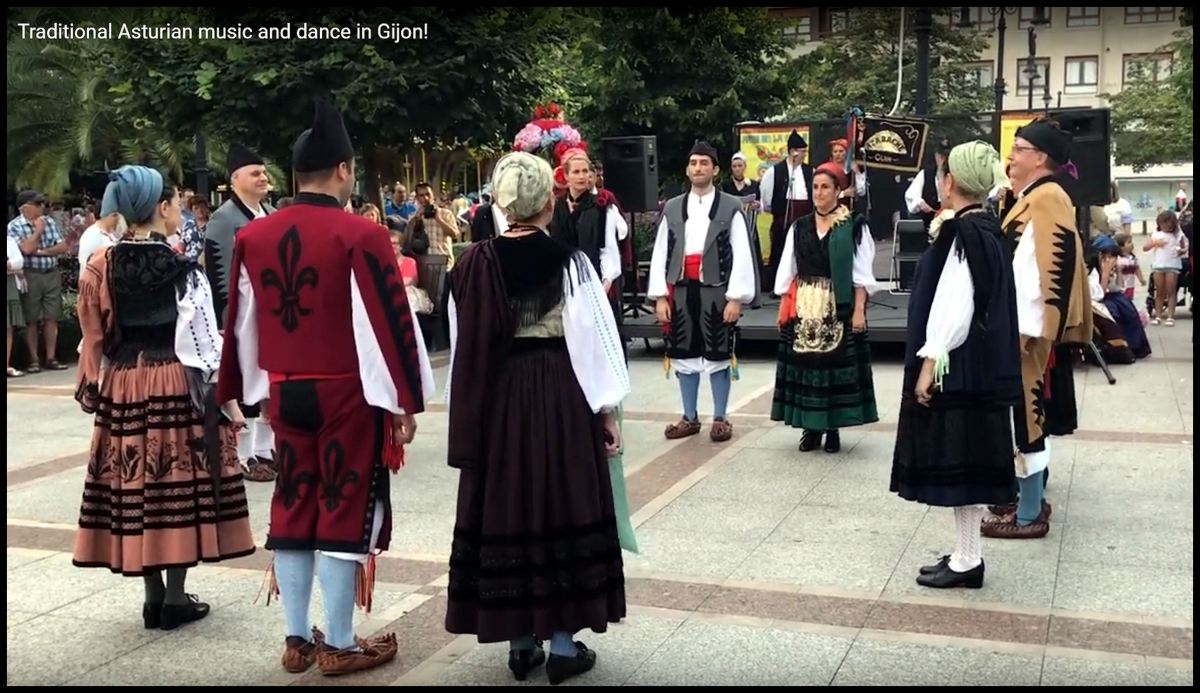
In studying the music and dancing traditions of Asturias yesterday, I was shocked to learn that the ancient dances of that province are very similar to the original dances of the Southern Appalachians. They are square dances, circle dances and clogging. The bagpipes, flute, various types of drums, tambourine and guitar are their traditional musical instruments. It is easy to see how the culture of the Mestizo Asturian and Galician families easily blended with that of later Scottish and Irish immigrants. Go far enough back . . . and THEY had the same ancestors!
More Asturian bagpipe music by a large band. It sounds astonishingly like Scottish Gaelic music, but its origins go back to the Bronze Age or earlier.
 The Americas Revealed
This dance reminds me of both the Irish dances and the Scottish dances they are very similar.
LikeLiked by 1 person
Yes, they are. That was my point. There was not a whole lot of difference between the Asturian and Galician settlers with the Irish and Scottish settlers.
LikeLiked by 1 person