“Maya” city states relied on peoples, who migrated to southern Mexico, Guatemala or Belize from other regions, to transport goods along the coastlines, then delivered them by freight canoe or porters to their customers. The peoples, who we now label “”Mayas” were terrified of hurricanes and the ocean in general.
by Richard L. Thornton, Architect & City Planner
The present states of Yucatan, Tabasco and Veracruz, plus the northern part of Campeche actually blossomed, when major cities to the south were abandoned. TV documentaries typically don’t mention this. Although considered barbarians by the Classic Period “Mayas,” these peripheral peoples, such as the Itza, Tamulte, Chontales and Soque, dominated Post-Classic Period Maya city states. It is Itsa, Soque and Tamulte words that one finds on the landscape of the Lower Southeast.
I put “Maya” in parentheses because we now know that the only indigenous American people, who actually called themselves “Maya” before the Spanish arrived, originated in Southern Florida! Miami is the Anglicization of the word, Maiami, which means “Principal Place of the Mayas” in their own language and in Tamulte Maya.
In fact, the Seminoles living from the Everglades southward in Florida called themselves Mayas, until forced in 1951 to change their name by the United States Bureau of Indian Affairs. They were a mixture of North Georgia and Western North Carolina Itsate Creeks, who had intermarried with ethnic Mayas, who fled Yucatan after the Spanish invasion.

Back in 2019, I stumbled upon this fact, while reading my journal from the 1970 fellowship in Mexico for the first time. On our first day of exploring Campeche, Ana Rojas, my driver and tour guide, first took me to the handfuls of ruins on the coast, before we headed northeast toward Edzna.
I noticed that the houses in the “Maya” villages on the coast were different than those in Yucatan State. They were smaller, had thicker walls and were coated with a thick stucco made of hydrated lime and crushed sea shells. This stucco is called “tabby” on the South Atlantic Coast of the United States.
Ana responded that the people on the coast of Campeche were not “real” Mayas. We would have to drive about 40 km (25 miles) into the interior of Campeche to see “real” Maya cities. She said that the Tulum town site on the coast of Quintana Roo, which was just then being opened to tourists, was built by people from Central Mexico. Perhaps, it was a shrine to the Maya Hurricane God – Hunraqan.
Ana added that the coastal Indians came from elsewhere. They knew how to build sturdier houses, whose walls (at least) would withstand hurricanes. Over time, their foreign languages became dialects of Classic Maya. She did not know where these coastal peoples came from, but they looked like many Indians to the south in Central America or northern Columbia.
Then in 2007, I read the report from archaeologists at the American Museum of Natural History, when they excavated Native American houses on St. Catherines Island, GA. In addition, to documenting the Spanish mission, I was to produce architectural drawings of the indigenous architecture.
These houses were built by the Guale, which is the Hispanization of the Coastal Creek word, Wahare, which means “Southerners.” The coasts of western Campeche, Tabasco and Georgia are almost identical in appearance.
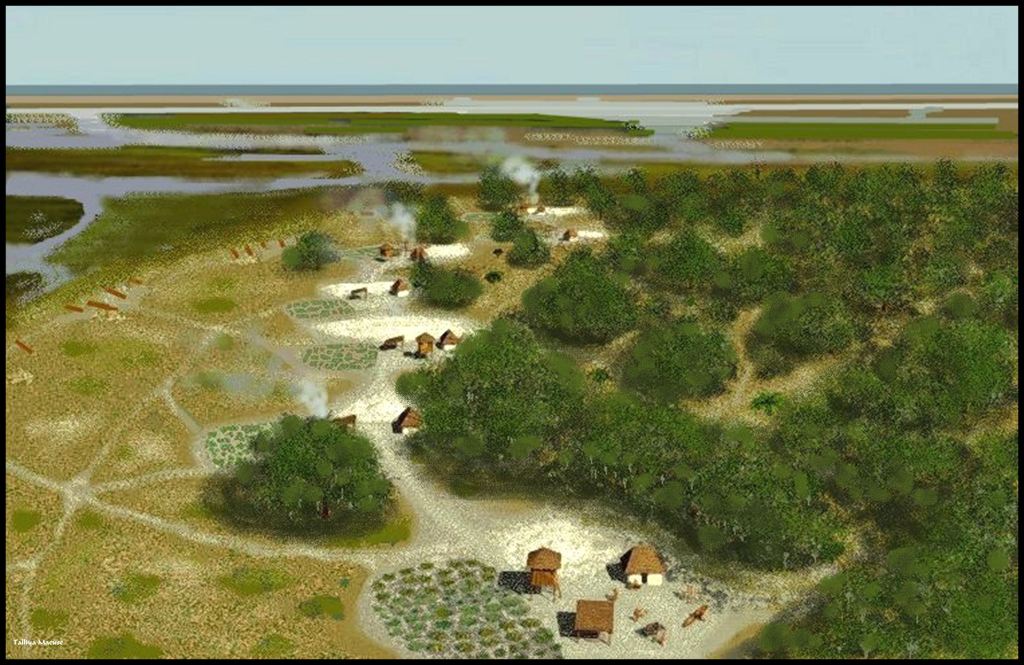
Campeche coastal houses on the coast of Georgia
Guess readers are wondering why it took me almost 50 years to read my own journal. Almost immediately after returning to Atlanta from Mexico, classes at Georgia Tech began. That meant having to study or draw dawn to at least midnight most days, with time off for a date on Saturday night and Methodist campus church on Sunday morning. The morning after I graduated from Georgia Tech, I flew to a job in Sweden. A few days after returning to the USA , I was hired by a firm in Columbia, MD.
The journal was put in the same special box as the letters and photographs from Alicia. That box was sealed and stored until 1976 at my parents house. It stayed hidden inside another box for the rest of my adult life, until I bought this house in the Nacoochee Valley.
There has been a handful of Southeastern archaeologists, who have worked in southern Mexico and the Southeastern United States. One of them was Robert Wauchope, who also worked in Northern Georgia in 1939 and 1940. Very few Southeastern archaeologists have worked on the coastal sites of Campeche, Tabasco and Yucatan, because one is less likely to find trophy artifacts on the coasts of those states . . . except on Jaina Island, Yucatan.
It just never dawned on this handful of archeologists that the houses, earthen pyramids (mounds), town plans and pottery of the coastal peoples were identical to those in Georgia between around 800 AD and 1200 AD. There is virtually no difference between the shell-tempered redware at Ocmulgee and the shell-tempered redware made by Maya commoners in Mexico. The former suburbs of Maya cities are covered with millions of shell-tempered redware potsherds.

 The Americas Revealed
Happy Summer! Yes, there;’s something like a dozen peoples in Central America who are called Maya because they adopted (or had forced on them by war) the traditions, but not the language. One sister-in-law, a Garafina from Belize, has Yu Ka Tec ancestry, and they’re a lot different from Kʼicheʼ people, who are local. When the Yu Ka Tec invaded in the early 18th century, they did so because of pressure from colonial slavers, fought a few wars with the Kʼicheʼ, Carib, and Moskitos, then had to ally against invasion. Together with Kongo escaped slaves, they whipped Spanish slavers, then fought the British pirates to a standstill. niio
LikeLiked by 1 person
Very interesting Richard Thankyou. Have you a picture of the Shell Weathered pottery. is it decorated at all. ?
LikeLiked by 1 person
It’s Shell Tempered Redware pottery The shells chemically react with the clay in the firing process, making it possible for the pottery to become vitreous at a lower temperature – thus saving firewood. Maya Commoners were required to make this type of pottery in order to reduce losses of woodlands. Here is a URL of this type of pottery. https://www.metmuseum.org/toah/hd/mayac/hd_mayac.htm
LikeLiked by 1 person
Thanks Richard.
LikeLiked by 1 person