
Architecture of the North American Frontier Series
In August, 1970, while staying in the Maya house above near Labna with Ana Rojas, I briefly wrote in my journal that about half the population of northern and central Chiapas disappeared around 550 AD. There was no evidence of mass deaths. No Mexican archaeologist had discovered to where they migrated.
One of the few other books in my backpack was Modern Maya Houses by archeologist Robert Wauchope. He described this oval style house as being commoner’s houses, aboriginal to northern Campeche. A smallpox epidemic in 1500 AD wiped out about 75% of the Indigenous population of Yucatan State and the Territory of Quintana Roo. Mayas from Campeche spread into that region during the Spanish Colonial Period and introduced the oval house to the survivors.
In 1939, Robert Wauchope excavated the Eastwood Village Site in the Nacoochee Valley, It is in the bottomlands, immediately east of Kenimer Hill and northwest of Nacoochee Methodist Church. Wauchope noted that this was the earliest known location of Chickasaw houses that eventually spread across the Southeast as far north as the Ohio River. The Chickasaws in northeast Georgia continued to live in this style house until their land was ceded in 1818 AD. The oldest hearth charcoal at Eastwood was later dated to around 550-600 AD.

As you can see in this color slide that I took somewhere in east-central Campeche, Maya houses in the late 20th century were still being built the traditional way. It is called post ditch construction and is identical to the manner that Chickasaw houses were built in the Southeast United States, when it was explored by Hernando de Soto.
The first step was to lay out a precise oval. A ditch was dug in this pattern and filled with clay slurry. Posts were set in the slurry and the clay was allowed to dry. In regions, where field stones were available, a low stone buttress wall, about one foot or 30 cm high was stacked around the posts to furnish lateral support during hurricanes or severe thunderstorms. Then rafters with interwoven sapling supports are erected.
Palmetto or thatch roofing was then installed. It was necessary to attach the roofing first in order to protect the finished wall, while it was drying. Through the many years of this house’s occupation, additional layers of palmetto fronds or grass were bound upon the roof . . . until it became quite thick.

Interior of the Maya “Love Shack” that we stayed in near Labna.
The final stage of home construction was wattle and daub walls, which were installed outside and between the posts. First, vines and saplings were interwoven around the posts. Then sandy clay was packed around this herbaceous lathing. Once it had dried to the texture of modeling clay, a second coat of less sandy clay was applied.
The final coat of stucco varied in composition. Campeche Mayas within the interior mixed red clay, with red ocher and crude lime. On both the coast of Campeche and Georgia, the final coat was a mixture of white clay, sand, crude lime and crushed shells, called tabby. In northern Georgia, yellow or red clay was mixed with crushed mica.
The Maya elite also mixed mica with lime stucco for their final coat, but this was expensive, because the nearest source of mica was in northern Georgia. It was hauled in Chontal Maya freight canoes or sail boats the entire length of southern Georgia and Florida then across the straight to Cuba then across another straight to the tip of the Yucatan Peninsula.
Maya walls were thinner and exposed the inner posts. Muskogean walls were by necessity, much thicker, in order to provide insulation in the winter time. The inner walls and floors of Muskogean houses were finished with decorative wove mats. As can be seen above, the underside of Maya houses were left exposed. The inner surface of Creek houses were plastered with clay.

A Woodstock Culture (Highland Itza) house in northern Georgia
After the disastrous explosion of the El Chichon Caldera in 800 AD, many Itza Mayas left the Chiapas Highlands. Some settled as far north as the Georgia Piedmont and Highlands. This became what Georgia archaeologists call the “Woodstock” Culture. Highland Itza houses were built the same way as the Campeche Maya houses, but had rectangular floor plans.
Around 1000 AD, large rectangular houses with interior room partitions began appearing on the acropolis in Ocmulgee Mounds. These were identical to the traditional houses of the Soque (Zoque) and Tamulte Maya in Tabasco State, Mexico. They were quite different than any architecture built in North America until that time. More and more Soque began arriving in Georgia, to the point that they occupied the northeastern corner of the state until decimated by Native American slave raids and smallpox, during the late Colonial Period.
The Soque houses reflected a major architectural innovation, which then spread to several branches of what would become the Creek Confederacy. Their walls and roofs were prefabricated! We will be discussing the Soque architecture in the next article of this series.
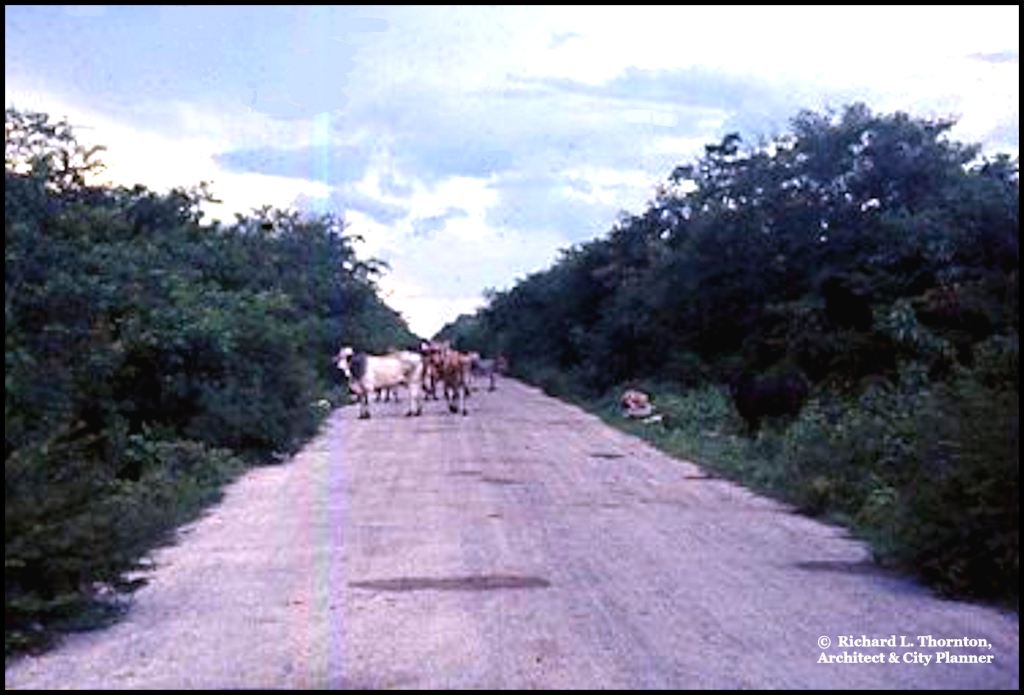
This is a five-decade old color slide of the only paved road in the State of Campeche, east of its narrow Coastal Plain. The highway had virtually no signs and there was no accurate road map of any part of the Yucatan Peninsula.
The Campeche Maya – Georgia Chickasaw Connection
First, we should explain that neither the official Georgia History textbook nor online references such as Wikipedia mention the Chickasaws being in Georgia. Chickasaw villages occupied substantial sections of Northeast, Northwest and Southwest Georgia as early as 600 AD or earlier. In fact, the tribes that formed the Creek Confederacy were merely varying mixtures of the Chickasaw and Uchee with tribes that immigrated from Mesoamerica and Peru
Grossly inaccurate maps, even to this day show the Chickasaw’s territory in Georgia, Alabama, Tennessee and Kentucky to be “Cherokee.” However, colonial archives by the Spanish, French, South Carolina and Georgia clearly label them to be the predominant tribe north of the Coosa River in Georgia and Alabama and west of the Tennessee Valley in Tennessee. The Migration Legend of the Kaushete (Creek) People states that they were one of the four original members of the Creek Confederacy.
Our story about the Maya Love Hut near Labna and archaeologist Robert Wauchope gets even more ironic. Ana Rojas and I struck out in her white Jeep on the adventure of a life time. The only federal highway was 1 1/2 lanes wide and had virtually no signs. The state highways were 1 1/2 lane dirt roads that were barely covered with gravel. The carreteras del condado were little more than one lane Jeep trails. Most of the roads were of the latter variety.
As will be described in the video below, we followed a carretera for about 21 miles until we passed through a time machine and entered a large Maya village in the 19th century. There were very, very few vehicles with internal combustion engines. There were not many more horses or carts pulled by burros. Most people walked, wherever they went. It was the Maya kaajal of Xculoc.
Relatively large oval Maya houses formed an oval plaza on a southwest to northeast orientation. Smaller oval houses were clustered along asymmetrical pedestrian lanes. A three lane “avenue” extended northeastward from the plaza to connect with the stone ruins of the towns original governmental acropolis.
A communal building, raised up from the ground by three steps, was at the southwest tip. A small, traditional religious meeting building was on the northeast tip. There was Roman Catholic church in the community.
The color slides of Xculoc sat in a metal storage case until 2020. When I pulled them out, I quickly realized that Xculoc was virtually identical in architecture, size, site plan and solar orientation to the Eastwood Village site in the Nacoochee Valley of Georgia. There was little doubt that the ethnic group, who founded Xculoc also lived at the Eastwood Village sites.
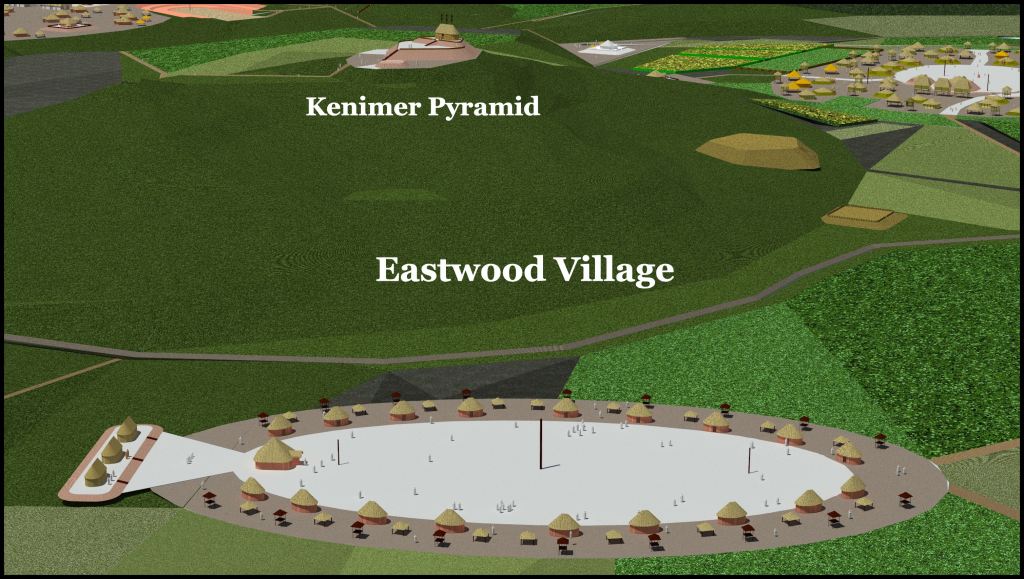
Architectural rendering of the Eastwood Village in the Nacoochee Valley.
 The Americas Revealed
Always fascinating and love feeling these greater histories of the ancients coming more and more to the surface even if just one blog post and artifact discovery at a time. Especially love living in a state where that appears to be ocurring more and more often! Thanks for all of the knowledge sharing!
LikeLiked by 1 person
Thank you! I have over 2,500 slides from my four trips to Mexico, plus my journal. They contain knowledge that would some day be lost, if not shares in various ways to the public. Three times during the past decade, deans of the College of Design at Georgia Tech tried to arrange for me to give lectures at the School of Architecture so that knowledge could be shared with the students, but a clique of female professors torpedoed their plans. Thus, I am sharing this knowledge with the general public instead.
LikeLike