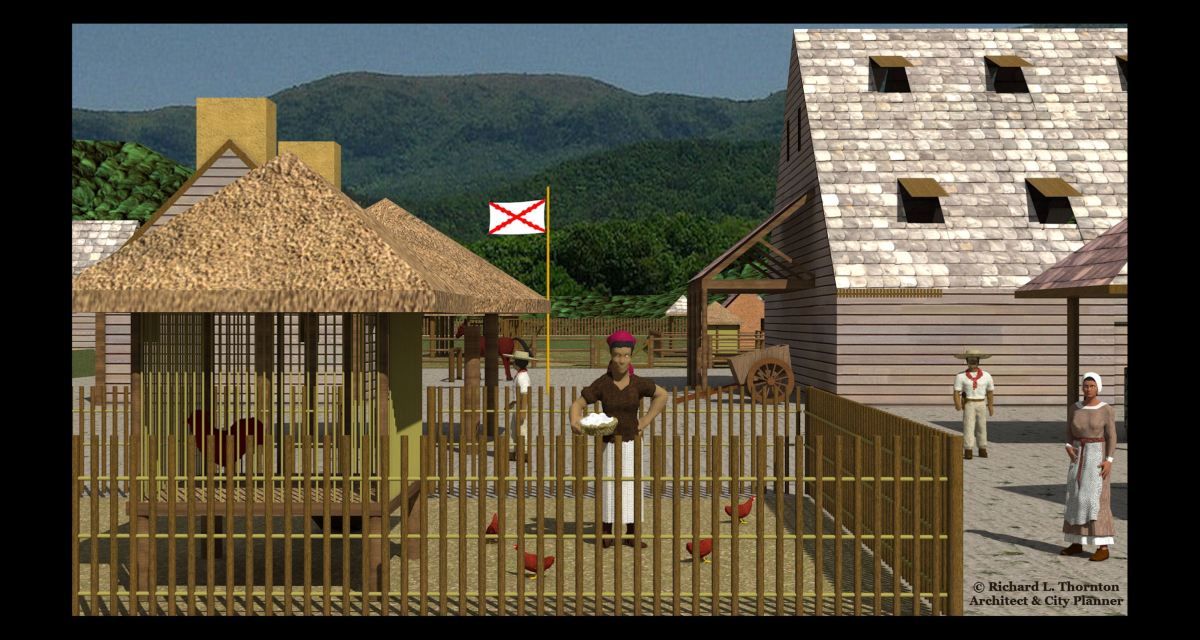
1653 – Fort Apalache at the headwaters of the Chattahoochee River in what is now, Helen, GA
Santos is the Mestizo caretaker of the chickens and turkeys, plus works as an Assistant Cook. Her descendants today are called Seminoles . . . or Georgians, who know they had Native American ancestors, but don’t know what tribe they were from. LOL
Along with the large, multi-colored indigenous chickens, raised by Native Americans in Georgia, Santos probably also raised Brown Galician chickens, Black and White Speckled Asturian Chickens, Golden Navarre Chickens and Black Basque Chickens, Virtually no Gringo anthropologist or archaeologist knows that the indigenous peoples of the Lower Southeast raised indigenous chickens long before Columbus sailed the ocean blue.
Three centuries later, Agricultural Engineer Jessee Jewell and a legion of local farmers in this very same region of Georgia pioneered the modern poultry industry. Northeast Georgia began promoting itself as the Poultry Capital of the World. None knew how far back the raising of chickens went in their locale.
Architecture of the North American Frontier Series
by Richard L. Thornton, Architect & City Planner

Spanish fort, trading post, mission and mule-breeding farm on the headwaters of the Chattahoochee
Erased history in the Southern Appalachians
We continue to accompany English explorer, Richard Brigstock, as he makes friends among the Spanish-speaking personnel of a fortified trading post and mission at the headwaters of the Chattahoochee River. Brigstock spent most of 1653 in what is now the State of Georgia.
Brigstock was a cousin of Virginia entrepreneur, Edward Bland. Along with Florida governor, Benito Ruíz de Salazar Vallecilla, Bland in 1646 was a principal investor in the construction of the La Coda Trail, which connected St. Augustine with the Nacoochee Valley in Northeast Georgia, plus a fortified trading post complex. There is no evidence that the King of Spain knew about this project. The profits from gold being mined in NE Georgia went into the pockets of a privileged few. Perhaps Brigstock was one of the heirs of Edward Bland.
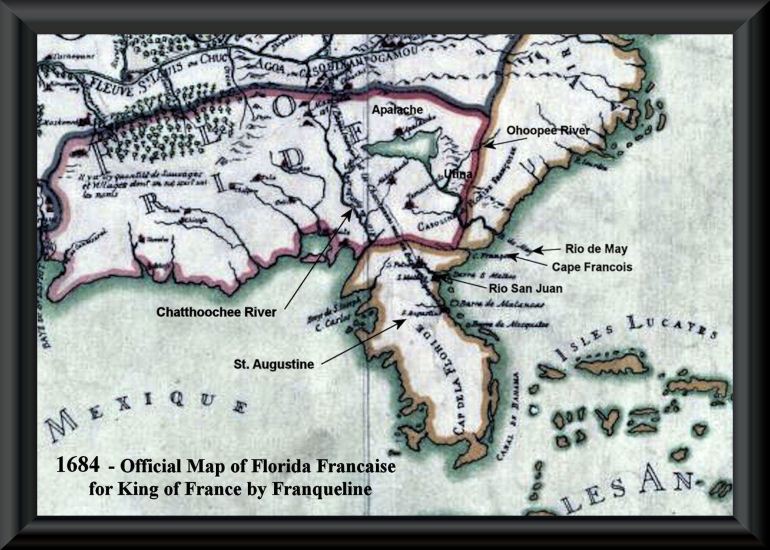
This map suggests that the La Coda Trail was constructed west of the Okefenokee Swamp and Ocmulgee River. After reaching the cluster towns on the Ocmulgee River near present-day Macon, GA the trail ran parallel to the east of the Chattahoochee River.
Gov. Salazar-Vallecilla succumbed to a disease in 1651. Bland died the same way in 1652. Apparently, the Spanish-speaking colonists became autonomous after 1652 There is substantial evidence that the Spanish trade operation continued until at least the Great Smallpox Plague in 1696.
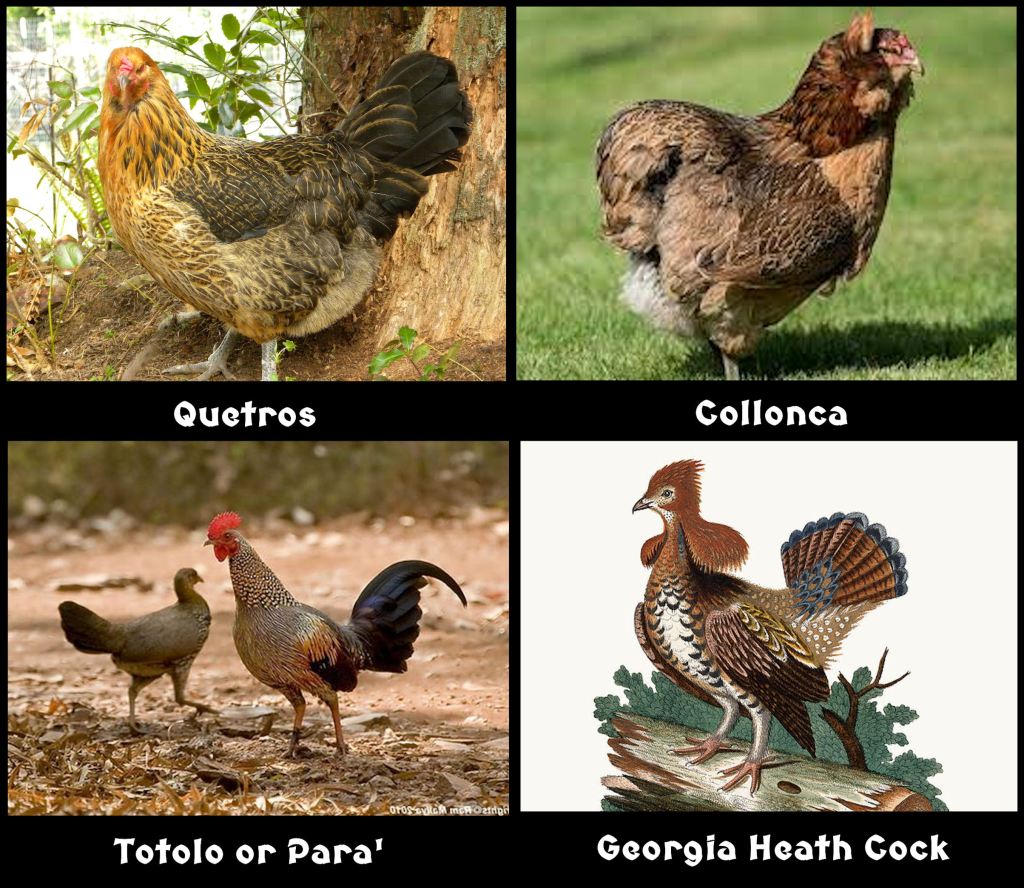
Indigenous members of the chicken family can be found in both of the Americas. Colonial Era explorers and settlers in what is now Georgia stated that the Native Americans bred both chickens and Heath Cocks. The now extinct Georgia Heath Cock was much larger and tastier than the Woodcocks, which still may be found along the Atlantic Coasts of North America and Europe. It seemed to be the result of inter-breeding between an ancestral chicken and the North American Grouse.
The Totolosi
Over a decade ago, scientists in Peru, France, Italy and India working together, proved that the Araucana Chicken of the Andean Region of South America was indigenous to the Americas. It’s closest relative is the Wild Chicken of India, which is the ancestor of all modern chicken breeds. Chickens were NOT introduced to Peru by Polynesians. In fact, the species of Araucana chickens with long tails were bred with Medieval European chickens to produce superior meat and egg-laying breeds.
The Totolosi were one of the many bands of indigenous peoples from South America, who immigrated to the Coastal Plain of Georgia and southern South Carolina. The original name of their tribe has been lost to time. Totolosi is the Panoan (Peruvian) and Georgia Creek word for “chicken.”
At the time that they were visited by French explorers from Fort Caroline, they seemed to have been concentrated in the area of Southeast Georgia between Alma and Baxley. The La Coda Trail passed through their territory, so there was significant trade between the Totolosi and St. Augustine.
Although not Muskogeans, the Totolosi associated with the Creek Confederacy. The Peruvian name for chicken became the Creek word for Chicken. By the late 1700s, the main Totolosi village was located on the southern tip of Chattahoochee River and called Fowltown by Anglo-Americans. By this time, they were speaking a dialect of Itsate, the Maya based lingo of most Georgia Creeks, until the early 1800s.
The Itsate-speaking tribes in southwest Georgia sided with the United States during the War of 1812 and Redstick War, but became hostile when they learned that their loyalty was repaid by having their land stolen by the United States in the Treaty of Fort Jackson. They rightfully objected to the legality of hostile Red Stick leaders giving away the land of the United States’s allies.
After being thoroughly thrashed by units from General Andrew Jackson’s army, the surviving Totolosi fled into Florida, which was then owned by Spain. During the sad years of the multiple Seminole Wars, the surving Totolosi became indistinguishable from other branches of the Seminoles.

Many agriculturalist Indigenous American tribes in the Southeastern and Southwestern United States raised turkeys. Spanish colonists quickly adopted the practice from their indigenous neighbors. Turkeys were allowed to wander within palisades, but could not be allowed wander through the forests like domestic hogs. The domestic turkeys were so closely related to their wild cousins that they would frequently wander away with them.

Domestic goats in Asturias, Galicia and Navarre have much larger torsos and udders . . . have different coats and are longer-necked than the breeds farther south in the Iberian Peninsula. Their Milk Chocolate colored hair is quite unusual for the animal world. They are directly descended from the wild Asturian Goat as pictured above. Because of their superior milk-production ability, Asturians were imported into Eastern Switzerland.
In the late 1800s some of these domesticated Asturians were imported into the United States from Switzerland, where they were named “Toggenburg goats.” The massive Toggenburg goats on my farm in the Shenandoah Valley were descended from champions developed by Lilian Paula Sandburg, wife of poet, Carl Sandburg. One of those princesses could produce three gallons of milk a day! Throughout the operation of Shenandoah Chevre, all of our milk was pasteurized in a pasteurizer, purchased by Carl as a Christmas gift to Paula.
All of the architectural renderings above were created by the author with BricsCAD architectural software by BricSys in Brussels, Belgium and Artlantis virtual reality software by Studio Base 2 in Paris, France.
 The Americas Revealed
And now, Chatham County has outlawed domestic chickens, until Paula Deeen made a plea for her rescue chickens. Now, the county doesn’t enforce theaw unless someone complains. Now Paula Deen has moved to California, but the factory farmers have turned Buena Vista into Stink City.
LikeLiked by 1 person