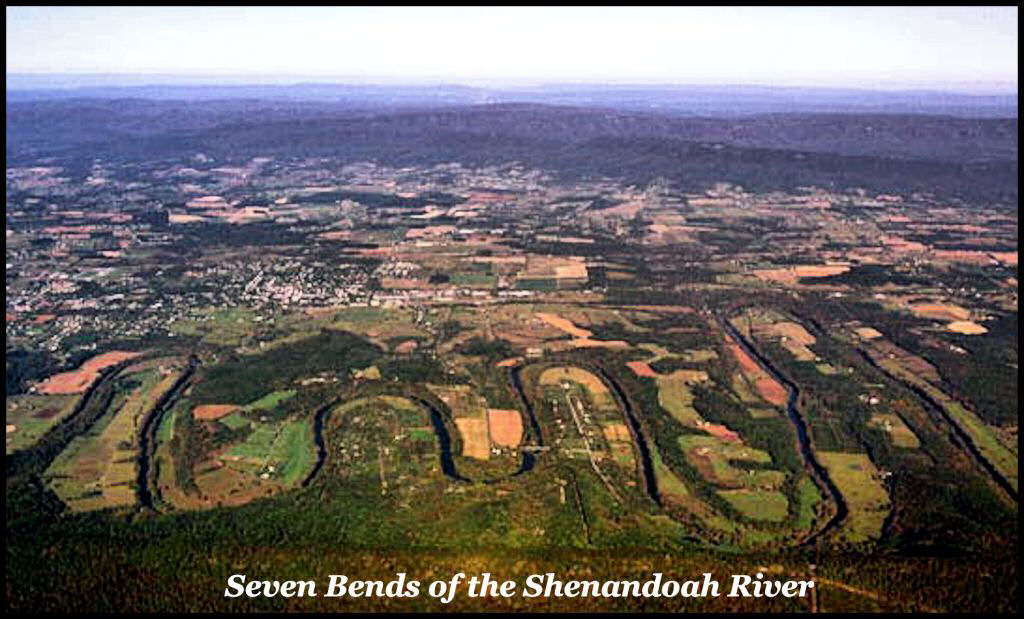
Virginia students have been taught for over a century that the Shenandoah Valley was uninhabited until white men settled it. That is a bald faced lie, which was only challenged by an astute Virginia academician in 2020.
The original spelling of Shenandoah was Shannontoa. This is a pure Gaelic word, meaning “Ancient River Tribe or Clan” or “Sea Goddess Tribe or Clan.” Thus, it has the same name as the Shannon River in Ireland. As in Gaelic, toa is the Uchee word for tribe or clan in Georgia and Tennessee. However, that hint at a Gaelic infusion in its past, is just one chapter of the Shenandoah Valley’s rich heritage.
The Peopling of Eastern North America Series
by Richard L. Thornton, Architect & City Planner
Because of my friendship with several avant garde archaeologists, based at institutions in Washington, DC, and artifacts unearthed at my own project sites in the Shenandoah Valley, I probably know much more about the cultural history of the Shenandoah Valley than anthropology professors at the University of Virginia.
Even though the University of Virginia is on the other side of the Blue Ridge Mountains from the Valley, its archaeology professors have consistently ignored the Shenandoah Valley. In fact, unlike the states of Louisiana, Mississippi, Alabama, Tennessee, Georgia, Florida and South Carolina, Virginia archaeologists have never even surveyed the dense concentration of Native American occupation sites in the Shenandoah Valley . . . only the Civil War sites!
In 1988, I found painted Native American pottery shards in the garden of Jay Monahan/Katie Couric’s 1790’s farmhouse and then five years later, found a wide range of Mesoamerican style artifacts and burials, where a contractor was digging the septic field for James Carville/Mary Matalin’s 1790s farmhouse. In both cases the University of Virginia archaeology professors refused to look at the artifacts. In fact the second time, the professor laughed at me and refused to take the phone from the receptionist.
Thus, it was only in 2018, 22 years after being involuntarily separated from my beloved farm in the Valley, that I began to put together all the pieces of the puzzle. I bought a reprint of Samuel Kercheval’s A History of the Valley of Virginia (1833). Except while being away a war, Colonel Kercheval lived his entire life in the Valley. He grew up in a time when Indian mounds were endemic there and one could even still see the some ruins of large American Indian towns.
Kercheval was a French Huguenot and extremely well educated man. He openly stated that the architecture and artifacts that was strewn across the Valley were entirely different than those produced by more primitive indigenous peoples elsewhere in Virginia. He speculated what part of Mexico these people had migrated from. He specifically discussed the stone sarcophagi, metates and tortilla grills (plus painted pottery) that the contractor unearthed near James Carville’s future septic tank, but that the University of Virginia professor laughed at.
The first half of this article consists of culturally chronology and images. The second half, to be published next, will tell the story of how the National Park Service archaeologists and historians, working on my farm, plus regular lunches with the staff of the Thunderbird Site archaeological team, completely changed my understanding of Eastern North America’s past.
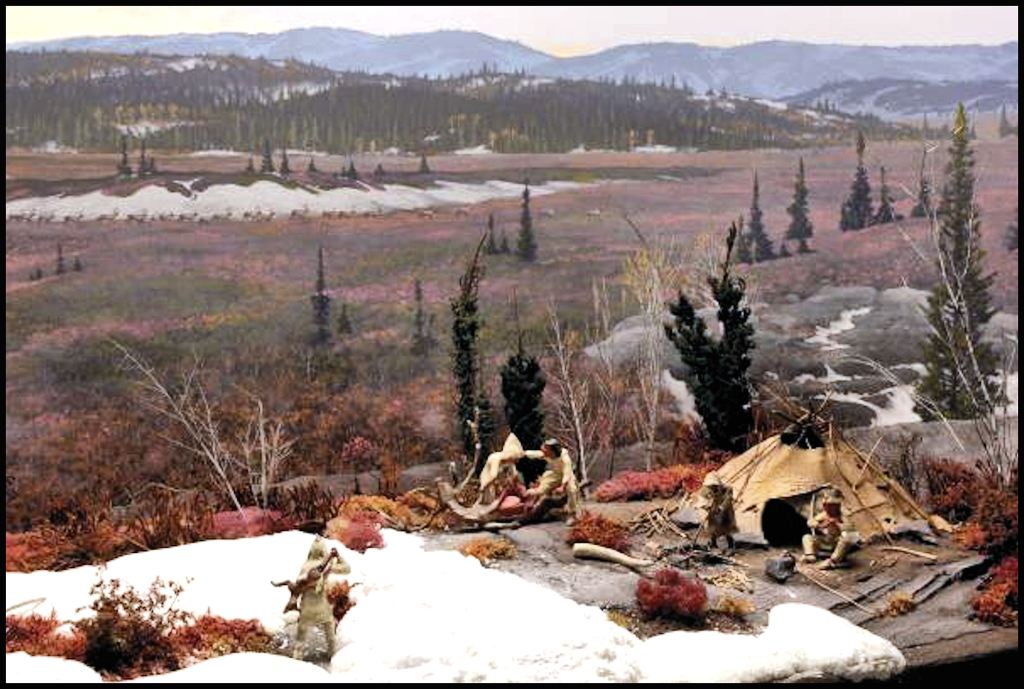
At the very end of the Pleistocene Epoch (Ice Age) in around 9,500 BC, humans established permanent villages with as many as about 1000 inhabitants near flint and jasper deposits in the Shenandoah Valley near present-day Front Royal, VA. They are the oldest permanent villages in the Americas and a thousand years older than the oldest known permanent village in Europe!
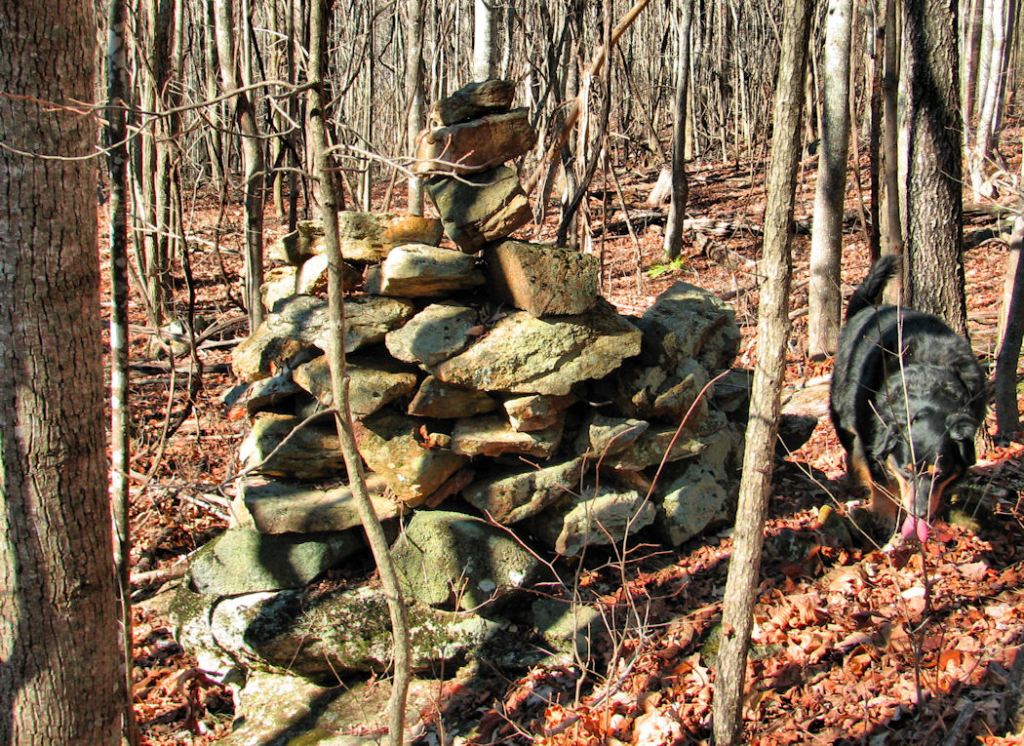
The cairns in Georgia are identical to those near Winchester, VA, but much more numerous.
Around 2500 BC a people arrived in the Blue Ridge Mountains and upper Piedmont of present-day Georgia, who made pottery, plus built mounds out of freshwater mussel shells, ceremonial stone walls and stacked stone stone cairns on the southwest slopes of mountains and large hills. Not too long after that, they built some stacked stone cairns and ceremonial walls at the northern tip of the Shenandoah Valley near Winchester, VA. This people or some other people also built stone covered burial mounds throughout the Valley. They were commonplace in 1800, but now have been cleared by farmers and real estate developers.
Although the stone cairns are endemic in northern Georgia, while only a couple hundred seem to have been built at the northern tip of the Blue Blue Ridge Mountains, only those in Virginia and West Virginia have been thoroughly studied by professional archeologists. They appear to be locations where the flesh of deceased persons was eaten by maggots and vultures then cremated in ceremonial fires.
The Hopewell Culture suddenly declined in present-day Ohio around 550 AD due to a “Little Ice Age” caused by a comet impact off the coast of Cape Canaveral, plus massive volcanic eruptions in Mesoamerica and Iceland. It continued to flourish in the warmer climate and more fertile soil of the Shenandoah Valley. National Park Service archaeologists found both an Adena Culture village and a long-occupied Hopewell Culture village on my former farm along Toms Brook in Shenandoah County, VA.
The descendants of the Hopewell Culture in northern West Virginia called themselves, Xuare (aka Suare and Suale), This is a combination of an indigenous word for Vulture with the Archaic Gaelic suffix, “reigh,” (re) for nation, kingdom or tribe with a chief. The word is pronounced, Jzhwä : (r) ē. English speakers typically perceived the rolled r (r) as an “L” sound. During the early 1700s. they were considered a Shawnee Tribe, which was an arch-enemy of the Cherokee.
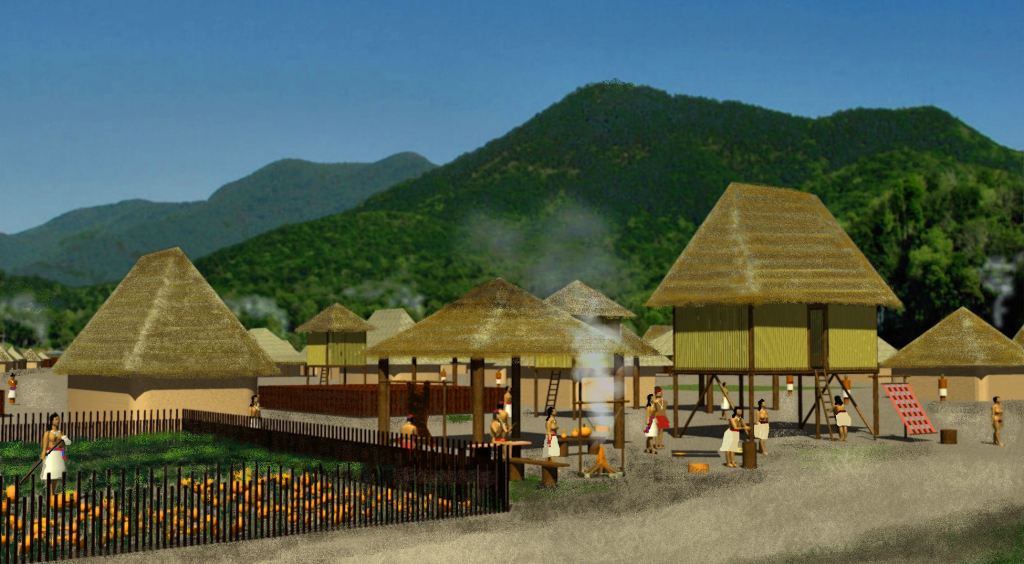
Advanced indigenous peoples from the Southeast arrived in the Valley and pushed the Xuare, descendants of the Hopewell Culture, westward into the mountain valleys of northern West Virginia. Some Xuare also settled in the foothills of the Blue Ridge Mountains in North Carolina and South Carolina. Since there has been NO archaeological work on agriculturalist village sites in the Shenandoah Valley, we can only guess at the chronology.
We do know what they called themselves – Tamahiti. That is the Itza Maya and Itzate Creek word for “Merchant People.” The plural of this word is Tamahiten, which was pronounced as Tomohitan by English colonists. They densely occupied the Shenandoah Valley and Southwestern Virginia when Jamestown was founded. They were known for growing a tropical type of tobacco, which was much “sweeter” than the pepper-like tasting tobacco, grown by most tribes in northeastern North America and eastern Virginia.
That means the last major occupants of the prime bottomlands of the Shenandoah Valley were related to the Creek Indians of Georgia. In fact, the tribal name, Tamahiti, is found in Southeast Georgia on early maps of Georgia. The last major occupants of the Shenandoah Valley were clearly participants in the Southeastern Ceremonial Mound Culture, but official Virginia anthropological texts do not recognize that fact.

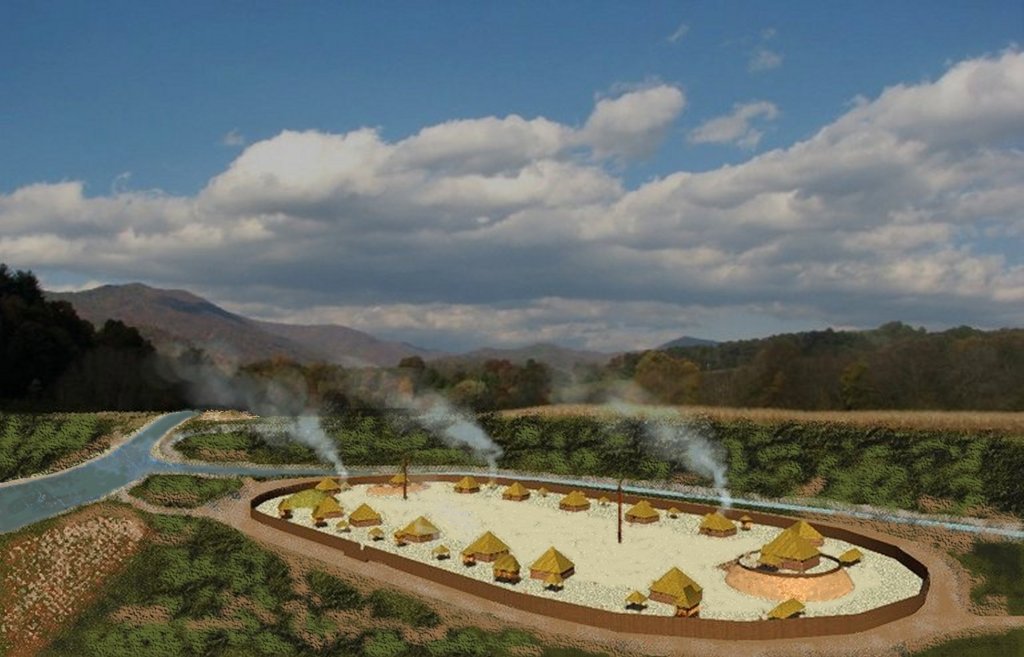
Keyser Village on the edge of the Shenandoah Valley
Since I moved back to Georgia, Virginia archaeologists have acknowledged a Native American culture that lived on edges and in the less fertile sections of the Shenandoah Valley. Their occupation lasted from around 1450 AD to 1665-1670 AD. They were not the Mesoamerican type people as found in the bottomlands, but I am not certain of their identity otherwise.
This sketch by an artist, employed by the archaeologists of the Keyser Site, may not contain an accurate portrayal of the houses. The round houses, as portrayed, are Eastern Siouan. Round houses with vertical walls and conical roofs would be Uchee (Yuchi). This mysterious people may also be descendants of the Adena Culture. More study is neede!
At least back in the late 20th century, Virginia archaeologists refused to even excavate the Hopewell and Tamahiti town and mound sites in the Seven Bends Area, because their contents conflicted with their own orthodoxy. The only excavations of Tamahiti Mounds in Loudon County, VA on the Potomac River and in the far southwest corner of Virginia were carried out by archaeologists from other states.
A radical change in understanding of their valley’s history occurred among residents in the Shenandoah Valley occurred in 2020. Dr. Carole Nash of James Madison University published Native American Communities of the Shenandoah Valley: Constructing a Complex History, Nash was forced to draw much of his material from archaeological work done by the National Park Service near Luray Caverns in 1944 or outside the Shenandoah Valley, but it was the first published document to acknowledge the rich Native American history of the Valley.
The Native American Apocalypse
In 1665, Governor William Berkeley and the House of Burgesses adopted laws, which institutionalized the slavery of Native Americans and Africans. The Rickohocken Indians, based in the mountains near Bedford, VA, were provided firearms and steel tomahawks. They were promised trade goods for every Native American slave that they delivered to the plantations in eastern Virginia.
In one horrific and short period between 1665 and 1670, most of the Tamahiti population in the Shenandoah Valley was either massacred or enslaved by the Tamahiti. Survivors said that they arrived with their muskets without warning and killed until there was no one remaining to either kill or enslave.
Remnant, fortified Tamahiti villages remained on the Potomac River in present-day Berkeley and Jefferson Counties, West Virginia. They came to be known as Petan (or Tobacco) Indians. They were eventually pushed westward by Iroquois slave raids, where they became allied with the Wyandot (Huron) Indians, who survived Iroquois massacres in Canada.
The Tamahiti in far southwestern Virginia first moved farther south into Eastern Tennessee, where they were allied with the Apeke and Cusate Creeks. There was strength in numbers, which protected them from Rickohockens. Apparently a counter-attack by allied tribes in Eastern Tennessee and northern Georgia, aka the Apalachen Kingdom or Confederacy, wiped out the Rickohockens in Virginia in 1684, because they are no longer mentioned in Virginia Colonial Archives after that date.
With the Rickohockens gone from the landscape, a band of Xuare-Shawnee established a large village near where Winchester, VA was located. It departed the region about the same time that the first English settlement was founded in 1744. However, from 1754 until 1773, the Shawnee and allied tribes of the Ohio River Basin returned again and again to ravage the settlers in the Shenandoah Valley.
All Native Americans did not leave the Shenandoah Valley. Civil War Era newspapers described the bravery of Native American Confederate soldiers from Shenandoah County, who were members of the Stonewall Brigade. However, official Virginia History texts do not remember these Native American Confederates and still claim that the Valley was merely a shared hunting grounds for several tribes until occupied by European settlers.
As discussed in an earlier article in The Americas Revealed, while I was living in Shenandoah County, VA, . . . on a few occasions, Native Americans and mutually recognized each other in stores. They claimed to have always lived in Shenandoah County, not know their tribal identity and would not tell me where they lived. Later, surveyors, working for the county’s tax office, discovered a forgotten mixed-heritage Native American village within the George Washington National Forest on the western edge of county.
In the second part of this article, I will tell readers about the very interesting friends that I made while living in Shenandoah County, Virginia. Most were either professional archaeologists or historians. All contributed pieces of information about the Shenandoah Valley’s past, which have been left out of official state history and the orthodoxy of archaeologists.
Until then . . .
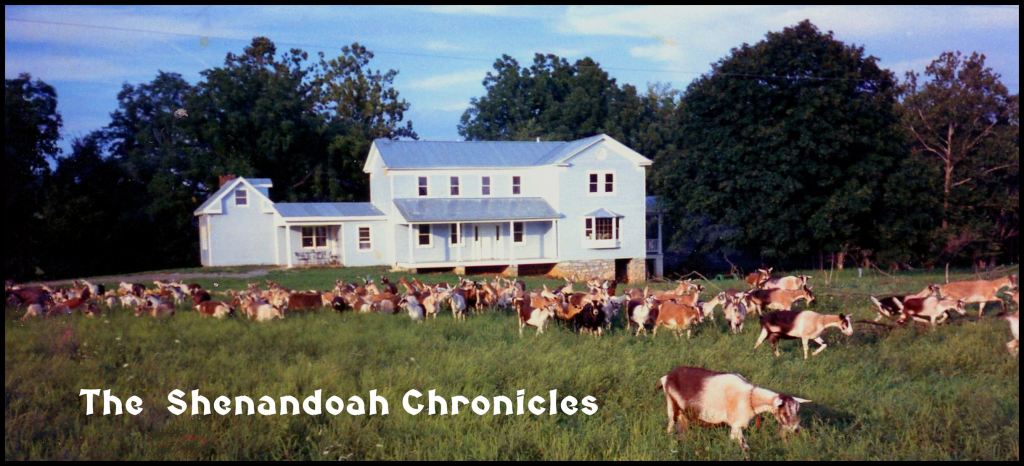
They are talking to me about making this a TV series!
 The Americas Revealed
I’m getting an influx of posts about linguistics all over the world tonight. Indo-European, Over There, and Native American culture Over Here. All most interesting, about the Family of Man.
LikeLiked by 1 person
Essentially none of this is true. There have been hundreds of archaeological studies in the Shenandoah valley, which have lead to the discovery of hundreds of sites. These studies have taken place consistently for at least 100 years. No real archaeologist has ever denied the Native American population in any part of Virginia. And Carol Nash is a woman.
LikeLike
If you mean that the belief that the Shenandoah Valley was uninhabited is false – It is false, but the official state history textbook that my former wife taught stated that. Like many articles in Wikipedia. it stated that the valley was a shared “hunting ground” for several tribes.
If you are saying my article was false . . . how dare you! . . . you probably was not born when these events took place. At the time, I was the only licensed architect in Shenandoah County and so got almost all the historic preservation projects there, plus a lot of projects in the Winchester-Frederick County area. I was the first chairman of Shenandoah County’s Historic Preservation Commission in 1992. At that time, no one had ever carried out a countywide historic-archaeological site survey. The National Park Service had surveyed properties in the locations where the Battles of Toms Brook and Fisher’s Hill. Our farm was designated a key property for the proposed National Battlefield Park. NPS archaeologists found two Native village sites and three mounds on our farm. They tried to get them assigned state site numbers, but bot not response from the state historic preservation office. They were only interested in Civil War sites in the Valley. Had I know about Samuel Kercheval’s book describing a dense, sophisticated Native population in the Shenandoah County area, I would pressed harder to get Native American archaeological sites in the Valley listed.
As mentioned in the article, I was friends with archaeologist William Gardner and the folks at Thunderbird Associates. their office was on the same block as my office. Despite receiving international fame for their discoveries at the Flint Hill and Thunderbird Sites, they received very little work in the Valley. William identified a large Late Woodland village site on a bend in the Shenandoah River with a stacked stone wall around it. mounds, plazas and ramps, where I was restoring the early 19th century house and farm buildings. He could not find a penny from the state or county government to study the site. It remains one of Virginia’s most important NA sites, yet is not listed in the state’s archaeological files.
LikeLike