
The Peopling of Eastern North America Series
During my seven years of living on a Civil War battlefield, I was exposed to many pieces of a puzzle that would tell a very different version of Eastern North America’s past. Some of the pieces were discoveries I made myself on construction sites or in historical documents. However, several outstanding archaeologists also provided pieces of that puzzle.
In one of their first uses of high resolution infrared satellite imagery, National Park Service archaeologists discovered on my farm footprints of twelve 18th and early 19th buildings, plus two Native American mounds, a small Early Woodland Period village and a large Middle Woodland Period village. Native American village sites in the Shenandoah Valley shocked the team, but Virginia archeological texts and websites still do not mention this discovery.
It was a time of rapid technological change in which both computers and software typically were obsolete within a year. Microsoft invited me to be a beta tester for new type of computer-aided drafting, which was based on the new Windows 2.0 software. Meanwhile, the National Park Service Center in Harpers Ferry persuaded the U.S. Geological Survey to let me experiment with military quality infrared imagery, which was forbidden to the general public.
by Richard L. Thornton, Architect & City Planner

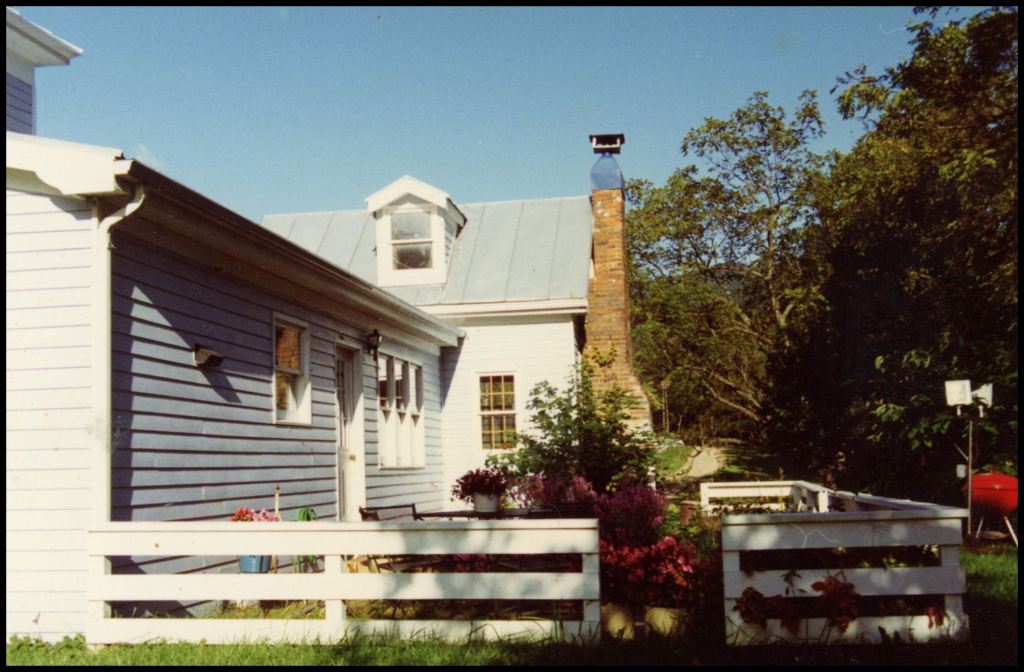
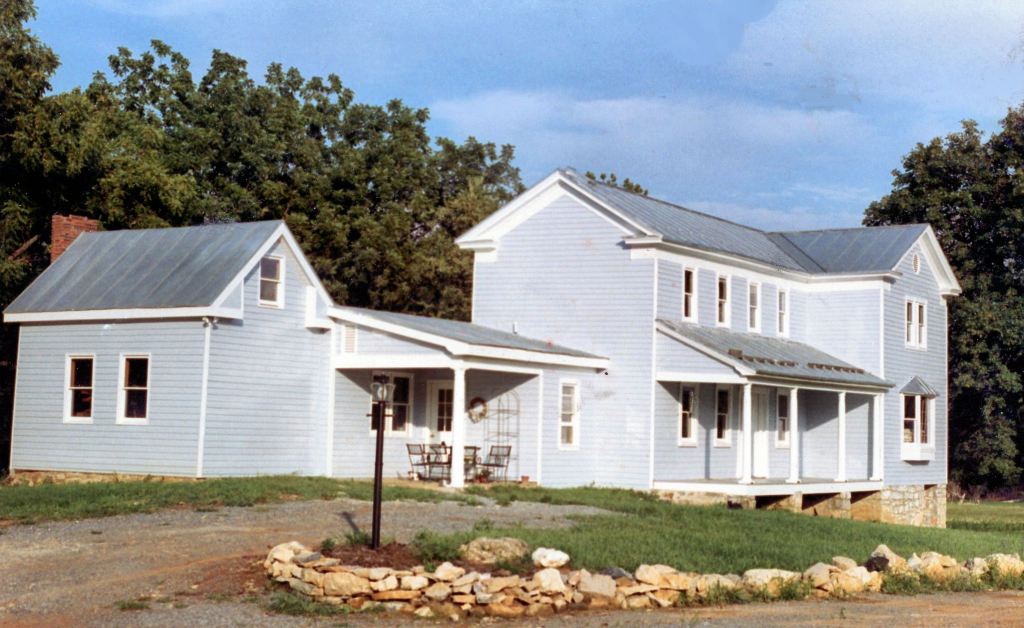
This photo of my Shenandoah house was made in July 1987, but was digitally aged to about 1887.
An abandoned farmhouse on a little known battlefield
The 54-acre farm that I bought for our new goat cheese creamery operation had not been for sale, so I tracked down the owner and made him an offer. However, it had all the agricultural assets for a world-class dairy goat farm. The house had not been lived in since 1951. There was no bathroom, electrical wiring, plumbing or HVAC system. The previous occupants had cooked over coals in the Keeping Room and Summer Kitchen hearths with pot cranes.
Throughout the 19th century until the advent of gasoline-operated buses in the early 20th century, the house had functioned as a stage coach inn. The farm family mostly lived on the first floor, while stairs led directly from the side porch to the second level. The guest bedrooms were heated with sheet metal pipes, suspended by wire hangers from a crude heat exchangers inside the four chimneys.
My now-former wife had complained for years that she had married an architect because she expected to live in a showplace house. I agreed to make this house into a showplace. Indeed, it would become the 1990 National Residential Historic Preservation Project of the Year.
The current owners knew very little about the history of the farm other than “it was one of those Civil War houses in the county” . . . whatever that meant. Our attorney only traced property ownership to 1864. However, the seller’s attorney used a photocopy of a plat prepared by land surveyor George Washington in 1754! The plat seemed to show George Washington as the owner, but that did not make sense.
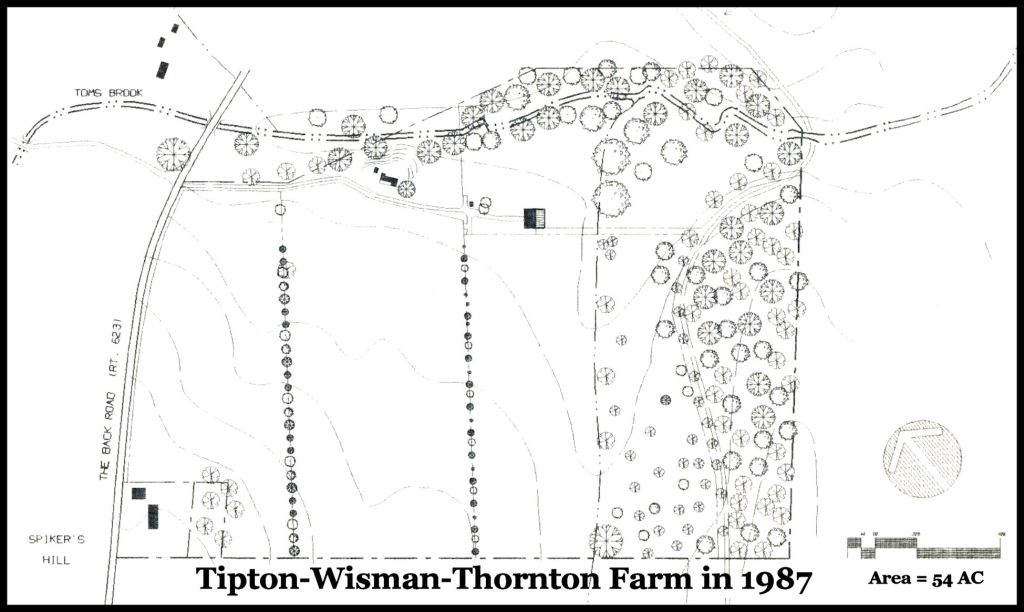
The original tract had been 64 acres deeded by Toms Brook Plantation, whatever that was. Ten acres had been sold off when the new route of The Old Back Road cut across the west end of the tract in the 1920s.
Thanks to the internet, in 2021 I would learn that in 1734, Toms Brook Plantation became the first European settlement in the Shenandoah Valley, not Winchester. It could best be described as a planned unit development. George Washington received my farm as payment for surveying the property lines of the last section to be marketed. Until the mid-1940s, when stolen by a tourist, George Washington’s initials could be seen on the big oak tree at the entrance to our driveway.

Shenandoah County Courthouse (1792) – Designed by Thomas Jefferson
Meeting my neighbors
Upon arrival in Virginia on October 21, 1987 I set up an office in a downtown Woodstock rental space. I immediately purchased a new-fangled gadget, known as a FAX machine. It enabled me to send letters and images over the telephone lines instantly.
Simultaneously, I began measuring the existing buildings on the farm then preparing the restoration plans. I knew nothing about the history of the Shenandoah Valley and next-to-nothing about Virginia’s architectural history, so I also began reading every book I could find on those subjects. Remember . . . there was no internet.
Next on the list of purchases for the office was a state-of-the-art Leading Edge “tower” computer. It contained a revolutionary new device called the hard disk drive, which stored an incredible 30 mb of memory. Leading Edge replaced the clumsy floppy disk, made of cardboard, with a rigid plastic memory disk that could hold an amazing 5.6 mb of data. The tower computer also accepted standard floppy disks and came with new Windows 2.0 software that produced a full color screen . . . an amazing technological accomplishment.
After Christmas I received a letter from the Microsoft Corp. which invited me to be a beta tester for their new Visio drafting software. I would get the software free along with a new style of “dove handle” Microsoft Mouse, designed for architects and draftsmen. All I had to do was answer bimonthly questionnaires about the functionality of the program, plus suggested improvements.
I called them back on their WATTS line number and told the man that I would love to jump over the computer drafting, but I couldn’t afford the $6,000 to $12,000 for a plotter. A lady called me back the next day to tell me that they knew of an engineer in the Silicon Valley, who had invented a new type of lightweight plotter, which was based on the new Windows software. It would be more than adequate for a one-man architecture practice. He built them in his garage and they sold for under $300. I told her that she had a deal.
Once all the new equipment was set up, news began to spread that the new architect owned a robot that could draw. Downtown workers began stopping by, wanting to see the robot draw. That took time from my work, but it was really a cheap advertising campaign.
Redware & Painted, shell-tempered pottery
Soon, a realtor came by on behalf of a prominent lawyer in Downtown Washington, named Jay Monahan. She said his new wife was that cute weekend reporter for Channel 4, Katie Couric. The couple wanted me to inspect a farmhouse near the Shenandoah River to determine if it was suitable to restore. If it was, they wanted me to measure the house and produce drawings for restoring the exterior, plus floor plans that Katie’s sister could use in planning the interior. That became my first project in Virginia.
While walking around the grounds of the Monahan-Couric House, I noticed potsherds in and around the garden that seemed out of place. They were shell-tempered and brightly colored . . . either stained with red ocher and polished or abstract patterns painting with fired, mineral colors. All of the potsherds on our farm were about the same color as dry clay and chalky in texture.
I called the University of Virginia’s Department of Anthropology. I was passed around to several professors then promised that someone would call me back. A female professor did call me back a couple of days later. She lectured me that there were very few potsherds in the Shenandoah Valley, because it was shared hunting ground. What I had found was pottery made in the Tidewater Region during the Colonial and Federal Periods by Pamunkey Indians. (It’s been a long time, but I think that is what she said.)
I then told the professor that there were a lot of potsherds on our farm on Toms Brook. She said that was impossible. I was seeing bits of dry clay. I told her that I would be delighted to drive over the mountains to give them the potsherds for analysis. She responded that she was not interested, then abruptly hung up the phone.
I looked up the Pamunkey Indians on the internet just now. They did make shell-tempered pottery during the Colonial and Early Federal Period for sale to neighboring plantations. Their ceramics were distributed to the slaves. However, the Pamunkey Reserve is over 200 miles from the Seven Bends. The professor’s interpretation is possible, but not probable.
My mentor in 1970, Dr. Román Piña Chan, was fond of saying, “Si no haces preguntas no adquirirás nuevos conocimientos.”
If you don’t ask questions, you will not gain new knowledge!
My former wife and I saw Jay and Katie quite often on weekends, while she was working for Channel 4 and then when she was laid off from the station. Once she went to work for the Today Show in New York City, her visits to the Valley were more infrequent, but when she did come, she usually brought NBC higherups to our farm to see the goats and sample the cheese. In contrast, I saw Jay much more often. We toured Civil War battlefields on weekends.
The last time that I saw the two of them together was at the Shenandoah Races Steeplechase in the spring of 1992. I was selling tickets and they came in at half time. They wanted to pay half-price for their tickets. I finally gave in and agreed. I felt sorry for them, because they couldn’t afford to have livestock on their Valley mini-farm. However, Jay and I continued to be increasingly involved with the preservation of battlefields, until I was suddenly, no longer in Virginia.
Thunderbird Associates
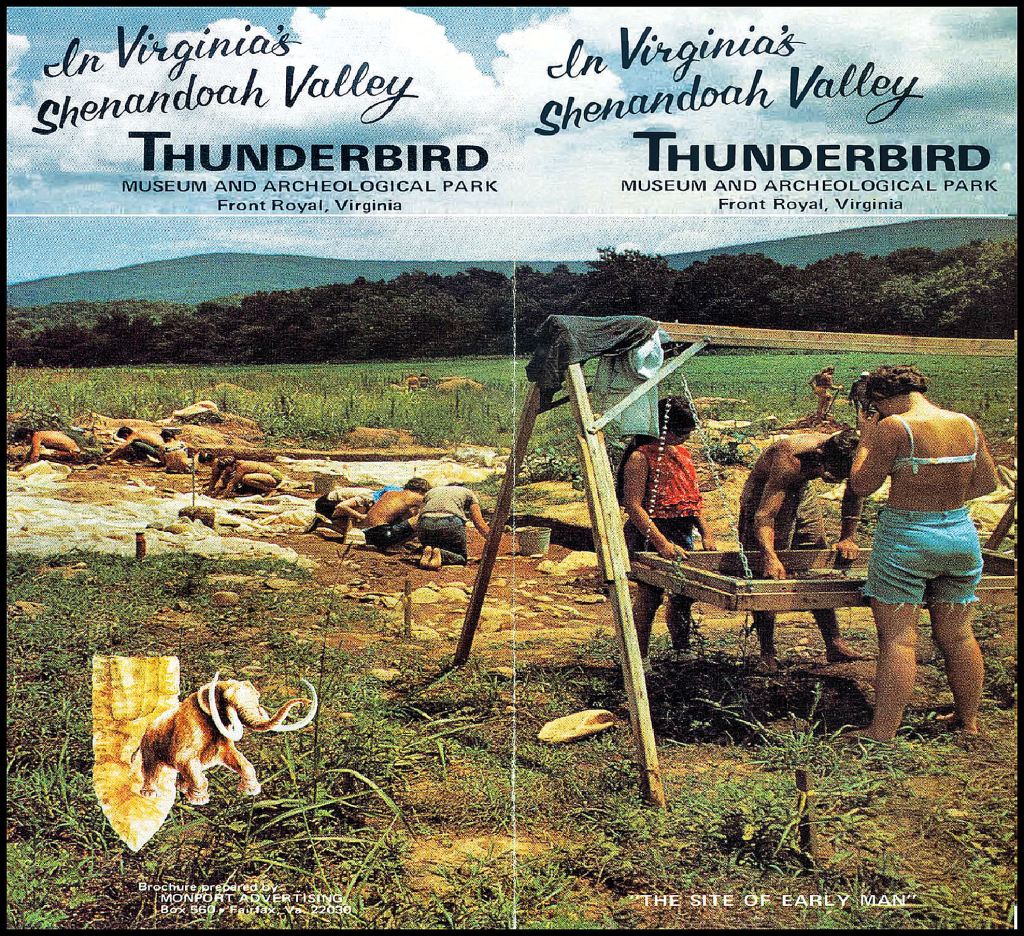
Another early visitor to my office was a man in his early 20s, who said that he worked for Thunderbird Archaeological Associates. I think that I was supposed to be impressed, but it seemed like a flakey, New Age name for a firm. He asked me if my robot could draw things other than buildings. I said “Yes, of course,” the tried to explain that I still created the drawing on a monitor screen, then the plotter did the actual drawing. He was not very computer savvy, so didn’t quite understand.
A little later in the day, Dr. William Gardner, founder of the firm, stopped by the office. He needed a site plan for some Native American burials, unearthed at a highway construction site . . . by tomorrow. The draftsperson, who normally did their drawings was unavailable for two weeks. I told him that it was no problem. I could do the work in two hours.
I lied. The site plan took less than 30 minutes. I just charged them $20 and hand-delivered the drawing to their office around the corner. Gardener had driven back to DC, but Joan Walker, a lady with long blond hair . . . .in her 20s . . . and apparently Gardner’s significant other, accepted the drawing. She was pleased with the quality of an ink drawing and astounded at the speed of completion. However, I don’t recall doing any more work for the firm. Thunderbird became my archaeological consultants at historic farm sites, where I encountered things out of the realm of historic architecture.

From time to time, Bill Gardner and some of the staff would meet with me for lunch at the Old Springhouse Tavern in Woodstock. I learned that Bill was a professor at Catholic University and had been working on an ancient flint and jasper quarrying site near Front Royal, VA in the 1970s. In the vicinity of the quarry pits, they found Clovis and Post-Clovis points and tools. The archaeological district was designated a National Historic District and National Historic Landmark in the late 1970s. The Thunderbird Museum closed in 1977.
In the last phase of the investigation, the archaeological team began encountering hundreds of cooking fire pits, surrounded by the detritus of long-term domestic occupation. They had discovered several permanent villages, associated with Clovis and Post-Clovis artifacts. Village sizes varied between 500 and 1000 persons.
In my Introduction to Anthropology class at Georgia Tech, Dr. Lewis Larson taught us that American Indians did not start living in permanent villages in Georgia until around 400 BC . . . much later in other, more primitive parts of North America. Obviously, he was very, very wrong. Although nationally famous for his work at Etowah Mounds, Larson apparently did not know that Louisiana archaeologist-geologist, William G. Haag, had obtained a radiocarbon date of 3545 BC at the Bilbo Mound and platform village site in Savannah during 1957.
Many of Gardner’s peers were already hostile because of his claim of permanent villages at Thunderbird. However, when he announced radiocarbon dates of 9500 BC – 6500 BC . . . with prime occupation at around 8300 BC . . . a firestorm erupted. Although his fellow faculty members at American Catholic University remained loyal, Gardner was shunned by many peers in his profession.
When the restoration of the house was finished, I moved my architecture office to the building on the farm, where formerly wool had been boiled, dyed and spun. I no longer socialized with the Thunderbird staff. It was about that time that the National Park Service reran the radiocarbon testing and confirmed Gardner’s findings.

The National Park Service studies our farm
Just as we had finished restoring the house and started work on the cheese creamery in 1989, a historian with the NPS came to our door to tell us that our farm was to be a key property in the proposed Shenandoah Battlefields National Park. Our farm was the site of one of the largest cavalry battles of the Civil War . . . The Battle of Toms Brook on October 9, 1864.
On the north side of Toms Brook was the First Michigan Volunteer Cavalry, commanded by Brig. Gen. George Armstrong Custer. Spread along the hill side on the south side of the stream were multiple Confederate cavalry and partisan units, commanded by Major General Tom Rosser, a 6′-3″ mixed-blood Choctaw Indian from Louisiana. Rosser and some of his troopers men had achieved fame three weeks earlier, by stealing 3,000 cattle from behind the lines of General Grant’s army.
On this day, however, Rosser was not so fortunate. Custer led a charge past my new “old” house, while another large detachment flanked Spiker’s hill on he west side of our property. The Yanks then chased the Rebs all the way to Woodstock, VA.
The historian wanted permission for an archaeological crew to work there, because the key moment of the Battle of Toms Brook took place on our farm. Archaeologists were there off and on for about two years.
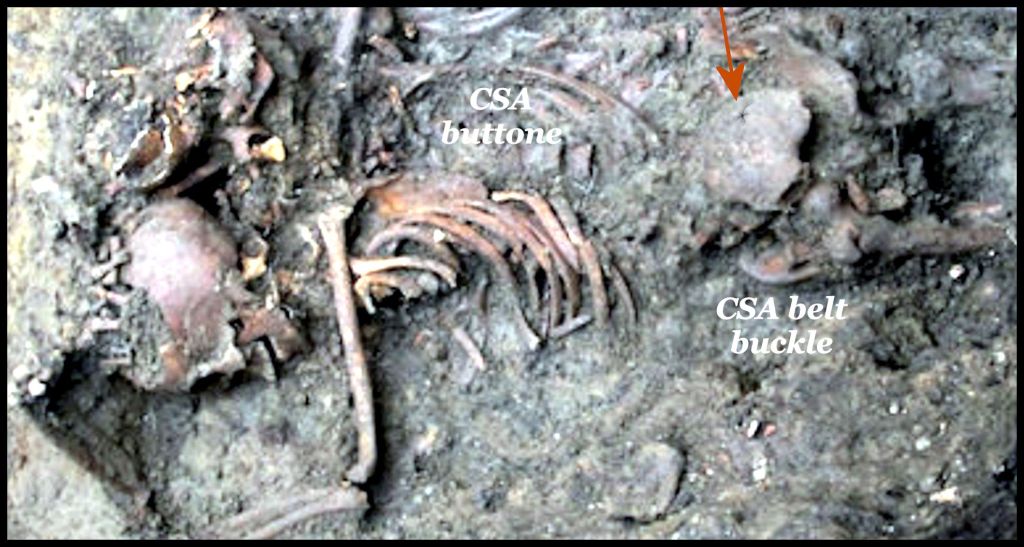
During that period, an archaeologist came to our door to show me artifacts and exclaimed “Your barn was built on top of a Hopewell mound.” A week or so later, he came with more Native American artifacts in his hand then he said they were Adena. What they thought was a Confederate artillery redan was actually a burial mound.
At that point in my life, I was totally focused on Mesoamerica and assumed that my Creek ancestors were like how Walt Disney portrayed them. I had no clue, what he meant by Adena and Hopewell, I had to go to the library to check out a book on the Adena and Hopewell Cultures. LOL
While writing this article, I contacted Dr. Carole Nash, an anthropology professor at James Madison University. She stated that the official policy of Virginia archaeologists is that the Adena and Hopewell Cultures did not exist in Virginia. Not knowing one way or another, I labeled the photograph of my barn and pasture to match the current beliefs.

Large Native American town on bend in Shenandoah River
About three years later, I was working on the restoration of an early 19th century farm that occupied an entire bend in the Shenandoah. I noticed earthworks, large terraces with ramps, etc. unrelated to the farm buildings. I told the owner. He said that they had been finding many potsherds. Some were painted. I told him that I had also picked up painted potsherds around Katie Couric’s house, while I was working there.
The owner agreed to pay Bill Gardner to do some small test holes. Bill told me that the lower levels were Hopewell and the upper-level artifacts looked like they belonged down in Georgia. At that point in my career, I wouldn’t have known, one way or another.

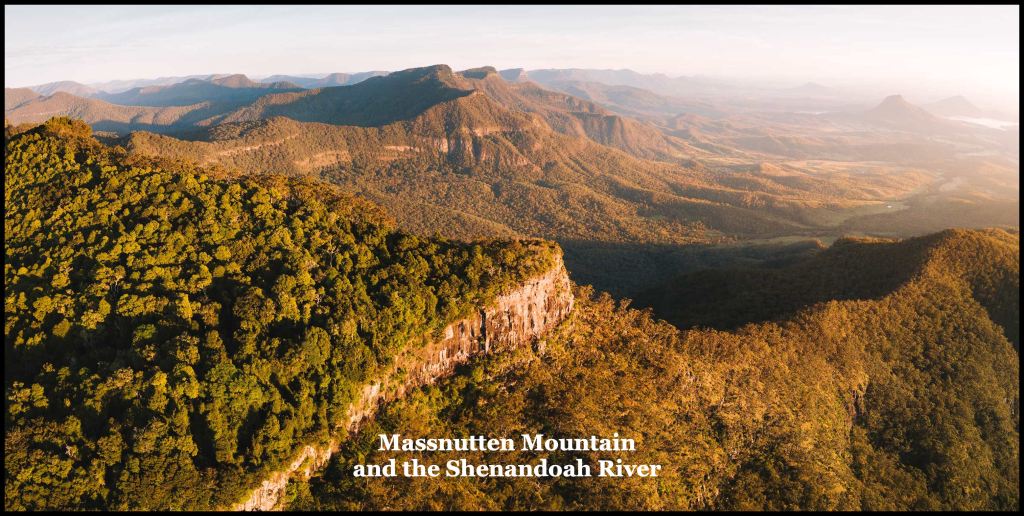
Note the Native American mounds near the upper – center of this photo.
James Carville – Mary Matalin Farm
This large project was begun for another owner, who planned to move there from Pennsylvania. It involved the radical expansion of a 1792 two-story log house, a large indoor swimming pool, renovation of 19th century farm buildings, plus construction of a massive art studio. The farm was very close to Jay Monahan’s and Katie Couric’s house.
At the same time, James Carville was guiding the Bill Clinton Presidential Campaign and Mary Matalin was Deputy Campaign Manager for the George H. Bush Re-election Campaign. While thought by the public at this time to be arch-enemies, they serendipitously met then fell in love. They married in 1993 after Bill Clinton was inaugurated and simultaneously bought the farm that I was renovating.
While I was working on the restoration of the farm buildings, a backhoe dug up many stone lined sarcophagi, stone metates, stone tortilla grills, painted pottery and very finely crafted stone tools in the future septic field. All of these things were like those I had seen in Mexico. At that point in my career, I had no clue that there were probably thousands of stone box sarcophagi in the Proto-Creek town sites of northern Georgia.

A metate similar to the ones in the Seven Bends area of Shenandoah Valley
The Native American Graves Protection and Repatriation Act had been passed by Congress. Architects are licensed professionals. Archaeologists are not licensed. I could lose my license, if I didn’t obey the new federal law. However, I couldn’t even get the county coroner to remove the skeletons and examine them, as required by law. He told me that farmers had been digging up those old Indian graves for many generations, so he didn’t care what I did with the bones.
I called the University of Virginia Department of Anthropology to tell them about the stone sarcophagus burials and Mesoamerican artifacts that we had unearthed. The professor laughed at me and blurted, “Nothing like that exists in Virginia.” He wouldn’t even take the telephone from the receptionist.
I basically thought at that moment, “<Expletive deleted> them. They are only interested in the Civil War.” I went on with my life. The artifacts and bones remained exposed to the elements for a few days then disappeared.
Within a couple of months, I found myself “suddenly single.” During what was supposed to be a short Easter Weekend visit to Georgia, our bank account was drained, the credit cards were run to the limit, my cellular phone account was cancelled and I was stuck at my parents’ house in Metro Atlanta. I had to finish the project for Carville and Matalin from my parent’s house.
On my trips back up to Virginia, James Carville and Mary Matalin were always gone. I only had contacts with the construction manager. I never got to see the finished interior of the main house.

In my now-abandoned farmhouse, I found a secret compartment behind the Dining Room cabinets, where my wife had hid the records of four savings accounts in Florida, the cash box where she hid cash shaved from her pay checks, my client’s checks and cheese sales, plus a well-worn book, named A Woman’s Seven Year Guide to Winning at Divorce. She had followed every recommendation, including making me sleep in a separate bedroom. Then, I moved to a townhouse in walking distance from Etowah Mounds in Cartersville, GA. My life took a very different direction. The rest is history.
Post-Script
A few years later, NBC produced a one-hour special on the Carville-Matalin Estate, hosted by Katie Couric. The show had very high viewership. First, Katie interviewed the power couple with my architectural drawings spread on a nearby table. The three of them then toured the buildings that I had designed. The cameras zoomed in on the drawings a couple of times. I also caught quick glimpses of some of the artifacts that the backhoe unearthed in the septic field.
Katie never mentioned my name in the program as the Architect or that she knew me personally! Can you imagine how different my life would have become, if she had done that minimal professional courtesy?
Then in 2018 I purchased a reprint of Charles Kercheval’s The History of the Valley of Virginia. (1833) He described everything that I found at those construction sites, but the UVA prof said didn’t exist, as being endemic in the bottomlands of the Shenandoah, The sarcophagi constantly snagged plows and the metates were used to hold flower pots on front porches.
Kercheval said that in his era virtually every farm contained a mound – some dome-shaped, others truncated – and many also contained a village site. On some farms, you could even see where the Native American houses had been.
Much has been erased and forgotten since then.

 The Americas Revealed
Thanks for this very interesting post Richard.
LikeLiked by 1 person
A personal chronology was necessary because conventional architects are typically not exposed to the type people, who I befriended in Virginia.
LikeLiked by 2 people