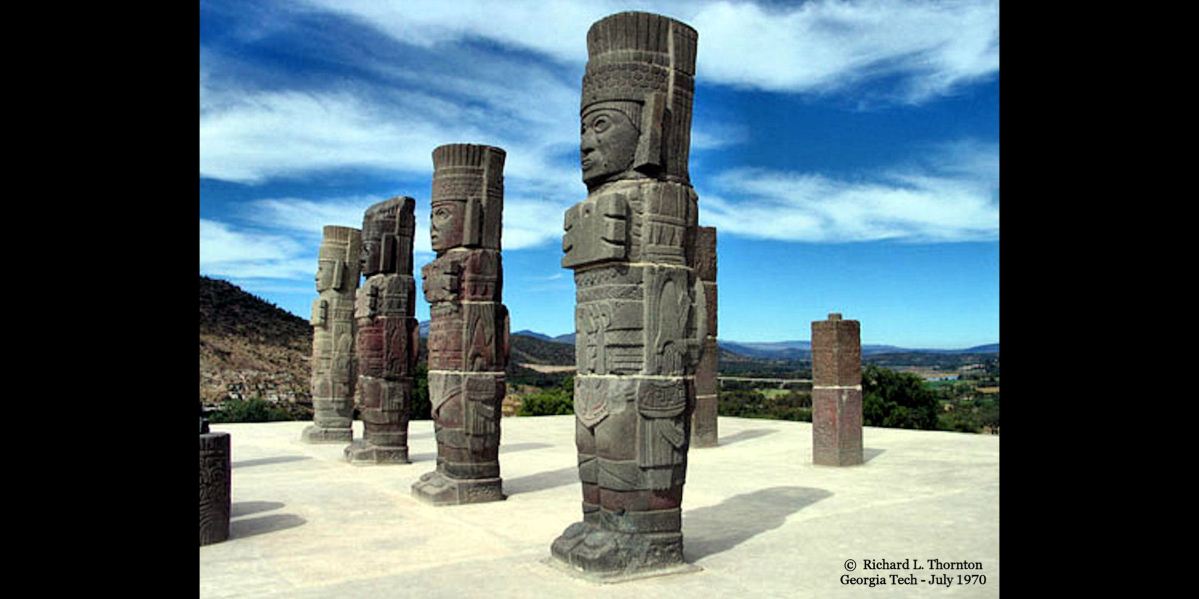
A Late-20th century controversy, typified by ignorance on both sides
The proponents assumed that Indigenous Americans were intellectually incapable of creating civilizations by themselves or even that all humans were incapable of designing the early monuments on both sides of the Atlantic Ocean.
Archaeologists, the most vocal opponents of these theories, typically based their arguments on the belief that they held Sacred, Inviolate Knowledge, which could not be challenged by mere mortals. When backed in the corner, they would state that the peoples in the Old World were incapable of sailing across the Atlantic Ocean until Cristobal Colon (aka Columbus) developed the navigations skills to do so.
The color slide above was taken in 1970. In that era, these giant stone figures were some of the most famous statues in the world. They are still featured in TV programs and movies, which claim that extraterrestrials founded the civilizations of the Americas.
The Peopling of Eastern North America Series
by Richard L. Thornton, Architect & City Planner
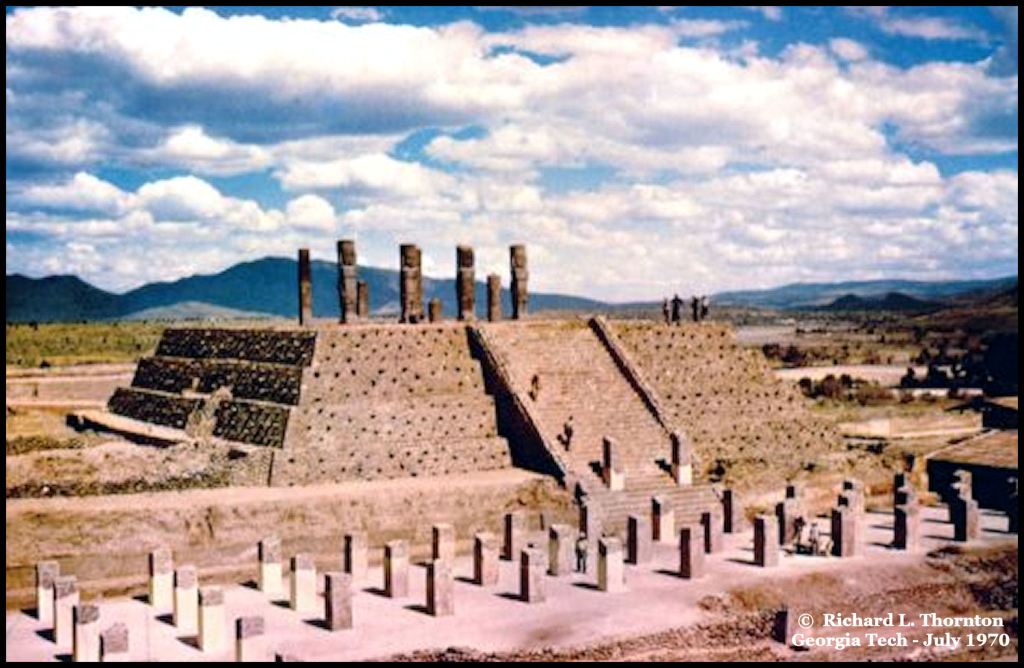
Temple of the Warriors in Tula, Capital of the Toltecs – Edo. de Hidalgo, Mexico
Tuesday, July 7, 1970
A wet-behind-the-ears Georgia Tech architecture student, about four weeks away from turning 21, stood in awe next to some of the most famous statues in the world. A week earlier, I had been standing in awe within the office of Dr. Román Piña Chan, Curator of the Museo Nacional de Antropologia. Casually on display were some of the most famous Pre-Columbian artworks in Mexico.
In compliance with a Latin American academic tradition, I had him given two books on Southeastern Indian archaeology, plus a copy of the Etowah Mounds archaeological report. While thumbing through one book, Dr. Piña Chan let out a Spanish explanation, stood up, turned around, then pulled his book, Los Toltecas, from the bookshelf. The famous archaeologist then invited his graduate assistant, Alejandra, and I to sit on either side of him as he pointed out with the two books how the commoner’s pottery in and around Tula was almost identical to the pottery found in Moundville, Alabama.
I had never been to either archaeological site. Moundville had to wait, but obviously, I needed to visit Tula ASAP.
According to my daily journal, I was driven up to Tula by my hosts, Dr. José Angel Soto and his wife, Sra. Guadalupe Soto Quinard. Although both were well-educated (José had a PhD in Biology) neither had ever seen Tula.
Although Tula’s buildings that had been restored, contained interesting architectural details, they were smaller than I expected them to be. These stone-veneered pyramids were shorter in height and smaller in volume than many earthen pyramids in Georgia, Alabama, Mississippi and at Cahokia Mounds, Illinois.
In 1970, very little was known about Tula or the Toltecs. No writing or numerical system is displayed on its buildings. From radiocarbon dating, Mexican archeologists determined that Tula had the exact same lifespan as the Acropolis at Ocmulgee Mounds in Georgia . . . c. 900 AD to c. 1150 AD. In addition, they knew that Tula was also the real name of Teotihuacan.
The Mexica (Axtecs) honored the Toltecs as the founders of civilization in Central Mexico, but Tula was in ruins when the Mexica arrived in Central Mexico. The Mexica Codices contain some legends associated with Tula, such as the founder of the city being named Quetzalcoatl. However, Dr. Piña Chan was not certain of their veracity. Quetzalcoatl was said to have been born in Tepoztlan, Morelos then as a young king migrated 170 km (106 miles) northward to found Tula. However, the original town of Tepoztlan was associated with a town that predated the Olmec Civilization then was rebuilt after Tula was abandoned.
The possibly mythical King Quetzalcoatl of Tula was thus, not the same mythical person as the red-haired Quetzalcoatl, who founded Tepoztlan and who, was said to return some day to Mexico. Hernando de Soto tried to dupe the Mexica into believing that he was Quetzalcoatl returned.
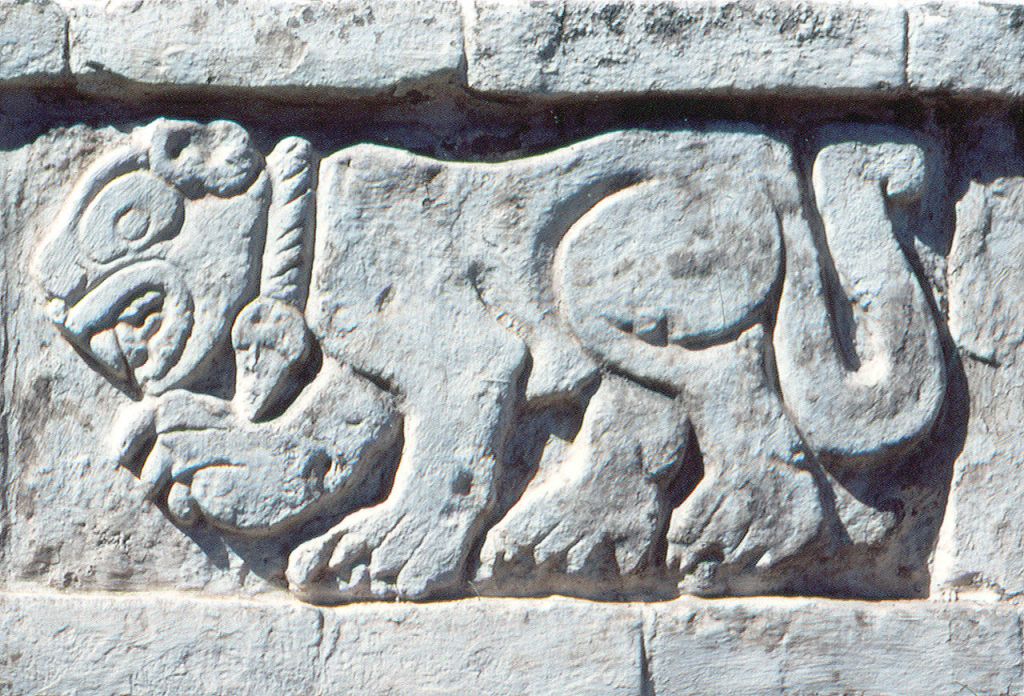
This appears to be a pet jaguar or ocelot, wearing a collar.
What we know today about the Toltecs
Armed with the powerful research capacity of the desktop computer and dramatic advancements in genetics, Mexican anthropologists now know that the Toltecs were a large, widespread tribe, which dominated the Sierra Orientale (Eastern Mountains) and Jalisco Highlands. They were tall and lanky, plus tended to have lighter complexions than the Nahua-speaking tribes, such as the Mexica, and sometimes, even had brown hair. While claiming to honor the Toltecs, who founded Tula, in reality, Toltecs were the favorite source of protein for the Aztecs. Aztec armies hunted them viciously for three centuries, making the Toltecs almost extinct in most of Mexico by the time Cortez arrived in 1519. The only remaining distinct Toltec villages are now found in the highlands of the state of Jalisco.
After I found the original, complete Kaushete (Upper Creek) Migration Legend in 2015, I was able to quickly interpolate what it said with the new knowledge of the past among Mexican anthropologists. The Upper Creeks originated in a region, formerly occupied by Toltecs. The Upper Creeks ARE Toltecs. As you can see below, a typical Toltec village in Jalisco was and is identical to a typical Creek village in Georgia and eastern Alabama until the early 1800s. Talassee is the Anglicization of the Upper Creek word, Tulasi, which means “Descendants of Tula (aka Teotihuacan).
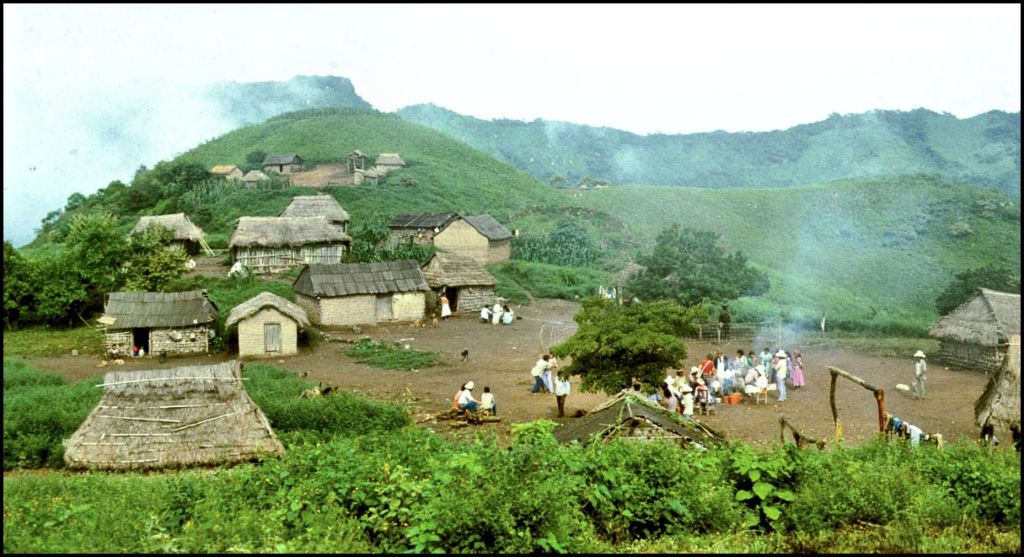
A Toltec village in Jalisco State in 1970
Photography in 1970
Back then, there was no prohibition against actually touching the volcanic stone statues. Visitors were also allowed to use tripods to photograph them. That was the only way that my Olympus Single Lens Reflex (SLR) 35 mm camera could take such a crisp, dramatic photo . . . assuming that there was also intense sunlight.
SLR 35 cameras had only recently become affordable to regular folks and middle-class students. In the mid-1960s, several Japanese companies began exporting consumer-priced cameras to compete with Hasselblad, Rolleiflex and Leica from Europe. Over the Spring Holidays, I built a stone wall and atrium garden for a family near my parent’s house in order to purchase the camera for about $110. That would be about $860 in late 2024.
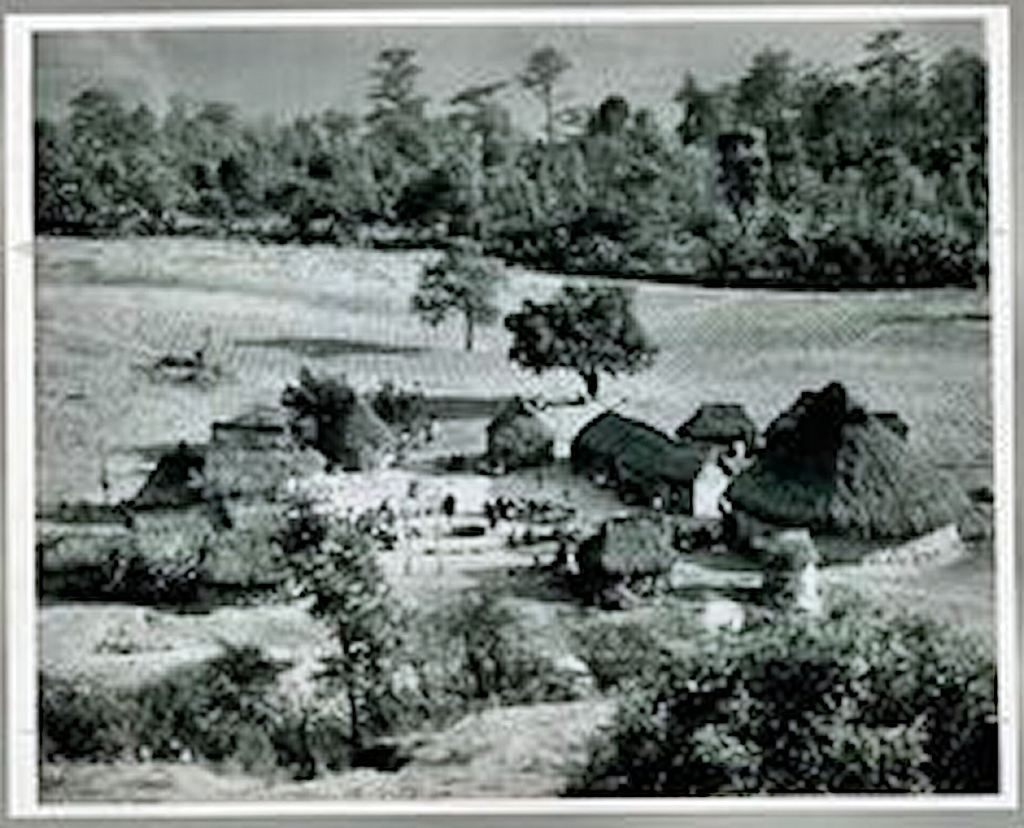
This early 20th century Toltec village looks just like a Creek village
Pop culture anthropology in the late 20th century
Chariots of the Gods was published in March 1968 during the apex of the Hippie Culture. The premise of the book was that visitors from other solar systems and galhad either constructed or guided the construction of the major monuments in early history. Most of chapters in the book dealt with Indigenous Architecture in the Americas such as Teotihuacan, Tula and the Maya city of Palenque. The giant statues at Tula were billed as proof that alien astronauts had visited there. The text was backed up by very convincing photographs and drawings.
This book skyrocketed to the best seller list. Its official author was Erich von Däniken in Switzerland. Von Däniken was presented as the world’s leading expert on Astro-Archaeology, a pseudo-science that he had invented and at that time, was the only practitioner.
Readers were not told that Von Däniken had no formal education beyond gymnasium (high school). During his senior year, he had been convicted of theft and served a four-month jail term. He then worked as an apprentice at a Swiss hotel for awhile, before moving to Egypt. His career in Egypt ended when he was convicted of fraud and embezzlement involving a jewelry transaction. He served a nine-month term in prison
In 1964, von Däniken wrote “Hatten unsere Vorfahren Besuch aus dem Weltraum? (“Were Our Ancestors Visited from Space?”) for the German-Canadian periodical Der Nordwesten. The original draft of this article was developed while Von Däniken was in prison.
After release from his second prison term, Von Däniken became a manager of the Hotel Rosenhügel in Davos, Switzerland, during which time he wrote Chariots of the Gods? (German: Erinnerungen an die Zukunft, literally “Memories of the Future”) The book’s photos and drawings were low resolution Xeroxed (aka photocopied) of photos taken by him, plus from other books and magazines without permission. Most photocopies were crudely doctored by the author.
Several reputable publishers refused to print the original German language book because of its misspellings, bad grammar and amateurish word flow. Eventually, one publisher agreed to publish the book, because of its sensational content. There was a condition that it be completely re-written by a professional journalist. They chose Utz Utermann. The real author used the pseudonym of Wilhelm Roggersdorf for a good reason. Utermann was a former editor of the Nazi Party’s newspaper Völkischer Beobachter and had been a Nazi bestselling author.
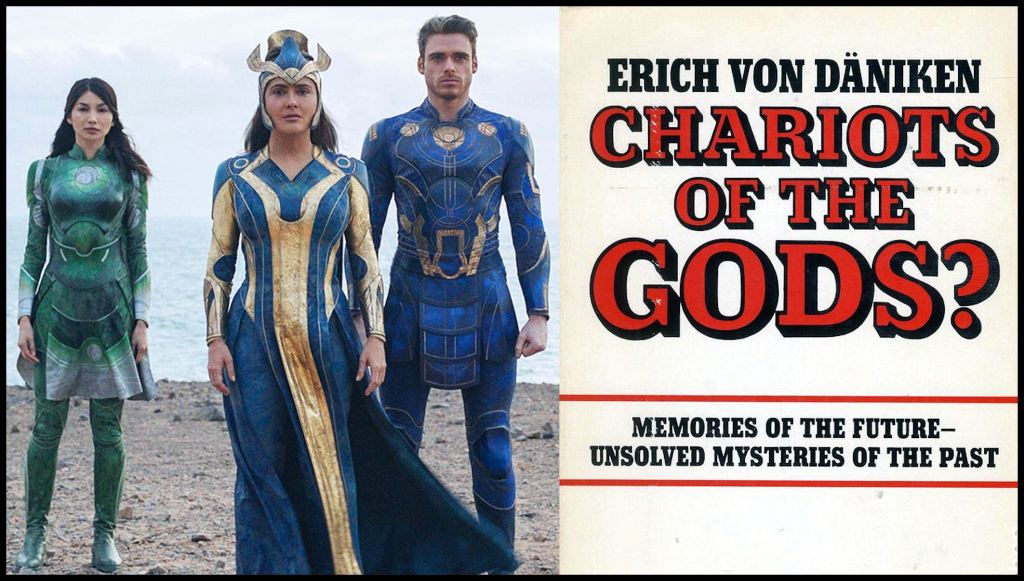
In November 1968, Von Däniken was arrested again by Swiss police . . . this time for the most serious crimes. During his 12 years as a hotel manager, he “cooked the books” presented false credit references and failed to pay taxes in order to give himself a $130,000 in loans to travel abroad.
Two years later, Von Däniken was convicted for “repeated and sustained” embezzlement, fraud, and forgery, with the court ruling that the writer had been living a “playboy” lifestyle. He only served one year of a three-year term, because profits from Chariot of Gods enabled him to pay all his debts and court fines in a few months. While in prison, he wrote his second best-selling book. Von Däniken has grown quite wealthy in the decades since then, due to continued healthy sales of his books, plus TV and movie appearances.
A popular myth in the United States during the first half of the 19th century was that the “Ten lost tribes of Israel built all the Indian mounds.” Soon after Von Däniken published his first book, there began a continuous succession of books and TV documentaries, which proposed either Ancient Alien Architects or such peoples as the Atlanteans, Egyptians, Libyans, Phoenicians, Etruscans, Sub-Saharan Africans, Irish, Welsh, Viking, Gallic Celts, Cretans, Myceneans, Chinese and Islamic explorers as the REAL progenitors of Indigenous American civilizations.
Most of these authors were marginally-educated, self-styled scholars offered little proof, only speculations and premised on the belief that their particular “team” were the master race and that Native Americans were intellectually incapable of starting civilizations. The reality was that these literary efforts produced far more income for their authors than serious books on Indigenous American Architecture by accredited professionals.
A partial exception were the books written by Dr. Barry Fell, an English zoology professor, who became obsessed with creating a European origin for American civilizations. Some of his evidence for Pre-Columbian voyages to the Americas is hard to refute. They include caches of Roman coins and a very old carvings of the earliest form of Gaelic writing, Ogam, on boulders and caves. However, Fell never bothered to learn Indigenous American cultural history, architecture and languages. He frequently went out into lala land, when he broadly generalized fake facts from isolated discoveries of artifacts and rock art.
The consistent opponents of the legion of “Others did it” books and films were archaeologists in the United States. They branded all efforts in that direction as Pseudo-Archaeology. Their consistent counter-argument was “Our profession has adopted as a religious belief that all Pre-Columbian occupants of the Americas were Clovis Culture People, who walked over the Bering Land Bridge. They defined cultural history as the English names of Native American pottery styles and projectile points. Very few even bothered to learn Native American languages so they could translate the Indigenous names of their archaeological sites.
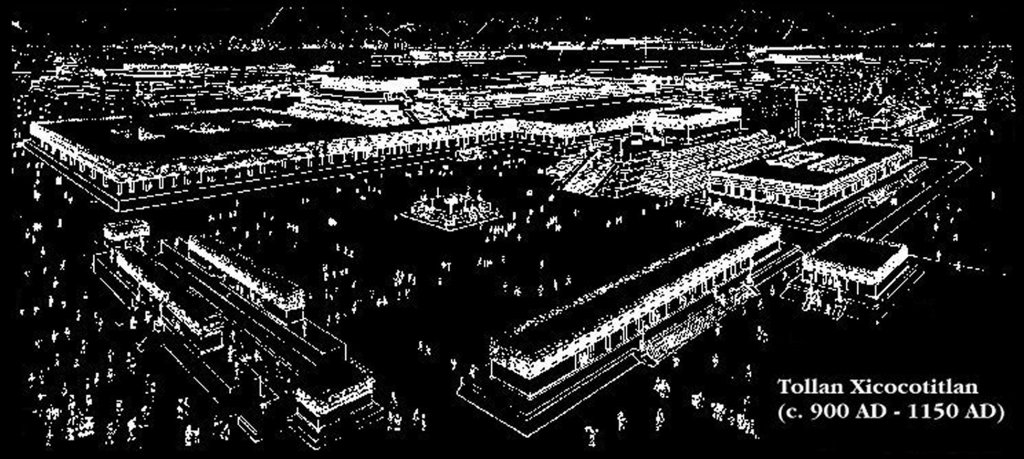
A Mexican architect’s drawing of Tula – Tollan is its Aztec name.
A Confession
I took a copy of Chariot of the Gods with me to Mexico! After seeing the giant warriors at Tula close up and personal, I realized that Von Däniken had doctored his photos. His books were caca de toro. As soon as we got back to the De Soto house in Colonial Nueva Santa Maria (Mexico City) I threw the book in the garbage. For the next two years, when I taught Pre-Columbian Architecture at Georgia Tech, I included slides, which compared my photos of the real thing next to fake photos in Von Däniken’s books.
For the next four decades, my mind was almost as closed to the possibility of Pre-Columbian European settlers in the Americas as those minds of the Gringo archaeologists. There was still the memory of seeing “Creek sacred symbols” carved on boulders near Landskrona, Sweden and 2000-year-old Maya glyphs, carved on boulders near Nykōping, Sweden on the Baltic Coast. I tried not to think about them.
Then in 2012, I encountered the name of a tribe, which was next-door neighbors to Fort Caroline on Georgia’s Altamaha River . . . the Alekmanni. Fort Caroline’s commander, René Goulaine de Laudonnière stated that the Alekmanni’s name meant “doctor-people.” The Alekmanni village near Fort Caroline specialized in growing cinchona trees, from which quinine is derived. Wild cinchona still grows near the mouth of the Altamaha River. Greatly diminished by Spanish diseases and military attacks, the Alekmanni moved to near where I live on Alek Mountain then joined the Creek Confederacy.
“Alek” means “medical doctor” in modern Muskogee Creek. Until the late 1800s, it meant “herbal healer.” “Lek” is an Indo-European root word used extensively in Scandinavian, Finnish, Baltic, Slavic, Germanic and Greek languages. For example, läkare (pronounced lekare) is the modern Swedish word for a medical doctor. The old Swedish word for an herbal healer, was “att läka.” The Anglisk counterpart, when the “English” lived in southern Scandinavia was “Aleka.”
For several years, I tried to find the word, “manni” in one of the Indigenous American languages being used to mean “people.” Then I remembered that several Germanic tribes encountered by Julius Caesar had “manni” as part of their name.
My Indo-European Etymology book stated: The source of the word, “many” in English is manni, which meant a group people or tribe. It could also mean a group of noblemen, while “mæn” meant a group of commoners.
The Alekmanni Tribe was originally a group of Archaic English colonists, who were skilled at healing with herbal medicines. They intermarried so much with AmerIndians that they became indistinguishable from pure AmerIndians.
There are many Indo-European or Pre-Indo-European root words in the Muskogee Creek Language. Most come from the Archaic Gaelic, Illyrian, Latin and Swedish languages. Factual history is far stranger than fiction.
 The Americas Revealed
Well, why not? That people were exploring the world, by land and sea, before modern inventiveness, doesn’t surpirse me. Mixing of language, art. tools, traditions, genes, and know-how had to occur by whatever means for individuals and groups to survive in the vast unknown.
LikeLiked by 2 people
Hey Richard
I found an interesting article on the Georgia Fever Tree https://www.tallahassee.com/story/life/home-garden/2017/04/06/pretty-pinckneya-rare-species-known-fever-tree/100088410/
I also remember an article you wrote several years ago about an officer in the Seminole War mentioning in his diary, the men from Georgia under him did not get sick from swamp fever because they drank a tea made from fever tree bark. Today you can buy the plant from several native plant nurseries in the area. According to what I read it’s a particular plant and can be hard to grow. I still find it amazing that people found plants to use like this.
Thanks for all your work.
LikeLiked by 1 person
You are welcome!
LikeLike