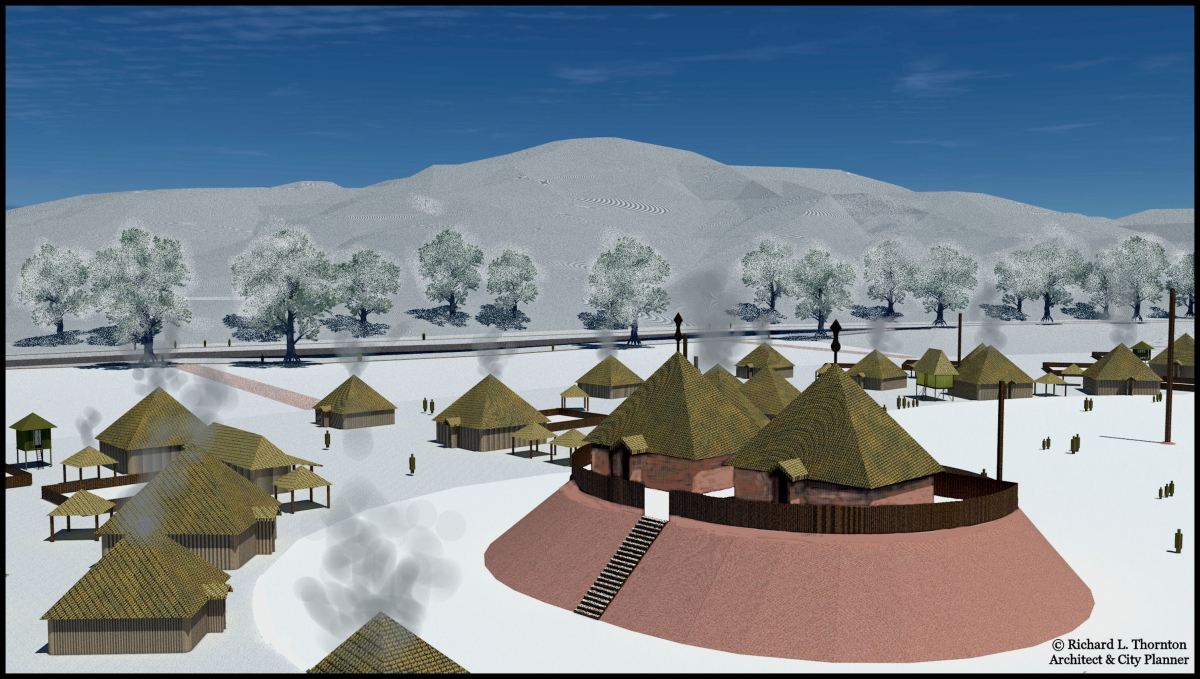
Beginning in the mid-1300s AD, winters became quite harsh in the Southern Highlands of eastern North America. Deep snows made mountain trail usually impassible after mid-December, until mid-March. Winter snowfalls started declining in the late 1700s.
Severe droughts typified the summers of western North America during the Little Ice Age, but the summers in the Southern Highlands were warm, plus had adequate rainfall for maize and other plants that originated in the tropics.
This peculiar combination of cold, snowy winters and mild summers explains the very high population density of northern Georgia, northwestern South Carolina, western North Carolina and eastern Tennessee, when the region was explored by the Hernando de Soto Expedition in 1540 AD. You see . . . each spring, the melting of a heavy snowpack caused silt-filled water to spread across the bottomlands, depositing a new layer of alluvial soil and nutrients.
The Peopling of Eastern North America Series
by Richard L. Thornton, Architect & City Planner
The good news is that those thick-walled prefabricated houses that I showed you in the previous article stayed warm inside during the coldest of weather, just from a couple of logs in their central hearths! Creek families wore very little clothing inside their homes in the wintertime!
In an earlier article of this series, I shared to readers a photo of my French soulmate, Vivi, playing with my herd dog pups in deep snow on December 19, 1990. That was to illustrate how radically the climate has changed in Southeastern North America in the past three decades. However, 200 years earlier at the same location, sleighs would have been the only way to travel throughout the winter.
Meanwhile in the Deep Southeast, melting snow was a big problem. While traveling from Pensacola, FL to Savannah, GA in the spring of 1776, William Bartram found that most of southeast Georgia and northeast Florida were covered by water, due to the melted snow in the Georgia Mountains. It was only possible to travel by canoe.
On the other hand, the Atlantic Ocean was significantly cooler during the Little Ice off the coasts of Delaware, Virginia, North Carolina, South Carolina, Georgia and northern Florida. Being outdoors would have been quite a bit more bearable during the summer in coastal regions than today.
Few Southeasterners are now aware that during the Colonial Period, the landscape of the coastal plains of South Carolina, Georgia and northeastern Florida strongly resembled the Amazon Rain Forest. Climate change seems to explain why several plant species, identified in the region by William Bartram, seem be extinct now.
Our indigenous agriculturalist ancestors here in the Southeast developed advanced societies, which were finely tuned to their natural environment. When the climate changed, they had to change too!
 The Americas Revealed