
History will come alive in 2025!
Also . . . the forgotten history of a shipload of “Pilgrims,” who didn’t settle near Cape Cod in Massachusetts
by Richard L. Thornton, Architect & City Planner

This is a segment of a map painted by Jacques Le Moyne, resident artist and cartographer for Fort Caroline. It was based on the field notes of a six months lonf expedition up the May (Altamaha) River into the Southern Highlands by Lt. LaRoche Ferrière of Fort Caroline. Fort Caroline was at the mouth of the Altamaha River, not near Jacksonville. The mouth of the St. Johns River was impassible to sea-going vessels until 1860!
The Kingdom of Apalache
The Apalachee Indians of the Florida Panhandle did not call themselves “Apalache” until the Spanish told them that was their name. The “faux” Apalache were Southern Arawaks from Peru, not Mesoamericans or Muskogeans. However, the real Apalache, from northern Georgia, did establish a large trading town, named Tula Hiwalsi on Lake Jackson near Tallahassee. Tula Hiwalsi means “Town of the Highlanders” in the Apalachete and Itstate languages (not Muskogee) spoken by most Creeks in Georgia.
The real Apalache were the most advanced indigenous people, north of Mexico. Their name appears on all maps of the Southeastern United States until the early 1700s, but I have found that contemporary academicians in the Southeast are totally ignorant of their existence. The plural of their name, Apalachen, evolved into the name of the Appalachian Mountains.
When Savannah, GA was founded in 1733, most Middle and Lower Creek tribes called themselves Apalache-te or Palache. That is the name that they called themselves in the “The Creek Migration Legend.” The Upper Creeks called themselves the Kaushete (Cusate in European languages). Around 1748 they changed their name to Maskoki . . . a hybrid word that means “Mixed Ethnic Groups – People.”
According to the Apalache Migration Legend, they were originally one of the Panoan tribes, who settled along the coasts of Georgia and South Carolina. The actual Panoan name, Aparashe, means “From ocean (or Amazon Basin) – Descendants of”. They established the acropolis on the Ocmulgee River, now called Ocmulgee Mounds, then migrated northward to the headwaters of the Oconee River in NE Metro Atlanta.
According to the Kaushete (Creek) Migration Legend, the Apalache occupied the lower mountains in Georgia, when the Kaushete arrived there. The Itzate controlled the higher mountains in Georgia and North Carolina at that time, but by around 1585, the Apalachete controlled both regions and the Itzate had merged with the Apalachete.
After acquiring firearms and horses, the Apalache created a confederated kingdom that stretched from northeastern Tennessee to southwestern Georgia. This confederated kingdom disintegrated, after the horrific 1696 AD smallpox plague and the 1700 AD eruption of the Chimney Mountain Volcano, about seven miles north of my house. My property’s soil contains young lava bombs, pumice rocks and volcanic ash.
The modern Creek Confederacy was established at Ocmulgee Mounds in 1717, under the dominance of the Muskogee-speaking Coweta and Tuckabatchee tribes. It included all the members of the Apalachen Confederacy, except the tribes allied with the Cherokee, who were now arch-enemies. It also included the Chickasaw, but they soon dropped out, because of the requirement that Muskogee be used in all political meetings.

Fanciful illustration of the Nacoochee Valley in 1653 by Dutch printer and engraver, Arnout Leers, from the book written by Charles de Rochefort. In the lower left, one can see the exaggerated appearance of the fortified Spanish trading post and Franciscan mission.
The Brigstock Expedition
Charles de Rochefort’s landmark, 1658 book, Histoire naturelle et morale des îles Antilles de l’Amérique, contains ten chapters that are an account of the 1653 expedition of Barbados planter, Richard Brigstock, to what is now northeastern Georgia. He also spent several weeks with Spanish-speaking gem miners in the vicinity of Franklin, NC. The book was so popular that it went through six more editions, printed simultaneously in French, Dutch, English and German.
The book provided the eyewitness details, utilized in maps of North America, produced by French Royal Cartographer Guillaume De L’Isle. Later editions even include a long letter, written by Edward Graeves, a late 17th century English colonist, living in northeastern Georgia. It describes the flora and fauna of that region.
European universities still consider De Rochfort’s book to be the most comprehensive resource for information on the 17th century indigenous peoples, indigenous architecture, wildlife and vegetation of the Caribbean Basin and present-day Georgia, but very few anthropologists and historians in the United States are even aware of its existence.
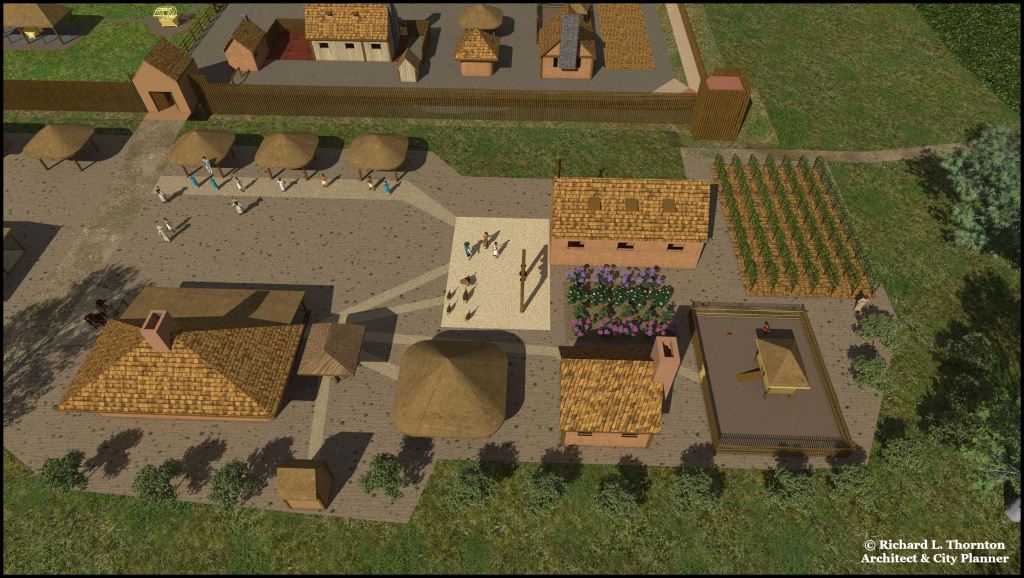
Speculative birds-eye view of the mission, based on contemporary missions in the mountains of the Philippine Islands. The Robertstown Elementary School was developed at this site in the 1930s, so there is little probability of finding mission building foundations intact.
The friendship between an Englishman and Spaniards
We will begin The Americas Revealed exploration of the world, which Richard Brigstock saw, with a compelling story that he related to Charles de Rochefort. During his long stay in what is now called the Nacoochee Valley, Brigstock developed a close friendship with the Franciscan friar, who served at a small Roman Catholic mission next to the fortified Spanish trading post, built in 1646. De Rochefort did not provide the friar’s name.
The elite of the Kingdom of Apalache were Protestant Christians . . . converted by survivors of Fort Caroline in the 1560s. There was also a congregation of mixed-blood Anglican Protestants, founded by a shipload of English Separatists from the Netherlands in 1621. More about that later. We know from other eyewitness accounts, most notably in the 1780s, by Colonel John Tipton and Captain John Sevier from Shenandoah County, VA that there were numerous, perhaps several thousand Spanish and Portuguese Sephardic Jews in the Southeast.
However, the leaders of the Kingdom of Apalache did not distinguish between the various factions of Christianity and Judaism. Religious beliefs were a personal matter among the ancestors of the Creek Indians. Religious tolerance was the law of the land. Although called a kingdom by Brigstock and De Rochefort, it was actually a constitutional monarchy, very similar to Great Britain in the 1700s and 1800s. The High King was elected for life, but could be impeached by the nation’s bicameral legislative bodies.
The friar primarily served the Spanish/mestizo traders, miners, muleteers, cooks and laborers at the trading post, plus elsewhere in the Southern Highlands, but apparently Brigstock was the only person around, with whom the friar could discuss intellectual subjects. Brigstock stated that they spent many hours of delightful conversation. Also, at the friar’s urging, Brigstock spent several weeks among the friar’s flock near present-day Franklin, NC and Clayton, GA. He found them to be very friendly.
Interracial marriage was the LAW!
The placement of an Indigenous American wife next to the friar in the VR image above is no figment of my imagination. Brigstock tells us that all single adult immigrants into the Kingdom of Apalache were required to marry indigenous spouses. Celibacy was considered to be unhealthy . . . whether the person was single or married. The same rule applied to the children of non-indigenous married couples, who were granted citizenship. There were no exceptions . . . whether they be from another indigenous ethnic group, Jewish, African, Anatolian Christian, Moor or European.
Thus, the next generation of settlers were 50% indigenous American. Within three or four generations of mestizos intermarrying, they would have looked little different than their ancestors at the time of the Columbus voyages. However, they would have carried some genetic resistance to the European diseases that probably killed 90% of the pure-blood indigenous peoples in Mesoamerica, the Andes and the Amazon Basin.
The death rate for newly arrived European settlers was almost as bad! They lacked immunity to American microbes, but they could always be replaced by new colonists.
This policy, which continued until the late 1700s in the lands of the Creek Confederacy, had an additional objective beyond maintaining civil tranquility. The leaders of Apalache wanted to obtain European technology through trade and the knowledge carried by immigrants . . . in particular, metal tools, swords and firearms.
They were quite successful in this latter endeavor. In his 1966 book, Archaeological Survey of Northern Georgia, archaeologist Robert Wauchope stated that Nacoochee Valley farmers had plowed up a tractor trailer load of late 16th and 17th century European tools and weapons . . . including many arquebuses and muskets. Nineteenth century Georgia newspapers reported that gold miners had unearthed such items as 17th century Spanish cigar molds, bronze retorts for refining gold and presses for squeezing grapes to make wine.
Sheer distance probably protected the friar from being defrocked for violating the Franciscan rule of celibacy. The mission was over 500 miles (806 km) over rugged terrain from St. Augustine and about 385 miles (620 km) from the headquarters of the Franciscan mission system on St. Catherines Island (now Georgia). I strongly suspect that the friars remained with their families in Apalache until their deaths.
Brigstock stated that forced marriage to the locals was not a problem for most immigrant men, since the Apalachete gals were generally very pretty and quite intelligent. The same response applied to the most female immigrants. Apalachete men were taller, plus more skilled at farming and hunting than most European men.
Also, the complex in the Nacoochee Valley may have been unknown to the Spanish government, even if the Franciscans furnished a friar. Florida archives present it as a personal endeavor of the Governor of La Florida, he used royal funds to build the road to connect it with St Augustine. Virginia archives provide the additional information that Edward Bland was a major investor in the project. Well . . . if a Spanish or church official did suddenly show up, the friar could have claimed that the woman was his cook.

View of the (L-R) fruit orchard, chicken coop. vineyard, kitchen and chapel at the mission
Obtaining wine for the sacrament of Communion was a initially a major problem for all Spanish missions in North America . . . especially within the interior, where there was no possibility of ships bringing kegs of wine from Europe or Mexico.
The friars at Mission Santa Cantalina de Guale and St. Augustine tried to grow wine grapes, but a parasitic fungus in the soil quickly killed the roots. The friars did not know how to make a palatable wine out of the native muscadine, scuppernong and Fox grapes in present-day Georgia.
This fungus is present in much of the United States. European vinifera grape species must be grafted to the roots of indigenous grape species.
There is one big exception to this problem for North American winemakers. The mountainous portion of the Georgia Gold Belt has an excellent climate for growing French and German vinifera grapes, but the gold, copper and zinc in the soil seems to block the growth of the parasitic fungus.
The discovery of 17th century wine-making equipment in the bottomland of the Nacoochee Valley suggests that early European immigrants discovered this fact. I also have a feeling that after the governor of La Florida and his English partner died a year apart, the friar at the isolated mountain mission received very little financial support from St. Augustine. He could justify planting a vineyard to make sacred wine, but making it larger would produce sorely needed income for his mission. Of course, this is a speculative feature of the mission, but quite plausible.
The forgotten 17th century English colony in Georgia
Although buddies with a Spanish friar, Richard Brigstock attended a English Protestant church. It was founded in 1621 by the same type folks, who founded the Plymouth Colony later that year. There were two big differences.
The English Separatists thrived because of the milder climate and abundant food. Over half the Plymouth colonists died the first year. However, single English Protestants in Apalache were required to marry indigenous spouses or else leave the kingdom. Thus, by 1653, most of the congregation would have been mestizos, who spoke English as a second language.
Brigstock did not say whether the Anglican church services were conducted in English or a Creek dialect. He did state that the High King of Apalache considered the congregation and later arrivals of escaped bond servants from Virginia to be very important assets for his nation. He had a significant body of citizens, who were fluent in English and thus could be actively involved in the desired trade with Great Britain.
Below is an earlier article on the Forgotten English Colony.
 The Americas Revealed