
Slide Show
The Uchee are believed to be the oldest indigenous people in the Lower Southeastern United States, still maintaining a tribal identity. This is what they told the British colonists in Savannah in 1733. The Creek leaders agreed with them. The Uchee signed several treaties with Great Britain, but never with the United States . . . because they never fought a war against the U.S. As a result, the Bureau of Indian Affairs refuses to grant them separate recognition and groups them with the Muscogee-Creek Nation in Oklahoma.
Specifically what they told Supervising Trustee, James Edward Oglethorpe, is this: They crossed the Atlantic Ocean from the “Home of the Sun” and first landed at the mouth of the Savannah River. The South Atlantic Coast was uninhabited, but they could see many shell mounds and shell rings, built by a people, who lived there before them. To the north, in the present-day North Carolina and Virginia Piedmont and Coastal Plain were Algonquian tribes.
Uchee bands and tribes began quickly spreading into the interior of the Southeast, where they established villages that traded commodities from the Atlantic Coast, in particular, salt, to other peoples. These other peoples usually allowed the Uchee to establish trade colonies in their midst. The Uchee eventually even established trade ties with the Gulf Coastal civilizations of Mexico.
The Uchee were also called the “Round Town Indians” because of their long tradition of building round houses and temples in round villages!
by Richard L. Thornton, Architect & City Planner

Painting of a Uchee man near Savannah, GA in 1736 by Philip Georg Friedrich Von Reck. Note the pronounced cheek bones and heart-shaped head. There was much mixing in Georgia between the Uchee and Itsate Creeks. These features are common in their descendants in the region from Atlanta southward to Macon, Sparta, Hawkinsville and Dublin, GA. The exotic look is what contributes to female descendants being frequent winners in beauty pageants. We are part Uchee in addition to the Itzate and Apalachete ancestry. My sister has a heart-shaped head. I look more like Australopithicus. LOL
Original ethnicity of the Uchee
That’s a good question. Oklahoma Uchee (They call themselves Euchee) are reluctant to provide samples for DNA testing after the first results. Several elders, who look like full-blooded American Indians, had no or very little AmerIndian DNA markers.
Meanwhile, Eastern Creek descendants of known partial Uchee descent are showing up with very exotic ancestries in addition to Mesoamerican than cannot be explained by their known ancestors in the Colonial Period. These unaccountable DNA markers are Sami, Finnish, Archaic Irish/Scottish, Basque and Polynesian.
Colonial maps provide the names of many of the principal Uchee tribes. I can translate all of their names with either Archaic Gaelic, Itzate Creek, Sami, Archaic Swedish, Illyrian or Maori-Polynesian dictionaries! Many of the names mean Water or Sea People.
Uchee (Ue-shi) means “descendants of the Water” in hybrid Illyrian-Creek. Tocah-re means “Principal People” even in modern Irish. Wassaw is a Maori-Polynesian name for the ocean. Wateree is the Anglisk word for “Water People.” Alekmanni is the Anglisk word for Medicinal Herb People. The Angles lived in southern Sweden before migrating to southern Denmark and then southeastern England.
This suggests that the Uchee were not originally one ethnic group, but bands of Sea People, who originated from several parts of the world, but who first landed on the South Atlantic Coast. The reason that they look American Indian, but instead carry an exotic blend of DNA is that the Archaic Sami DNA from immigrants with looks like the Nenet People immediately below, came to determine much of their physical appearance.

The Nenet People form individual tribes of the Northern Sami in extreme northern Sweden and Norway, plus occupy a remote region of northwestern Russia. Although most people in the Americas would assume that they are indigenous American Indians, they actually are Eurasians, descended from branches of the Sami, who didn’t intermarry with Scandinavians.

This painting portrays a Uchee chief and his wife. It is also by Philip Georg Friedrich Von Reck. Von Reck, in 1736 painted several Uchees, living near Savannah. They strongly resemble either Sea Sami or some remote Northern Sami tribe, living in the remote mountain valleys between Kiruna, Sweden and Nordkap, Norway. Johana, an Austrian biologist, and I stayed with one of those tribes for a night. I was astonished to how much they resembled the Nenet People of Northwestern Russia or mixed-blood descendants of the Uchee in Georgia . . . in particular the women, with heart-shaped heads.
Their communities and architecture

The Robertstown Mounds were utilized by a series of indigenous peoples until around 1700 AD. A 1684 map by Jean Baptiste Franquelin shows Apike Creeks living at that location. They remained visible until the late 20th century, when they were bull-dozed by the City of Helen, GA, when it built a parking lot and park for visitors tubing the headwaters of the Chattahoochee River. The houses in this image are typical of the Apalachete Elite. Some of the later occupants of the village site seemed to have used the platform mound as a dancing ground. Others built typical, rectangular Creek temples on top.
Robertstown Mounds
The Virtual Reality image at the top of article portrays the probable appearance of the Robertstown Mounds from around 1200 BC – 500 BC. Robert Wauchope excavated parts of the village, oval-shaped platform mound and dome-shaped burial mound in 1939. The village and platform mound was designated Site 9WH20, while the burial mound was 9WH21. He interpreted the earliest, permanent village occupation to be Proto-Deptford Culture, because they made very similar beaker-shaped, cord-marked pottery to that found in the Deptford Mound in central Savannah, GA.

A southern Sami summer village in Jämtland Province (Central Sweden) during the 1700s.
Their initial, bullet-shaped houses were identical to those built by the Southern Sami in Sweden until the mid-1800s. Identical houses were also built by the Adena Culture in the Ohio River Basin, plus later by the Caddo of Texas and the Ottawa & Ojibwe of the Great Lakes Basin.
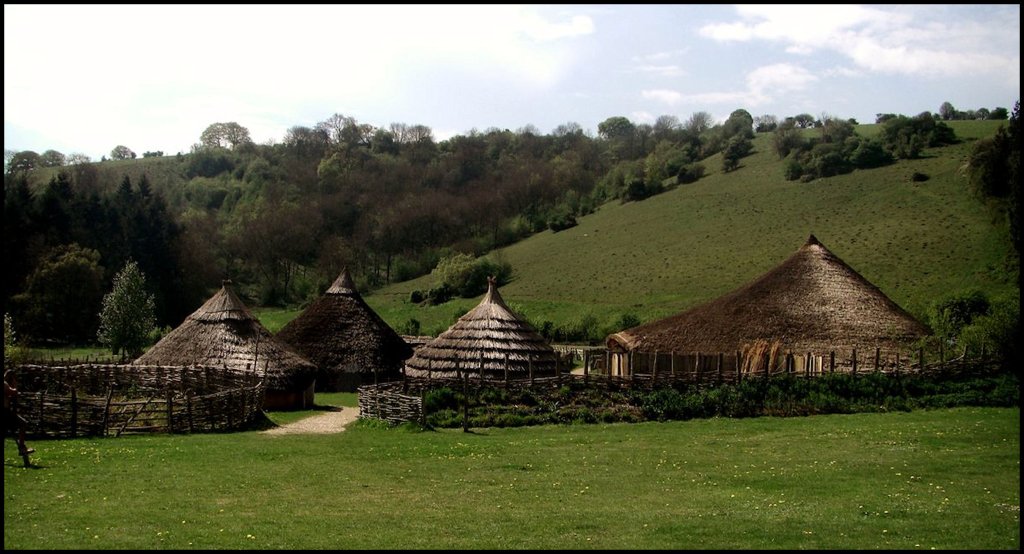
Probable appearance of a small proto-agricultural Uchee village
Proto-agricultural villages on major rivers
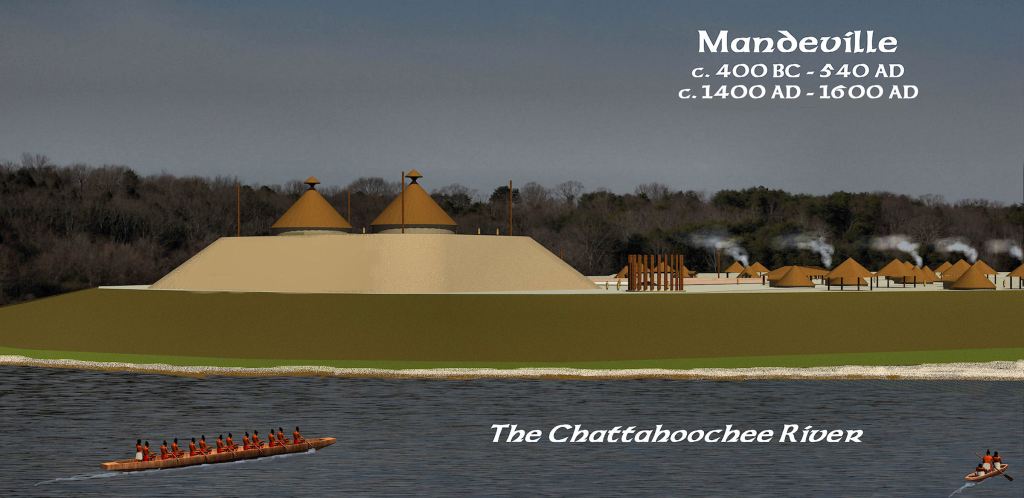
By around 500 BC, much more substantial round houses began appearing in the Chattahoochee River Valley . . . from Robertstown southward to the Mandeville site in southwest Georgia. They were still round, but the walls were constructed with large timber posts filled with wattle & daub. It could be than some bands of Uchee always built these style houses. They were identical to those in Ireland, southern Britain, Denmark and southern Sweden during the Neolithic, Copper, Bronze and Early Iron Ages.
Forensic botanists have determined that Indigenous Americans in the Southeast began domesticating indigenous plants at least as early as 3500 BC. The shift to agriculture seems to occurred gradually over a period of over 2,000 years.
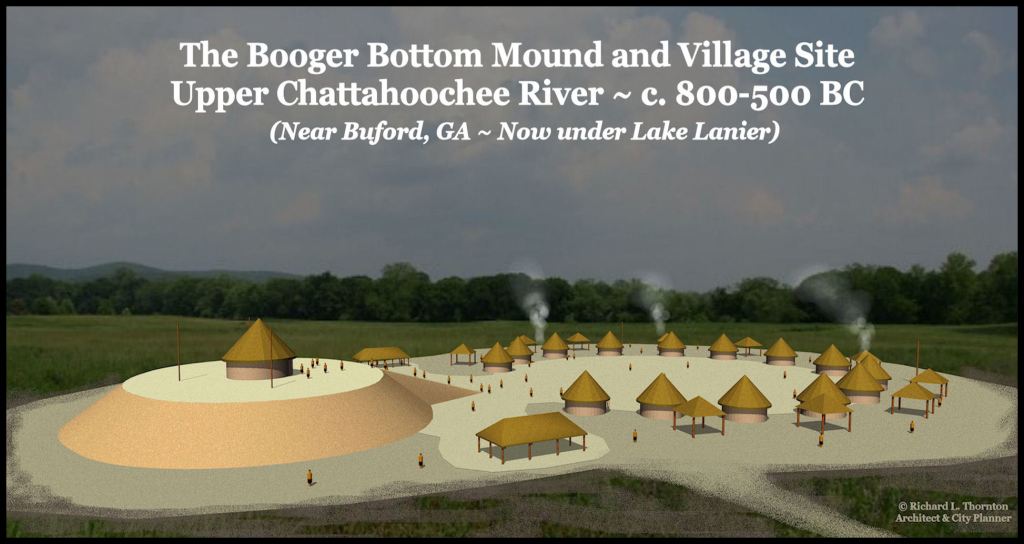
The Uchee town that archaeologist Arthur Kelly called Booger Bottom, was unusual in that it was only occupied for 300 years. Most town and village sites on the Chattahoochee were repeated occupied by various peoples . . . perhaps future member tribes of the Creek Confederacy . . . until 1700 AD or even 1827 AD.
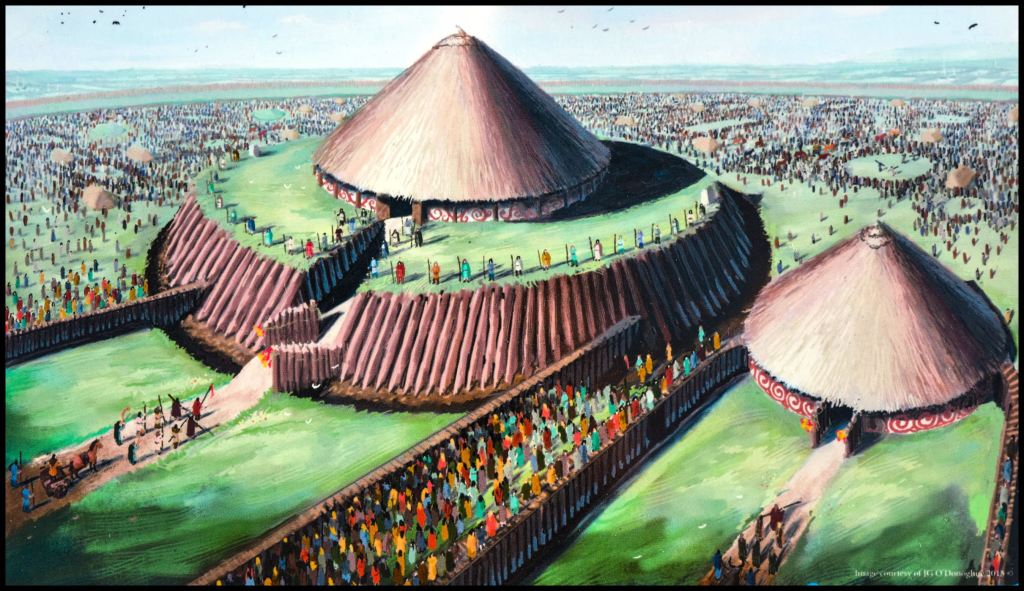
An oval-shaped platform mound in Ireland, contemporary with the Robertstown and Booger Bottom mounds in Georgia

Pakanahuere was probably founded around 800 BC. It was located near the confluence of the Chattahoochee River and Peachtree Creek in Atlanta, GA. It was occupied by several ethnic groups until 1818. Its final occupation was by Apalachete Creeks. On the top of the old mound grew an ancient Peach Tree, which gave Peachtree Creek its name.
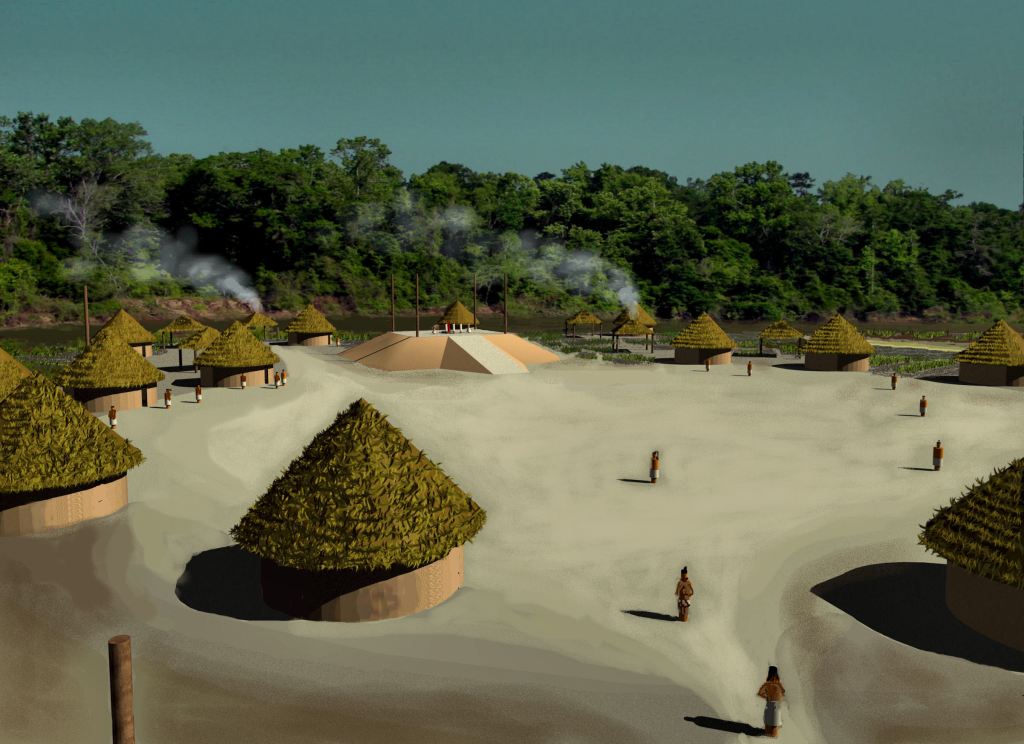
Archaeological site 9FU14 is located on the east side of the Chattahoochee River, near Six Flags Over Georgia in Fulton County, GA (Atlanta). It was occupied from around 250 BC to 540 AD. Archaeologist Arthur Kelly determined that the villagers grew a variety of indigenous and Mesoamerican crops, but specialized in the cultivation of indigenous sweet potatoes. Four types of feral indigenous sweet potatoes grew in and near the village site. The village was last occupied by people making Swift Creek style pottery. until a large comet struck off Cape Canaveral Florida in 539 D.

Dr. Arthur Kelly at the 9FU14 site in the spring of 1969. Photographer-journalist John Pennington from the Atlanta Journal Constitution was standing on the mound, when he took this photo.
Archaeologist Arthur Kelly found stone hoe blades in the strata, associated with the first occupation of the town. This proved that its population were farmers in addition to being traders.

A Uchee town, dating from around 1250 AD to 1696 AD on the Oconaluftee River in the North Carolina Cherokee Reservation. Cherokee High School is now located on the site.

Chestua was massacred and burned by the Cherokees in 1713 AD. The survivors moved to the Noteley River in Union County, GA. Some Uchee descendants of Chestua still live in Union and White Counties, GA.

This fascinating painting is a Uchee hunting camp, upstream on the Savannah River from the new town of Savannah. This is one of many paintings of the new Province of Georgia, made in 1736 by Philip Georg Friedrich Von Reck. The entire collection are on display at the Kungal Bibliotek (Royal Library) in Copenhagen, Denmark. Von Reck was of German ethnicity, but grew up in a province that was formally part of Denmark, but conquered by Prussia in 1864.

Uchee Town was constructed in the mid-1700s on the Chattahoochee River near present-day Columbus. It was occupied until around 1825. The site is now on land, owned by the U.S. Army’s Fort Moore and protected by the U.S. Army. Note that in the late 1700s, the Uchee stopped building round towns with round houses. However, their chokopa or Mesoamerican style council house was still round!
The painting is by the highly respected artist, Martin Pate, who has created many paintings for the National Park Service, Corps of Engineers and military branches in the late 20th century, up to the present. He and his wife live in Newnan, GA.
 The Americas Revealed
As you know, I’ve always been fascinated by the history of the Uchee people. Thank you, Richard.
LikeLiked by 1 person
Hey! Well, the truth is that there is much that we don’t know about the Uchee. The academicians periodically have national conferences on the Uchee (or Yuchi). There was one last week. However, because they never bother to translate or find the origins of Uchee words, these conferences typically go out into lala land. The one last week focused on family folklore from people in East Tennessee, who believed that they were part Uchee. For the most part, they were fairytales. Our family does have some solid cultural memories, because from 1763 until after World War II, most of the family lived in the same general area on the Savannah River near Elberton, GA. They were literate. We have a genealogy, which goes back to 1752,
LikeLiked by 1 person