
A picture speaks a thousand words!
You will see why for five decades, I was convinced that ancient Sami bands migrated to eastern North America and became some of the ancestors of indigenous peoples in southwestern Ireland and the southeastern United States . . . especially the Uchee and Siouan tribes,
by Richard L. Thornton, Architect and City Planner
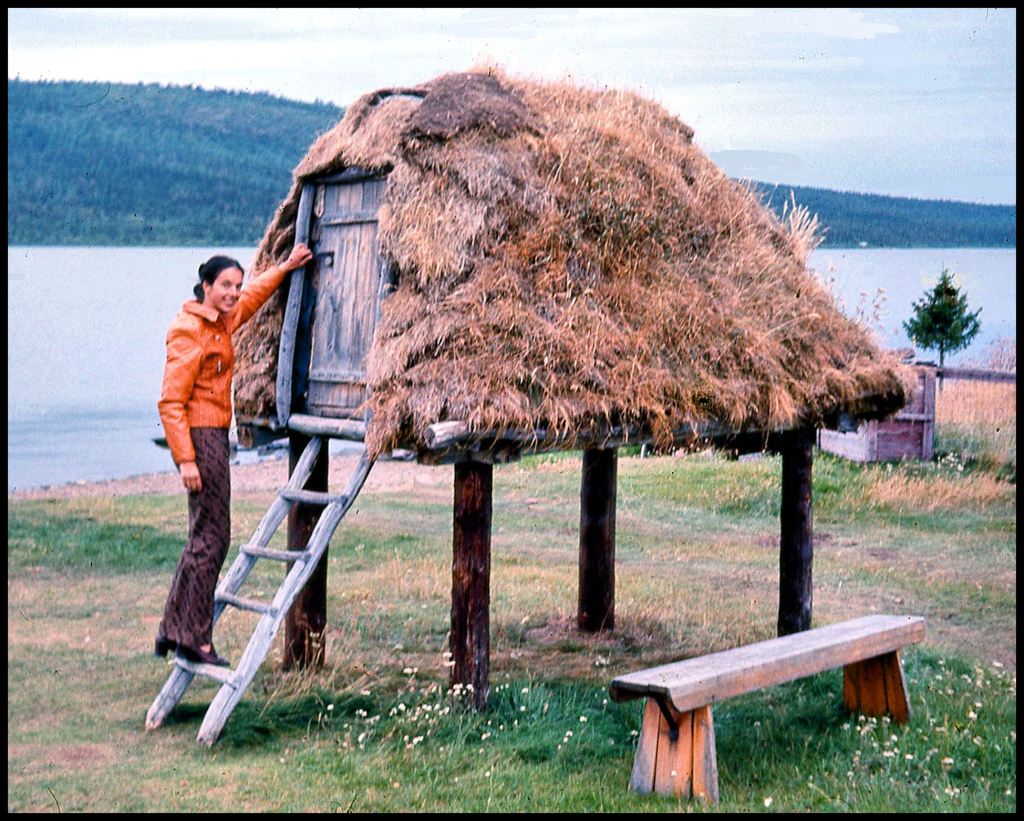
Johana was a biologist from Salzburg, Austria, but her ancestors were a band of Sami, who migrated to the high mountains of extreme western Austria in Late Roman times. This photo was taken in mid-August 1972 at an old Sami village near Jukkasjärvi, Norrbotten County, Lapland (Sweden). It was already sleeting in central Lapland. Farther north, snow flurries were falling.
Life is stranger than fiction
Shortly after my birthday in August 1972, I was informed that I was to take a paid leave from the Landskrona Stadsarkitektkontoret and journey first to Stockholm for an orientation then travel by rail to north of the Arctic Circle, Apparently, the Swedish Royal Navy was paying for the circular journey, where I would see most of Sweden and Norway. Once, I was in Kiruna, Lapland, I would accompany a female NATO biologist as she sampled vegetation, several hundred miles north of the Arctic Circle.
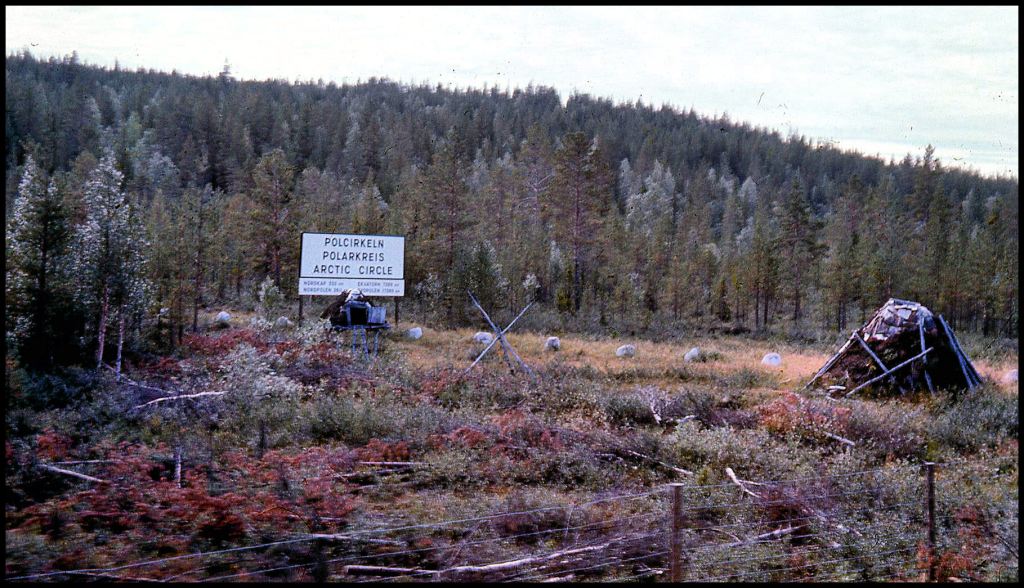
In mid-August there was already frost on the trees at the Arctic Circle
We were to pose as a happy, young Sami couple, so any Soviet spies would not get suspicious. * Everyone in Landskrona always said that I did not look “Amerikansk” but like a Northern Sami. My partner was Austrian, but but of ancient Sami heritage. Indeed, in Lapland, the Sami spoke to us in Sami and several times, Swedish tourists, thinking us to be “civilized Samis,” asked us for directions.
*During that era, Scandinavia, particularly northern Sweden, Norway and Finland, plus the region around Malmo, Sweden and Copenhagen, Denmark . . . were crawling with Soviet spies. They were natural blondes, recruited from Karelia and the captive Baltic countries. The KGB was delusional in thinking that opposition to the Vietnam War in Scandinavia and the USA, plus the Watergate Scandal would weaken NATO to the point that the Nordic countries would embrace Marxism. The Russians planned to send a massive armor thrust across Lapland, while the Soviet Navy would quickly capture all the major Scandinavian cities along the Oresund Channel.

This is not the “American Indian” village that we visited, but a 1970s photograph of another very similar one, which I found in the Swedish version of Wikipedia. Note that their earth lodges are identical to those built by non-agricultural tribes in the Southeastern and Southwestern United States! My understanding is that out of embarrassment, the Swedish government has begun funding more modern housing for those Sami, living near new Euro-tourist destinations. Even today, few North Americans see the remote parts of Sápmi (the land of the Sami.)
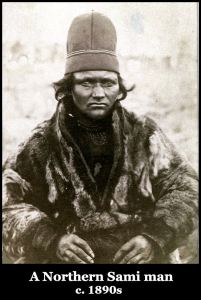
What convinced me more than anything else was our overnight visit to a Sami tribe in a remote mountain valley, between Kiruna and Nordkap, who looked like American Indians. We didn’t use the word “Native American” in 1972.
When Johana’s yellow Volkswagen Beetle first approached the village, a man stepped out of an earth lodge like the one in foreground above with a hunting rifle. I had a Northern Sami glossary book, so stepped out of car and said, “Dearvva!” (Hello!)
He quickly saw that we had black hair and tan skin and thus were not Swedes. They obviously hated the Swedes in that era. I told them in probably, very inept Sami that we were “a new husband and wife from a Sami tribe far away.” They heard us speaking English to each other, so we clearly were not even Norwegian or Finnish. From then on, they treated likes gods, visiting from the heavens. However, they would not let us take any photos of either their village or themselves.

1924 photo of an extended Sami family in front of an earth lodge
Genetics is still a science in transition
So, for decades, I told people about seeing American Indians in the northern tip of Scandinavia, but no one believed me, because I had no photos. Anthropologists laughed at me, then reminded me that geneticists had proven that the Sami were a Uralic-Finnish people, whose physical features had adapted to their harsh climate. They had very little Asiatic DNA.
Then around 2007, Scandinavian scientists simultaneously said oops! All the DNA labs in the world were using a Sami DNA marker, furnished by Upsala University in Sweden. It turned out that some lazy professor had gone to a small Southern Sami settlement near Upsala to obtain the DNA samples. This particular Sami tribe was 90% Scandinavian, genetically.
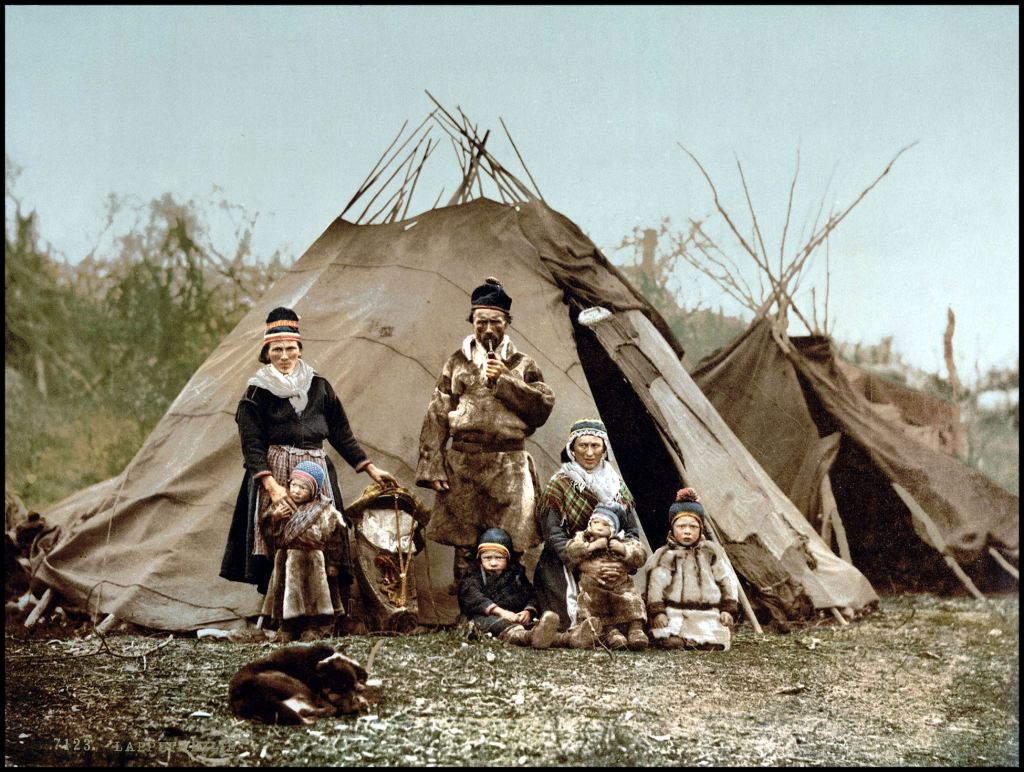
Sami tribes in Finland and Karelia (Russia) tend to look more Uralic-Finnish
More sophisticated genetic testing revealed that the Sami were originally an ancient Eurasian people. Varying intermarriage over thousands of years with the Finns and later the Scandinavians has altered the appearance of some Sami tribes, but not all. What was equally surprising was that ethnic Swedes carried up to 38% Asiatic DNA in more remote areas. The Neolithic and Bronze Age inhabitants of Sweden were Eurasians, who looked like mixed-blood Native Americans!
My 2005 genetic test told me that I was a Mexican mestizo with about 80% Nordic-Gaelic heritage and 20% Southern Mesoamerican, Polynesian and Southeast Asian. The man on my birth certificate was not my biological father. I assumed that the Nordic came from Norwegian Vikings, who had settled in northern England and eastern Scotland.

Swedish Sami singer and political activist, Maxida Marak . . . her facial features, including the fat lips, are identical to mine . . . except she is quite pretty. No wonder my co-workers in Sweden insisted that I must be a Northern Sami, rather than a typical Amerikansk. When she attends Native American pow-wows in the USA and Canada, everyone assumes that she almost full-blood, Native American. Maxida would like to see more cultural and political ties between the Sami and Indigenous Americans. She feels quite at home in rural areas of the United States, but is based in Sweden.
A more precise test in 2014 told me that I was a mixture of Southeastern Scotland/Yorkshire, England Scandinavian, Sami, Finnish, Pre-Germanic Swedish, Maya, Irish/Scottish Gaelic, Zoque (Mexico & NE Georgia), Panoan (Peru & Georgia), Polynesian, Archaic Irish, Northwest Iberian and Basque! Say what? No wonder everyone thought that I was a Sami.
Several years ago, my sister toured Scandinavia, while she was living in England. She even followed my footsteps in Lapland to see what I had always marveled about. In Finland, the store clerks spoke English to her companions from the United States. However, they spoke Finnish to her, since they assumed that she was either Finnish or Finnish Sami!
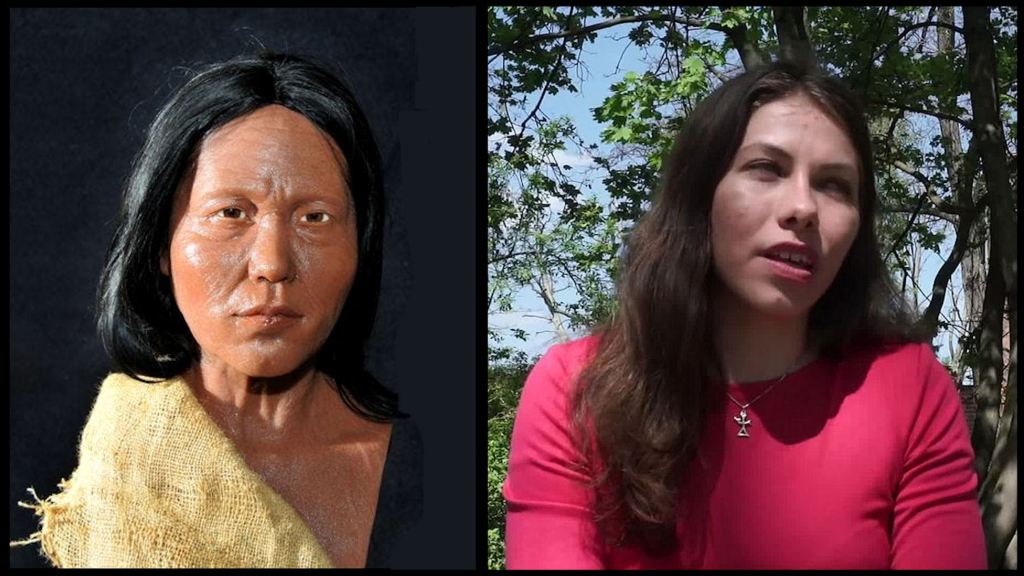
On the left is a sculpture of a Windover Pond woman (Florida Bog People) by a forensic artist. On the right is a South Sami lady, who I met in Östersund, Sweden. Not only do they look alike, but they carried the same Archaic Nordic genes.
The Bog Burial People
Four years after my second DNA test, another group of bog burials was found on the Florida Atlantic Coast. This cemetery was under the water of Manasoto Bay. Shortly thereafter the DNA results of the earlier Windover Pond and Warm Mineral Springs burials were released along with the DNA of the new burials. These burials date back 8-6,000 years.
What none of the Gringo archaeologists seem to know was that the earliest peoples of Karelia, Finland and Sweden buried their dead in an identical manner to those at Windover Pond. The bog burials in Florida are contemporary with the earliest bog burials in Sweden, Finland and Russia.
Headlines in Florida briefly read, “Oldest Floridians are not American Indians.” The articles explained that newer burials at Windover Pond were the offspring of the original folks and American Indians from Siberia, but all the oldest burials were definitely not Siberians. The reporters were afraid to say the “E-word” (Europeans). Then the bureaucrats in the federally-recognized tribes had a flying hissy . . . squawking the same ole “you’re stealing our heritage nonsense.” No more DNA results were publicized. You have to go on Youtube to learn what the geneticists discovered.
I am no expert on genetics, but not totally ignorant of the science either. I immediately recognized the DNA markers of the Windover Pond People to be the same markers linked to my family’s Sami/Finnish/Pre-Germanic Swedish ancestry. I strongly suspect that there are thousands of such bog burials along the Atlantic Coast of North America. Perhaps they are the people, who made the Solutrean style stone points, found around Chesapeake Bay. Undoubtedly, they are the founding member of the Uchee family of tribes.

Exactly the same underwater burial techniques were used in the South Atlantic Coastal region, Sweden, Finland, Karelia and the coastal plains of the Baltic nations at the same time. They date to immediately after the Ice Age, when the glaciers were melting, but the Atlantic Ocean was approximately 100 feet lower than today.
Photographic proof that I saw “Indians” in Lapland

Yesterday, I used geographical place names in Lapland to search the Swedish version of Wikipedia for photographs that might prove I saw “American Indians” in Lapland. Eurika! If found an 1868 photo of a 35 year old woman in the same Sami tribe that we visited. A note at the bottom of the photograph even told me her name and the name of her tribe . . . Elsa, daughter of Nils, in the Sirkas Tribe. She strongly favors several of the paintings by Von Reck of Uchees in the Savannah, GA area. (See previous article.)
The Sjö Sami (Sea Sami)
There are distinct differences in the physical appearances of both Sami and Uchee tribes. In most of the photos, I have shown you so far, the Sami resemble either the Uchees, painted by Von Reck near Savannah or Uchee descendants in central Georgia and northern Florida. However, there was a very powerful Sami tribe living in the coastal regions of northern Norway and Sweden. Uchee descendants in the Georgia Mountains and some of the Oklahoma Uchee strongly resemble the Sea Sami.
Norwegians traditionally used the word, Sjøke (Sea People) for the Sea Sami, but now more commonly use Sjø Sami. Sjøke is pronounced Jzhō : kē like the Indigenous American tribal name Soque/Zoque/Sokee.
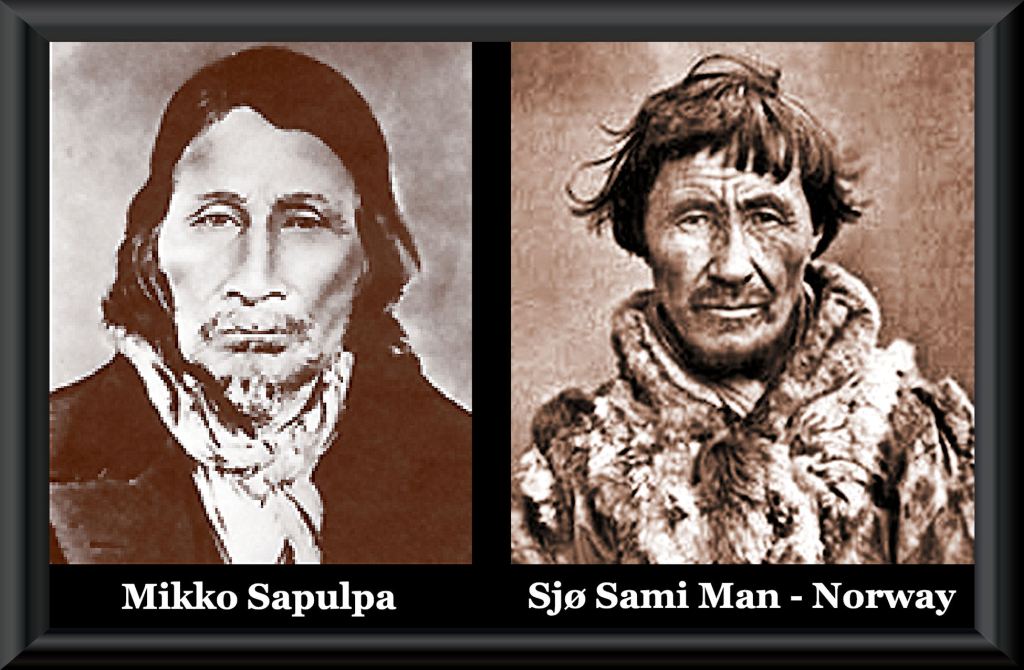
Mikko (chief) James Sapulpa was born in 1824 in the Upper Creek town of Kashita, Alabama. his mother was Uchee. However, Kashita was originally a fortified garrison town at the confluence of the Nottely River and Coosa Creek near present-day Blairsville, GA, the county seat of Union County. Coosa is the Frontier English name for the Kausha- te (Coosa People). Sapulpa moved with his family to Oklahoma in 1840.
The upper Nottely River Basin was at that time predominantly, Highland Uchee . . . the Uchee Rabbit Clan. Kashita initially remained when their land was given to the Cherokees by the US Government in 1784, but disappeared from Georgia in the early 1800s then reappeared in Alabama. Whatever the case, the Kashita Creeks intermarried constantly with their Rabbit Clan neighbors, thus a large Uchee community developed around Sapulpa, Oklahoma, which itself developed around Sapulpa’s ranch.
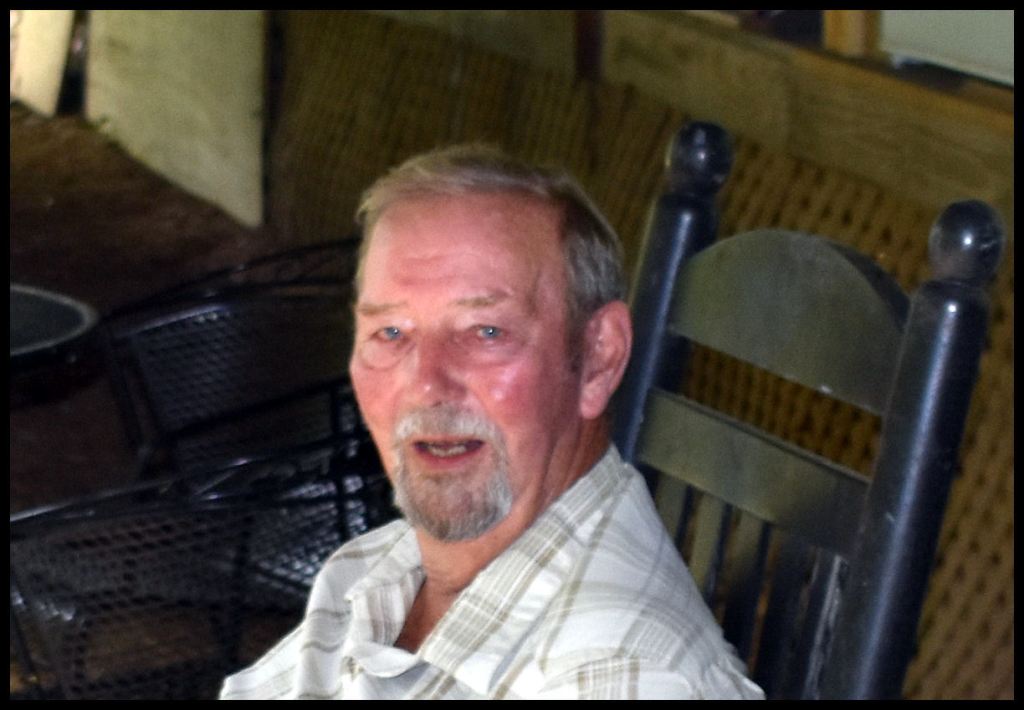
Curtis Dyer is a Highland Uchee descendant, who literally lives in eyesight of the Nacoochee Mound. His father moved to the Nacoochee Valley from Union County. According to family lore, his Uchee ancestors avoided being arrested by soldiers and sent on the Cherokee Trail of Tears because being Uchee, their names were not on the Cherokee Rolls. Afterward the Union County Uchees intentionally married into white families to avoid being deported in the future.
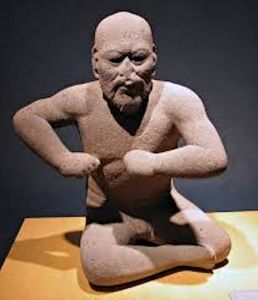
As you can see the Highland Uchee looked quite different than the Uchee living south of the Georgia Mountains and almost identical to the Sea Sami. What they are also similar to are the balding, bearded statues with Eurasian features of the original Soque, who landed on the shores of Tabasco State, Mexico around 1000-900 BC. It is very rare for a Native American man to become bald.
The Soque or Zoque claim to be the progenitors of the so-called Olmec Civilization. The Olmecs didn’t arrive down there until around 1100 AD! Whatever the case, the people in Tabasco did not make pottery or build mounds until after the Soque arrived.
Then . . . around 1250 AD or later, Nahua-speaking soldiers from the Valley of Mexico began raiding Soque towns and village to obtain captives to sacrifice and eat. A large band of Soque fled the region and followed the edge of the Gulf of Mexico until they reached the mouth of the Apalachicola River. They then followed the Apalachicola to the Chattahoochee River and the Chattahoochee River to the Soque River, where they established a very advanced province. Then in the late 1700s and early 1800s, most of Soque migrated to southern Florida.
You can see why tracing the ancestry of Southeastern Indigenous American descendants is a very complicated thing. Let me make it clear, though. Unlike the Uchee and Creeks, the Soque or Zoque in Mexico today do not look like the Sami. They have intermarried so much with Totonac, Toltec, Maya, Mixtec and Zapotec tribes in the past 3,000 years that they look little different than other indigenous peoples in Tabasco and Chiapas States.
And now for some Sami entertainment. In this video, Southern Sami singer, Sofia Jannok, sings a beloved American folk song by Woody Guthrie in both Sami and Swedish before the royal family of Sweden. The Southern Sami are the result of mixing with the many peoples, who came to Sweden after them.
 The Americas Revealed
This land was made for you and me… Beautiful…
LikeLiked by 1 person