Eight years ago, I would have laughed at anyone making such a ludicrous proposition. Then on February 25, 2017, I used the infrared setting on my Nikon digital camera to photograph the “Tugaloo Petroglyphs Stone” about 23 miles (37 km) east of my cottage. It is not as sensitive as a real infrared camera, but does pull out more details. Out of curiosity, I rotated the images on my computer screen 180 degrees. I was shocked to be looking at European Bronze Age boats and navigation symbols!
On two sides of the stone, were the European Bronze Age symbols for gold and silver. Northern Georgia contains the purest gold in the world, plus deposits of zinc, copper, natural brass, rubies, sapphires, clear quartz crystals, a type of jade and diamonds, The symbol for silver was on the edge of the stone. Those deposits are in western North Carolina.
by Richard L. Thornton, Architect & City Planner

The Tugaloo Stone was discovered in 1795 near the bank of the Tugaloo River, which is a primary tributary of the Savannah River. This was the year after the land was ceded by the Creek and Cherokee Nations. Laborers were gathering stones to build chimneys for a new frontier inn, 900 feet to the west. The Tugaloo Stone has lain at Traveler’s Rest Inn ever since then. There are absolutely no grounds for challenging its authenticity. The problem was that until 2017, everyone was looking at it upside down!
Then in June 2019, I had my only romantic experience in the past decade. An Italian Architecture Professor came up to me in Betty’s Country Market in Helen, GA, while I was buying snacks for a hike up to some stone ruins. She asked me if I was a tour guide. That resulted in a two day tour of the Northeast Georgia Mountains with her. As a birthday gift in August, she sent me a military grade combination electronically-enhanced binoculars and infrared video camera. Unlike my Nikon camera, it detects a broad range of infrared spectra, plus actually emits infrared beams. That has enabled me to see footprints of ancient, European and Indigenous American style buildings, which just look like plain dirt to the naked eye.
Two years ago, the United States Geological Survey placed its national LIDAR map online. I am finding astonishing structures in the rugged mountains near my home, which are covered by dense forests. Except for the agricultural terrace complexes and earthen mounds, most look like European Neolithic and Bronze Age stone structures.
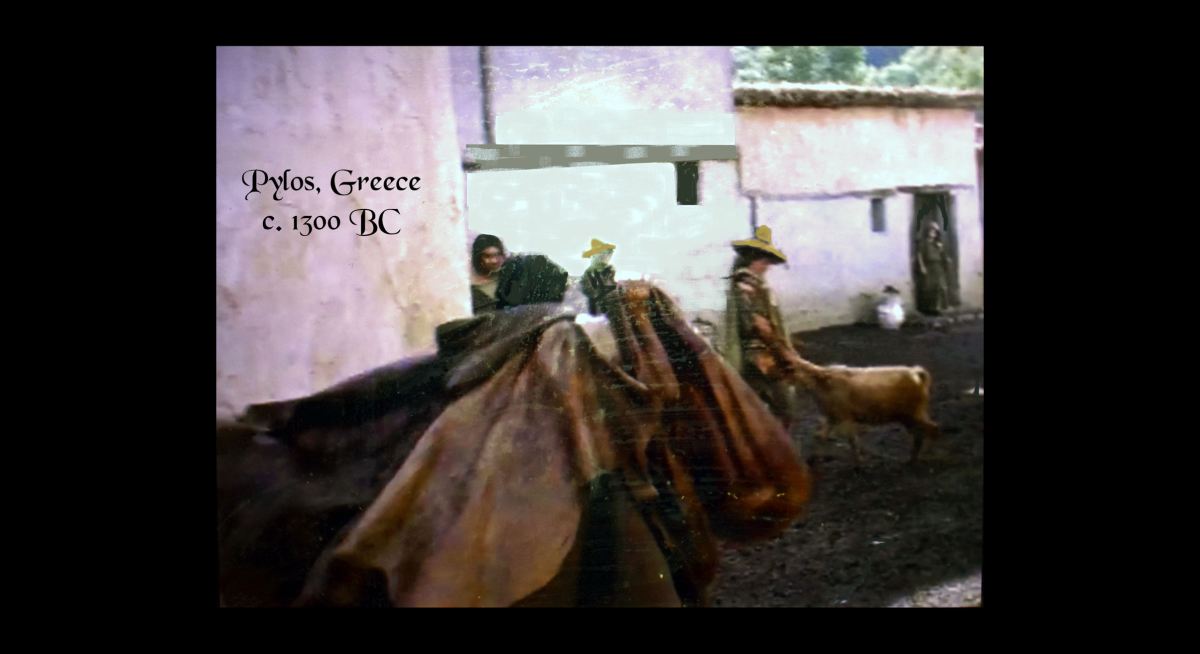
Then last night on Amazon Prime, I saw something that blew my mind . . . the traditional clothing of the Creek Indian elite and many tribes in eastern Peru on the citizens of Pylos, Greece – c. 1300 BC. I will explain below.

This detail of a 1658 Dutch engraving shows Apalachete (Creek Indian) elite near the banks of the Chattahoochee River in Robertstown, immediately north of Helen, GA. Their straw hats, long tunics and capes are identical to the clothing of Bronze Age Greece.
Jason and the Argonauts
Last night, I watched the first episode of the 2000 BBC TV series, “Jason and Argonauts.” It is based on the ancient Greek folklore about a sea journey from The BBC bragged that extensive scholarly research went into the series. It contains the most authentic portrayal of Bronze Age Greek clothing, architecture, ships and cultural traditions. It is worth watching for that reason alone.
I apologize for the poor quality of the image at the top of the article. Amazon has put some sort of digital trick into the movie, which blocks high resolution screen shots. I had to take a photograph of my computer screen with a digital camera.
I was instantly stunned by the opening scenes in the show, The “regular folks” around Pylos wore clothing identical to that of the Apalachete elite in northern Georgia during the 1600s. Their clothing evolved during the 1700s into the colorful “traditional” clothing of the Creek and Seminole Peoples. Seminoles are really just Creeks, who moved down into Florida during the 1700s and early 1800s.
Here is the significance. A good friend of mine grew up in Georgia, but now lives in Colorado. Prior to obtaining his PhD, he earned a Masters degree in Latin and Greek. However, he is best known now for his expertise in genetics.
A couple of years ago, he informed me that he had detected Greek origins for many of the Apalachete words and political titles, mentioned by French scholar, Charles de Rochefort in his 1658 landmark book, Histoire naturelle et morale des iles Antilles de l’Amérique. He seemed to also found Mediterranean DNA in samples of modern Muskogee-Creek People. That sounded a little far-fetched, but I had to keep an open mind.
While working on my book, The Native American Encyclopedia of Georgia, I found Illyrian, Scandinavian and Latin root words in the Muscogee-Creek language. They are not in my ancestral Creek language, Itsate, which is a mixture of Itza Maya, Chontal Maya and Chickasaw. Illyria was northwest of Greece, where Croatia is now located. Of course, Latin was spoken just across the Adriatic Sea in Italy.
My friend told me that Illyria was believed to be the homeland of the Sea Peoples . . . a mysterious race of pirates and sea-raiders, who ransacked several major Bronze Age civilizations around 1200 BC. They temporarily conquered Egypt and permanently occupied part of Canaan. They are called the Philistines in the Bible.
Seeing Greeks in the Bronze Age wearing the same clothing as the Apalachete in the Georgia Mountains during the 1600s, certainly gives credence to my friend’s interpretation of words and DNA. Readers are probably thinking, “Well, if Europeans were here before Columbus, archaeologists would have found some Pre-Columbian artifacts!” Well . . . they have . . . but contemporary archaeologists have conveniently forgot to tell you about them!
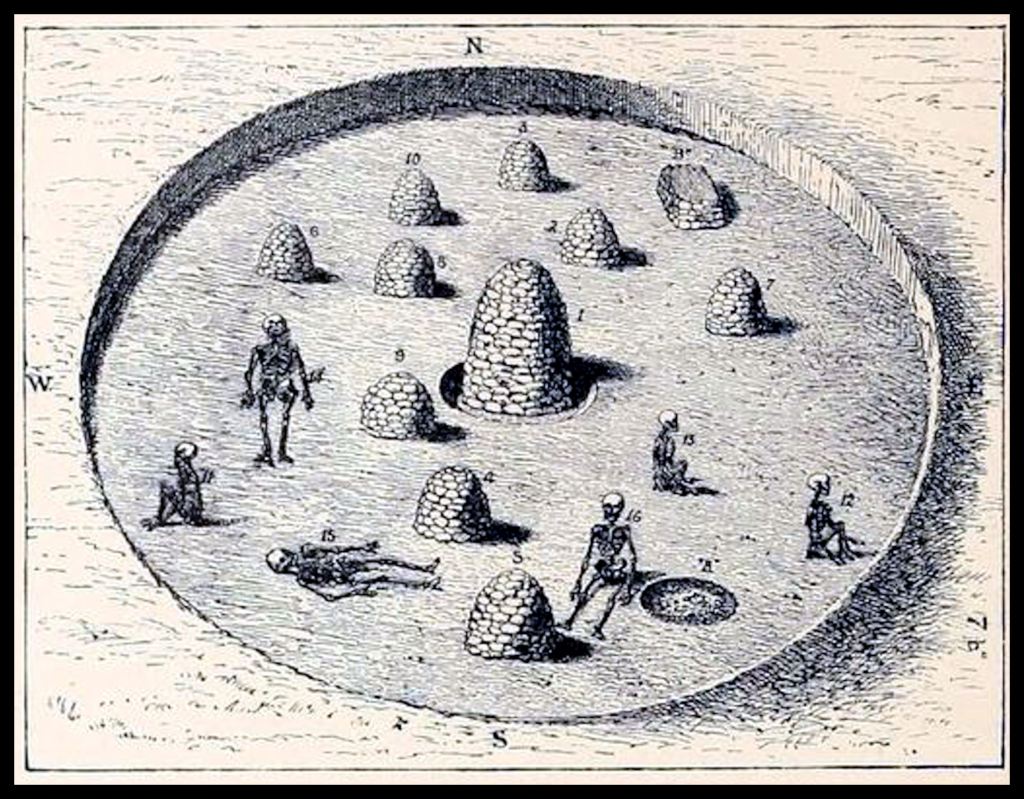
Smithsonian archaeologists found stone smelters in Caldwell County, NC which contained residue of copper and bronze smelting, plus Pre-Industrial bronze tools and later Native American burials.
Pre-Columbian European artifacts found in the Southeast
Unlike the dozen or so authors in the late 20th century, with NO credentials in archaeology, who proposed a wide range of European civilizations founded all of the advanced civilizations in the Americas, there are published reports by professional archaeologists about the discovery of Pre-Columbian metal artifacts in Southeastern North America. Contemporary archaeologists have either forgotten these discoveries or intentionally redacted that knowledge, if it conflicted with their particular form of orthodoxy.
By the way, I am not proposing that Europeans founded indigenous civilizations in the Southeast and southern Mexico. What I am saying is that small bands of Europeans in ancient times did arrive in the region. There would have been few or no females onboard these ships. The men would have married indigenous women. They would have added cultural and genetic diversity to the population, but within a few generations, detailed knowledge of the civilizations from which they originated, would have been forgotten.
I do not claim to have carried out an exhaustive survey of archaeological reports in the Southeastern United States. These are merely published articles that stumbled upon, while doing research for other projects or writing books on other topics.
1888 – A team led by T. F. Nelson of the Smithsonian Institute excavated a low mound in Caldwell County, NC. It was a perfect circle, located about 100 yards (meters) from the Yadkin River. Upper levels of the mound contained Native American artifacts and skeletons, typical of that part of North Carolina.
At the base of the mound were a cluster of beehive-shaped stone smelters. Within them were partially cremated skeletons of unknown ethnicity. One macabre explanation is that local Natives burned the European intruders inside their smelters. Within the smelters were the detritus of smelting copper and bronze, including metallic clinkers and drops of metal. Around the smelters were some bronze weapons and tools.
1927 – After excavating part of Mound C at Etowah Mounds, archaeologist Warren K. Moorehead probed several other mounds in northern Georgia. He spent a period of time at mounds near Downtown Ellijay, GA and the Coosawattee River in the North-Central Mountains.
The upper halves of the mounds contained progressively older artifacts, typical of the ancestors of the Creek Indians in Georgia. From the center of the mounds downward were found highly oxidized iron weapons and tools. These iron artifacts lost their forms rapidly when exposed to rain. Moorehead did not protect any of them from the elements and did not take any of them back to his museum in Maine.
1934 – The National Park Service contracted with the Smithsonian Institute to carry out an archaeological survey of Santo Domingo State Park in northern Glynn County, GA near Darien. The sites adjoined or were near the mouth of the Altamaha River. Georgia had nominated Santo Domingo to become a national park, because it was thought to contain the ruins of Mission Santo Domingo de Tallaxe.
Neophyte archaeologist, James Ford, was assigned to carry out the study, while his primary assignment was at Ocmulgee Mounds. The highest Pre-British Colonial era strata contained a mixture of charcoal, plus 16th century French and Spanish tools, weapons, kitchenware and china. Ford did not realize it, but he was at the real sites of Fort Caroline and Fort San Mateo! At the time, Ford only had one year of liberal arts education at Oxford College (now the University of Mississippi). He erroneously concluded that he had encountered a temporary Spanish army camp!
Ford next excavated numerous, deeper test pits along the bank of the South Channel of the Altamaha River. The 16th century detritus was much thinner here. A lower level contained iron tools and weapons. A much deeper layer contained bronze, copper and stone tools and weapons. He did not give much thought to these artifacts, since they were obviously not connected with a 17th century Spanish mission.
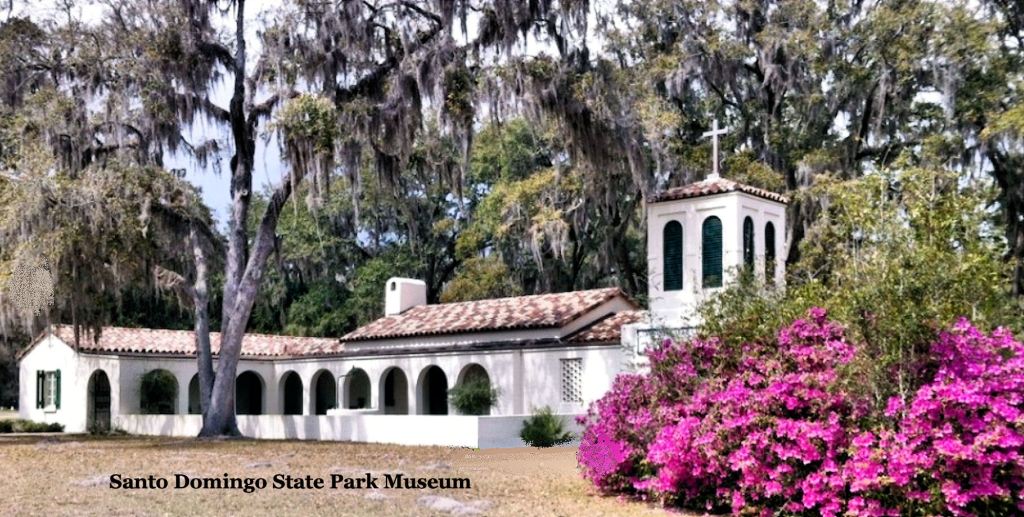
The museum is now a Family Counseling Center
All of the artifacts that Ford unearthed were put on display at the Santo Domingo State Park museum. When the State of Georgia foolishly converted the state park into a state orphanage, the artifacts were relocated to an unknown facility. Local historians and myself have received zero cooperation from the Georgia Parks and Historic Sites Division in locating these priceless artifacts. Perhaps the problem is that the 16th century French and Spanish artifacts would prove that Fort Carolina National Monument is in the wrong location and the bronze artifacts would radically challenge current orthodoxy.
1939 – Professional archaeologist Robert Wauchope spent much of this year, excavating sites in the Nacoochee Valley, which contains the headwaters of the Chattahoochee River. There is a thick layer of archaeologically-sterile, alluvial sand, dating from a natural disaster in 1700 AD, which cleanly separates British Colonial and Georgia Gold Rush artifacts from earlier periods.
While trying to reach the layers containing Native American villages and towns, Wauchope unearthed vast quantities of late 16th century and 17th century artifacts. He accumulated numerous 17th century European artifacts, mixed in with Creek artifacts. Occasionally, he would unearth iron, copper or bronze artifacts, while digging between layers of Pre-Columbian villages. These artifacts included iron, bronze, copper, ingots and glass objects.
The Pre-Columbian European artifacts did not receive any special treatment, thus were evident stored in boxes, containing post-Columbian European-style artifacts. The storage location of all the European artifacts is unknown . . . of if they were even stored.
1956 – Archaeologist Phillip E. Smith of the Peabody Museum at Harvard University explored numerous stone architecture sites in northern Georgia during 1955 and 1956. The still visible ditches and pits at the Alec Mountain Stone Oval near my cottage are some of his work. Less well known is his subsequent excavation of several stone veneered mounds on the Upper Oconee River in the Northeast Georgia Piedmont Region.
While digging through Pre-Columbian layers in these mounds, Smith unearthed several bronze and iron axe heads and tools. His report casually mentioned these discoveries and he listed the artifacts on his inventory, published by the University of Georgia. However, he did not discuss the profound implications of European metal tools being found in mounds dating back to the early Woodland Period. If one did not closely read the report, which very few people now do, you would not know that he found European artifacts in ancient, Pre-Columbian mounds.

This boulder on the slope of Chimney Mountain, a gas volcano, contains some of the oldest petroglyphic symbols in Scandinavia, but is located in NE Georgia. In the upper left corner you can see a ship with a sail.
Georgia’s extraordinary petroglyphs
Most of the petroglyphs in Georgia’s Gold Belt are different than any found elsewhere in North America or Mesoamerica and identical to Bronze Age petroglyphs in Europe. The main exceptions are stela at the confluence of the Chattahoochee and Soque Rivers, which is Itza Maya and several Apalachete burial markers in the Nacoochee Valley, which are in the Apalachete writing system that was derived from a Pre-Maya writing system in Southern Mexico.
- Petroglyphs in the Nottely River Basin (such as Track Rock Gap) eastward to the Chattahoochee River Basin thence to the Savannah River are typical of Southern Sweden, but may include symbols used universally in Bronze Age Europe.
- Petroglyphs in the Etowah River Basin are identical to those in either southwestern Ireland OR Galicia in northwestern Iberia.
There you have the gist of the problem. The references that most people read, tell us that there is no archaeological evidence of a European presence in the Americas, except at one small Viking site in Newfoundland. Just in happenstance, I discovered these discoveries of Pre-Columbian metal artifacts, published online with no attention drawn to them. Undoubtedly, there have been many more discoveries, which I missed or whose archaeological reports were never digitized for the internet.
 The Americas Revealed