They apparently lived in harmony until Virginia and Carolina began sponsoring slave raids on Native Peoples.
The Chickasaw often paired their towns with those of the Kanza (Kaw Nation) or Kaushete (Kusate~Upper Creeks).
Most of the population of the powerful Province of Kaushe (Coosa) were Earthlodge Siouan, Chickasaw, Uchee, Alibaamu or relatively recent arrivals from southern Veracruz. . . not “Muskogee-Creek speakers.”
by Richard L. Thornton, Architect & City Planner
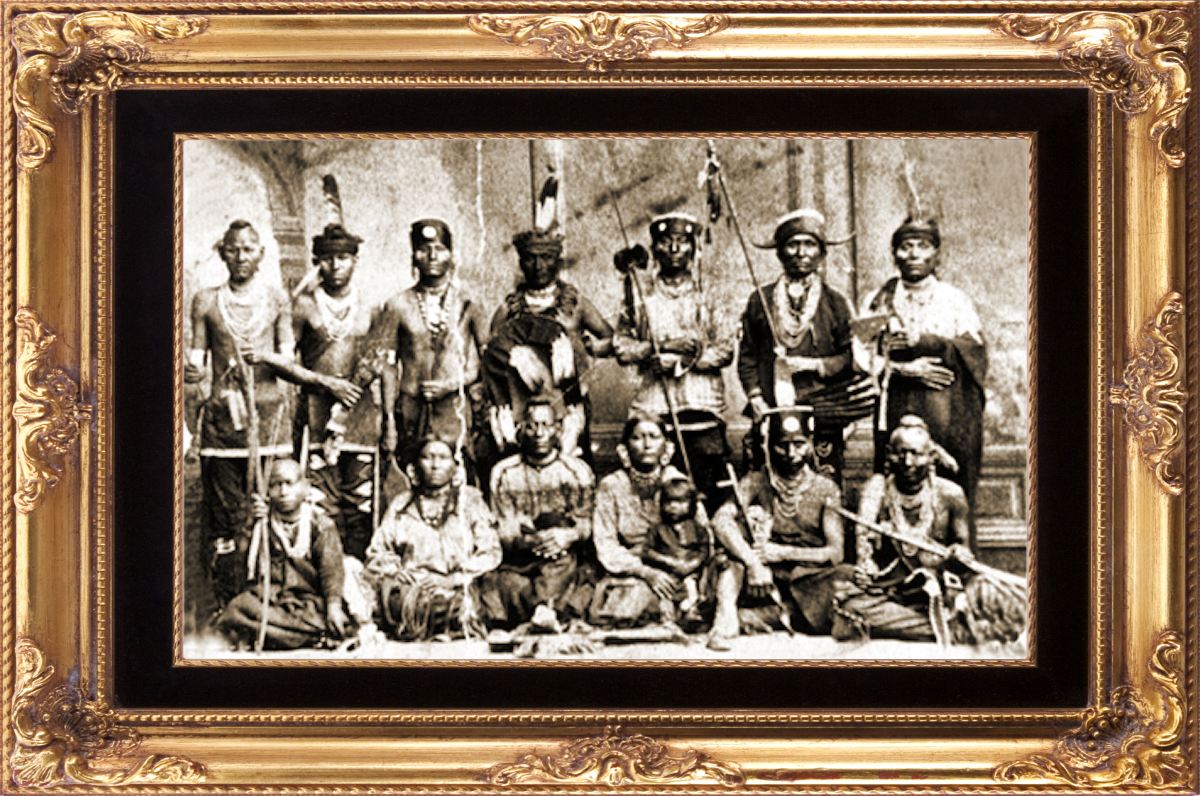
Photo Above: This is a photo of some leaders of the Kaw Nation on the Western Plains in the mid-1800s. Note that several of the men are wearing traditional Seminole clothing. Say what?
+
After reading Robert Wauchope’s Archaeological Survey of Northern Georgia, it was obvious to me that early history of the Southeast, as taught in my official Georgia History textbook back at Lakeshore High, was highly flawed. There was no mention in the book of a substantial presence of Chickasaw, Siouan Earthlodge, Mesoamerican and Uchee communities. The same flaw can be charged against the other official state history books of the Southeastern states . . . except Louisiana and Florida.
A small group of Creek descendants had just chartered the Apalache Research Foundation, which gave me an aura of credibility. Apalache is what the Creeks called themselves until around 1748. I did some research online and found that the Kansa on early Georgia maps now called themselves the Kaw Nation or Kanza. However, 19th century scholarly articles on them, when they lived in earth lodges in Kansas, listed their alternative names as Kansas or Kaushe.
That’s odd. Kaushe is the name of the largest tribal member of the Upper Creeks. The Creek Migration Legend is really about the migration of the Kaushe (Kaushete) from southern Veracruz to northern Georgia and eastern Tennessee.

I contacted the Kaw Nation Cultural Heritage Preservation Office to tell them that 18th century maps of Georgia, show them living on the Coosawattee River in Northwest Georgia. The Director of the office was very gracious and interested in learning more.
She knew that they had become a distinct Siouan tribe on an island in the Tennessee River near Guntersville, Alabama. They became too numerous for the small island and so migrated to a province ruled by an advanced people, who were master farmers. They learned farming from these people, but when the rising number of white people began causing problems in the 1700s, they gradually migrated westward until settling in Kansas, where the adopted the lifestyles and many of the “words” of the Western Plains Siouan Peoples.
The director told me that their tribe also were known as “The People of the South Wind.” They were told by some Midwestern professors that they had originally lived in Indiana or Ohio. What the professors said did not make sense, if their own tribal memory said that they were blown onto the Great Plains by the South Wind. She did not know why they called themselves now the Kaw Nation.
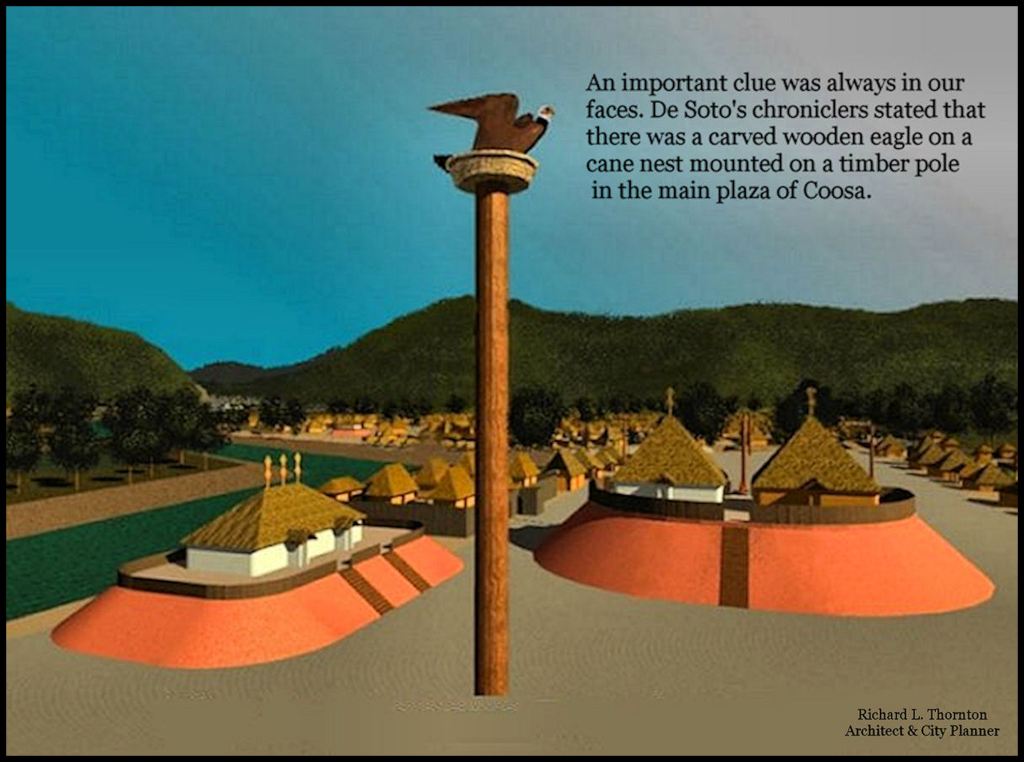
She also told me that unlike most Great Plains tribes, they only had two clans, the Black Eagle and the White Eagle Clans. I told her that Kaw was the Itza Maya word for an eagle. She said that they had another word for eagle, but wondered why they called themselves a Maya word.

She sent me a Kanza dictionary and photos of her people in 1867. Two of the photos caught my eye because they were wearing the same type of Mesoamerican and eastern Peruvian hat, which was worn by Florida Seminole leaders until the late 20th century. You can see that hat on several men in the photo at the top of the article. Actually, some Seminole leaders still wear this style of hat in ceremonies, but not daily.
The woman above-left, named Allegawaho, is holding a tobacco pipe and wearing a Mesoamerican chief’s hat. Apparently, she was leader of a clan, a clan mother or the wife of a chief. What also got my attention were her facial features. They are identical to those of several Northern Sami tribes, particularly in Eastern Swedish Lapland and northern Finland.
Since the Cultural Resources Director had said that the Kanza’s language had changed after they began interacting and inter-marrying with Western Plains peoples, I really did not know how much had been retained from their many centuries in northern Alabama and northwest Georgia. Nevertheless, I compared some key words in both the Kanza and Chickasaw dictionaries.
There were some shared words! Most notable was the word for town in Kanza and Chickasaw. It is “tama” . . . which is the word for “trade” in Totonac, Itza Maya, Chontal Maya and Itzate Creek. Apparently, the Kanza and Chickasaw journeyed to large Kaushete (Upper Creek) and Apalachete (NE Georgia Creek) towns to buy and sell.
My sleuthing turned up a bit more of Native American history, overlooked by archaeologists, but confirmed by their own archeological reports. In March 1954, my former anthropology professor at Georgia Tech, archeologist Lewis Larsen, was assigned by the Georgia Historical Commission to oversee the work of excavating New Echota . . . the short-lived capital of the Cherokee Nation in northwest Georgia. No one could translate the original Cherokee name for New Echota . . . Kansayigi. It means “Place of the Kansa People.”
Larson was surprised to find that the Native American artifacts immediately beneath the shallow stratum of New Echota, were not Cherokee artifacts, but identical to those found on McKee Island in the Tennessee River near Guntersville, Alabama. The McKees Island residents were definitely not Cherokees,
In the late 1960s, my first archaeological mentor, Dr. Arthur Kelly, found McKee Island pottery in the Commoner’s section of the capital of Coosa. They were associated with entirely different types of house than found just across Talking Rock Creek, where the elite and their temples were located. In other more distant neighborhoods of Coosa, he found more McKee Island pottery and earth lodges, but some neighborhoods, the houses and pottery were typical of the Dallas and Mouse Creek cultures of southeast Tennessee or that of Etowah Mounds, 30 miles to the south.
The archaeology profession assumed that all of northwest Georgia was occupied by Muskogee-Creek Indians in 1540 AD. It still does. Why would both the architecture and pottery vary in each neighborhood of this large town of about 12,000 people? Dr. Kelly made a note of this enigma, but in the 55 years since then, both the discovery and the mystery have been forgotten by subsequent generations of his profession.
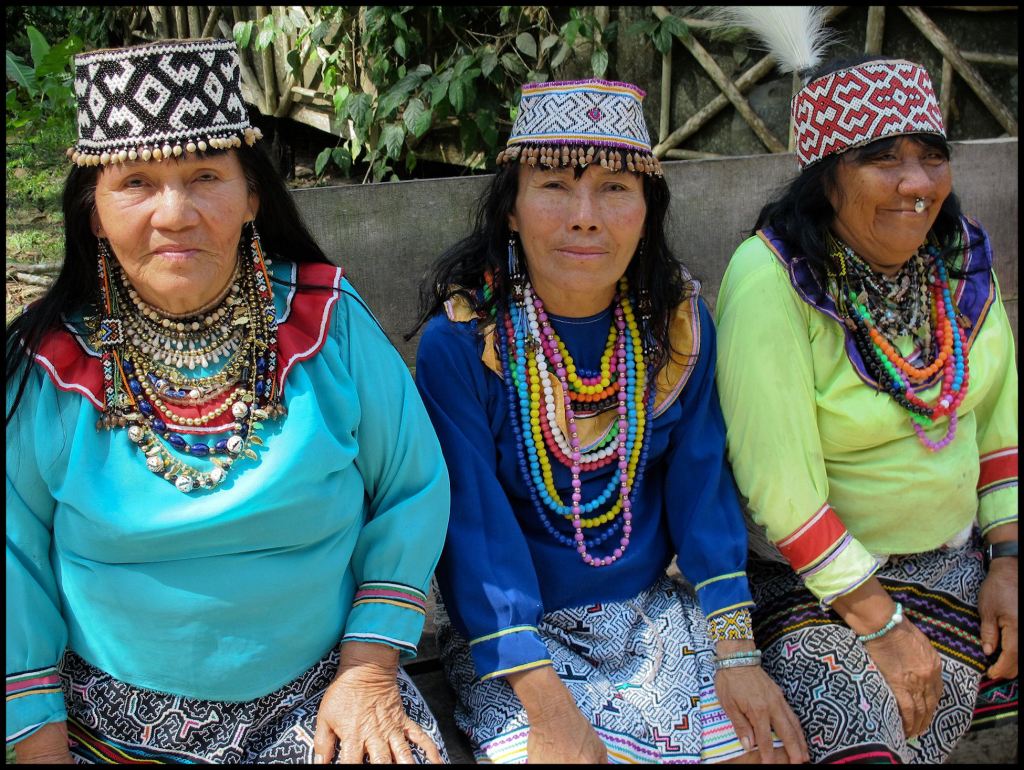
Three clan mothers of a tribe in the southern edge of Veracruz State, Mexico. I do not remember the tribe’s name, but the women are wearing the same shaped hats as the Kanza lady, Allegawaho.
The truth is out there somewhere!
 The Americas Revealed