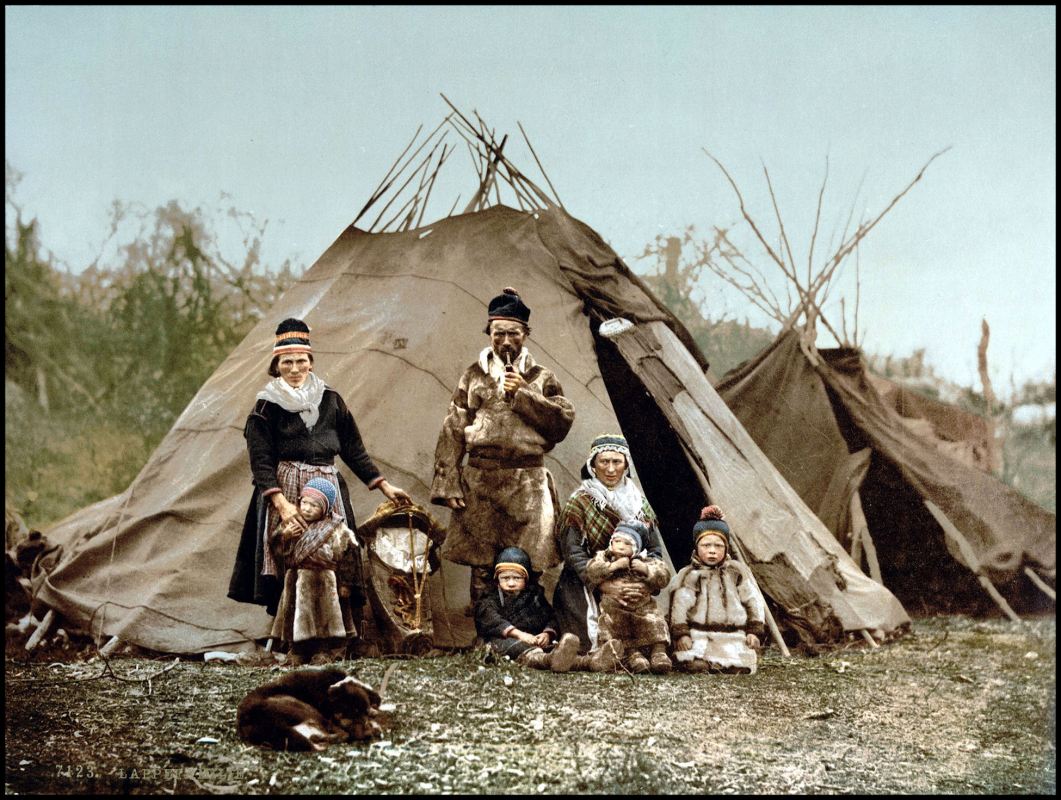
As seen in the colorized, late 19th century photo above, the Sea Sami lived in teepees in the warm months and earth lodges in the cold months. The same could be said of the Kanza, when they moved out into the Western Plains from the Southeast. The earth lodges of these two peoples were identical.
In real life, these Sea Sami would have had black hair and darker complexions. The photo artist tried to make them look European. Some Northern Sami tribes look like Native Americans. Most Swedes and all Sami assumed that I was a Northern Sami. The Sami in Lapland spoke to me in Sami, before I told them in Swedish that I was from the United States and part American Indian. In 2014, a DNA test told me that I was indeed . . . part Sami . . . but descended from a different tribe than the Sea Sami.
Perhaps as early as 3,500 BC, the Sea Sami constructed large, plank-built boats for traveling far out into the ocean to catch whales. Scandinavian anthropologists now believe that it was the Sea Sami, who taught the Bronze Age peoples of southern Scandinavia how to build the craft, which evolved into the famous, Viking Era Långbåter (Longboats).
by Richard L. Thornton, Architect & City Planner
Here is the photo of a Kanza woman, taken in 1867 that was shown in the previous article.

Notice that the Kanza woman is wearing the same style of hat as the Sea Sami man. The faces of the Sea Sami woman and the Kanza woman have the same proportions. Is this coincidence or the same genetic heritage?
The truth is out there . . . somewhere.
 The Americas Revealed
Do you think that this would have any bearing on your findings? This from Google: “The Appalachian Mountains in North America are considered an extension of the same ancient mountain range that stretches into parts of Western Europe, particularly in the British Isles, due to the fact that they were all formed during the same geological event when continents were joined together as part of the supercontinent Pangaea, long before the continents drifted apart; essentially making them part of the same mountain chain across multiple continents today.” https://vividmaps.com/central-pangean-mountains/
LikeLiked by 2 people
The separation of the continents occurred long before the appearance of primate mammals, not to mention humans. I don’t know the source that the Google AI program used for making that statement. It may refer to an ancient range of mountains in the Southeast, which are barely visible today. However, the prevailing interpretation of the mountains visible today is that a section of Africa broke off and eventually rammed the ancient coast of North America causing mountains to rise up. The volcanic range in which I live are younger and rose later. Most of the petroglyphs in the Georgia Gold Belt are identical to Bronze Age petroglyphs in either Scandinavia, Ireland or Galicia . . . depending on the river valley.
LikeLike