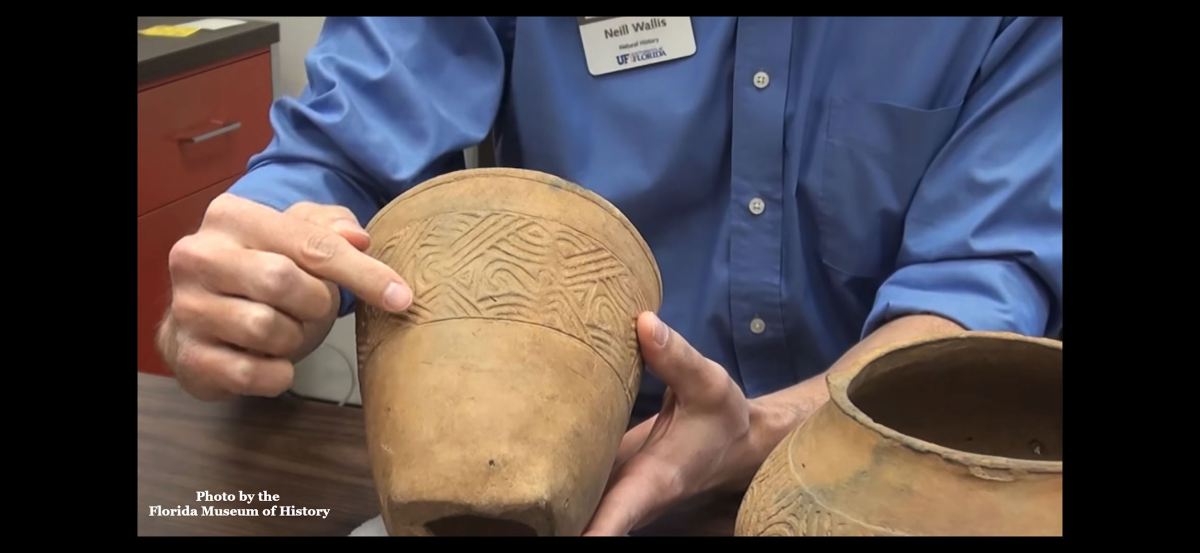
Americas Revealed readers this coming week will learn facts about a Native American culture in the Southeastern United States that you won’t read in Wikipedia or even the latest university archaeological textbooks.
Both the textbooks and articles on the internet about the Swift Creek culture focus on the ornate designs of Swift Creek Complicated Stamp pottery, but tell you little else. There is much more to the story, which has either been forgotten or never realized by archeologists in the Southeast.
by Richard L. Thornton, Architect & City Planner
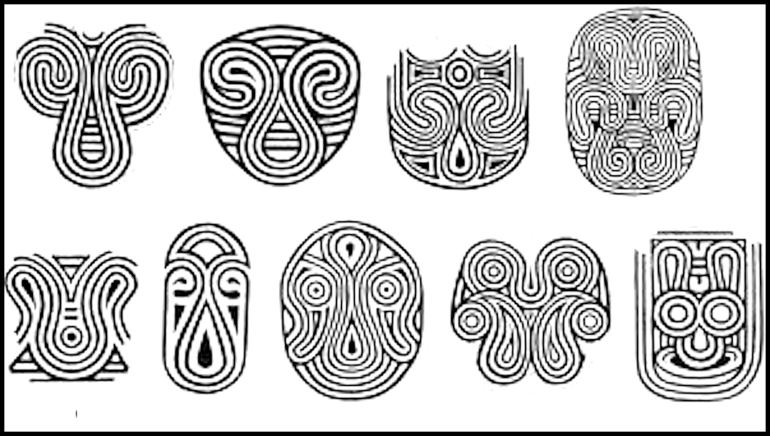
Swift Creek pottery decorative motifs by archaeologist Frankie Snow – 1998
In 1935, while excavating a village site, two miles from the Ocmulgee Acropolis, Dr. Arthur Kelly identified a style of stamped pottery, much more sophisticated than the typical redware unearthed on the Acropolis. Since Swift Creek flowed near by, he labeled both the village site and the pottery, “Swift Creek.”
In 1960, while Dr. Kelly was excavating the Mandeville town site (9CY1) on the Lower Chattahoochee River, he encountered an entirely different style of pottery at the 100 AD level. It was a very sophisticated form of Swift Creek pottery, but only represented about 1 % of the potsherds.
Over the next 100 years, the proportion of Swift Creek Complicated Stamp pottery grew at Mandeville to represent 100% of the potsherds. The fabrication of Swift Creek style pottery expanded mostly northward and eastward until it reached the “Swift Creek Archaeological Site” at Macon. The last locations of Swift Creek Cultural traits were in extreme Northeast Georgia, the Upper Hiwassee River Basin, the Florida Panhandle and the Garden Creek Site near Canton, NC (WNC mountains).
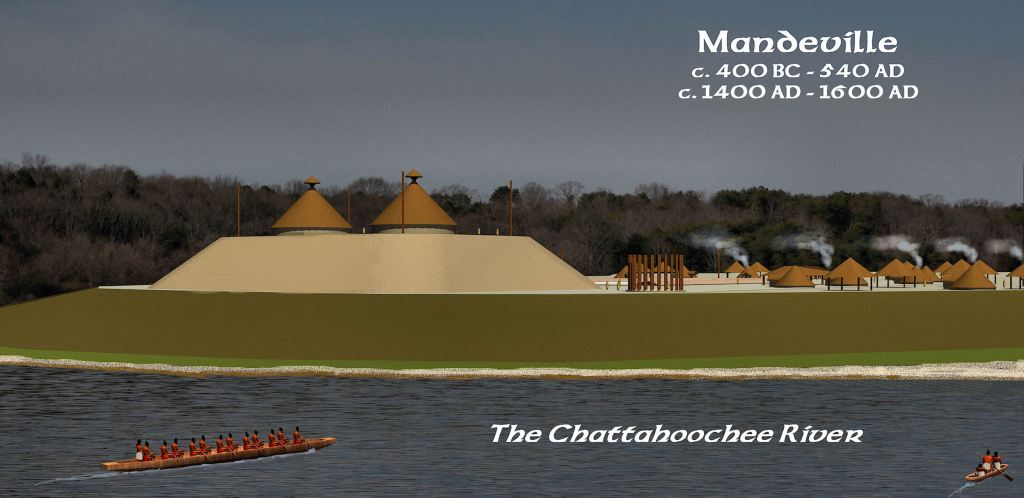
The Mandeville Site started as a small village, but grew into a major town.
Dr. Kelly spent the rest of his career searching for older Swift Creek pottery south of Mandeville. He never could. He later stated that he never figured out where the concept of this ornate form of pottery originated. However, he did find many artifacts along the Lower Chattahoochee River, which seemed to have come from Mexico or been copies of Mesoamerican artifacts. He showed them to me in my interview for doing some graphics work for him in February of 1969.
In March of 1969, Dr. Kelly showed me some potsherds from Site 9FU14 on the Chattahoochee River near the Six Flags Over Georgia amusement park. I was about to start work on a ink-line on Mylar plastic site plan of 9FU14. Dr. Kelly told me that these potsherds were made during the final phase of the village’s occupation. I didn’t know diddlysquat about what he was talking about.
About a year later, I was taking an introductory course in Anthropology from Kelly’s friend, Dr. Lewis Larson, prior to going on the fellowship in Mexico . . . made possible by Kelly’s endorsement. Larson spent a disproportionate time on the Swift Creek Culture, but only showed us color slides of the pottery. That was very frustrating to the students, since our class was mainly composed of future architects and engineers.

Beatriz and Roman Pina-Chan in August 1970.
On July 6, 1970 while we were having one of our “talking lunches” in his private office at the Museo National de Anthropologia de Mexico, Dr. Román Piña Chan continued to discuss the two books that I had given him on the Southeastern Indians. He said that he thought a band of both male and female Toltecs founded Moundville, Alabama . . . since the pottery at Moundville and several of Moundville’s best known artistic motifs were very similar to the pottery made by Toltec commoners or symbols on the walls of buildings in the Toltec capital of Tula.
However, the Georgia sites were different. The architecture was very similar to that in Tabasco and southern Veracruz, but the stamped pottery was unlike anything in Mexico, He thought that probably the bands from Southern Mexico were mostly males. He pointed to a photo of a Swift Creek bowl and said, “This is like pottery I have seen far, far away . . . but that does not seem possible.”

Note how vivid the blue, turquoise and red pigments are on this Teotihuacan mural, while the white and yellow pigments have somewhat “evaporated” because of exposure to rain, wind and sunshine.
A week later, I was photographing murals at Teotihuacan, which dated from around 100 AD to 500 AD. I asked the staff INAH archaeologist, accompanying me, why the blue and red paint was in so much better condition that the white and yellow paint. In fact, the blue paint was much harder than the lime stucco underneath it.
She said that they had noticed the same thing in Maya cities, which were several hundred years younger. The blue and red paint contained a special clay that is very rare in Yucatan and Central America, but doesn’t exist at all in Central Mexico. The nearest large deposits of this clay are in the state of Georgia in the Southeastern United States, but that it did not seem possible that such large quantities of this clay could be transported to Teotihuacan. The archaeologist did not know that I had been born in South Georgia! LOL
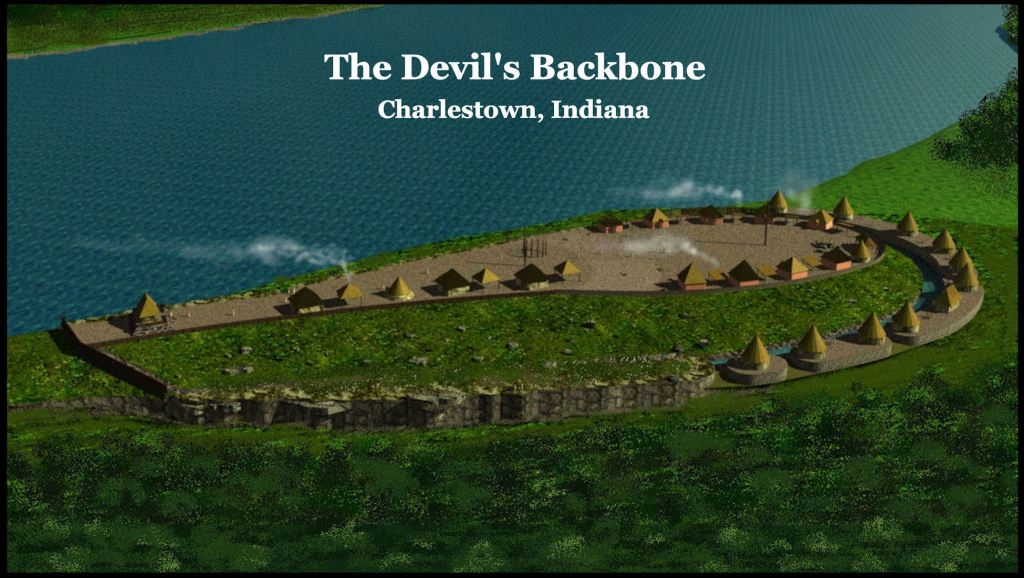
The structures on the Devil’s Backbone are all built of stone. The larger houses were round with cone shaped roofs. The town contained vast cisterns for storing rain water. These features are very unusual for the Ohio River Basin, but typical of the Andean region of Peru.
In 2011, an Indiana film production company paid me to create a Virtual Reality computer model of the Devil’s Backbone Archaeological Site near Charlestown, IN. Authenticated Moche Culture ceramic artifacts had been recently unearthed in the alluvial soil beneath the Devil’s Backbone. The Moche Culture was in Peru, but this did not seem possible.
I went online to learn more about the Moche Culture. Indeed, the man-made structures at the Devil’s Backbone were similar to those at Moche forts. But then . . . in a photo within an internet version of a Peruvian archaeological magazine, I noticed a female archaeological student, wearing a fashion trendy dress, which looked like the motifs on Georgia Native American pottery.
Yep! Her dress had the same motifs as a famous Late Swift Creek Complicated Stamp bowl, unearthed in perfect condition in the county, where I now live, by Archaeologist Joseph Caldwell in the 1960s. That did not seem possible.
 The Americas Revealed
I have found pottery like this on the high bluffs of the Alapaha beside my fathers grave, near the FL/GA border.
LikeLiked by 1 person