
While working in Georgia’s Nacoochee Valley during 1939, archaeologist Robert Wauchope was surprised to find a 12,000 year long pattern of cultural evolution, rather than distinct cultural strata.
What seemed to be happening was that immigrants came from many lands then mixed with the people, who had mixed before them. There was no evidence of sudden ethnic replacement, which would have produced distinct cultural layers, created by a violent invasion of another ethnic group.
In 1934, archeologist Arthur Kelly unearthed South American style houses at the “founding” layer of the Acropolis at Ocmulgee National Historical Park. Radiocarbon dating had not been invented, so Kelly presumed that they pre-dated the mounds and thus ignored them. There is still no mention at the Ocmulgee Museum that the town was founded by South Americans around 900 AD, then expanded about a century later by an influx of people building houses, typical of Tabasco State, Mexico.
This non-violent cultural evolution seems to be the primary reason that anthropologists did not discern a South American influence on the indigenous cultures encountered by European explorers and colonists. It is still only acknowledged in anthropology and state history textbooks, published in Florida. Taino-Arawak speakers of the Toa Province were encountered by the de Soto Expedition in 1540 on the Lower Ocmulgee River in Georgia and by British traders, during the 1700s, in what is now southern Metro Atlanta.
by Richard L Thornton, Architect & City Planner
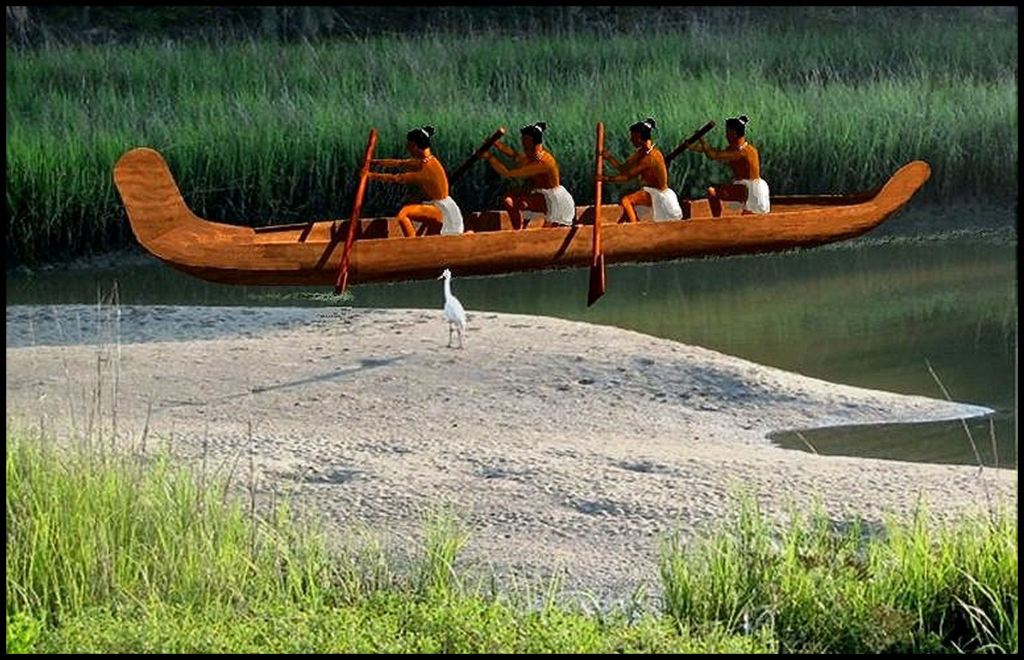
The Mayami of the Lake Okeechobee and Everglades Regions of Florida built canoes identical to those of Coastal Mayas of the Yucatan Peninsula, Campeche and Tabasco. These style canoes were also used by certain tribes on the coast of Georgia, plus the Altamaha, Ocmulgee and Savannah Rivers in Georgia. We now know that most of the Mayas did not call themselves Maya until the Spanish told them they were Mayas. The real Mayas originated in Florida, while some migrated to the northern tip of Yucatan around 1000 AD. Mayami means “Principal Place of Lake People” in both their language and Putun Maya. It is the origin of the name of Miami, Florida!
2005 – South American origin of the Timucua Language
In early 2005, William & Marry College of Virginia launched a program to recreate the Timucua Language, spoken in northeastern Florida at the time of the Spanish Conquest. There have been no living speakers of the language in Florida since 1732.
Linguist Jack Martin was co-author of The Muskogee-Creek Dictionary and head of this research program at William & Mary. He and fellow professor, Ann Reed, soon discerned that Timucua had the structure of Muskogean languages in the Southeast, but much of its vocabular was South American Arawak mixed with some Itsate (Hitchiti) Creek words. They made this announcement in November 2005.
Later in that decade, I read one of their published professional papers. They were never able to translate the ethnic name, Timucua. The words that Martin and Reed labeled as being Hitchiti Creek were originally Itza Maya and Tamulte Maya words . . . the same people, whose DNA flows in my family’s veins.
Timucua is a Hispanization of their actual name, Tamakora, which was earlier correctly transliterated by French explorers. It is a hybrid word that combines the Totonac and Itza Maya word for “trade” with the Southern Arawak (South American) word for “tribe or people.”
Brilliant linguist Julian Granberry, then of the University of South Carolina, now Director of the Native American Language Services of Florida, has determined that the Timucua language was something of a “trade language” used by a cluster of tribal bands that settled in the northeastern coastal regions of Florida around 1100-1150 AD. Their root words are from Arawak languages on the Orinoco River Basin of northern South America . . . in particular, the Wareo.

The Putun (Chontal) Mayas constructed both large, wind and paddle-propelled cargo boats, easily capable of crossing the seas between South America, Mexico and North America. They were constructed with lap-sided wooden planks like the ships of the Iron Age Scandinavians. A Putun sailing boat was about the size of a large Viking longboat. This is one of three virtual reality drawings that I prepared for researcher Douglas T. Peck in 2008. The other two boats were propelled by paddles. The large paddle-driven boats also had steering oars like the sailboat.
Crossing the Caribbean Sea or Gulf of Mexico
A typical presumption of the general public, history textbook writers and North America archaeologists is that Indigenous Americans lacked boats, capable of navigating ocean waters. Spanish eyewitness accounts, engravings on Maya stone and water color illustrations in Maya books tell a different story.
From earlier articles in The Americas Revealed, readers may remember that while on the fellowship in Mexico, I learned that the coastal peoples of Tabasco and the Yucatan People are labeled “Mayas” today, plus the Itza Mayas of the Highlands, are labeled “Mayas” by academicians today, but they were ethnically a different people than most of the Maya tribes. They probably originated in South America or southern Central America. Whereas the “real” Mayas were frightened by the ocean and placed there communities at least 20 miles (32 km) from the ocean, the “Coastal Mayas” arrived by boat and had considerable maritime skills.
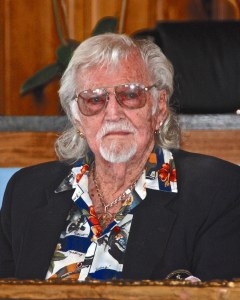
It was Douglas T. Peck (Jan. 7, 1918 – Jan. 4, 2014) a mariner and historian In Bradenton, FL who first brought attention to the Putun Mayas. Still today, Peck’s books and essays on the Putun are the predominant resource in English on that subject.
Being a skilled navigator and sailor, Peck’s research in the 1990s initially focused on the navigational skills of the Putun. In 1992, he used his sailboat to study to probable trade routes of the Putun in the Caribbean. He then focused on the evidence of Putun contacts with the indigenous peoples of southern Florida.
Peck presented his research and theories to Florida archaeologists in 1999. His paper was published, but generally ignored by archaeologists. His work did have an impact on other researchers, particularly Southeastern Native Americans, who were trying to create a more accurate history of their ancestors than archaeologists had adopted.
Peck’s work also strongly influenced the Institutio Nacional de Anthropologia E Historia (INAH) in Mexico. During the first decade of the 21st century, INAH archaeologists began to study the long ignored coastal towns and ports of the Putun that ring the Gulf and Caribbean coasts of Mexico. Excavations at several ports have greatly expanded the understanding of the Putun’s hybrid cultural characteristics.
In 2008, Douglas hired me to create Virtual Reality drawings of three types of Putun cargo boats, after learning that I had taken Naval Science classes at Georgia Tech and personally seen many Viking sea craft, while working in southern Sweden. He used them in slide lectures and planned to feature them in a planned book, which put together all his knowledge on the Putun Maya, gathered during the previous 20 years. Unfortunately, this book was not completed before his death in 2014.
Based on my past experiences, I considered the Putun sailboat to be equally capable of crossing the Atlantic Ocean or tropical waters of the Americas as a Viking longboat. The large paddled boat could have easily traveled from Yucatan to Cuba to southern Florida or done island-hopping in the Caribbean Sea from South America to southern Florida.

No one in this photo actually climbed up the slopes of Buzzard Roost Mountain to see the half square mile display of ancient stone ruins. Of course, none of them had even seen a Maya agricultural terrace complex, either. None of the Native Americans in the photo were from Georgia, yet presented themselves to the news media as experts on our archaeological sites. They knew absolutely nothing. This shenanigan greatly contrasted with the excellent archaeological work done by the National Park Service.
Chattahoochee is a Highland Maya word
By 2012, there was general agreement among Florida anthropologists that most of the Native Americans in Florida had arrived there from the Caribbean Basin or northern South America. It is much easier and closer to take a boat from Yucatan to Cuba to southern Florida than to reach Florida from most island in the Caribbean Basin, YET Florida archaeologists remained silent or even joined forces with their peers in Georgia to feign outrage at the claim by Georgia Creeks that their ancestors had come from Mexico . . . just like the famous Creek Migration Legend said.
Because of budget cuts in Fiscal Year 2012, the Chattahoochee National Forest office of the U.S. Forest Service could not afford to hire contractors to maintain its roads. Many of them were impassible, yet the office somehow found over $20,000 in funds in February 2012 to sponsor a public relations program focused, on discrediting a History Channel Program of unknown content that was not to be broadcast until December 21, 2012.
Most of its office staff, plus personnel in the Southeastern Regional Office, were frantically involved with a subject they knew nothing about. The archaeologists, who they hired as public spokesmen, were not much better. The principal public speaker was from South Africa and had never been in Mexico, nor worked on a Creek Indian town site. None them knew that the Chattahoochee River gets its name from the Highland Maya words. Chata – hawche, which mean “Stone Stela (or ancient ruins) – Shallow River.” In the years afterward, I would gradually learn, though, there was much more to the Creek’s history than their substantial Southern Mesoamerican heritage.
Georgia archaeologists, who were paid to give talks to civic groups by the U.S. Forest Service, were unanimously unaware of Douglas Peck’s published research. They repeatedly mocked the idea that indigenous Americans in Mesoamerica could have traveled to North America via the ocean. In their minds, the only boats Native Americans had were small. crude canoes, carved from logs.

Unraveling the missing links in our cultural history
2012 – Track Rock Terrace Complex
In early 2012, when I was doing research to reinforce the tradition of the Creek People that many of our ancestors came from southern Mexico, it never dawned on me that there might have also been a substantial migration of indigenous peoples from South America. The “Maya Thing” was a no-brainer. I knew from a 2005 DNA analysis, like most Creek descendants in Georgia and South Carolina, much of my Native American DNA was Maya or a neighboring tribe. Since then, I had identified many Itza Maya, Tamulte Maya and Totonac words in the Creek and Chickasaw languages. Well . . . the Creek Migration Legend BEGINS in southern Mexico.
Over four decades earlier, two, very famous archaeologists, Arthur Kelly and Román Piña Chán had first broached to ME, the evidence of Maya immigration to Georgia. I was a wet-behind-the-ear, young architecture student at the time, who knew nothing about the subject at the time. I did not “pull the idea out of thin air” as the Forestry Service’s archaeologists-spokesmen repeatedly told the Atlanta Journal-Constitution reporters. These reporters never gave me the opportunity to respond. However, as mentioned in an earlier article, Dr. Piña Chán hinted to me that Swift Creek style pottery had apparently come from somewhere, faraway. He didn’t elaborate.
Yet . . . in my comprehensive study of Creek Indian linguistics, architecture and artifacts I found many things that could not be explained . . . even if one accepted the immigration of Mesoamericans into the Southeastern United States. There were many core words, which could not be found in Chickasaw and Choctaw . . . which were supposedly parent languages of the Creek languages. Traditional Creek clothing was different from both Mexico and the rest of North America. There were cultural traditions such as the Stomp Dance and the drinking of Yaupon Tea, which did not seem to be from Mexico. The Creeks were the only people in the Americas, who used a digital numerical system. Their calendar was just as accurate as the Gregorian calendar and VERY different from the Maya calendar.
My book, The Itza Mayas in North America, closes by stating that there were gaps in the past . . . indeed, unknown peoples . . . that were yet to be identified.
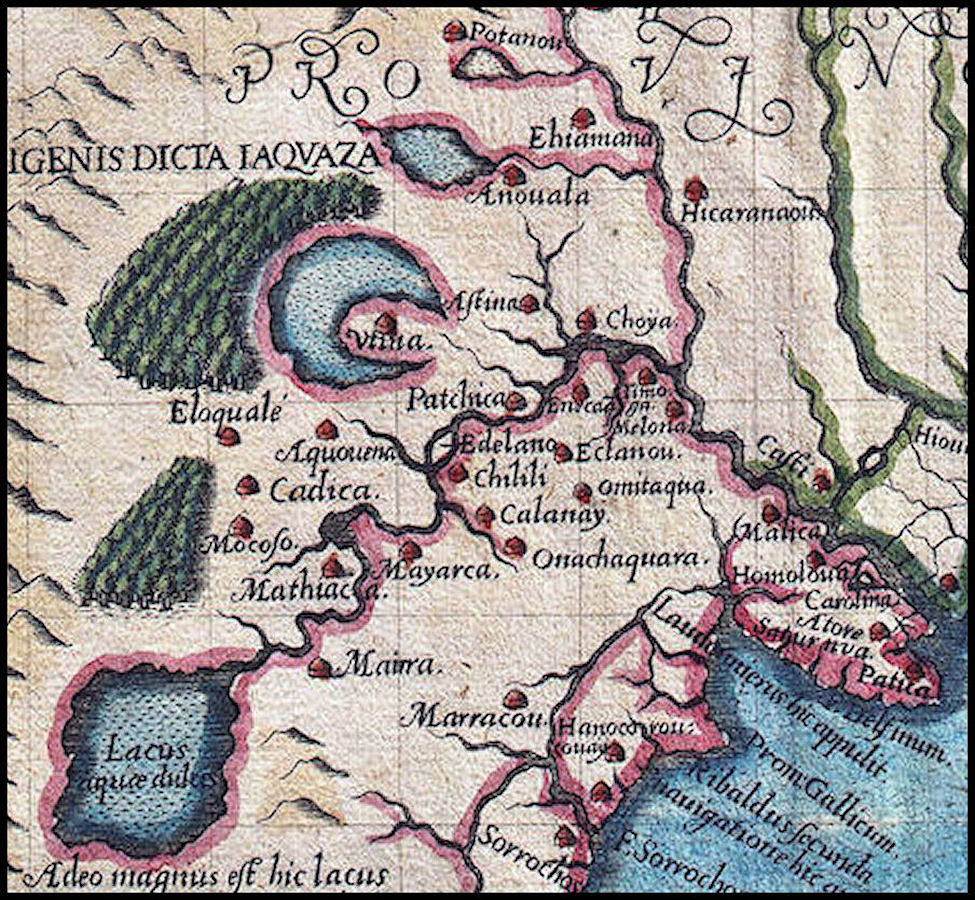
Fort Caroline was actually on the south bank of the Altamaha River in Georgia. All historical maps place it there. The mouth of the St. Johns River in Florida was not navigable to sea-going vessels until 1860, No French or Spanish artifacts have been found at the fake site in Jacksonville, while an archaeologist for the Smithsonian Institute found numerous 16th century artifacts at the real site in Georgia during 1934. The fort at Jacksonville is an inaccurate 1/12th scale model, built in 1961. The myth of Fort Caroline being in Florida was created by the same man, who created the myth of the Eternal Fountain of Youth being in St. Augustine. He was a real estate speculator from New York!
2012 – The Search for Fort Caroline
My longtime friend, Michael Jacobs, a Senior Planner at the South Georgia Regional Commission in Waycross, GA has repeatedly described 16th century French artifacts being found near the banks of the Altamaha and Satilla Rivers in Georgia. My official father’s mother was French Huguenot. Her Morel family owned Ossabaw Island, GA until the end of the Civil War. She always insisted that Fort Caroline was on the Georgia coast, south of their island. That’s another story and another book, but . . .
Among all the Native American tribal names, words, political titles and Island names recorded by the 16th century French explorers of the Georgia Coast, I could only translate ONE word, the original name of Tybee Island near Savannah . . . Taube . . . it means “salt” in Itza Maya and Itstate Creek. It would take me a decade to translate those words. That will be the topic of the next article on this series.
Spoiler alert! All but one of those words were from South America or the Caribbean Basin. The only exception, Alekmanni, of all things, was Anglisk . . . the language spoken by the Angles in Scandinavia, before they moved to Britain and mixed with the Saxons. You will also learn about that strange discovery in the next article.
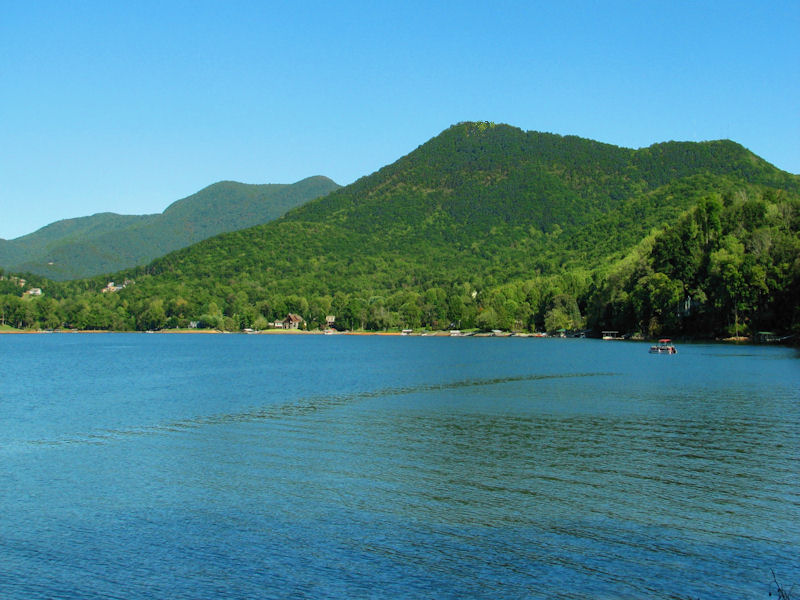
Lake Chattuge in Towns County, GA – Home of the Hialwasee Indians
2012 – Hialwasee Indians DNA tests
Towns County, GA, just north of the Nacoochee Valley, contains a large population of residents with substantial Native American DNA. The county seat is appropriately named Hiawassee. Outsiders call them Cherokees, but they insist that their ancestors were here at least a thousand years before the Cherokee. They are the Hialwasee Indians, who gave their name to the Hiwassee River. Their physical appearance and personalities are very different than the North Carolina Cherokees.
Towns County is east of the Track Rock Terrace Complex. During 2010 through 2015, I was National Architecture Columnist for the Examiner. In response to the articles that I wrote in the Examiner on Track Rock Gap, several Hialwasee took DNA tests. None of them had DNA test markers were typical of the Cherokee. All carried DNA test markers typical of Southern Arawak tribes in Peru. About half of them also carried Highland Maya DNA markers, typical of the Itza and Kekchi Mayas. Their percentage of Native American DNA was one of the highest in the eastern United States . . . up to around 40%, while Cherokee typically 0-2% Native American.
After I wrote an article about the DNA results of the Native Americans from Towns County, I received emails from readers in small isolated populations of Native Americans in the mountains of southwestern Virginia and northeastern Tennessee. They also had been shocked to learn that their Native American heritage was Southern Arawak from Peru!
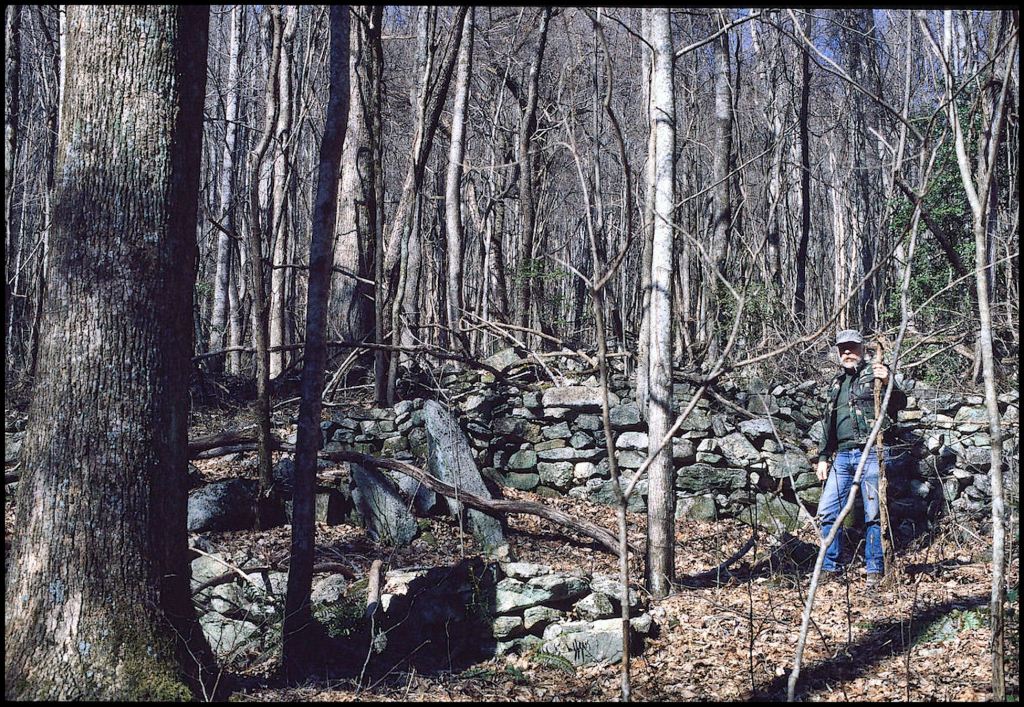
In the autumn of 2012, archaeologists from the University of South Carolina discovered a town in the northwestern corner of the state, near the Savannah River and Georgia State Line, which was occupied by people who lived in round, Peruvian-style stone houses. It was adjacent to a stone walled agricultural terrace complex. They kept the discovery a secret, because they did not want to seem to be allies of those Georgia Creeks, who claimed that “the Mayas came to Georgia.” However, a young lady of Creek Indian descent, who had just transferred from the anthropology program at USC to the historic preservation program at Clemson University, slipped me photographs and a map of the site.
2013 – The real Apalache of NE Georgia
In the early summer of 2013, Marilyn Rae from Boston University contacted me. She had discovered an intriguing book, published in French, which seemed to describe the builders of the Track Rock Terrace Complex. It was hidden away in the “Fantasies and Utopia” bin, upstairs in the Carter Brown Library of Brown University. In the book, was a note from a professor, written in the late 1800s, which said that the contents of the book should be ignored because “it describes an advanced Indian civilization in Georgia, who lived in large towns and built great earthen pyramids . . . totally implausible.”
Histoire Naturelle et Morale des isles Antilles de l’Amérique (1658) by Charles de Rochefort contained ten chapters based on an eyewitness account of what is now Georgia by English explorer, Richard Brigstock, when he spent most of 1653 in the Apalache capital , , , the Nacoochee Valley of Northeast Georgia, where I live now. De Rochefort clearly stated that the so-called Apalache of the Florida Panhandle did not call themselves that name, until told that was their name by the Spanish. The Creek Indians called themselves Apalache until around 1648, when they changed their name to a hybrid coined word, Maskogi (Muskogee). De Rochefort added that the Appalachian Mountains got their name from the plural of Apalache, Apalachen.
The Apalache elite were South Americans, who founded the great town on the Ocmulgee River. In 1653, they still wore South American style clothing and lived in South American style houses. They ruled a confederated kingdom of multiple ethnic groups, the most prominent being from southern Mexico. Intermarriage over many centuries had produced a hybrid language that mixed South American, Mexican and Chickasaw words.
Initially, Richard Brigstock’s description of the Apalache kingdom did seem fanciful, but all of my research since 2013 has verified everything. Much of it was verified by archaeologists, who didn’t realize what they had discovered . . . or like the case of the University of South Carolina, concealed what they had discovered.

Both the Florida “Apalachee” and the Southern Arawaks of Peru wore grass skirts.
2014 – Advanced DNA tests produce surprises
Marilyn Rae and I were curious, if we carried genetic proof of South American immigration. We contacted an institutional genetics lab, who were known to be much more professional than the heavily advertised consumer-oriented labs. Marilyn was doubtful, since she was a direct descendant of the last hereditary principal chief of the Cherokee, Pathkiller. I thought that I might have a trace of South American, since part of my maternal grandmother’s Creek and Uchee heritage was from a town near Savannah.
Oops! Marilyn carried no DNA markers, typical of the Cherokee, who migrated from southern Canada to the Southeast in the late 1600s. All of Marilyn’s Native American DNA was a trace of Florida Apalache (Peruvian Southern Arawak) Most of her ethnic appearance came from a substantial Sephardic Jewish heritage. She had twice as many Sephardic Jewish DNA markers than her former husband, who was a practicing Sephardic Jew.
Most of my Native American DNA came from Highland Maya, Tamulte Maya and Soque (Zoque) peoples in Tabasco and Chiapas States, Mexico. However, I also had substantially more Panoan ancestry from Satipo Province, Peru than Marilyn’s Southern Arawak ancestry, Hm-m-m . . . the capital of a Native American province near Fort Caroline was name Satipo! There were other towns named Satipo in NW Georgia and eastern Tennessee.
Both Marilyn and I carried small amounts of Southeast Asian and Polynesian DNA. Obviously, genetics was telling us a very different story about North America’s past than what the history books said.

Most of the corn grown in the United States is descended from South American corn varieties.
2015 – South American corn in eastern North America
A little over a decade ago, the US Department of Agriculture funded a genetics research program to determine how the multi-colored corn grown by Native Americans became the white and yellow corn grown by farmers around the world today. In 2015, the USDA funded scientists announced a big surprise.
All of the varieties of corn grown by farmers in arid parts of the United States today could be traced to varieties grown in arid regions of Northern and Central Mexico . . . via corn grown by Native Americans in the western part of the United States.
All of the corn grown in relatively humid areas of the United States from Oklahoma eastward, was descended from varieties of corn initially grown on the eastern slopes of the Andes Mountains and headwaters of the Amazon River . . . Satipo Province in Peru! Although all Native American corn varieties were multi-colored, the corn grown by Native Americans in the eastern United States and modern commercial varieties of corn in the eastern United States, had no relation to the corn grown by Native Americans in the Southwest, the arid regions of Mexico or even the hot, humid Lowland tropical regions of southern Mexico!
The continuing research into the genetic history of corn became even more surprising in 2022. Botanists and geneticists discovered that the varieties corn grown in the Maya Highlands of Chiapas State, Guatemala, Belize and Honduras was also descended from South American corn varieties in the foothills of the Andes. This region looks like the Georgia Mountains, but does not have freezing temperatures in the winter like the Appalachians or the higher elevations of the Andes.
In our next article, we will discuss the many cultural traditions of the Creek and Seminole Indians, which originated in the Andes Foothills or headwaters of the Amazon River. Their architecture and many of their words were definitely from southern Mexico, but many other aspects of their society, such as music, pottery, clothing, dances, rituals and foods came from Eastern Peru.
Panoan (Shipibo) dance in Satipo Province, Peru
Creek music was traditionally played with many South American instruments and was syncopated. Note how similar the Shipibo ladies look to Creek ladies in Georgia and South Carolina. The Shipibo lass, at the beginning of the video, is almost identical to a Creek college student from near Macon, GA, who I dated my Freshman year at Georgia Tech.
 The Americas Revealed
I’ve mentioned before about my varied ancestry. My mother passed away without ever doing any DNA testing, but her youngest sister (who is now 87 years old) has tested and shows Panoan ancestry as well as Mayan.
LikeLiked by 1 person
Well, you’re mother’s family was Eastern Creek. The Panoan typically does not show up in Alabama and West Georgia Creeks. However, they will have DNA from other parts of Mexico, that we don’t generally carry.
LikeLiked by 1 person