SLIDE SHOW
This week, my joint professional work with researchers from the United States and eastern Asia produced totally a unexpected . . . actually shocking . . . new understandings of the past.
The oldest known pottery in North America and Mexico is found in the State of Georgia (c. 2800-2500 BC). Between around 1200 BC – 400 BC, the Deptford Cord-marked Beakerware in Georgia was identical to the pottery of southern Scandinavia and Ireland. From Georgia it spread outward to other parts of North America.
Stamped, check-marked pottery first appeared in Georgia around 400 BC then spread outward. Archaeologists have long assumed that this style of ceramic finish along with later Swift Creek, Napier and Etowah Complicated Stamp pottery were home-grown innovations that spread outward into North America.
Nope . . . they were first made by Austronesians in Taiwan or as they spread outward across the Southeast Asian islands and across the Pacific Basin. Even the wave and spiral motifs of the elegant “Lamar Culture” pottery, made by the Creek Indians between around 1375 AD and 1776 AD are found first on Late Austronesian and early Polynesian pottery. Among both the Austronesians, Iberians, Japanese and the Creek Indians, the spiral was a symbol for the Sun Goddess
by Richard L. Thornton, Architect & City Planner
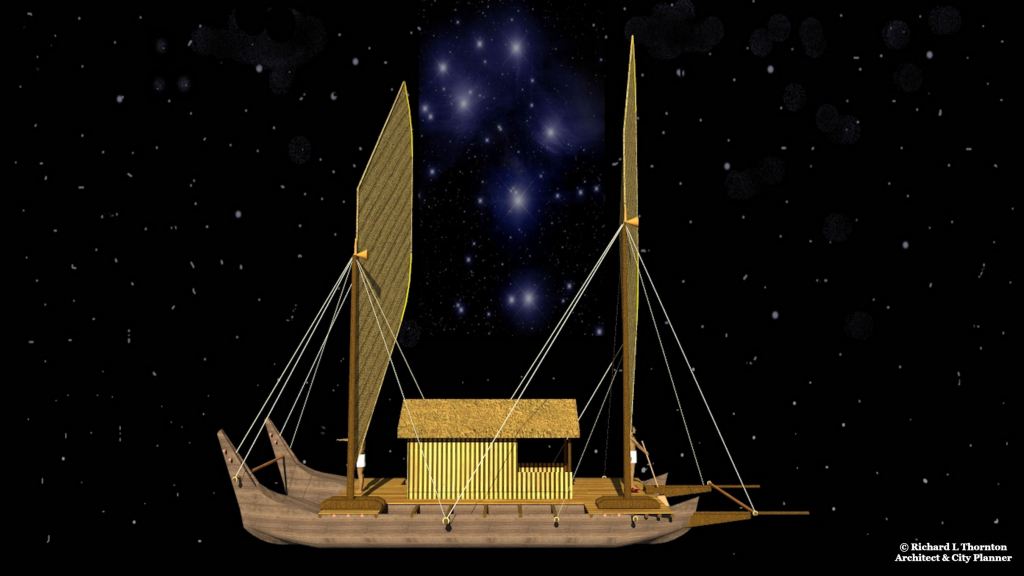
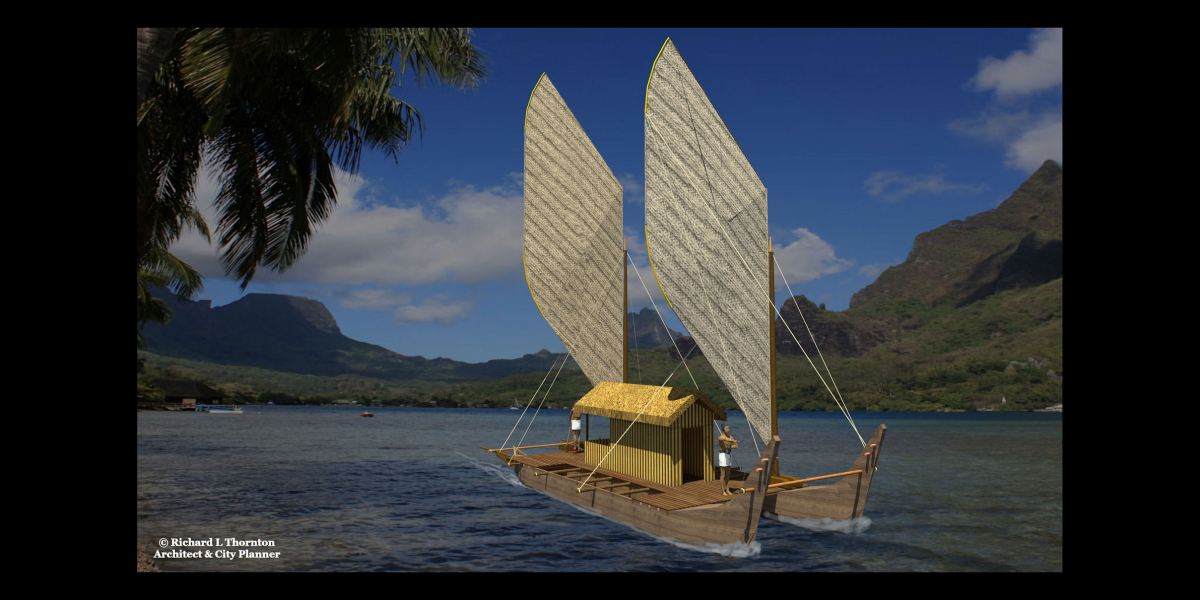
The Virtual Reality architectural renderings portray a Lapita (Proto-Polynesian) catamaran (c. 1200 BC – 200 AD) which was the first catamaran with the structural design to transport humans and small livestock across the vast waters of the Pacific Ocean.

The Lapita People made sails by beating bamboo stalks into strands of wood fibers then weaving them like baskets. Such a material could not be rolled tightly like modern sails, but was very durable in ocean storms. One of the facts that I learned this week from a translated Japanese book was that the people of Fuchow Province, China and Taiwan first made kites then applied the idea of wind propulsion to their boats. Thus the early Lapita Culture sails were built like kites. They did not have spars, but rather were attached to a butterfly-wing shaped bamboo frame.
Life is stranger than fiction
One of the reasons that I interjected a humorous article about my first adult romantic experience in a Navy Midshipman’s dress uniform was for readers to take my future articles on early canoes, boats and ships seriously. My Navy “Science and Engineering Officer” curriculum focused on the history of naval architecture and coastal fortifications. the design of ships, fortifications and ports, world geography and navigation. I never dreamed in a million years that in 2025 those experience would change the early history of humans in the Americas.
A year and a half after dancing with the Cuban-American coed on a chilly Saturday morning in Midtown Atlanta, I was with my Mestizo-Maya tour guide in Campeche and southern Yucatan State. It was also an unforgettable romantic experience that began with us dancing in a Maya hut near the ruins of Labna. At the time, Ana was a rising senior at the University of Campeche in High School History Education, but the wonder we experienced in the then-unmapped jungles of eastern Campeche changed her life. She went on to earn a PhD in Anthropology and become an internationally recognized expert on Maya music and dance.
On the first day of our journey, we explored the ruins on the coastal plain. In my journal I noted that Ana had told me that the coastal peoples of southern Veracruz, Tabasco, Campeche and Yucatan were not real Mayas, even though anthropologists labeled them Tamulte Mayas, Chontal Mayas and Potun Mayas. They originally spoke very different languages than the ethnic Maya tribes and had arrived on the coast by boat from some place faraway. The real Mayas were terrified of the ocean and so were quite happy to let the Tamulte, Chontal and Potun traders have a monopoly on maritime shipping . . . even operate a Mesoamerican equivalent of UPS and FedEx.

Large sail-propelled craft like this one was used by the “Coastal Mayas” to transport the massive amounts of attapulgite and mica from Georgia needed to construct buildings in the Maya lands. The Maya Homeland had no local sources for mica and very limited deposits of attapulgite. The Tamulte or Tamahiti were also a tribe on the Altamaha River in Southeast Georgia , in the Blue Ridge Mountains of Georgia, near Murphy in western North Carolina and in western Virginia, so obviously they also sent colonists to the Southeastern United States.
Oh did I mention that the Mexican “Coastal” Mayas share several key words with the Maori of New Zealand? The original colony of the Maori is called Maoripa. The sections of Tabasco occupied by Coastal Mayas are called Chontalpa and Tamaulipa. The Mexican State of Tamaulipas also gets its name from those Austronesian root words.
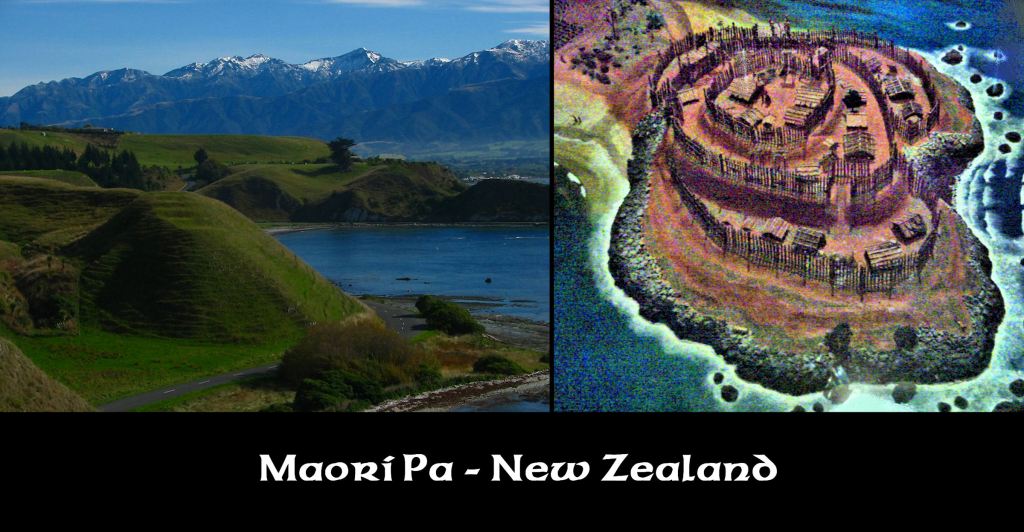
The original colonists of New Zealand had red hair and fair skin. They carved petroglyphs identical those found in southwestern Ireland, the Etowah River Basin of Georgia and in the mountains immediately north of Tepoztlan, Morelos, Mexico. They were followed 1320- 1380 AD by Polynesians. Descendants of the original red-haired colonist still live in New Zealand and are legally classified as Maori.
My primary work for the scientist in Colorado initially involved preparation of maps and a few illustrations. However, after I discovered that anthropologists in Japan, Taiwan and Fuchow knew a great deal more about the Austronesians than most North American academicians, he encouraged to research those sources.
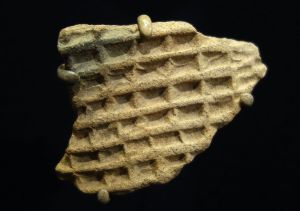
That is when I discovered that check-stamped pottery first appeared in Taiwan then later appeared in Southeast Asia and the State of Georgia, after the time period when the Lapita first developed ocean-going catamarans. It is quite likely that the pottery was introduced to Georgia by people of mixed Amer-Indian – Polynesian descent, not full-blooded Polynesians. However, this is not known for certain because the only DNA testing of pre-Columbian skeletons in the Southeastern United States has been confined at a few sites in Florida.
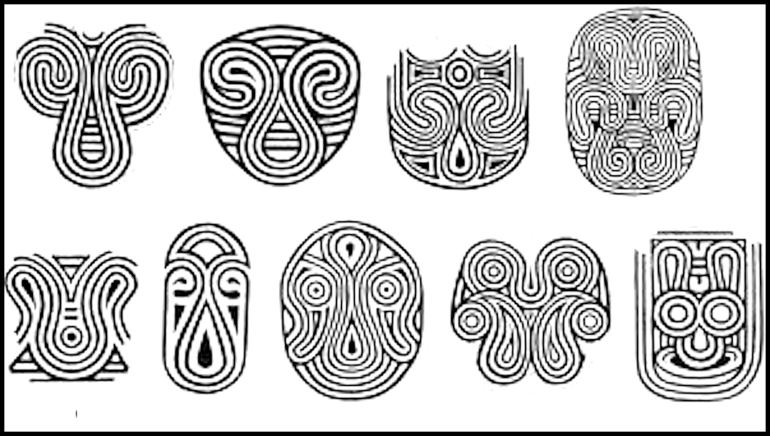
Symbols identical or similar to traditional Polynesian tattoos may be found on the Swift Creek style pottery in Georgia.
Swift Creek Pottery evolved from Polynesian tattoo paddles
However, stamped pottery, identical to that of the Swift Creek Culture, was first made in Peru by the Panoan tribes . . . by applying wooden paddles originally developed by the Lapita and Polynesians to apply tattoos. Both the Panoans and Southern Arawaks of Peru, Bolivia, Ecuador and Brazil practice many cultural traditions similar to or identical to the Polynesians. Just like the Polynesians, Panoans and several tribes in the Southeastern United State covered their bodies with tattoos.

Symbol of the Lapita (Austronesian) Sea Goddess – Osaka Museum of Anthropology
While reading a translated Japanese anthropology book this past week, I was shocked to see how many of the Lapita artistic symbols appear on murals, codices and stone engravings in Mexico – especially at Teotihuacan, Aztec, Zapotec and Totonac cities. Some of those symbols, such as the Spiral (Sun Goddess) and Wave (Sea Goddess), appear on pottery produced by many indigenous peoples in the Southeast and Mississippi basin. How these traditions reached North America is still in the realm of theory . . . but there is the DNA evidence . . . see below.

Most of the pottery found in a large Apalachete-Creek village on the south side of the Chattahoochee River in the Nacoochee Valley of Georgia are adorned with either painted or incise spiral motifs.
Genetic evidence
It is quite common for Uchee (Yuchi) and Creek descendants in Georgia, Alabama and South Carolina to carry Southeast Asian and/or Polynesian DNA markers. Both my parents carried them. This indicates Austronesian ancestry. Upper Creeks, Uchees and other branches of the Creeks, whose ancestors originated in Tennessee, NW Georgia or Alabama typically have few or no Austronesian DNA markers. The Highland Uchees seem to have had different ancestors than those in eastern Georgia.
It is difficult to predict Austronesian ancestry among Creeks in Oklahoma, because they are the product of the 28 tribal members of the old Creek Confederacy intermixing among themselves and other Oklahoma tribes for 200 years. Conversely, Uchees in Oklahoma, who trace their ancestry to the Savannah River Basin, can be almost entirely Austronesian with very little or no AmerIndian DNA markers. This is the reason that they have become reluctant to order DNA tests or allow anthropologists to take DNA samples. Most commercial DNA labs incorrectly classify Southeast Asian/Polynesian DNA markers as a Post-Columbian admixture and not Native American.
No Pre-Columbian DNA test markers are available for the Tamulte and Chontal Maya. In fact, Mexican genetics websites do not even list them as a category, I surveyed Spanish-language professional literature from Mexico and found no records of Mexican anthropologists doing DNA testing of Coastal Maya populations.
I did find one posting from a Tamulte Maya gentleman in Tabasco, which was labeled “¡Prueba de ADN desconcertante! (Puzzling DNA test!) He thought that his family was almost full-blooded Tamulte, but the commercial lab in Mexico City told him that he was not even Maya. He didn’t say in what ethnic label the lab placed him. Of course, that is exactly what Ana Rojas told me so many years ago, right after both of us had just turned 21.
The Truth is out there somewhere!

Hawaiian style catamaran
 The Americas Revealed
Here’s my Gedmatch.
LikeLike
LikeLike