
Restoration, Reconstruction of a dilapidated wing and New Construction . . . all on a beautiful, historic farm in the Shenandoah Valley of Virginia.
During the 1800s, each Schwartz generation constructed an addition to the house, but by 1990, the newer the addition, the worse condition it was in!
Slide Show
by Richard L. Thornton, Architect & City Planner
By now, I have been the Architect-of-Record for well over a hundred residential, commercial and institutional historic preservation projects. Of course, if you throw in the townhouse and apartment developments, I have designed well over a thousand new buildings in my career, but to tell you the truth . . . It was the revitalization of the really old buildings that were the joy of my profession. I often personally did the stone masonry restoration for my clients in addition to conventional architectural services. There is just a special feeling putting your hands on the components of buildings, over 200 years old.
The construction dates of these works-of-love range from an odd, fort-like stone cottage, built by a German Protestant sect around 1690 on the Shenandoah River near Strasburg, VA to the First Church of Christ Scientist in Downtown Asheville, whose first phase was completed in 1912. My former house in the Shenandoah Valley was originally a log blockhouse fort, constructed by George Washington in 1755, on land he received as payment for surveying work in Toms Brook Plantation . . . a large, planned residential-agricultural real estate development, begun in 1735.

The massive limestone chimney and fireplace of the blockhouse was retained in the house that Tipton built in 1770. Below is a photo of the hearth as it looks today. John Sevier’s log house was on the north side of Toms Brook, which is in the upper right of this rendering. By the time I arrived in the Valley (1987), it was merely a rectangular ruin of the stone foundation in the middle of a pasture. Colonel Tipton moved to NE Tennessee in 1780, when it looked like the British might win the American Revolution. He built a copy of the original house, I lived in. It is now a Tennessee State Historic Site and museum.
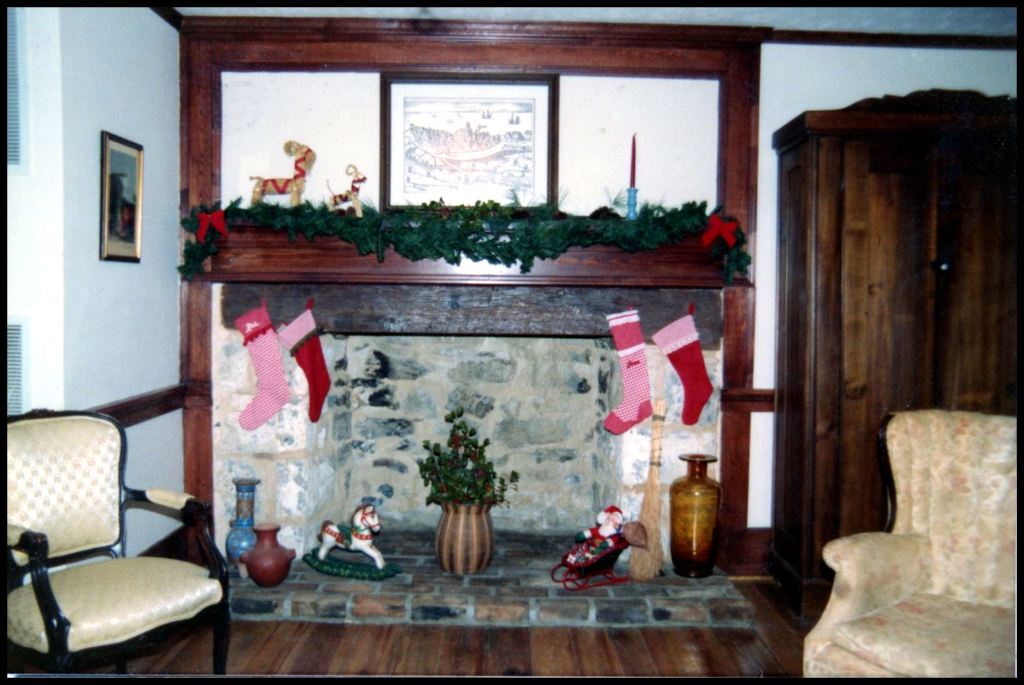
This is a photo of the massive 270-year-old fireplace in the Keeping Room in my former farmhouse on Toms Brook, taken by my French soulmate, Vivi, on December 19, 1990. The house was decorated for the Annual Shenandoah Valley Christmas Tour of Homes. She sent me a digital copy, when we reconnected on LinkedIn during the Pandemic. Throughout the French & Indian War, Colonel George Washington kept his hands warm at this hearth! The basket in the hearth was made by my Creek grandmother.
However, my favorite project of all was on a beautiful farm, about two miles south of my farm in the rural hamlet of Saumsville. The original core of the house, was a log structure from the early 1750s, but the owners integrated this structure into a handsome Federal style house after the American Revolution. It was one of a few brick farmhouses, built in Shenandoah County in the 1700s. The other 18th century houses that I worked with in the Shenandoah Valley were log, stone or heavy timber with wood lap siding.

This is a section of an 1862 map of the Shenandoah Valley, prepared by Captain Jedediah Hotchkiss, Chief Topographic Engineer under General Thomas “Stonewall” Jackson. Hotchkiss was an interesting man. He was considered the most skilled map maker on either side during the Civil War. After Gen. Jackson died, Hotchkiss eventually was assigned to be at Gen. Robert E. Lee’s side. He surrendered at Appomattox with Lee. General Ulysses S. Grant, USA so admired Hotchkiss’s work that he let Hotchkiss keep his maps after surrendering . . . then obtained special approval to let Hotchkiss immediately go to work for the Union Army!
George Washington laid out both the Schwatz and Tipton farms to run west-to-east between the Old Back Road and the Middle Road. Both houses faced the Middle Road. However, since today the Middle Road is still a dirt wagon road, both houses now are accessed from the Old Back Road.
NOTE: I apologize for not providing interior photos of the Schwartz House. Very honestly, I could not find them.
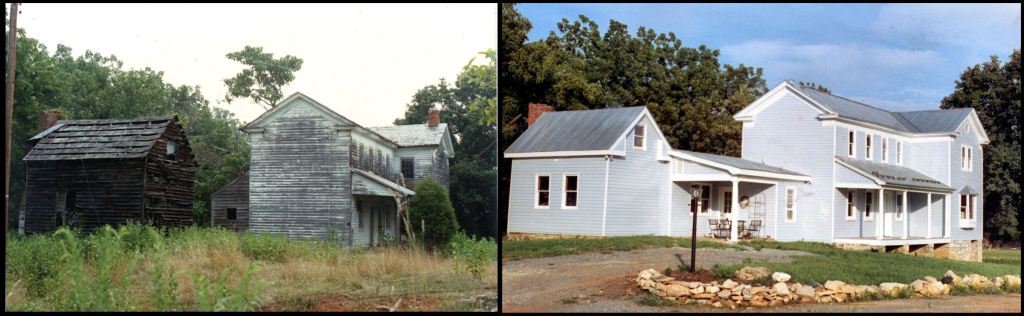
On the left is a view of the rear and south facade of my former farm house in July 1987. On the right is the same house in September 1988. Motorists, driving along the Old Back Road in Shenandoah County were amazed at the change. The project brought me many clients in the coming years, since I personally did much of the work.
We have a problem!
The owner had made a substantial profit on the electrical contract for an expansion of the Washington Metro. He and his wife always dreamed of living in the Shenandoah Valley and now price was no object. Several prominent architecture firms in Fairfax and Arlington Counties, Virginia were “licking their chops” to get the contract on whatever farm he chose.
However, he and his wife had been watching the dramatic changes in my house as they drove up and down the Old Back Road, looking for their ideal estate. They visited the house and farm during the 1990 Shenandoah Valley Christmas Tour of Homes. That clinched the deal for me to supervise the restoration of the farm, house and farm outbuildings.
The Schwartz House was really four entirely different houses joined together. All of the exterior and interior walls were solid brick masonry in the 1788 core. It was in great condition, but going to be a real “pain” to install modern electrical service, plumbing and HVAC. The ancient log house in its rear was hidden by newer walls but in great condition. The 1810 section was a detached Summer Kitchen like the one on left photo of my house. It had been joined to the brick house by a covered porch with a cistern underneath for storing rainwater. It was in restorable condition, but so small and primitive that it would me impossible to make into a modern kitchen.
Unfortunately, the 1854 and 1888 additions were severely damaged by termites and powder post beetles. Most homeowners would have walked away from the project. My clients told me to save what I could. My house, even though older, was constructed from virgin longleaf pine log joists and red oak timbers. It had absolutely no insect damage.
North wing of Schwartz House
The 1854 addition (right side of top photo) was build on timber mud sills and framed with 4″ x 4″ oak posts. The timber mud sills had been lain directly on the raw earth and were the only foundation for this wing. They apparently had stayed damp for the entire life of the house and were completely rotten. The first floor joists were only about four inches from the soil and also rotten. Above the first floor joists, powder post beetles had devoured the hardwood posts,, while termites had feasted on the pine framing materials. The small chimneys of this wing were terribly eroded by the caustic smoke from coal burning in pot belly stoves.
My recommendation was to demolish the 1854 addition and summer kitchen. Restoration of this section would have required replacement of almost all structural elements from the mud sill up to the second floor. This would have an unimaginably costly process.
The clients asked me to prepare a detailed, measured drawing of the existing structure, before it was demolished then prepare plans for a wing covering the area of the original south wing and Summer Kitchen. They wanted me to maintain the general appearance of the original structure, but design the rooms inside for modern lifestyles and comfort. I would also have to design new chimneys, since the old ones were barely standing.
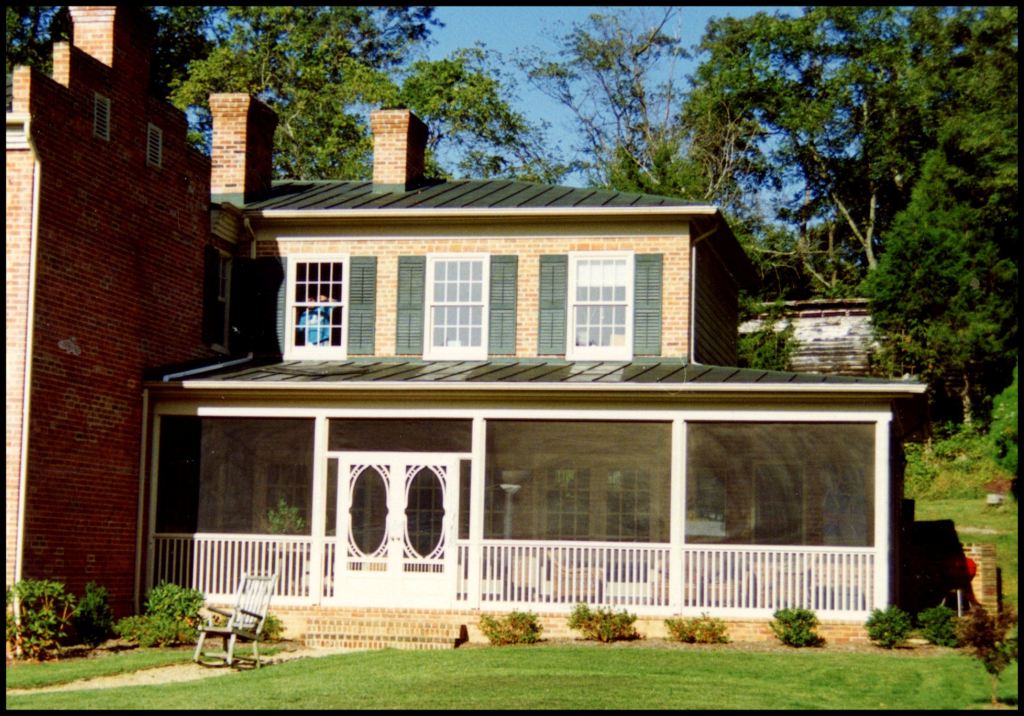
The original 1854 addition was attached to the rear corner of the main 18th century house. It was rather plain, other than having the large windows, typical of the 1850s and 1860s. That was going to look unbalanced when we added the new wing on the south side of the house. So, I created a shed extension for a morning sun-facing screen porch on the front facade and a wider floor plan on the lower level.
I have frequently added a new section, compatible to match the old many historic structures. It enables me to install modern HVAC, kitchens, bathrooms and mechanical rooms that meet contemporary building codes. I first tried this “trick” on my own farmhouse. A 28 feet long country kitchen, informal dining area and mudroom linked the early 19th century Summer Kitchen with the remainder of the house.
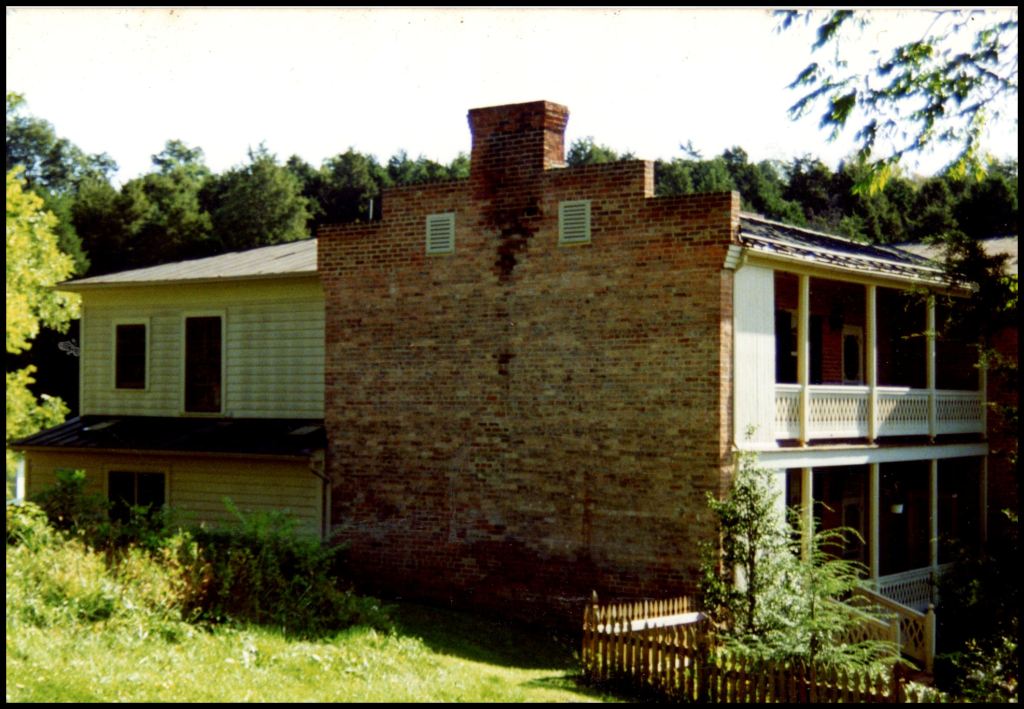
The lower portion of the brick end wall stayed damp constantly due to the lack of modern waterproofing. This caused the wood on that end of the wing to rot and allowed termites to easily climb up and into the structure.
Rear Wing
There was evidence that the rear wing had originally been the two story log house from the 1700s. During the 1800s, the logs were removed then replaced by a masonry foundation and relatively modern type of wood framing system, which was much easier to repair than the mud sill – post frame of the 1854 wing. Contractors did have to install modern waterproofing on the inside and outside of the brick end wall.
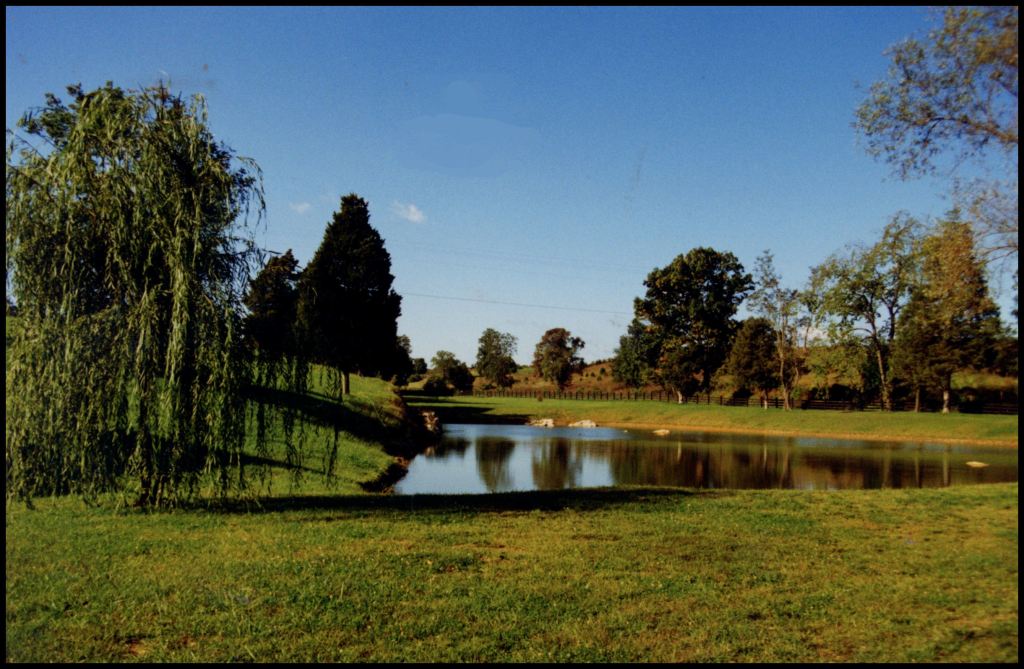
View from the first floor of the South Addition. The second floor has views of both the Massanutten and Allegheny Mountains because of the chamfered end of the wing.
South Addition
While I was working on plans for the restoration of the house core and reconstruction of the North Wing, the owners decided that they wanted a wing on the south side for an entertainment room downstairs and guest quarters upstairs. Apparently, part of the owner’s success as an electrical contractor was entertaining the elite of the Washington, DC Area.
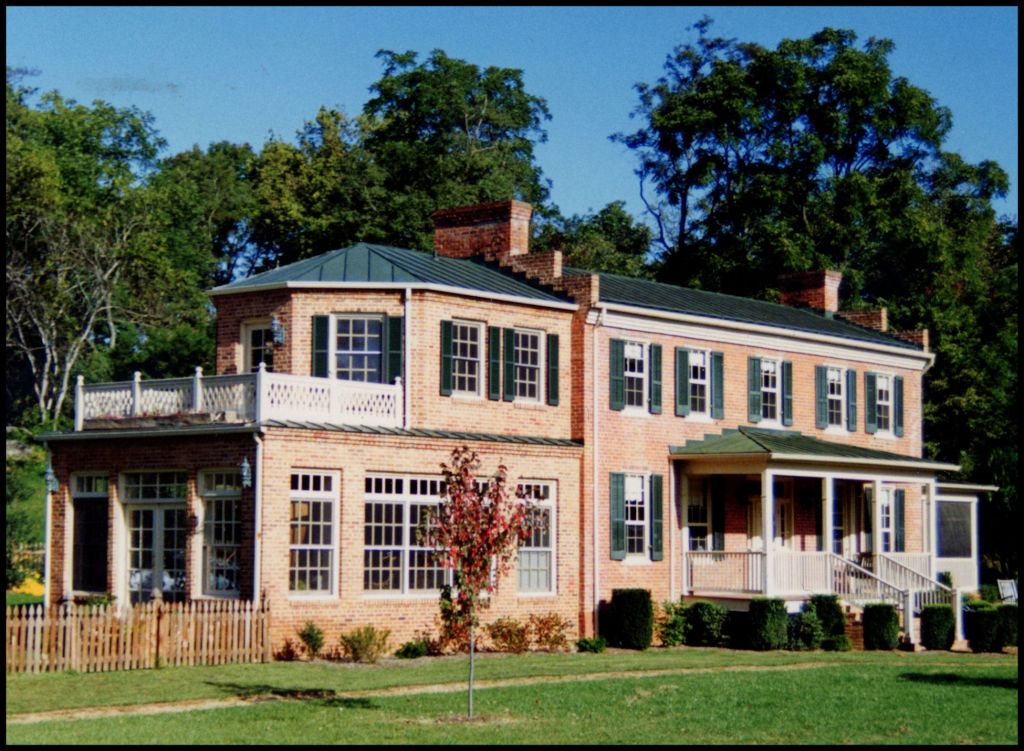
South Addition and Late Eighteenth Century house
Once the South Wing was completed, the owners decided that THEY wanted to move into the Guest Bedroom. The Master Bedroom in the old part of the house became one of the guest rooms. Having a chamfered end on the second floor of the addition was probably breaking all the rules set by the Secretary of the Interior’s Guidelines for Preservation of Historic Buildings, but in the years since then, both the owners and visitors have loved this departure from architectural correctness.

A Google satellite image reveals how I doubled the floor area of the historic house without changing the historic scales of the south and east sides of the mansion. Thirty-three years later and the little saplings in my first photo have turned into a forest. Also, either the owners, who I dealt with or later owners constructed large outdoor entertainment complex, complete with an indoor swimming pool to the north of the mansion. Note that they also constructed a large formal garden with pavers, worthy of a French chateau to the west (upper part of photo) of the indoor swimming pool.
Well, I still like my little cottage on the crest of Alec Mountain. It ain’t a palace, but I can take care of it by myself. LOL
 The Americas Revealed
Thoroughly enjoyed, Richard. God or something divine touched you if just an awareness of wonder & a desire to give so much passion to your projects. Your handiwork is undeniable, your legacy lives in so many facets of the world, continues to grow.
LikeLiked by 1 person
I do try to do my very best on every project, That is the only way one can grow.
LikeLike
“Washington warmed here.” Pretty special.
LikeLiked by 1 person